Guest:Joseph Chalom — CEO, Sharplink(NASDAQ: SBET)|Former Head of Digital Assets, BlackRock
Compiled by: Cynthia(@cynthiaju333)
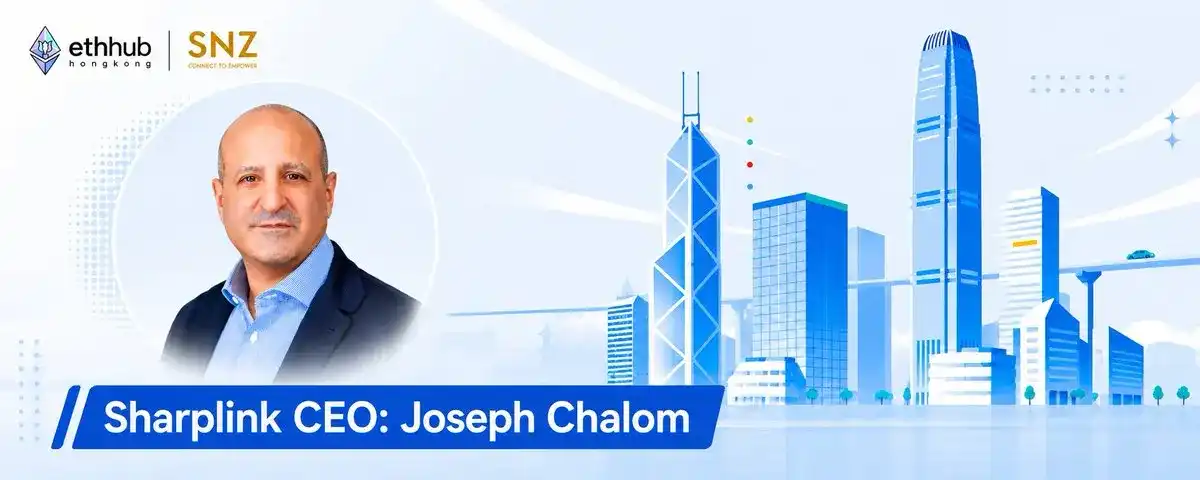
On June 8, 2026, at a VIP event co-hosted by Futu, SNZ, ETH HK Hub, and Sharplink, Sharplink CEO Joseph Chalom (former Head of Digital Assets at BlackRock, who led BlackRock's Bitcoin/Ethereum ETF, BUIDL tokenized fund, and Circle/USDC reserve management) delivered a speech titled "The Future Transformation of Financial Markets," which he summarized as "The Industrialization of Trust."
Drawing from his 20 years of institutional experience at BlackRock, the speech analyzed the massive hidden costs of "building trust" in the traditional financial system, proposing that Ethereum is becoming the settlement layer and "commodity of trust" for global finance. He predicted that stablecoins, tokenized assets, DeFi, and "Agentic Finance" will fundamentally change the way the financial industry operates in the coming years.
Table of Contents:
I. My Institutional & Crypto Journey: From BlackRock to Sharplink
II. Trust is Breaking Down: From Web1 to "Web2.5"
III. The "Cost of Trust" in Traditional Finance: $9.3 Trillion Per Year
IV. Rewriting Infrastructure: From "9-to-4" to 24/7 Tokenized Assets
V. Ethereum: The "Commodity of Trust" for Global Finance
VI. The Three Accelerating Pillars: Stablecoins, Tokenized Assets & DeFi
VII. The Fourth Pillar: Agentic Finance
I. My Institutional & Crypto Journey: From BlackRock to Sharplink
Today's topic is "The Future Transformation of Financial Markets," but if I were to give it another title, I'd call it "The Industrialization of Trust." I'd like to start by giving you some background—briefly talk about my career—and then share my outlook on the future.
I'm probably the oldest person here. I'm the CEO of Sharplink, a publicly traded company. But before that, I spent 20 years as a senior executive at a large financial services firm called BlackRock in New York—BlackRock is the world's largest asset manager.
For the first 12 years, I helped build the Aladdin platform—a technology platform that now provides risk management services for roughly $50 trillion in assets for buy-side institutions (pension funds, asset managers, etc.). For the last six years or so, from around 2018 to 2025, I led a team that spent several years figuring out what role an asset manager could play in the crypto space—essentially becoming a bridge between traditional finance and the crypto industry.
The initial answer was "no"—the industry wasn't up to the standards our clients expected at the time. But eventually, we launched this strategy and did some very interesting things:
- We launched Bitcoin ETFs and Ethereum ETFs in 2024—the first of their kind in the US. We communicated with regulators, educated them, and these products later became the world's largest crypto ETFs by size, raising about $100 billion, enabling institutional investors to participate more equally in digital asset investments.
- We also launched BlackRock's first tokenized fund—BUIDL, a silly name, not my choice. We weren't the first to do this; Franklin Templeton had launched a tokenized money market fund before us. But our fund was launched natively on Ethereum (and later expanded to a few other chains). We allowed clients who wanted to hold stablecoins to do so, but also to—even in the middle of the night—instantly transfer into this tokenized treasury fund. This fund raised about $26 billion and is currently the world's largest tokenized fund. The second largest will likely be another fund BlackRock is launching, backed by about $80 billion in existing money market assets.
- We also made a significant investment in Circle and became the manager of the USDC stablecoin reserve assets—managing around $75 billion in reserve assets for this leading, regulated global stablecoin.
I have extensive experience and am a bit older, so let me share some of my thoughts on the future.
A bit of background: Sharplink is the first company to build a digital asset treasury around "non-Bitcoin tokens." We are the first Ethereum-first company and currently hold the second-largest public ETH position—just over $20 billion. My friend Tom Lee holds a larger position at BitMine, and we share an interest in "making the ecosystem stronger." We actively manage our treasury and have participated in DeFi from day one. By the end of this year, we will have allocated about $325 million worth of ETH to DeFi protocols to support this ecosystem. We are undergoing a real transformation.
II. Trust is Breaking Down: From Web1 to "Web2.5"
Before talking about the future, I'd like to discuss the past. We are at a moment where "trust is breaking down"—partly caused by AI—and it will ultimately be repaired by a combination of AI and blockchain.
Let's go back to the era of Web1: it essentially unified the world's information—you could find information, it connected all of humanity. The promise of Web3 is: verifiable, trustworthy information, clear identity, and the ability to transfer funds securely with economic guarantees. But we're not there yet. We are not in Web3 today—we are in what's called the "Web2.5" stage. In most societies—I'll use the US as an example—you can't trust the information presented to you. Social media uses information as a weapon. I wouldn't trust that the identity of anyone contacting me online is real, nor would I trust that the code of any software company in the world—including Anthropic—is completely bug-free.
That sounds bad, right? But no—we are at an inflection point on the way to the future. It's just that we can't fully trust information yet.
III. The "Cost of Trust" in Traditional Finance: $9.3 Trillion Per Year
So, what is the change coming? Let's start with the financial services industry. In the US alone—because people don't trust each other in economic transactions—the industry spends over $9.3 trillion per year on "artificially built trust": contracts, insurance, counterparty risk management, etc. This is all wasted capital.
Why? Because transaction settlement takes 1 to 3 days—it's roughly same-day in the US, two days in Hong Kong, and up to three days in much of Southeast Asia. You have to trust that your counterparty will actually settle by then—and that they will still exist. Because of this, there are over 1 million separate, siloed databases worldwide, each requiring independent maintenance, with endless daily reconciliations: where is my cash? where are my stocks? where are my holdings? This system is slow, fragmented, and not a good economic system. Most of the technology behind the US trading system was built over the past 40 years.
IV. Rewriting Infrastructure: From "9-to-4" to 24/7 Tokenized Assets
We are moving away from this fragmented system—where people can only trade between 9:30 am and 4 pm, and if the US President announces a war on a Friday night, you want to sell your stocks but have to wait until Monday at 9 am. Did everyone hear what I just said? If the President announces war at that time, the only assets you could sell over that weekend would be crypto assets—tokenized stocks, tokenized precious metals, tokenized assets, and futures.
This is the direction of the future. We will have 24x7 tokenized assets. You will be able to trade "programmable money" with others. Assets will be transferred and settled instantly on decentralized blockchains—with no trust issues. This is what I'm talking about: AI verifies identity and facts, and blockchain provides the final settlement confirmation.
V. Ethereum: The "Settlement Layer of Trust" for Global Finance
But this takes time. In capital markets, Ethereum is leading this change, becoming the settlement layer for financial transactions—you could call it "trustware," or the "proof layer," confirming that a transaction is real, an identity is real, because in Web3, once a transaction is done, it's irreversible. Today, Ethereum has over 1 million validator nodes across 84 countries, with zero downtime in over 10 years—it is by far the most battle-tested financial infrastructure. The value of liquid assets secured by Ethereum and its Layer 2 networks also exceeds that of its closest competitor by more than 10 times. Ethereum currently secures over $300 billion in on-chain assets, with over 65% of the world's stablecoins and tokenized assets securely stored and transacted on Ethereum.
When you've been in the financial services industry for 20 years, you make a lot of mistakes—but if you're lucky, you also gain some experience and wisdom along the way. I can tell you: most traditional finance professionals want to work on trusted platforms that don't go down and are secure enough. There are other public chains that are faster and cheaper, but they go down, lack economic security, and don't have the liquidity profile required by the world's largest institutions.
This is where assets like ether come into play—it's the native token of this network, and you can stake it to help secure the network. This is a bit tricky to explain: on one hand, it's a store of value; on the other, you can stake it to secure transactions, validate blocks, and earn yield as a result—unlike Bitcoin, which itself does not produce yield (someone like Michael Saylor has to leverage MicroStrategy to get a return on Bitcoin). Staked ETH yields close to 10%, and the more ETH staked, the stronger the network's economic security. We stake 100% of the ETH we hold to enhance this security.
VI. The Three Accelerating Pillars: Stablecoins, Tokenized Assets & DeFi
Using a baseball analogy: in the US, a baseball game has nine innings. I think we're about in the second inning. Even though the crypto industry is about 16-17 years old, we are on the cusp of what I call a "step-function" change. Bill Gates has a classic quote—people often overestimate the change that will occur in one year and underestimate the change that will occur in ten years. And that's what's going to happen in the remainder of this decade.
Stablecoins: The total stablecoin supply is currently around $330 billion, with about 99.75% being dollar-denominated. Europe has a small portion; Hong Kong just approved its regulatory framework, and South Korea is about to follow. Initially, stablecoins basically had one use—"I want to participate in crypto markets, but my USD can't go directly in, so I need a stablecoin as a bridge." But that's changing. Stablecoins will become a cross-border payment rail. Companies will use them to move money between thousands of subsidiaries; individuals will be able to transfer money across borders instantly, almost for free. The salary you get in a year or two might be in stablecoins—efficient, fast, with almost no fees.
Tokenized Assets: Asset tokenization started about eight years ago, but eight years later, the total size of tokenized assets is only about $35 billion—which is incredible. I think the world's largest institutions are about to completely change this. There have been four announcements this year that would have been unthinkable a few years ago. The New York Stock Exchange and Nasdaq—the world's two largest exchanges—are both moving toward 23-hour-a-day, 7-day-a-week trading, so tokenized assets can trade freely around the clock. And then there's DTCC—most people haven't heard of it, but it's the world's largest securities settlement and clearinghouse—processing transactions on the order of about 15 quadrillion dollars annually. They are currently running a pilot, with regulatory approval, for a DeFi-like model—things like lending, swapping, mostly based on Ethereum—which will change how centralized venues operate and how money works, because stablecoins will have more uses, there will be more tokenized assets, and more things to trade.
I believe that within a few years, this will no longer be a conversation about "crypto"—we won't even use the word "crypto" anymore. The financial industry will undergo a digital transformation on a scale not seen since stocks went from paper to electronic in the 1970s.
DeFi (The Third Pillar): A year ago, I would have said the three pillars driving this change are: stablecoins, tokenized assets, and DeFi—these decentralized protocols now provide automated trading, lending, and liquidity services on-chain, open 24/7, always accessible, with over $200 billion currently flowing through DeFi protocols.
VII. The Fourth Pillar: Agentic Finance
I believe the real potential game-changer is "Agentic Finance." AI agents are already trading autonomously—executing payments, making investments, autonomously managing portfolios. What they really need is "programmable settlement": stablecoins plus smart contracts, allowing funds to execute automatically when conditions are met—no bank accounts, no wire transfers, no intermediaries. Standards are already emerging—like X402, which defines machine-readable payment protocols; and ERC-8004, which enables agents to perform programmable, permissioned financial operations.
How many people here have a "smart wallet"? Probably very few. There are about 800 million such wallets globally today. I envision that soon, every person with a securities account will also have a digital "agent" wallet—operated by a regulated agent, within a regulated company—essentially your own digital twin, an AI agent that understands your goals, risk tolerance, and asset situation, capable of doing things that are difficult for retail investors to do on their own today.
What I'm saying is, by around the end of 2027, every person here will essentially have a "CFO in your pocket." It will scan all your accounts for idle cash not earning proper interest and move it to higher-yielding accounts. If you hold assets like SpaceX or Tesla in tokenized form, it will operate like a large institution: put those holdings on-chain, lend them out, return the generated yield to you, and rebalance your portfolio allocations accordingly. Your AI agent will be a reflection of you, helping you achieve better investment outcomes.
The Boston Consulting Group (BCG) estimates that in about a year, the number of on-chain transactions could be about 1,000 times current levels—these will be "agent-to-agent" transactions following rules and guidelines, transferring funds and managing wealth in a way that is almost impossible today. If you have a chance, talk to the team from Canopy later; some of what they're working on gives you a sense of the direction.
About
Sharplink (NASDAQ: SBET) is a leading institutional-grade Ethereum reserve platform designed to provide public market investors with smarter, more efficient Ethereum investment opportunities. Ethereum underpins most of the world's stablecoins, tokenized real-world assets, and decentralized financial settlement, making it a unique asset with both native yield and long-term network growth.
ETH HK Hub is Asia's first physical Ethereum community hub, supported by the Ethereum Foundation's "Ethereum Everywhere" team and operated in partnership with SNZ and ETHTAO. The hub is dedicated to connecting Eastern and Western ecosystems, serving as a bridge between traditional finance and decentralized innovation.
SNZ is a research-oriented investment company active in Web3 and fintech since 2014, with a portfolio of over 200 companies across blockchain infrastructure, decentralized finance (DeFi), payment systems, and real-world applications. As one of the earliest institutional supporters of Ethereum in Asia, SNZ has been involved in ecosystem development since the network's inception and supports founders.
Futu is a leading integrated digital financial platform in Hong Kong. Its SFC-licensed virtual asset trading platform, PantherTrade, provides institutional investors and high-net-worth clients with one-stop services, enabling seamless access to on-chain digital assets and traditional securities markets through a single account.