At Meta, you take a medical/maternity leave, and then... your job is gone??
Even more outrageous is that it's not your direct supervisor who laid you off, but AI.
This might be the first "AI Layoff Discrimination" case in the U.S.: Meta is being sued by 26 employees for allegedly improper use of AI in layoffs.

At 4:00 AM local time on May 20, a Meta scientist received an email from company leadership:
"Your role has been eliminated."
She was on approved pre-natal leave at that moment. The next day, her water broke. The day after, she gave birth.
This is not a joke. It is a real experience documented in black and white within a 71-page federal complaint.
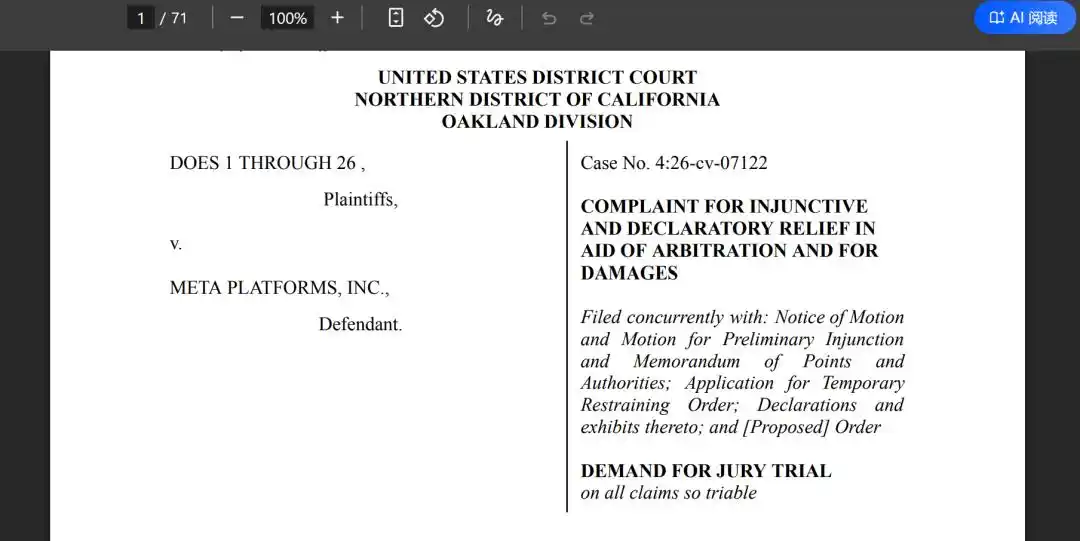
On July 13, 26 current and former Meta employees filed a lawsuit in the U.S. District Court for the Northern District of California, alleging that Meta used a suite of AI systems to screen employees for layoffs, and that this system systematically discriminated against employees who were on legally protected leave.
The 26 individuals span engineers, scientists, designers, researchers, managers, and directors, located across six states and Washington, D.C.
They share only one commonality: Within the past 24 months, they had all taken or applied for maternity leave, parental leave, medical leave, or requested reasonable disability accommodations.
Take a Regular Leave, and Then... Job Gone?
Let's reconstruct the entire sequence of events based on the 71-page lawsuit and all publicly available information.
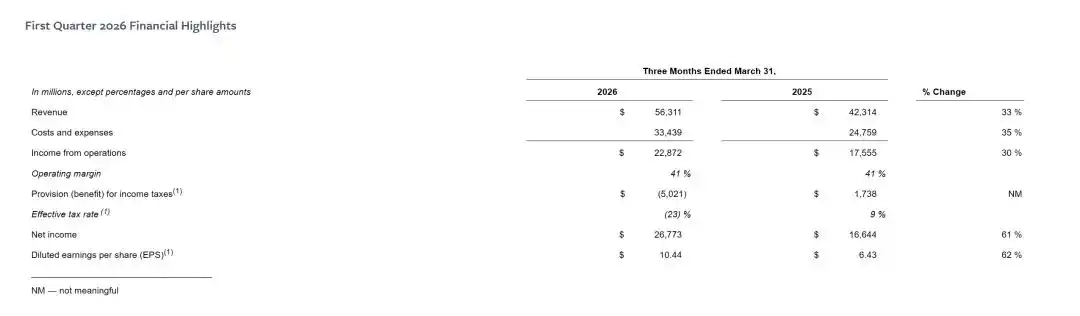
In April of this year, Meta announced layoffs of approximately 8,000 employees, about 10% of its global workforce, to focus fully on AI.
Did you think the company was struggling and had to cut jobs? Actually, no.
At the same time, Meta reported record-high revenue and pledged to invest $125 billion to $145 billion in AI in 2026, more than double its planned 2025 expenditure.
Setting revenue records while laying off on a massive scale. If I were a Meta employee, I'd probably be confused too.
But this just planted a seed of discontent and suspicion.
△
Fast forward to May 20, when layoff notifications began rolling out, starting at 4 AM Singapore time and progressing by time zone to the UK and the US.
Multiple plaintiffs stated they received emails around 4 AM.
Then... controversy emerged.
Some of those laid off started comparing notes and noticed a glaring pattern:
Among those selected, the proportion of people on maternity leave, medical leave, or who had recently requested reasonable disability accommodations was abnormally high.
Even more suspiciously, several employees' direct managers were surprised by their departure, with some even being told the day before the layoffs that "it's not known who will be affected."
Meaning, the selection might not have been made by managers at all.
So who made it?
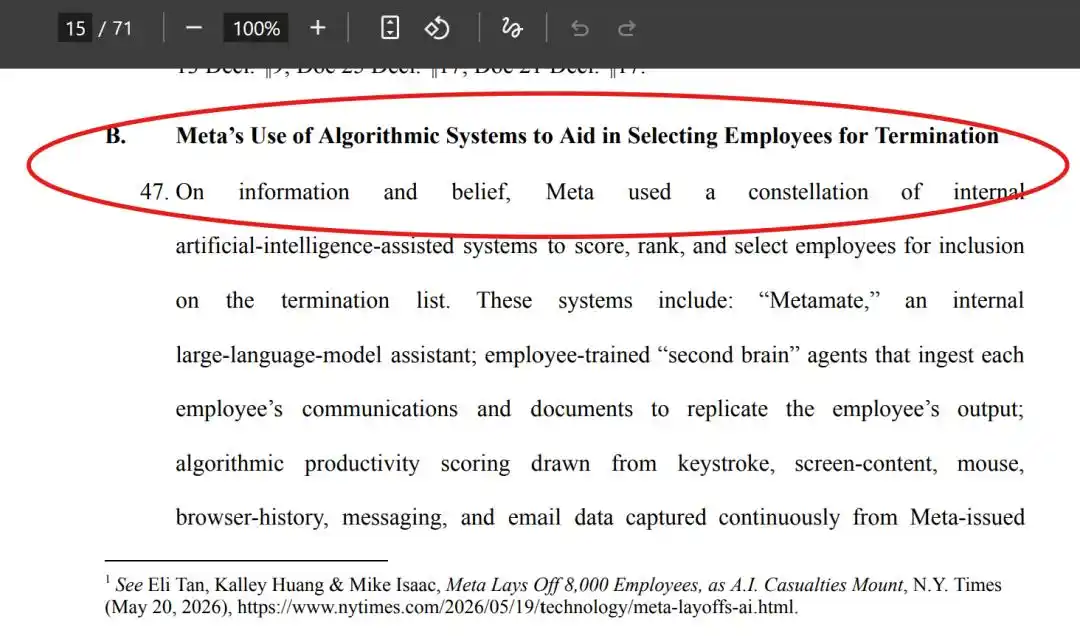
According to the complaint, the answer is a suite of internal AI systems at Meta.
The plaintiffs refer to it as a "constellation," including:
Metamate: Meta's internal large language model assistant;
Second Brain: Personal Agents employees are required to train, which ingest their communications and files to learn to replicate their output;
Employee Activity Monitoring System: Continuously collects data on keystrokes, screen content, mouse activity, browser history, email, messages, etc., on company devices;
AI Token Usage Dashboard: Displays AI tool usage at the employee level, with rankings against colleagues;
Algorithmic Performance Calibration Tool: Has largely replaced the previously manager-led performance review process.
Input metrics for this system include: rolling 12-month performance rating, code commit volume, AI tool usage, output volume, manager endorsement, and roadmap alignment signals.
See the problem?
An employee on 12 weeks of maternity or medical leave cannot accumulate these metrics.
And the complaint alleges that Meta neither excluded the protected leave time windows from the metrics, nor excluded those on leave from the screening pool, nor paused the system for individual case reviews.
The system only looks at data, not at why you were absent.
The result: "On leave" was recorded as "low output," and employees on leave were disproportionately selected for the layoff list.

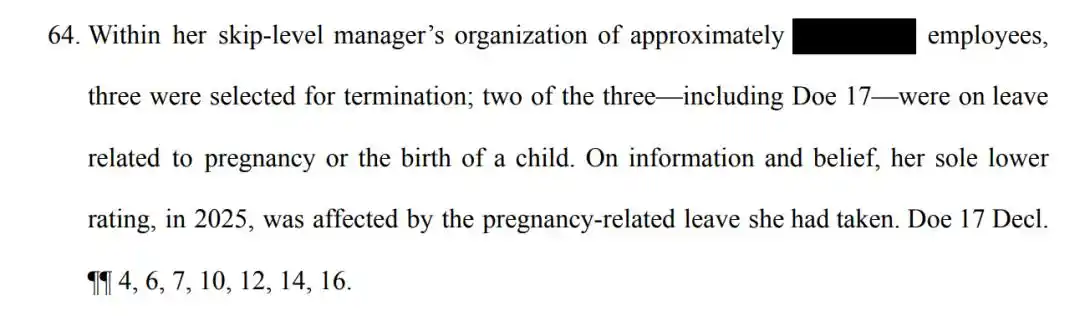
From the lawsuit, the scientist (Doe 17) laid off during prenatal leave: in her organization, 3 people were selected for layoff, 2 of whom were on leave related to pregnancy or childbirth.
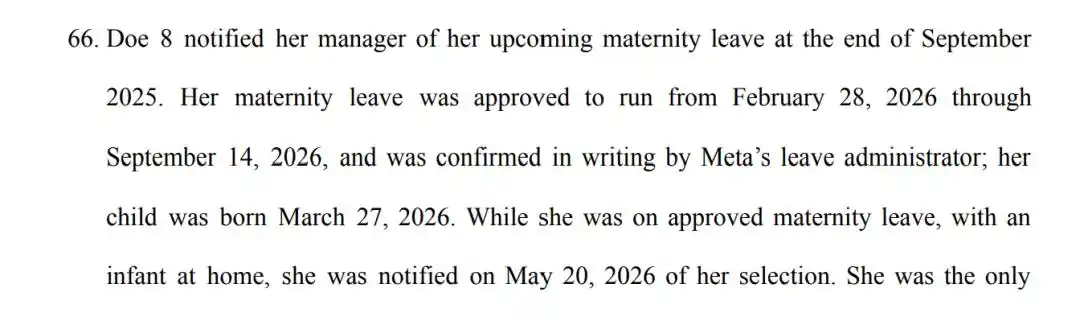
A designer (Doe 8), maternity leave approved until September, child born in March. On May 20, with a newborn baby at home, received the layoff notice. She was the only person on her team on maternity leave.
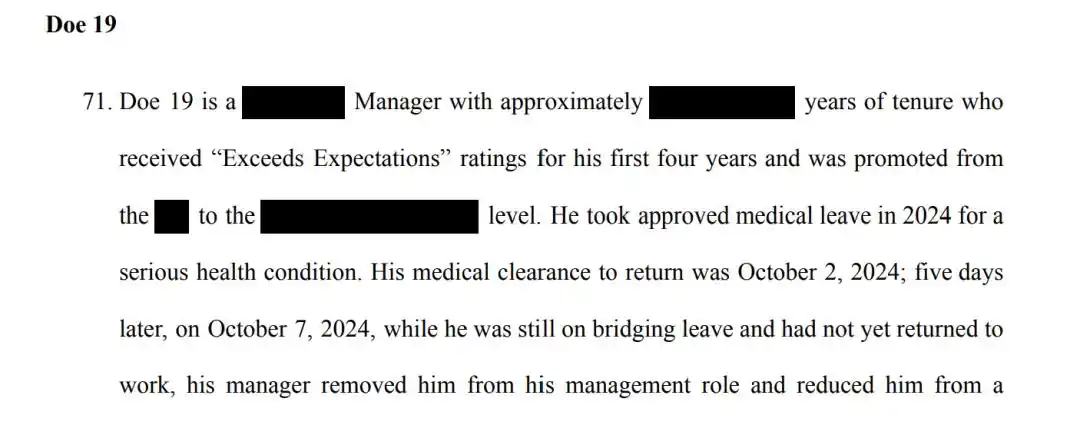
A manager (Doe 19), demoted from manager to individual contributor just 5 days after returning from medical leave in 2024. Selected for layoff only 16 days after starting a second medical leave in 2026.
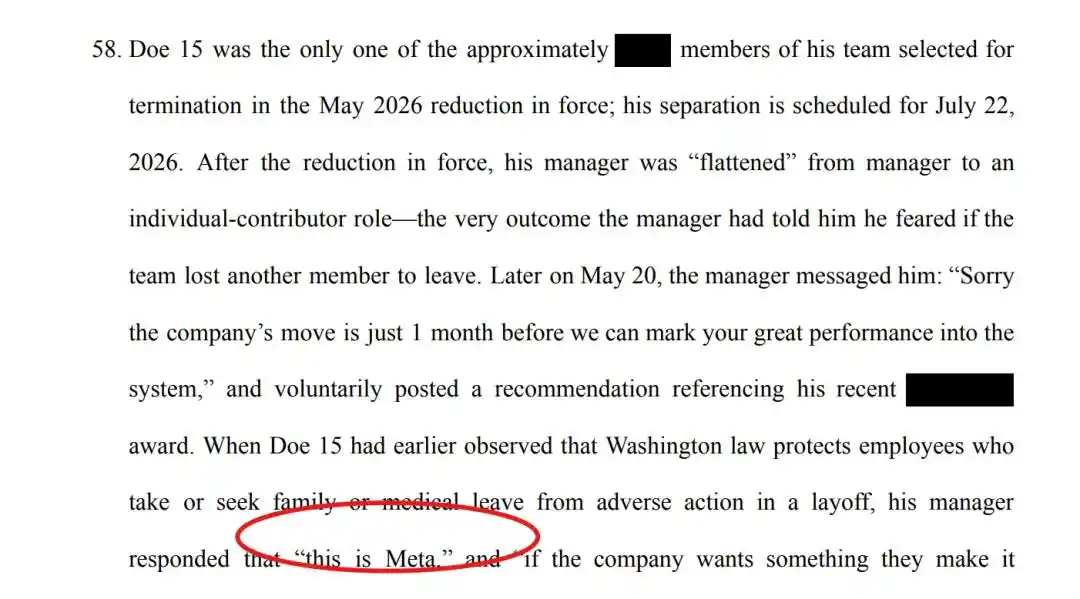
Even more heartbreaking is the experience of Doe 15.
This engineer was diagnosed with a serious health condition in March of this year. Two doctors, both from Meta's own healthcare providers, approved 12 to 16 weeks of medical leave for him.
When he notified his manager as a courtesy, following Meta's internal process, the manager became furious:
The team cannot afford to lose another person. If you take leave, senior leadership will definitely lay you off, or nominate you for the layoff list.
The manager then proposed a "win-win solution":
If Doe 15 gave up his leave, the manager would write an extremely positive performance letter to HR. However, the manager refused to put the threat in writing, saying to "avoid a paper trail."
Doe 15 was scared.
He not only didn't submit the leave request but also stopped his scheduled treatments.
Because he feared that continuing treatment through Meta's healthcare providers would expose his leave plans and trigger the retaliation his manager threatened.
Yet, he ended up being the only person on his team laid off.
After the layoff, his manager sent him a message saying:
Sorry, the company moved just one month before we could get your strong performance into the system.
Implied meaning: Didn't expect the company to act faster, it wasn't me.
And when Doe 15 had earlier reminded the manager that Washington State law protects employees on leave from adverse impacts of layoffs, the manager's response was:
This is Meta. The company can do whatever it wants.
Currently, the 26 plaintiffs are asking the court for a preliminary injunction to freeze the July 22 layoff effective date, restore their employment status as of before May 20, and require an independent auditor approved by the court to review the inputs, weightings, and outputs of the entire algorithmic screening process.
Meta's response was brief:
These allegations lack merit, and personnel management and organizational decisions are made by people, not AI.
Once this response came out, netizens exploded:
Don't obfuscate. Whether it's done by people or AI, the key point is that people shouldn't be laid off for taking normal leave.

Some were more emotional and let loose:

Meta Has Too Many Questionable Moves
To be honest, if this were just a single layoff controversy, it might be dismissed as an isolated case.
But digging into this lawsuit, a series of Meta's internal moves over the past half year makes anyone reading it shake their head.
First, that monitoring program.
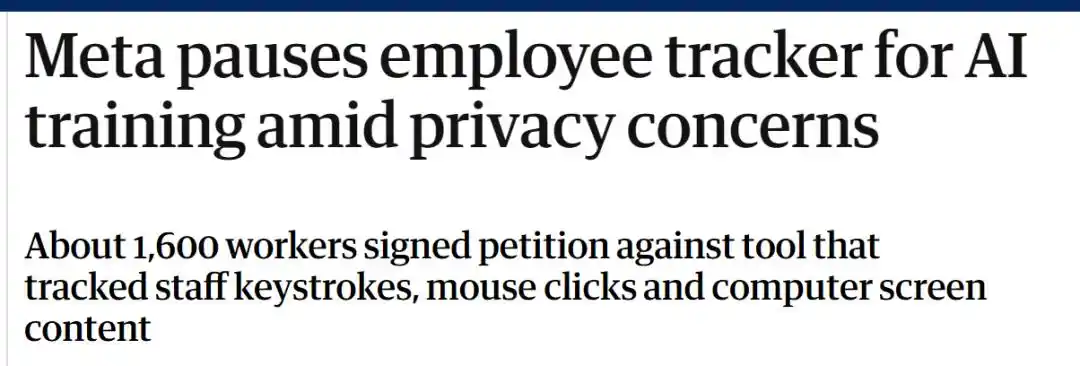
Earlier this year, Meta deployed an employee monitoring system company-wide, later officially named the "Model Capability Initiative" (MCI).
On Meta-issued devices, it continuously collects keystrokes, screen content, mouse activity, browser history, messages, emails. Some employees also had voice, video, and location data collected.
When this happened, The Guardian reported that over 1,600 employees signed a petition demanding Meta stop using employee data to train AI.
CTO Andrew Bosworth also admitted in a Q&A that a large number of employees were anxious about the future. He said:
It's bad. I'm not going to sugarcoat it.
A later internal security incident (employees' private conversations, performance data, and transcribed notes being visible company-wide) directly led to the system being shut down.
Then there's an AI performance assessment project called "Checkpoint."
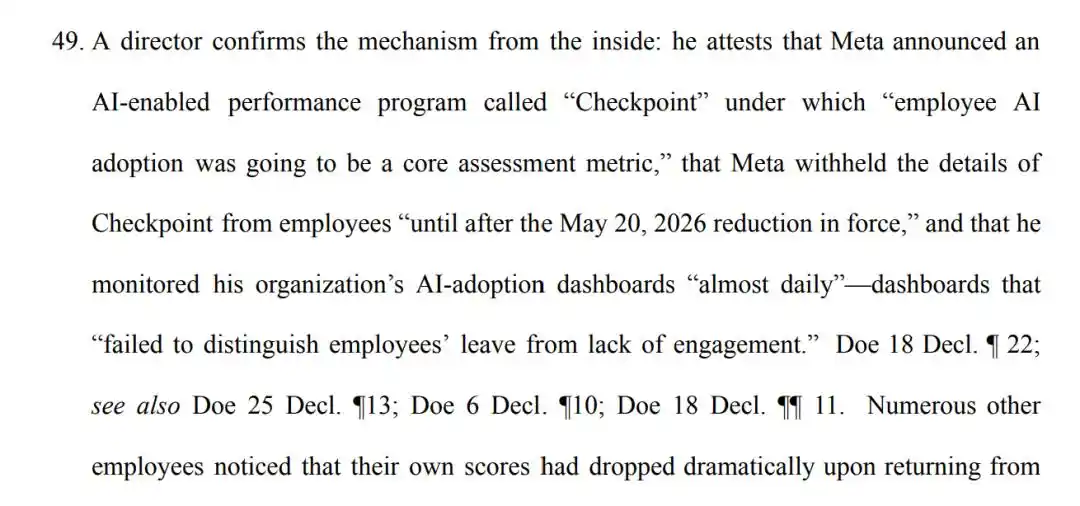
A director-level plaintiff (Doe 18) confirmed in the complaint: Meta announced this project, stating that "employee AI adoption rates will become a core performance metric," but intentionally withheld the specific details until after the May 20 layoffs.
He also revealed that as a senior finance lead in the infrastructure organization, he personally saw Meta include plans to save about $10 billion from layoffs in its financial forecasts.
Remember the backdrop to all this: Meta just set revenue records, promising to double AI investment in 2026.
Lay off 10% of people, save $10 billion, and redirect it into AI infrastructure.
So employees weren't outcompeted; they were sacrificed for capital reallocation.
Not everyone failed to see this.
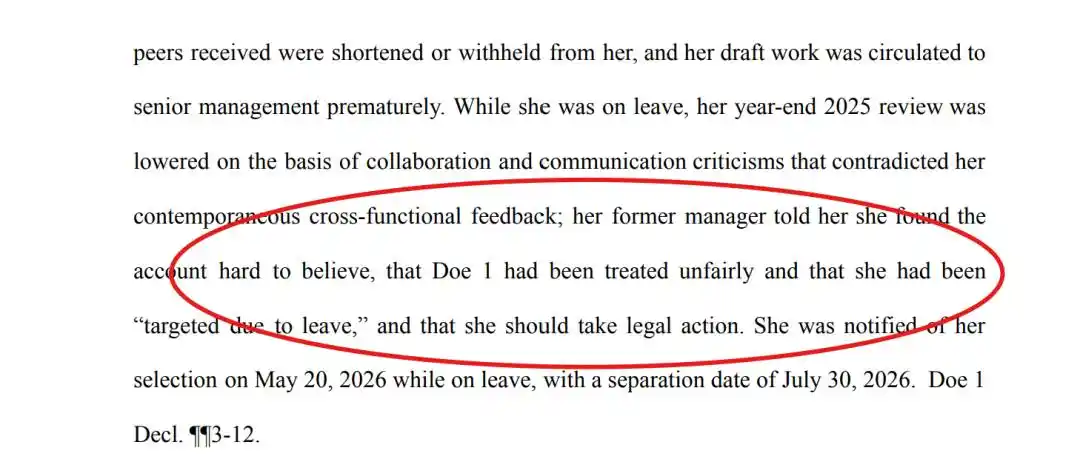
A plaintiff's former manager told her directly: You were targeted because you were on leave, you should take legal action.
So she did. All 26 of them did.
One More Thing
The irony is rich:
Meta says these layoffs are to build an "AI-first" company, to keep those who embrace AI.
But plaintiff Doe 14, who was in the top 2% of AI tool users company-wide at Meta at the end of 2025, was laid off anyway because he took parental leave.
AI doesn't care if you use AI; AI only cares if you are present.
This is what workers everywhere are facing, or will face...
References:
[1]https://www.reuters.com/world/meta-used-ai-target-workers-with-medical-conditions-layoffs-former-employees-2026-07-14/
[2]https://www.theguardian.com/technology/2026/jul/14/meta-ai-mass-layoffs-lawsuit
This article is from the WeChat public account "QbitAI", author: Focus on Frontier Technology















![Will Bittensor [TAO] hold $193 or sink to $186? Watch out for 2 signs!](https://d1x7dwosqaosdj.cloudfront.net/images/2026-07/41f6627611d24a5f96cbc0fe7b981e2b.jpg)