A Glimpse into Crypto Miners in Q2: Rushing into AI Data Centers – Are They Profiting?

marsbit2026-08-14 tarihinde yayınlandı2026-08-14 tarihinde güncellendi

Özet

Mining companies presented mixed Q2 results as they navigate the shift towards AI data centers alongside their core Bitcoin mining operations. While mining output increased for some, declining Bitcoin prices and rising network difficulty pressured revenues. For instance, MARA mined more Bitcoin year-over-year but saw a 27% revenue drop and a significant net loss, partly due to unrealized losses on Bitcoin holdings. The standout trend is the growing contribution of AI/high-performance computing (HPC) hosting revenue. Core Scientific now derives over 80% of its revenue from high-density hosting, while TeraWulf generates about 71% from HPC leasing. However, the transition is at varying stages. Companies like Riot Platforms and Cipher Digital are in earlier phases, with AI-related revenue still a smaller portion of their total income. The article cautions against conflating massive, long-term AI hosting contracts (often valued in billions) with current quarterly revenue, as income recognition depends on capacity delivery and lease commencement. Financially, net losses were common but driven by different factors: some by Bitcoin price revaluations or warrant fair value changes, others by operational costs exceeding revenue. The sector is diverging into three paths: pure-play miners focusing on efficiency, companies successfully transitioning to AI hosting, and those in a challenging transitional phase where legacy mining income is declining before new AI revenue scales up. The ...

In the mining farms, the loudest noise still comes from the mining rigs; yet in the Q2 financial reports, the AI business of most crypto mining companies is becoming increasingly prominent.

MARA recorded a net loss of $611.3 million for the quarter, which included $343 million in unrealized fair value losses on Bitcoin. On the other hand, Core Scientific's high-density colocation revenue increased from $10.6 million in the same period last year to $136.7 million, becoming the company's primary revenue source.

On one side, there is the contraction in mining revenue and the fair value losses on held coins due to falling cryptocurrency prices; on the other side, there is the long-term rent recognized upon the delivery of data center facilities. These financial reports simultaneously present two sets of report cards: one belonging to the Bitcoin mining rigs that are still 'putting food on the table,' and the other to the gradually ramping-up AI data centers.

The market is no longer short of multi-billion-dollar contracts. What needs to be verified next is how much capacity the mining companies have delivered, how much rent they have recognized, and ultimately, how much profit remains after deducting construction investments, depreciation, and interest expenses.

Mining More Doesn't Equal Earning More

The most direct pressure in Q2 came from the Bitcoin price.

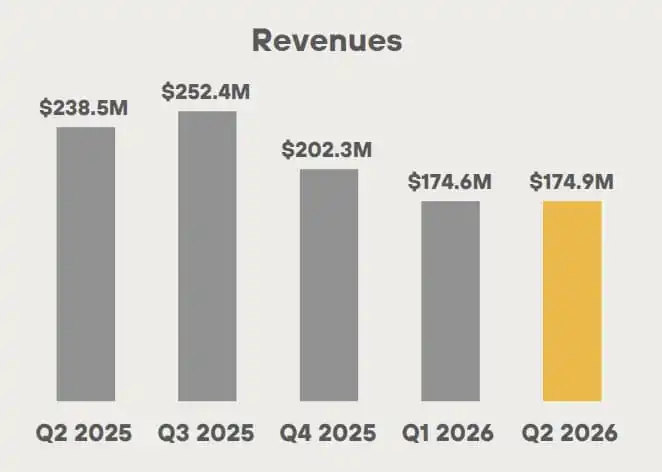
MARA mined 2,422 Bitcoins during the quarter, a slight increase from 2,358 Bitcoins in the same period last year, but its revenue still fell 27% year-over-year to $174.9 million. MARA's net loss for the quarter was $611.3 million, which also included $343 million in unrealized Bitcoin fair value losses. In other words, increased production could only partially offset the price decline and could not fully safeguard revenue.
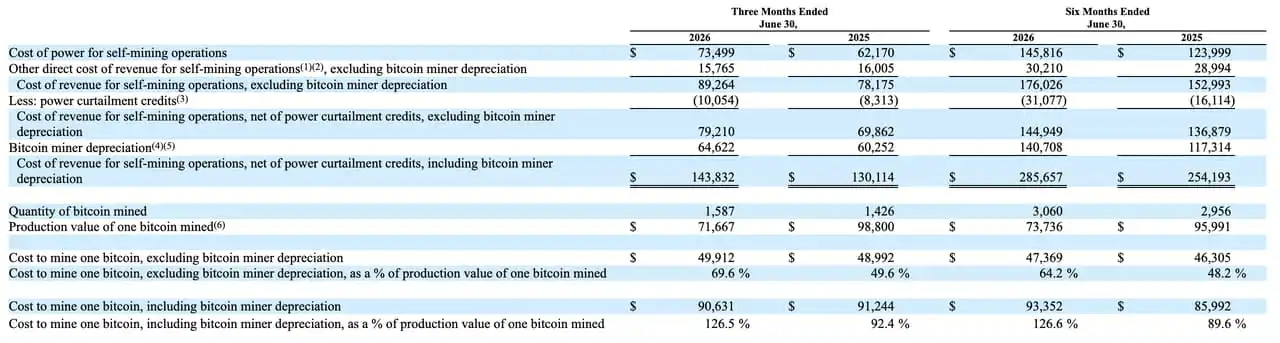
Riot Platforms presents a more typical case. The company produced 1,587 Bitcoins in Q2, an increase of about 11% year-over-year, but its mining revenue actually fell from $140.9 million to $113.7 million. The main reasons were the same: a decline in the average Bitcoin price and an increase in the global network hash rate. The production value per Bitcoin decreased from $98,800 to $71,667, while the mining cost per Bitcoin excluding rig depreciation increased from $48,992 to $49,912. Consequently, the cost-to-production-value ratio rose from 49.6% to 69.6%.
This doesn't mean the mining model is no longer viable, but rather that scale, machine efficiency, and electricity costs must work in tandem. American Bitcoin mined approximately 932 Bitcoins in Q2, a sequential increase of about 14%; mining revenue was approximately $67 million, up about 8% sequentially. Its mining cost per Bitcoin was around $36,500, with a gross margin close to 50%.

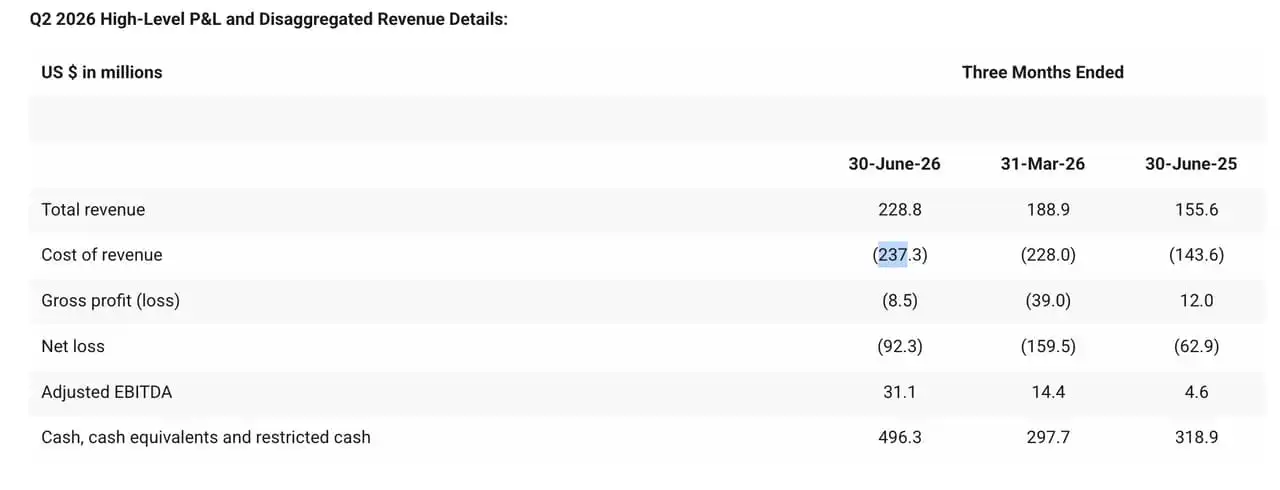
Bitdeer, however, shows another side: hash rate and production can expand rapidly, but profits may not follow synchronously. The company mined 2,694 Bitcoins in Q2, compared to 565 in the same period last year; total revenue increased 47% year-over-year to $228.8 million, with self-mining revenue contributing $168.4 million. However, the company's cost of revenue for the quarter reached $237.3 million, resulting in a gross loss of $8.5 million and a net loss of $92.3 million. Looking solely at production and revenue, it's easy to overlook that electricity costs, depreciation, and expansion costs had already exceeded current-period revenue.
AI Revenue Has Emerged, but Companies Are Not Starting from the Same Line

What is truly changing the industry landscape is that some miners have shifted from 'selling the Bitcoins they mine' to 'renting out power and data center space.'

Core Scientific is the most evident example of progress. The company's total revenue in Q2 was $164.2 million, of which high-density colocation revenue reached $136.7 million, accounting for approximately 83% of total revenue; self-mining revenue was only $21.5 million. In the same period last year, Core Scientific's colocation revenue was only $10.6 million. This signifies that its primary revenue source has shifted from mining to data center colocation, not merely the announcement of a future project.

A similar structural shift has occurred at TeraWulf. The company's Q2 revenue was $44.73 million, of which HPC leasing revenue was $31.93 million, accounting for about 71%, while digital asset revenue was $12.83 million. In contrast, in 2025, mining still constituted 90% (approximately $150 million) of TeraWulf's total revenue of $168.5 million, although it had already recorded its first HPC leasing revenue ($16.9 million) that year. The company has clearly stated that capital allocation and operational focus will primarily revolve around HPC data centers, and some existing mining farm infrastructure is also being repurposed.

Riot's transition is still in the ramp-up phase. Its Q2 total revenue was $174.2 million, up 14% year-over-year; of this, data center revenue was $23.2 million, while mining revenue remained at $113.7 million. It's worth noting that Riot's data center revenue includes $4.9 million in leasing revenue and $18.3 million in customer data center construction revenue – both are actual revenues recognized in the quarter's financials – but they are not yet sufficient to replace the mining business.

Cipher Digital reminds the market that 'commencing construction' and 'already generating HPC revenue' are two different things. The company's Q2 revenue was approximately $24.84 million, entirely from Bitcoin mining, with adjusted EBITDA at negative $30 million and a net loss of $267 million. Cipher only began delivering the first capacity of its Black Pearl project and started billing rent in early August, so this revenue was not yet reflected in Q2.

Hut 8's Q2 revenue increased from $41.3 million in the same period last year to $74.9 million, of which $72.5 million was categorized under Computing Operations. However, this category simultaneously includes ASIC computing, AI cloud, and traditional cloud services, meaning the entire $72.5 million cannot be directly labeled as AI revenue. Hut 8 still recorded a net loss of $177.1 million for Q2, of which $138.6 million was due to unrealized losses from digital assets.

AI Mega-Deals Dominate Headlines, but Revenue Realization Takes Time

The most common misinterpretation during miners' transition is mistaking the total value of long-term contracts for realized revenue.

Core Scientific disclosed leased customer power capacity of approximately 1.1GW, corresponding to potential contract revenue exceeding $24 billion, but its recognized colocation revenue for Q2 remained at $136.7 million; TeraWulf signed a 20-year lease with Anthropic post-quarter with an initial contract value of approximately $19 billion, but the company's Q2 HPC leasing revenue was only $31.9 million; Riot signed a 191MW data center lease post-quarter with an initial value of approximately $9.1 billion, while its Q2 data center revenue was $23.2 million.

These figures are not contradictory. The total contract value represents the potential revenue over the entire base lease term, typically recognized quarter-by-quarter into the financial statements only after the data center is built, delivered in phases, and billing commences. Project delays, construction cost variations, financing arrangements, and customer fulfillment can all affect the actual recognition pace. Therefore, when comparing miners' AI businesses, it's essential to distinguish at least three things: how much contract value has been signed, how much capacity has been delivered, and how much revenue was recognized in the current quarter.

Net profit also cannot be read in isolation from accounting items. For example, Core Scientific's Q2 net loss of $1.1553 billion was mainly affected by changes in the fair value of warrants; Cipher's net loss of $267.5 million included $150.5 million in fair value losses on warrants; MARA's loss was impacted by Bitcoin price revaluation. In contrast, Bitdeer's gross loss for the quarter reflects a situation where the cost of revenue already exceeded revenue, which is a different nature of loss.

Miners Are Evolving into Three Types of Companies

The Q2 financial reports show that listed mining companies can no longer be measured by the same standard.

American Bitcoin still primarily focuses on expanding hash rate, increasing production, and lowering the cost per coin; Core Scientific and TeraWulf already have a significant proportion of colocation or HPC revenue entering their current-period financials; companies like Riot and Cipher are in the intermediate stage of gradually delivering new projects.

Keel Infrastructure has taken an even more drastic path. This company, renamed from Bitfarms, has completed the shutdown of its US Bitcoin mining operations. Its Q2 revenue was approximately $30.43 million, down 50% year-over-year, due to the Bitcoin price decline and the closure of cryptocurrency mining operations in the Moses Lake area, USA, in April 2026; adjusted EBITDA was negative $23.7 million. The company has chosen to become an HPC infrastructure developer, but the new business has not yet formed a revenue stream sufficient to replace mining.
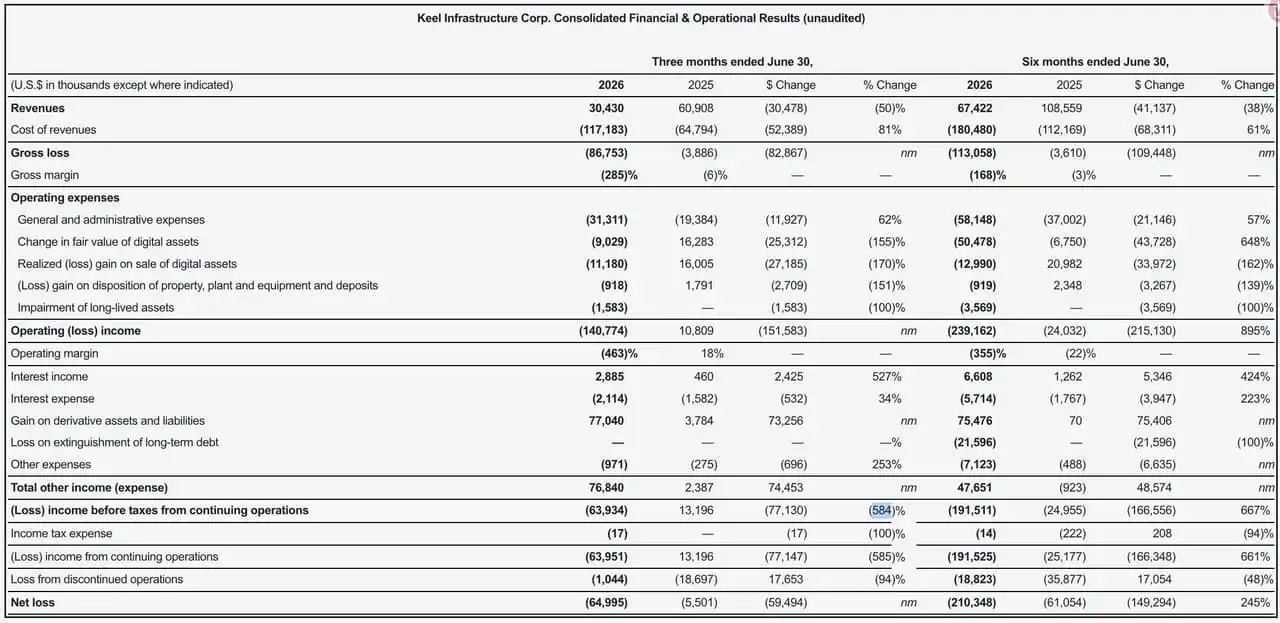
Therefore, what is truly noteworthy this quarter is not whether miners are all talking about AI, but rather the stage they have reached: some still rely on mining rigs to boost production, some have started collecting monthly data center rent, and others are experiencing a transitional period where old revenue streams are disappearing while new ones have not yet taken over.

The mining rigs are still roaring, but what will determine financial performance in the next phase is becoming: who possesses stable power, who can deliver data center capacity on time, and who can truly turn a long-term contract into current-period revenue.

Trend Kriptolar

İlgili Sorular

QWhat is the main factor that put pressure on mining companies' revenues in Q2, despite some companies increasing their Bitcoin production?

AThe main factor was the drop in Bitcoin price. Although companies like MARA and Riot Platforms produced more Bitcoin compared to the same period last year, their mining revenues decreased because the average price per Bitcoin was lower. The decline in price outweighed the gains from increased production.

QAccording to the article, which company saw the most significant shift in its primary revenue source in Q2, moving away from Bitcoin mining?

ACore Scientific saw the most significant shift. In Q2, its high-density hosting revenue reached $136.7 million, accounting for approximately 83% of its total revenue of $164.2 million. In the same period last year, its hosting revenue was only $10.6 million, while now its self-mining revenue was just $21.5 million.

QWhy does the article caution against directly equating the total value of announced long-term AI/HPC contracts with a company's current revenue?

ABecause the contract total value represents the potential revenue over the entire lease term (e.g., 20 years). Revenue is only recognized in the financial statements quarterly after the data center capacity is built, delivered to the client, and billing begins. Project delays, construction costs, and client performance can all affect the actual timing and amount of revenue recognized.

QWhat are the three different strategic paths or stages that crypto mining companies are diverging into, as illustrated by the Q2 reports?

A1. Companies like American Bitcoin continue to focus on expanding hash rate, increasing Bitcoin production, and lowering the cost per coin. 2. Companies like Core Scientific and TeraWulf have already transitioned, with a large proportion of their current quarterly revenue coming from hosting/HPC rentals. 3. Companies like Riot and Cipher are in an intermediate stage, with new AI/HPC projects being gradually delivered, but mining still constitutes a major part of their revenue.

QWhat does the example of Keel Infrastructure (formerly Bitfarms) demonstrate about the risks of transitioning completely to the HPC/AI data center business?

AKeel Infrastructure demonstrates the transitional risk where old revenue streams disappear before new ones are fully established. The company shut down its US Bitcoin mining operations, leading to a 50% drop in Q2 revenue. While it has pivoted to becoming an HPC infrastructure developer, this new business has not yet generated sufficient revenue to replace the lost mining income, resulting in a negative adjusted EBITDA.

İlgili Okumalar

Report: Bank of Japan Could Raise Interest Rates as Early as September, with Subsequent Pace Possibly Accelerating

According to Reuters, the Bank of Japan (BOJ) faces mounting pressure to raise interest rates, with a potential hike as early as September. Sources familiar with the internal discussions indicate the central bank is considering accelerating its tightening pace beyond the current schedule of roughly two increases per year. The September 17-18 policy meeting is now viewed as a critical juncture, with market pricing suggesting an approximately 80% probability of a rate hike. This would mark a third increase for 2024, potentially shifting expectations toward a quarterly tightening cycle. Key drivers behind this hawkish shift are multifaceted inflation risks. A persistently weak yen, near a 40-year low, continues to push up import costs. High wholesale prices at a three-year peak signal pending cost pass-through to consumers. Furthermore, inflation expectations among households, businesses, and economists are nearing or exceeding the BOJ's 2% target, raising concerns about de-anchoring. External factors, including energy price volatility from Middle East conflicts and strong global AI-related demand, add further upward pressure. Internal BOJ communications reveal a growing urgency. The July policy meeting summary showed some board members advocating for faster action to avoid "falling behind the curve." Governor Kazuo Ueda acknowledged the need to consider these heightened inflation risks, suggesting the pace of hikes could be increased if financial conditions are deemed too loose. This sentiment underscores a decisive shift within the BOJ toward preemptive monetary tightening.

marsbit6 dk önce

Report: Bank of Japan Could Raise Interest Rates as Early as September, with Subsequent Pace Possibly Accelerating

marsbit6 dk önce

To Counter Quantum Threat, Ethereum Abandons Poseidon and Switches to Traditional Hashes

On August 13th, Ethereum researcher Justin Drake announced a strategic pivot in the face of the quantum computing threat: the Ethereum Foundation will abandon the SNARK-friendly hash function Poseidon at the L1 level in favor of traditional hash functions like SHA2 or BLAKE2. This decision, informed by eight years of research, represents a major shift in Ethereum's post-quantum cryptography roadmap. Poseidon, introduced in 2019, has been favored for zkRollups and zkVMs due to its efficiency within SNARK circuits. However, its shorter cryptographic history and analysis timeline became liabilities when post-quantum security became a critical requirement. The change is enabled by breakthroughs in SNARK design, particularly the adoption of "binary field" arithmetic. This allows traditional hash functions (which rely heavily on bitwise operations) to be verified efficiently in SNARKs, with recent benchmarks achieving millions of hashes per second on a laptop. Another key driver is the accelerating timeline of the quantum threat. Reports warn that "Cryptographically Relevant Quantum Computers" (CRQCs) could break current public-key cryptography (like ECDSA) as early as the 2030s, risking trillions in on-chain assets. The enhanced cryptanalysis capabilities of AI have also weakened some post-quantum candidates, pushing Ethereum towards hash-based schemes, deemed more quantum-resistant. Ethereum's post-quantum deployment plan aims for a production-ready leanVM by 2027, followed by full deployment across the consensus, execution, and data availability layers by 2028. This leanVM will aggregate numerous large post-quantum signatures into a single compact proof per block. Other major blockchains are also preparing. Solana's core developers have independently chosen the NIST-standardized Falcon signature scheme for their post-quantum roadmap. Starknet has outlined a multi-phase plan, starting with replacing its Pedersen hash with BLAKE2. By moving from the specialized Poseidon to the battle-tested SHA2/BLAKE2, Ethereum is opting for mature, widely analyzed cryptographic primitives, prioritizing long-term security assurance in the quantum era.

marsbit34 dk önce

To Counter Quantum Threat, Ethereum Abandons Poseidon and Switches to Traditional Hashes

marsbit34 dk önce

Nomura Research Report Insights: Lumentum's Performance Confirms Continued Shortage of Optical Chips, Chinese Suppliers See Structural Opportunities

Lumentum's Q4 FY26 earnings, with revenue surging 109% YoY to $1.01B, confirm a sustained global shortage of key optical chips like EML and CW lasers. Nomura's analysis indicates this supply-demand imbalance is expected to persist through FY26-FY27, driven by explosive demand from AI data centers. This shortage creates a structural window of opportunity for Chinese suppliers. Lumentum's performance highlights strong demand across laser categories: narrow linewidth laser component shipments grew over 130% YoY, and pump laser shipments grew 80%. EML sales set a quarterly record, fueled by 100G demand, with 200G EML accelerating to over 25% of related revenue. CW lasers are dominating 1.6T silicon photonics applications, while EML is projected to regain share in the 3.2T era. The technological roadmap is clear, with NPO (Near-Packaged Optics) seen as an incremental step before CPO (Co-Packaged Optics) commercialization around 2027-2028. Furthermore, Lumentum's Optical Circuit Switch (OCS) shipments doubled quarter-over-quarter, aligning with AI data center architectural upgrades. Nomura identifies specific Chinese companies poised to benefit: chipmaker Source Photonics for global market share gains, module leader InnoLight from the 800G-to-1.6T upgrade and silicon photonics adoption, and Tianfu Communication from incremental NPO opportunities. The report issues ratings and price targets for these A-share companies. In summary, Lumentum's results signal a structural shift where AI-driven bandwidth demand is outpacing upstream optical chip supply, creating a strategic window for the Chinese optical communication supply chain.

marsbit46 dk önce

Nomura Research Report Insights: Lumentum's Performance Confirms Continued Shortage of Optical Chips, Chinese Suppliers See Structural Opportunities

marsbit46 dk önce

İşlemler

Spot

Popüler Makaleler

DATA Nasıl Satın Alınır

HTX.com’a hoş geldiniz! DATA Network (DATA) satın alma işlemlerini basit ve kullanışlı bir hâle getirdik. Adım adım açıkladığımız rehberimizi takip ederek kripto yolculuğunuza başlayın. 1. Adım: HTX Hesabınızı OluşturunHTX'te ücretsiz bir hesap açmak için e-posta adresinizi veya telefon numaranızı kullanın. Sorunsuzca kaydolun ve tüm özelliklerin kilidini açın. Hesabımı Aç2. Adım: Kripto Satın Al Bölümüne Gidin ve Ödeme Yönteminizi SeçinKredi/Banka Kartı: Visa veya Mastercard'ınızı kullanarak anında DATA Network (DATA) satın alın.Bakiye: Sorunsuz bir şekilde işlem yapmak için HTX hesap bakiyenizdeki fonları kullanın.Üçüncü Taraflar: Kullanımı kolaylaştırmak için Google Pay ve Apple Pay gibi popüler ödeme yöntemlerini ekledik.P2P: HTX'teki diğer kullanıcılarla doğrudan işlem yapın.Borsa Dışı (OTC): Yatırımcılar için kişiye özel hizmetler ve rekabetçi döviz kurları sunuyoruz.3. Adım: DATA Network (DATA) Varlıklarınızı SaklayınDATA Network (DATA) satın aldıktan sonra HTX hesabınızda saklayın. Alternatif olarak, blok zinciri transferi yoluyla başka bir yere gönderebilir veya diğer kripto para birimlerini takas etmek için kullanabilirsiniz.4. Adım: DATA Network (DATA) Varlıklarınızla İşlem YapınHTX'in spot piyasasında DATA Network (DATA) ile kolayca işlemler yapın.Hesabınıza erişin, işlem çiftinizi seçin, işlemlerinizi gerçekleştirin ve gerçek zamanlı olarak izleyin. Hem yeni başlayanlar hem de deneyimli yatırımcılar için kullanıcı dostu bir deneyim sunuyoruz.

515 Toplam GörüntülenmeYayınlanma 2026.07.01Güncellenme 2026.07.01

DATA Nasıl Satın Alınır

Tartışmalar

HTX Topluluğuna hoş geldiniz. Burada, en son platform gelişmeleri hakkında bilgi sahibi olabilir ve profesyonel piyasa görüşlerine erişebilirsiniz. Kullanıcıların DATA (DATA) fiyatı hakkındaki görüşleri aşağıda sunulmaktadır.

活动图片