Reframing Ethereum's Valuation: Why the Fee Model is Wrong, and the 'Treasury Logic' is the Future?

marsbit2026-05-28 tarihinde yayınlandı2026-05-28 tarihinde güncellendi

Özet

"Rethinking Ethereum's Value: The 'Vault Logic' Framework" Traditional valuation models incorrectly treat Ethereum as a company, valuing ETH based on transaction fees ("revenue"). This is flawed. Fees are network friction; a successful network aims to reduce them to zero. Ethereum's average fee has dropped from over $50 in 2021 to around $0.20 today, while transaction volume has tripled. Instead, view Ethereum as a digital vault securing ~$250 billion in on-chain assets (stablecoins, RWAs, L2 bridged funds, wBTC, etc.). Post-merge, Ethereum's security is directly purchased with its own asset: ETH. To attack the network, an attacker must acquire and control staked ETH. Therefore, the vault's security level is intrinsically tied to ETH's market value. Currently, the value of all staked ETH is only ~$72B, protecting ~$250B in assets—a dangerous imbalance. For robust security, the staked ETH securing the network should be valued significantly *higher* than the total value it protects. Applying a conservative security multiplier suggests ETH's fair value should be closer to ~$6,900 (vs. ~$2,070 currently). As on-chain asset value grows into the trillions, ETH's price must rise proportionally to maintain this security budget. Comparisons to free infrastructure like Linux or low-margin utilities like the DTCC are misguided. Their security is provided externally (community, law, banks). Ethereum's security is internal and must be purchased in the open market using ETH. ETH is not...

Author: Tom Dunleavy, Head of Venture Capital at Varys Capital

Compilation: Yuliya, PANews

Editor's Note: The market currently commonly views Ethereum as a traditional enterprise, calculating its price-to-earnings ratio based on the fees it generates and concluding it is overvalued. However, Tom Dunleavy proposes a completely different framework: fees are not revenue but network friction; Ethereum is not a company but a "treasury" safeguarding hundreds of billions of dollars in assets, with ETH itself being the lock. The following is a compilation of the original text:

TLDR

  • Stop focusing on fees to value Ethereum. Fees are a stumbling block; a successful network will inevitably strive to reduce fees to zero. ETH fees have dropped from over $50 at their peak in 2021 to around $0.20 now, while transaction volume has more than tripled. Plummeting fees signify network success, not failure.

  • After transitioning to Proof-of-Stake (PoS), ETH became the lock protecting the asset treasury. To attack Ethereum, you must control the staked ETH. Controlling one-third can paralyze the network; controlling two-thirds can falsify records. Either way, the cost of malicious action is calculated in ETH, and upon acting maliciously, this ETH is directly burned by the system. This tightly binds ETH's value to the network's security. No network operated this way before the staking mechanism existed.

  • Currently, there are about $250 billion in assets on the Ethereum chain (including stablecoins, tokenized assets, L2 network cross-chain funds, etc.), but the total value of staked ETH protecting these assets is only about $72 billion. This is like using a cheap, flimsy lock to protect a safe full of gold bars. Logically, ETH's fair price should be around $6,900 (currently only $2,070). If on-chain assets grow to trillions in the future, ETH's price must rise to tens of thousands to match its security responsibility.

  • Statements like "Ethereum is like the free Linux system" or "like DTCC (Depository Trust & Clearing Corporation)" are incorrect. The security of Linux and DTCC is provided externally (e.g., the open-source community's goodwill or the legal backing of governments and banks). But Ethereum's security is purchased using its own token, ETH. Therefore, ETH must be valuable, while Linux does not need to be.

  • If ETH fails, Crypto will likely fail as well.

Fees Are Not Revenue, But Friction

Last week, Bankless founder David Hoffman said he finally sold all his ETH, causing a stir in the crypto community. While I respect David's decision, I believe the way people evaluate ETH and other PoS public chains is long outdated. I've discussed my new framework with many people on podcasts, but it seems it hasn't sunk in (perhaps due to my explanation), so today I'll lay it all out clearly at once.

New things require new perspectives. Here's introducing a brand new ETH valuation model.

Many view Ethereum as a company, treating the fees collected as its operating revenue. Seeing fees decrease, they think this "company" is failing and the token is overpriced. This is completely backward; once you understand it, you'll never see it that way again.

In reality, fees are like taxes; the higher they are, the less willing people are to use the network. Lower fees encourage more people to participate, leading to more applications and capital on-chain. The data doesn't lie: the fee per transaction has dropped from over $50 in 2021 to around $0.20 now, but transaction volume has hit new highs, more than triple that of 2021, with L2s handling about 85% of transactions now. It's cheaper to use, and more people are using it. A successful settlement network should aim to reduce tolls to zero.
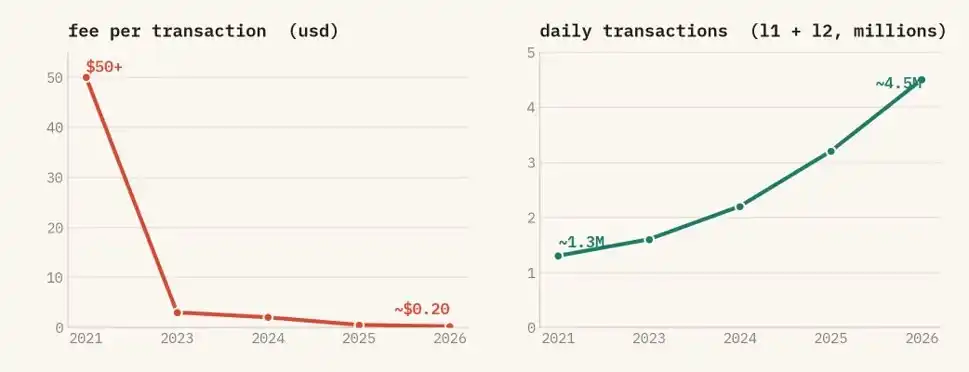
Ethereum's fees have plummeted, yet transaction volume is at a record high. It's become cheaper, and more people are using it. L2s now handle roughly 85% of the throughput.

So, if fees are the wrong metric, what is the right one?

Ethereum Is a Grand Treasury, ETH Is the Lock

Stop viewing Ethereum as a company; think of it as a massive treasury. This treasury holds approximately $160 billion in stablecoins, $20 billion in RWAs (like U.S. Treasuries, money market funds, and private credit), $35 billion in L2 cross-chain assets (with L2 networks inheriting Ethereum's consensus by design). Additionally, there's about $12 billion in wrapped Bitcoin and around $20 billion distributed across DeFi positions, NFTs, and on-chain treasuries. That totals roughly $250 billion in on-chain assets, growing each quarter.

The safety of the treasury depends entirely on that lock. And everyone has miscalculated the value of this lock. On Ethereum, this lock is forged from ETH.

In the old Proof-of-Work (PoW) system, you used mining hardware to secure the network. The lock was bought externally; its cost wasn't tied to the token's value. But now, with staking (PoS), everything has changed. To attack Ethereum now, you must buy and control the staked ETH. The lock is made from the token itself. This means the treasury's security level and the token's market price become one and the same. You can't separate them.

The Current State: A Lock Cheaper Than the Safe

This is the issue the market is ignoring. Today, the total value of all staked ETH protecting Ethereum is only $72 billion. But the assets it protects are worth $250 billion. The money in the safe is worth over twice as much as the lock protecting it.
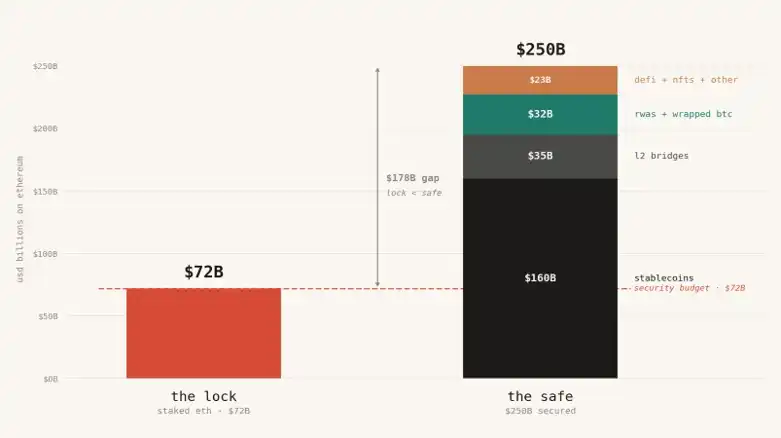
This is extremely dangerous. If what you're protecting is worth more than the cost of attacking it, your treasury is fundamentally insecure. For Ethereum to securely protect this $250 billion, the defensive staked capital must be greater than $250 billion, not less than one-third of it.

Currently, only about 30% of ETH is staked. So, simply to make this 30% stake equal the on-chain assets, ETH's total market capitalization would need to be over three times the on-chain assets (1 divided by 0.30). Currently, ETH's market cap is roughly equal to the assets it protects (around 1x). But by my logic, it should be over 3x. Calculating with the current $250 billion, ETH's fair price should be around $6,900, not the current $2,070. That is, even without a single new dollar entering, based solely on the assets it currently protects, ETH's price should more than triple. This aligns directionally with the model of BitMine Chairman Tom Lee.

"But Circle can freeze USDC, so it doesn't need ETH's protection at all."

Every time I say this, someone jumps in with this rebuttal, but it's fundamentally wrong. Here's why:

People think that if Ethereum is attacked, Circle, the issuer of USDC, can just freeze the attacker's address and reissue the tokens. So those hundreds of billions shouldn't count toward Ethereum's security responsibility.

But consider: Circle's freezing mechanism operates based on smart contracts; it executes on Ethereum and relies on Ethereum's ledger. If Ethereum's consensus is broken, there is no universally agreed-upon honest chain, and the freeze mechanism cannot function.

Furthermore, Circle could have chosen not to use Ethereum, opting for a private database instead. They chose Ethereum precisely for its neutrality, deep liquidity, and compatibility with other projects. Since they enjoy these benefits, the trade-off is: USDC's lifeline is tied to Ethereum's security. You want the benefits, you bear the dependency risk.

Moreover, people always assume the attacker wants to steal USDC. That's not it at all. If Ethereum collapses, that $150+ billion isn't stolen; it becomes trapped on a chain with no consensus, unable to be redeemed, with all loans and trades based on it thrown into chaos. The value of these assets isn't taken by a thief; it's destroyed. And that destroyed value is precisely the important factor for security considerations.

An attacker doesn't even need to steal money to profit. They can short ETH, short the entire ecosystem, or they could simply be a hostile actor profiting from paralyzing the network. The more money on-chain, the greater their incentive to cause destruction. Therefore, our security budget must grow alongside the total on-chain assets, not just guard against the small change a thief might steal.

As long as you put money on Ethereum, you consume its security, regardless of whether you have a "freeze" button. All the money must be counted.

"Ethereum is just Linux" or "Ethereum is DTCC."

Another rebuttal favored by the intellectually inclined.

  • First argument: Ethereum is like the Linux system. It's underlying infrastructure, powering the internet, but as an asset, it's worthless. Open-source infrastructure is a free public good; the money is made by the applications running on top, not the underlying protocol. So ETH will be the same: immensely important, yet utterly worthless.

  • Second argument: Ethereum is like DTCC (Depository Trust & Clearing Corporation), the infrastructure behind almost all U.S. securities transactions. DTCC processed $370 trillion in transactions in 2024, with revenues of about $2.5 billion but profits under $500 million. It's critically important, heavily regulated, but its value is only a tiny fraction of the transaction volume. Infrastructure is cheap; even if you can't live without it, even if Ethereum processes endless future transactions, it will only capture meager utility profits, nothing more.

Both arguments fail in the same place.

The security of Linux and DTCC is borrowed externally. Linux relies on the open-source community, reputation, and decades of code review. DTCC relies on U.S. law, federal regulators, and the backing of major banks with dollars and treasuries. Their security guarantees are outside the system. This is precisely why DTCC can settle massive wealth while capturing almost no value itself. It's a member-owned utility designed to operate at cost; it doesn't need a valuable token because trust is provided by the government and banks.

Ethereum has no such external shelter. No government enforces it. No member banks back it. No law can reverse stolen settlements. The only barrier between Ethereum and an attacker is the market value of the staked ETH used to secure it. Ethereum must purchase security for every block, in the open market, with its own asset.

This is the fundamental difference. Linux is software; no one is required to own a scarce asset to run it. DTCC provides collateral in dollars, external to itself. Ethereum's collateral is ETH, internal to itself. You cannot commoditize it to zero because security is not a line of code; it's a quantum of value that must be locked up and put at risk. Strip ETH of its value, and you haven't built a leaner Linux. You've built a chain with no collateral, one no one would trust with a single dollar.

So, stop comparing Ethereum to Linux or DTCC. You should compare it to the dollars and treasuries backing DTCC. No one values the dollar based on how many fees DTCC earns. You'd evaluate the clearing house's fees separately and evaluate the dollars and treasuries serving as the system's collateral—its monetary base—valued in trillions. ETH is not the clearing house. ETH is the collateral building the clearing house. That's the asset you're buying.

Linux never needed a treasury. Ethereum's security budget *is* a treasury, and it's denominated in ETH.

Looking Ahead and Market Dynamics

Following this line of thought. This model doesn't look at fees or market hype at all. It focuses on one core question: How much money will be settled on Ethereum in the future? To protect that money, how much must ETH be worth?

Stablecoins are poised to break $1 trillion in the coming years. RWA tokenization could reach several trillion by 2030. Add in various on-chain applications, and the assets Ethereum protects could soar from the current $250 billion to several trillion. Maintaining that "over 3x" security ratio constant, you can calculate how high ETH's price must rise as capital grows.
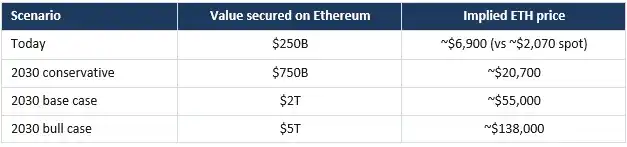
Even if you're more pessimistic and lower the security ratio a bit, it doesn't matter. On-chain capital is growing (that's the variable), and the security ratio (that's the leverage)—no matter how you calculate it, the trend is upward.

"This is blind optimism. The market will never price it this way."

This is the most pertinent rebuttal. Indeed, I'm saying what ETH "should" be worth, not what the market will price it at immediately. There's no forced arbitrage mechanism to close the gap. And my logic of "ETH should rise" has indeed been contradicted by its price performance over the past few years. Let's address each point.

  • About what bridges the gap: Ethereum is not an arbitrage; it's demand for the asset that prices the entire system. As value settles on Ethereum, ETH is used as collateral, paired trading asset, and staked to earn the network's base yield. This demand grows with the activity it supports. Reserve assets aren't priced on revenue; they're priced by how desperately the surrounding system needs to hold them. Gold is worth over $18 trillion without generating any cash flow. ETH is the reserve asset of on-chain finance, and this framework merely measures how large that reserve must be.

  • About the staking multiplier: My mental model treats the staking multiplier as a range, not a fixed target. At the current staking rate, parity (staked ETH equals protected value) is around 3.3x. A reasonable range spans from a lenient 1.7x to a strict 5x, where the cost to attack via a two-thirds stake equals the entire protected value. Price tracks protected value at some multiplier within this band. Fixing it to a specific number undermines rigor; this is also where rational people can disagree without breaking the model.

  • About reflexivity: The model does have more than one equilibrium, and nothing definitively selects the highest one. Today, Ethereum is secure enough with below-threshold coverage because acquiring a one-third stake is illiquid, slashing is brutally punitive, and the social layer can fork out an attacker. This is real. But these defenses determine whether an attack succeeds, not whether coverage is sufficient as risks escalate. Thin coverage may be tolerable when protecting $250 billion. When it involves two or five trillion in regulated institutional capital, coverage is no longer an academic question. The gradient to close the gap increases monotonically with adoption.

Finally, the most contradictory aspect is ETH's price over the past 5 years. Logically it should rise, but it has consistently fallen. I think the main reason is: previously, there wasn't enough money on-chain for people to see security as a major issue. When there was only $50 billion on-chain, nobody worried; when it grew to $175 billion, people started feeling uneasy; when it reaches $1 trillion, the first question large institutions ask before entering will undoubtedly be: "Is this chain secure?" And the answer to that question depends entirely on ETH's price. My model can't predict the exact day it will rise, but it tells you that as on-chain capital grows, this upward pressure will intensify. And "on-chain capital is growing" is a point even bears cannot deny.

Some counter with Bitcoin, saying Bitcoin's security budget is negligible compared to its market cap. But Bitcoin primarily protects itself. Ethereum protects other people's dollars and various assets—a far greater responsibility! And the trend is clear: more ETH is being staked, compliant products are continuously buying ETH, and as on-chain activity grows, the burn mechanism is constantly destroying ETH. All of this corroborates the demand growth I describe.

Those who only focus on fees and cash flow will continue shouting that ETH is overvalued. They've completely reversed cause and effect. On-chain activity comes first, and then security is needed. ETH must be valuable to secure the entire ecosystem. Fees are stumbling blocks you should strive to eliminate, not the chips you use to value ETH.


İlgili Sorular

QAccording to the article, why is it wrong to value Ethereum based on transaction fees?

AThe article argues that viewing transaction fees as revenue, akin to a company's income, is a flawed approach. Instead, fees are considered 'friction' or a 'tax' on the network. A successful settlement network aims to minimize this friction to encourage usage, not maximize it. The data shows that while average transaction fees have dropped significantly since 2021, transaction volume has tripled, indicating success, not failure.

QWhat is the central metaphor used to describe Ethereum's role and ETH's value in the new valuation framework?

AThe central metaphor is that Ethereum is a 'vault' or 'treasury' securing valuable assets, and ETH is the 'lock' on that vault. The security of the entire network is intrinsically linked to the market value of the staked ETH, which acts as the collateral that must be controlled or attacked to compromise the system.

QHow does the author justify the claim that Ethereum's current security budget (staked ETH value) is insufficient?

AThe author compares the total value of assets secured on Ethereum (estimated at $250 billion, including stablecoins, RWAs, L2 bridged funds, etc.) to the total value of staked ETH securing it (approximately $72 billion). This creates a dangerous imbalance where the 'lock' is cheaper than the contents of the 'vault.' For the network to be adequately secure, the defensive capital (staked ETH value) should be a multiple of the total value it protects.

QWhy does the author argue that comparing Ethereum to Linux or the DTCC is fundamentally incorrect?

AThe author states that both Linux and the DTCC derive their security and trust from external sources (open-source community reputation/government backing and legal/regulatory frameworks with bank guarantees, respectively). Ethereum has no such external backing; its only security is the market value of the staked ETH itself. Therefore, ETH cannot be commoditized to zero value because the network must 'buy' its security in the open market using its native asset.

QWhat is the primary driver for ETH's future price appreciation according to the 'treasury logic' framework presented?

AThe primary driver is the projected growth in the total value of assets settled and secured on the Ethereum network (e.g., stablecoins reaching trillions, tokenized RWAs). As this protected value increases, the market value of ETH must rise proportionally to maintain a sufficient security budget (the 'lock' must be valuable enough to protect the growing 'vault'). This creates a direct, non-speculative link between on-chain economic activity and ETH's valuation.

İlgili Okumalar

Six Complaints from an Ethereum Developer

A disgruntled early Ethereum developer and token holder presents six core criticisms of the project's trajectory, contrasting it with Solana's rise. 1. **Premature Complacency**: The Ethereum Foundation shifted from a "building" to an "infrastructure" mindset too soon, adopting a passive, "retired chairman" posture before securing market dominance, reflected in ETH's ~65% decline against BTC post-Merge. 2. **Misguided Messaging**: The Merge was marketed primarily on ESG (99.95% energy reduction) rather than user benefits like speed or yield, appealing to internal ideals instead of market demands. 3. **Delayed Execution**: Proof-of-Stake, on the roadmap since 2015, took seven years to launch, ceding critical narrative and development windows. Competitors like Solana built entire ecosystems in that time. 4. **Poor Native Staking UX**: Years after the Merge, there is still no first-party, user-friendly staking application, forcing reliance on centralized services like Lido and undermining ETH's "sound money" narrative. 5. **Managed Decline**: The rollup-centric roadmap deliberately weakens the base layer's fee capture, outsourcing value and profitability to L2s like Arbitrum and Base, which issue their own tokens and fragment capital. 6. **Ideology Over Product**: Ethereum culture prioritizes philosophical purity ("credible neutrality," "public goods") over competitive product delivery that meets user demands (e.g., financialization), while Solana's ecosystem focuses on coordinated execution. The diagnosis is accumulated execution debt, not a coordination failure. Ethereum possessed a structural advantage in 2021 but spent years in governance debates, while Solana efficiently executed. The current market cap reflects these specific strategic failures, not abstract theory.

marsbit1 saat önce

Six Complaints from an Ethereum Developer

marsbit1 saat önce

Six Complaints from an Ethereum Developer

Six Grievances from an Ethereum Developer The author, an early investor and developer still building on Ethereum, expresses deep frustration with its trajectory and declining ETH/BTC price since the merge. The core argument is that Ethereum's current market position stems from concrete failures in execution and strategy, not abstract coordination problems. The first grievance targets a shift in the Ethereum Foundation's mentality from builders to "infrastructure," adopting a premature posture of a retired victor. Second, marketing the Merge around ESG (99.95% energy reduction) is seen as talking to its own conscience rather than the market, which prioritizes user experience and yield. Third, the seven-year delay in delivering Proof-of-Stake (PoS) ceded critical narrative and development time to competitors like Solana. Fourth, three years post-merge, there is still no user-friendly first-party staking application, forcing reliance on centralized services like Lido and undermining ETH's monetary narrative. Fifth, the rollup-centric roadmap has strategically surrendered base-layer fee capture to L2s, fragmenting value within the ecosystem while Solana demonstrates an integrated L1's value accrual. Finally, the author criticizes an institutional culture that prioritizes philosophical ideals (credible neutrality, pluralism) over competitive product delivery focused on what users actually want. The diagnosis is "accumulated execution debt." Ethereum possessed a structural advantage in 2021 but spent years in governance debates, while Solana's ecosystem coordinated efficiently to deliver and capture the next wave of value. The conclusion is that Ethereum's market cap reflects its abandonment of the fight for asset appreciation.

链捕手1 saat önce

Six Complaints from an Ethereum Developer

链捕手1 saat önce

Token Budget Wars: Enterprise AI Enters the 'Accounting Era'

Token Budget Wars: Enterprise AI Enters the "Accounting Era" Enterprise AI is shifting from the question of "whether to adopt" to "how to account for it." As AI inference costs evolve from experimental budgets into ongoing operational expenses, CEOs and CFOs are demanding proof of value: what tangible results does each dollar spent on tokens deliver? The core of "Token Budget Wars" is not simply about reducing AI bills, but about intelligently allocating compute resources. It involves determining which business processes warrant more computational power, which tasks can use cheaper models, which can be outsourced or handled manually, and which are merely inefficient consumption. A key insight is that AI usage (token consumption) does not equal value. While SaaS usage indicated software adoption, AI token usage only indicates the "meter is running." The same workflow can cost vastly different amounts due to factors like prompt quality, context, model choice, and retries. The critical metric for scaling is "marginal token utility"—the business value created per additional dollar of inference cost. However, this is difficult to measure due to challenges like the long tail of retries, context inflation (where costs can scale quadratically with context length), and inefficient model routing (defaulting to the most powerful model for all tasks). The competition for token allocation is intensifying because, in the AI era, influence is tied to how much intelligence one can command, not just team size. AI spending is essentially competing with labor costs, whether for replacing external BPOs, internal staff, or generating new revenue. BPO contracts provide a clearer benchmark as they are priced per completed unit. The missing layer is attribution from tokens to business outcomes. Companies need a system that connects inference spending to completed work and results, capturing the agent's decision trajectory—what it saw, retrieved, tried, and why it succeeded or failed. This recorded rationale becomes a valuable asset. Ultimately, those who master token-to-outcome attribution will control the allocation of AI resources within enterprises, deciding which workflows get more compute, which are capped, or which revert to humans. The first phase of enterprise AI proved models could do the work. The next phase will determine how much of that work is worth paying for.

marsbit1 saat önce

Token Budget Wars: Enterprise AI Enters the 'Accounting Era'

marsbit1 saat önce

İşlemler

Spot
Futures

Popüler Makaleler

ETH 2.0 Nedir

ETH 2.0: Ethereum için Yeni Bir Dönem Giriş ETH 2.0, Ethereum 2.0 olarak da bilinir, Ethereum blok zincirinde önemli bir yükseltmeyi işaret eder. Bu geçiş yalnızca bir yüz değiştirme değil; ağın ölçeklenebilirliğini, güvenliğini ve sürdürülebilirliğini temelinden geliştirmeyi hedeflemektedir. Enerji yoğun Proof of Work (PoW) konsensüs mekanizmasından daha verimli olan Proof of Stake (PoS) mekanizmasına geçişle birlikte, ETH 2.0 blok zinciri ekosistemine dönüştürücü bir yaklaşım vaat etmektedir. ETH 2.0 Nedir? ETH 2.0, Ethereum'un yeteneklerini ve performansını optimize etmeye odaklanmış özel, birbirine bağlı güncellemelerin bir derlemesidir. Yenileme, mevcut Ethereum mekanizmasının karşılaştığı kritik zorlukları, özellikle işlem hızı ve ağ tıkanıklığı ile ilgili sorunları ele almak üzere tasarlanmıştır. ETH 2.0'ın Amaçları ETH 2.0'ın ana amaçları, üç temel unsuru geliştirmeye odaklanmaktadır: Ölçeklenebilirlik: Ağın saniye başına işleyebileceği işlem sayısını önemli ölçüde artırmayı hedefleyen ETH 2.0, mevcut yaklaşık 15 işlem/saniye sınırlamasını aşmayı ve potansiyel olarak binlerce işleme ulaşmayı planlamaktadır. Güvenlik: Geliştirilmiş güvenlik önlemleri, özellikle siber saldırılara karşı daha iyi direnç sağlama ve Ethereum'un merkeziyetsiz görünümünü koruma açısından ETH 2.0 için hayati öneme sahiptir. Sürdürülebilirlik: Yeni PoS mekanizması, sadece verimliliği artırmakla kalmayıp aynı zamanda enerji tüketimini de önemli ölçüde azaltma hedefiyle tasarlanmış olup, Ethereum'un operasyonel çerçevesini çevresel kaygılarla uyumlu hale getirmektedir. ETH 2.0'ın Yaratıcısı Kimdir? ETH 2.0'ın yaratılması Ethereum Vakfı'na atfedilebilir. Ethereum'un gelişimini destekleme konusunda kritik bir rol oynayan bu kar amacı gütmeyen kuruluş, dikkat çekici kurucu ortağı Vitalik Buterin tarafından yönetilmektedir. Daha ölçeklenebilir ve sürdürülebilir bir Ethereum vizyonu, bu yükseltmenin arkasındaki itici güç olmuştur ve protokolü geliştirmek için kendini adamış küresel bir geliştici ve meraklı topluluğunun katkılarını içermektedir. ETH 2.0'ın Yatırımcıları Kimlerdir? ETH 2.0 yatırımcıları ile ilgili detaylar kamuoyuna açıklanmamış olsa da, Ethereum Vakfı'nın blok zinciri ve teknoloji alanında çeşitli kuruluşlar ve bireyler tarafından desteklendiği bilinmektedir. Bu ortaklar arasında merkeziyetsiz teknolojilerin ve blok zinciri altyapısının geliştirilmesine karşılıklı ilgi duyan girişim sermayesi şirketleri, teknoloji firmaları ve hayır kurumları yer almaktadır. ETH 2.0 Nasıl Çalışır? ETH 2.0, onu öncüsünden ayıran bir dizi önemli özelliği tanıtmasıyla dikkat çekmektedir. Proof of Stake (PoS) PoS konsensüs mekanizmasına geçiş, ETH 2.0'ın en belirgin değişikliklerinden biridir. İşlem doğrulama için enerji yoğun madenciliğe dayanmak yerine, PoS kullanıcıların ağa yatırdıkları ETH miktarına göre işlemleri doğrulayıp yeni bloklar oluşturmalarına olanak tanır. Bu, enerji verimliliğinin artırılmasına yol açarak tüketimi yaklaşık %99,95 oranında azaltmakta ve Ethereum 2.0'ı önemli ölçüde daha çevre dostu bir alternatif haline getirmektedir. Shard Zincirleri Shard zincirleri, ETH 2.0'ın diğer bir kritik yeniliğidir. Bu daha küçük zincirler, ana Ethereum zinciri ile paralel olarak çalışarak birden fazla işlemin aynı anda işlenmesine olanak tanır. Bu yaklaşım, ağın genel kapasitesini artırarak Ethereum'u rahatsız eden ölçeklenebilirlik sorunlarını ele alır. Beacon Zinciri ETH 2.0'ın temelinde, ağı koordine eden ve PoS protokolünü yöneten Beacon Zinciri yer almaktadır. Bu, bir tür organizatör olarak işlev görür: doğrulayıcıları denetler, shard'ların ağa bağlı kalmasını sağlar ve blok zinciri ekosisteminin genel sağlığını izler. ETH 2.0 Zaman Çizelgesi ETH 2.0'ın yolculuğu, bu önemli yükseltmenin evrimini gösteren birkaç önemli dönüm noktası ile tanımlanmıştır: Aralık 2020: Beacon Zinciri'nin başlatılması, PoS'un tanıtımını işaret etmiş ve ETH 2.0’a geçiş için sahneyi hazırlamıştır. Eylül 2022: "The Merge" tamamlanması, Ethereum ağının başarılı bir şekilde PoW'den PoS çerçevesine geçiş yaptığı kritik bir anı temsil etmekte ve Ethereum için yeni bir dönemi müjdelemektedir. 2023: Shard zincirlerinin beklenen dağıtımı, Ethereum ağının ölçeklenebilirliğini daha da artırmayı hedeflemekte ve ETH 2.0'ı merkeziyetsiz uygulamalar ve hizmetler için sağlam bir platform haline getirmeyi pekiştirmektedir. Ana Özellikler ve Faydalar Geliştirilmiş Ölçeklenebilirlik ETH 2.0'ın en önemli avantajlarından biri, geliştirilmiş ölçeklenebilirliğidir. PoS ve shard zincirlerinin kombinasyonu, ağın kapasitesini artırarak, eski sistemle kıyaslandığında çok daha fazla işlem hacmi karşılayabilmesini sağlamaktadır. Enerji Verimliliği PoS'un uygulanması, blok zinciri teknolojisinde enerji verimliliği yönünde büyük bir adım teşkil etmektedir. Enerji tüketimini ciddi şekilde azaltarak, ETH 2.0 yalnızca işletme maliyetlerini düşürmekle kalmaz, aynı zamanda küresel sürdürülebilirlik hedefleriyle daha yakın bir uyum sağlar. Geliştirilmiş Güvenlik ETH 2.0'ın güncellenmiş mekanizmaları, ağ genelinde güvenliğin artırılmasına katkıda bulunmaktadır. PoS'un uygulanması ve shard zincirleri ile Beacon Zinciri aracılığıyla geliştirilen yenilikçi kontrol önlemleri, potansiyel tehditlere karşı daha yüksek bir koruma sağlar. Kullanıcılar için Düşük Maliyetler Ölçeklenebilirlik geliştikçe, işlem maliyetleri üzerindeki etkiler de belirgin hale gelecektir. Artan kapasite ve azalan tıkanıklığın, kullanıcılar için düşük ücretler anlamına gelmesi beklenmekte ve Ethereum'u günlük işlemler için daha erişilebilir hale getirmektedir. Sonuç ETH 2.0, Ethereum blok zinciri ekosisteminde önemli bir evrimi işaret etmektedir. Ölçeklenebilirlik, enerji tüketimi, işlem verimliliği ve genel güvenlik gibi temel sorunları ele alırken, bu güncellemenin önemi abartılamaz. Proof of Stake'e geçiş, shard zincirlerinin tanıtımı ve Beacon Zinciri'nin altyapı çalışmaları, Ethereum'un merkeziyetsiz piyasalarının artan taleplerini karşılayabileceği bir geleceği göstermektedir. Yenilik ve ilerleme ile şekillenen bir sektörde, ETH 2.0, blok zinciri teknolojisinin daha sürdürülebilir ve verimli bir dijital ekonomi için yol açmadaki yeteneklerinin bir kanıtıdır.

170 Toplam GörüntülenmeYayınlanma 2024.04.04Güncellenme 2024.12.03

ETH 2.0 Nedir

ETH 3.0 Nedir

ETH3.0 ve $eth 3.0: Ethereum'un Geleceği Üzerine Derinlemesine Bir İnceleme Giriş Hızla evrilen kripto para ve blok zinciri teknolojisi ortamında, ETH3.0, sıklıkla $eth 3.0 olarak adlandırılmakta, önemli bir ilgi ve spekülasyon konusu haline gelmiştir. Bu terim, netleştirilmesi gereken iki temel kavramı kapsamaktadır: Ethereum 3.0: Bu, mevcut Ethereum blok zincirinin yeteneklerini artırmayı hedefleyen olası bir gelecekteki güncellemeyi temsil eder, özellikle ölçeklenebilirlik ve performansı iyileştirmeye odaklanmaktadır. ETH3.0 Meme Token: Bu ayrı kripto para projesi, Ethereum blok zincirini kullanarak meme merkezli bir ekosistem oluşturmayı amaçlamakta ve kripto para topluluğu içinde etkileşimi artırmaktadır. ETH3.0'ün bu yönlerini anlamak, yalnızca kripto meraklıları için değil, aynı zamanda dijital alandaki daha geniş teknolojik trendleri gözlemleyenler için de hayati öneme sahiptir. ETH3.0 Nedir? Ethereum 3.0 Ethereum 3.0, zaten kurulmuş olan Ethereum ağına önerilen bir güncelleme olarak duyurulmaktadır; bu ağ, kuruluşundan bu yana birçok merkeziyetsiz uygulamanın (dApp'ler) ve akıllı sözleşmelerin belkemiği olmuştur. Tasarlanan iyileştirmeler, esasen ölçeklenebilirlik üzerine yoğunlaşmakta – shardlama ve sıfır bilgi kanıtları (zk-proofs) gibi ileri teknolojileri entegre etmektedir. Bu teknolojik yenilikler, saniyede eşi benzeri görülmemiş sayıda işlem (TPS) gerçekleştirmeyi kolaylaştırmayı amaçlamakta olup, muhtemelen milyonlara ulaşarak mevcut blok zinciri teknolojisinin karşılaştığı en büyük sınırlamalardan birine çözüm getirmektedir. İyileştirme yalnızca teknik değil, aynı zamanda stratejiktir; Ethereum ağını, merkeziyetsiz çözümlere olan artan talep ile belirginleşen bir geleceğe hazırlamak için tasarlanmıştır. ETH3.0 Meme Token Ethereum 3.0'ın aksine, ETH3.0 Meme Token, internet meme kültürünü kripto para dinamikleriyle birleştirerek daha hafif ve eğlenceli bir alanda hareket etmektedir. Bu proje, kullanıcıların Ethereum blok zincirinde meme alım, satım ve ticaret yapmalarına izin vererek, yaratıcılık ve ortak ilgi alanları aracılığıyla topluluk etkileşimini teşvik eden bir platform sunmaktadır. ETH3.0 Meme Token, blok zinciri teknolojisinin dijital kültürle nasıl kesişebileceğini göstererek, hem eğlenceli hem de finansal olarak sürdürülebilir kullanım senaryoları oluşturmayı hedeflemektedir. ETH3.0'un Yaratıcısı Kimdir? Ethereum 3.0 Ethereum 3.0'a yönelik girişim, esas olarak Ethereum topluluğundaki bir geliştirici ve araştırmacı konsorsiyumu tarafından yönlendirilmektedir ve bunlar arasında Justin Drake de bulunmaktadır. Ethereum'un evrimine yönelik içgörüleri ve katkılarıyla tanınan Drake, Ethereum'u “Beam Chain” olarak adlandırılan yeni bir konsensüs katmanına geçirme konusundaki tartışmalarda öne çıkan bir figür olmuştur. Geliştirmeye yönelik bu iş birliği yaklaşımı, Ethereum 3.0'ın tek bir yaratıcının ürünü olmadığını, aksine blok zinciri teknolojisini ilerletmeye odaklanmış kolektif bir dehanın tezahürü olduğunu göstermektedir. ETH3.0 Meme Token ETH3.0 Meme Token'ın yaratıcısına dair detaylar şu anda izlenemez durumdadır. Meme tokenların doğası, genellikle daha merkeziyetsiz ve topluluk odaklı bir yapıya yol açmakta olup, bu da spesifik bir atıf eksikliğini açıklayabilir. Bu durum, yeniliğin genellikle iş birliği yerine bireysel çabalardan ortaya çıktığı kripto topluluğunun genel felsefesiyle uyumludur. ETH3.0 Yatırımcıları Kimlerdir? Ethereum 3.0 Ethereum 3.0'a olan destek, esasen Ethereum Vakfı ve hevesli bir geliştirici ve yatırımcı topluluğu tarafından sağlanmaktadır. Bu temel birliktelik, yıllar süren ağ operasyonlarıyla inşa edilen güven ve itibarından yararlanarak önemli bir meşruiyet sağlamaktadır. Kripto para dünyasının hızla değişen ikliminde, topluluk desteği, gelişim ve benimsemeyi yönlendirmede kritik bir rol oynamakta ve Ethereum 3.0'ı gelecekteki blok zinciri ilerlemeleri için ciddi bir rakip haline getirmektedir. ETH3.0 Meme Token Mevcut kaynaklar, ETH3.0 Meme Token'ı destekleyen yatırım temelleri veya kuruluşları hakkında net bilgiler sağlamasa da, bu durum meme tokenlar için tipik olan finansman modelini göstermektedir; bu model genellikle tabandan destek ve topluluk katılımına dayanır. Bu tür projelerdeki yatırımcılar genellikle toplum odaklı yenilik potansiyeli ve kripto topluluğunda bulunan iş birliği ruhuyla motive olmuş bireylerden oluşmaktadır. ETH3.0 Nasıl Çalışır? Ethereum 3.0 Ethereum 3.0'ın ayırt edici özellikleri, önerilen shardlama ve zk-proof teknolojisinin uygulanmasında yatmaktadır. Shardlama, blok zincirini daha küçük, yönetilebilir parçalara veya “parçalara” ayırma yöntemidir; bu parçalar işlemleri ardışık değil, eşzamanlı olarak işleyebilir. Bu işlem yükünün merkeziyetsizliği, tıkanıklığı önlemeye yardımcı olur ve ağın yoğun yük altında bile yanıt verebilir olmasını sağlar. Sıfır bilgi kanıtı (zk-proof) teknolojisi, işleme katılan temel verileri ifşa etmeden işlem doğrulaması sağlamasıyla başka bir sofistike katman ekler. Bu yön, sadece gizliliği artırmakla kalmaz, aynı zamanda ağın genel verimliliğini de artırır. Bu güncellemeye, ağın yeteneklerini ve faydasını daha da artırarak sıfır bilgi Ethereum Sanal Makinesi (zkEVM) entegrasyonunun da eklenmesi gündeme gelmektedir. ETH3.0 Meme Token ETH3.0 Meme Token, meme kültürünün popülaritesinden yararlanarak kendini farklılaştırmaktadır. Kullanıcıların sadece eğlence için değil, aynı zamanda potansiyel ekonomik kazançlar için meme ticareti yapmalarına olanak tanıyacak bir pazar yeri oluşturur. Stake etme, likidite sağlama ve yönetim mekanizmaları gibi özelliklerin entegrasyonu sayesinde, proje topluluk etkileşimini ve katılımını teşvik eden bir ortam oluşturur. Eğlence ve ekonomik fırsatların eşsiz bir karışımını sunarak, ETH3.0 Meme Token, kripto tutkunlarından gündelik meme meraklılarına kadar çeşitli bir kitleyi çekmeyi hedeflemektedir. ETH3.0 Zaman Çizelgesi Ethereum 3.0 11 Kasım 2024: Justin Drake, ölçeklenebilirlik iyileştirmeleri etrafında şekillenen yaklaşan ETH 3.0 güncellemesine işaret ediyor. Bu duyuru, Ethereum'un gelecekteki mimarisi hakkında resmi tartışmaların başlangıcını simgeliyor. 12 Kasım 2024: Ethereum 3.0'a yönelik beklenen önerinin, Bangkok'taki Devcon'da açıklanması planlanıyor ve bu, daha geniş topluluk geri bildirimi ve gelişim için olası sonraki adımların zeminini hazırlıyor. ETH3.0 Meme Token 21 Mart 2024: ETH3.0 Meme Token, CoinMarketCap'ta resmi olarak listeleniyor, bu da kamusal kripto alanına adım atarak meme merkezli ekosisteminin görünürlüğünü artırıyor. Ana Noktalar Sonuç olarak, Ethereum 3.0, gelişmiş teknolojiler aracılığıyla ölçeklenebilirlik ve performansla ilgili sınırlamaların üstesinden gelmeye odaklanan Ethereum ağındaki önemli bir evrimi temsil etmektedir. Önerilen güncellemeleri, gelecekteki talepler ve kullanılabilirlik için proaktif bir yaklaşımı yansıtmaktadır. Öte yandan, ETH3.0 Meme Token, kripto para alanındaki topluluk odaklı kültürün özünü kapsamakta, meme kültürünü kullanarak kullanıcı yaratıcılığını ve katılımını teşvik eden etkileşimli platformlar oluşturmayı hedeflemektedir. ETH3.0 ve $eth 3.0'un farklı amaçlarının ve işlevlerinin anlaşılması, kripto alanındaki gelişmeleri takip eden herkes için hayati öneme sahiptir. Her iki girişim de benzersiz yollar çizerek, blok zinciri yeniliğinin dinamik ve çok yönlü doğasını birlikte vurgulamaktadır.

171 Toplam GörüntülenmeYayınlanma 2024.04.04Güncellenme 2024.12.03

ETH 3.0 Nedir

ETH Nasıl Satın Alınır

HTX.com’a hoş geldiniz! Ethereum (ETH) satın alma işlemlerini basit ve kullanışlı bir hâle getirdik. Adım adım açıkladığımız rehberimizi takip ederek kripto yolculuğunuza başlayın. 1. Adım: HTX Hesabınızı OluşturunHTX'te ücretsiz bir hesap açmak için e-posta adresinizi veya telefon numaranızı kullanın. Sorunsuzca kaydolun ve tüm özelliklerin kilidini açın. Hesabımı Aç2. Adım: Kripto Satın Al Bölümüne Gidin ve Ödeme Yönteminizi SeçinKredi/Banka Kartı: Visa veya Mastercard'ınızı kullanarak anında Ethereum (ETH) satın alın.Bakiye: Sorunsuz bir şekilde işlem yapmak için HTX hesap bakiyenizdeki fonları kullanın.Üçüncü Taraflar: Kullanımı kolaylaştırmak için Google Pay ve Apple Pay gibi popüler ödeme yöntemlerini ekledik.P2P: HTX'teki diğer kullanıcılarla doğrudan işlem yapın.Borsa Dışı (OTC): Yatırımcılar için kişiye özel hizmetler ve rekabetçi döviz kurları sunuyoruz.3. Adım: Ethereum (ETH) Varlıklarınızı SaklayınEthereum (ETH) satın aldıktan sonra HTX hesabınızda saklayın. Alternatif olarak, blok zinciri transferi yoluyla başka bir yere gönderebilir veya diğer kripto para birimlerini takas etmek için kullanabilirsiniz.4. Adım: Ethereum (ETH) Varlıklarınızla İşlem YapınHTX'in spot piyasasında Ethereum (ETH) ile kolayca işlemler yapın.Hesabınıza erişin, işlem çiftinizi seçin, işlemlerinizi gerçekleştirin ve gerçek zamanlı olarak izleyin. Hem yeni başlayanlar hem de deneyimli yatırımcılar için kullanıcı dostu bir deneyim sunuyoruz.

3.4k Toplam GörüntülenmeYayınlanma 2024.12.10Güncellenme 2025.03.21

ETH Nasıl Satın Alınır

Tartışmalar

HTX Topluluğuna hoş geldiniz. Burada, en son platform gelişmeleri hakkında bilgi sahibi olabilir ve profesyonel piyasa görüşlerine erişebilirsiniz. Kullanıcıların ETH (ETH) fiyatı hakkındaki görüşleri aşağıda sunulmaktadır.

活动图片