YouTube Crypto Channel Views Drop 70% by 2026, Retail Attention Crisis Reshaping Next Cycle

marsbit2026-07-01 tarihinde yayınlandı2026-07-01 tarihinde güncellendi

Özet

Major cryptocurrency YouTube channels are experiencing a severe decline in viewership, signaling a potential crisis in retail investor attention for the next market cycle. Analysis of six top channels shows monthly view counts have plummeted 27% to 79% compared to January 2025, with four channels down approximately 75%. While subscriber counts remain high (e.g., Coin Bureau with 2.72M, Altcoin Daily with 1.65M), current engagement tells a different story. Recent 30-day view counts are significantly lower: Coin Bureau at 1.24M views, Crypto Banter at 1.06M, with Altcoin Daily and Benjamin Cowen performing relatively better at 1.79M and 1.8M respectively. The core issue is that subscriber numbers are cumulative and reflect past interest, while views measure current demand. The dramatic drop indicates a fragmented and more selective retail audience. This contrasts sharply with the 2021 bull market, where channels reportedly garnered 3-4 million daily views. Now, daily views for major channels range from roughly 35,000 to 60,000. This divergence suggests a new type of market cycle. Bitcoin's price can be sustained by ETFs and institutional activity, but without strong retail engagement via content channels, the dynamics of the next bull run will be fundamentally different. The real signal for a retail resurgence will be a sustained increase in daily and monthly view counts, not subscriber growth. If viewership fails to recover, long-form YouTube content may become a lagging in...

Author: Liam 'Akiba' Wright

Compiled by: TechFlow Deep Tides

Deep Tides Introduction: Subscriber numbers appear to hold steady, but view counts have plummeted. Monthly views for six leading crypto YouTube channels have plunged by 27% to 79% compared to January 2025, with four experiencing drops around 75%. This isn't an issue with individual channels; retail attention is collectively receding from the content layer. Bitcoin can maintain its price with ETFs and institutional support, but a cycle without retail return will be an entirely different script.

The next cryptocurrency retail cycle might be foreshadowed by an increase in YouTube viewing velocity before subscriber numbers begin to shift.

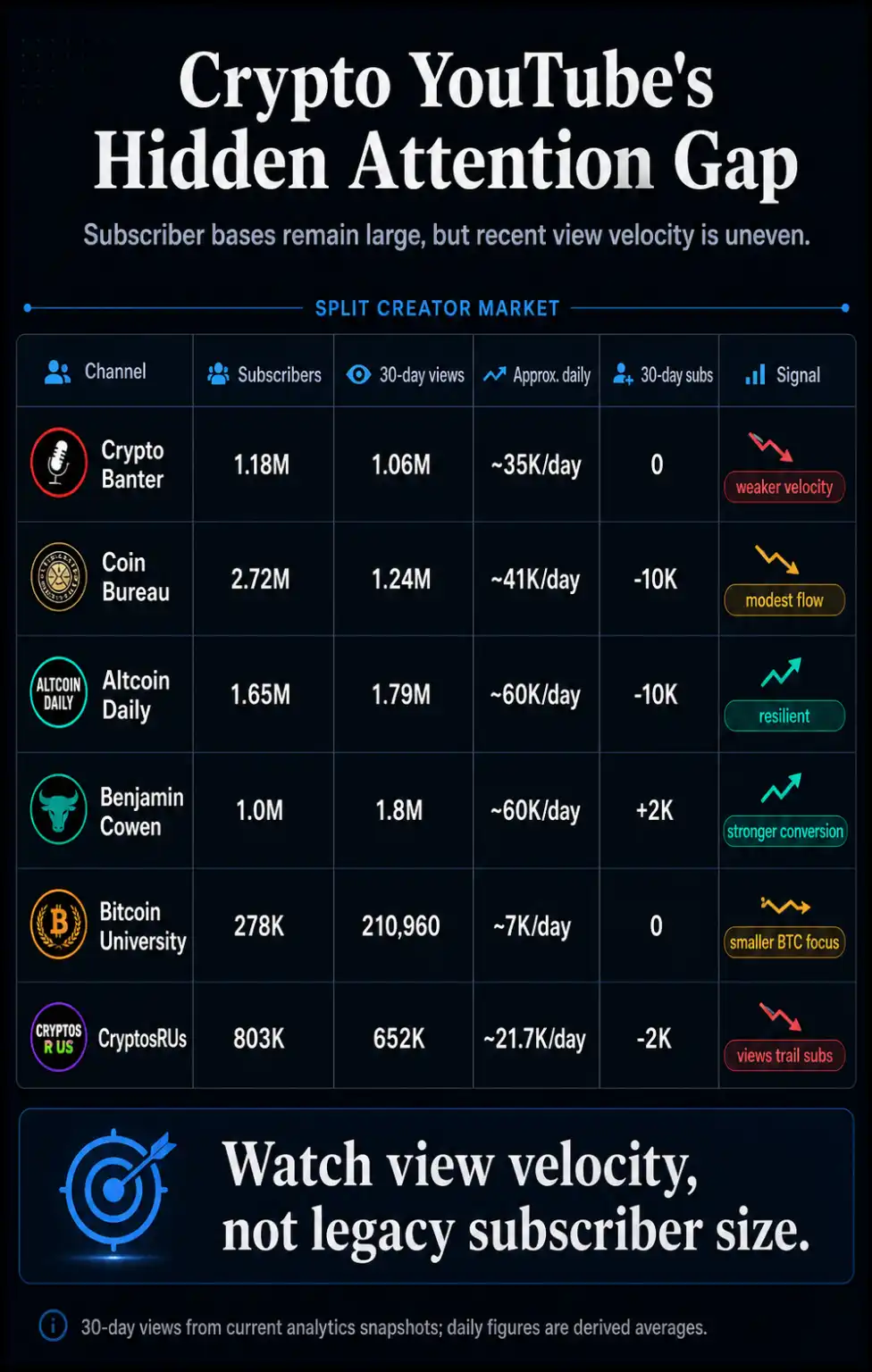
The old user base remains large. Among the biggest channels, Coin Bureau has 2.72 million subscribers, Altcoin Daily has 1.65 million, Crypto Banter has 1.18 million, and Benjamin Cowen has about 1 million.

Latest analysis shows Coin Bureau garnered 1.24 million views in the past 30 days, while Crypto Banter got 1.06 million. Altcoin Daily and Benjamin Cowen performed better, with 1.79 million and 1.8 million views in the same period respectively.

The result is a fragmented market—traditional user groups are still substantial, but current engagement is far lower and more uneven than surface data suggests.

Total subscriber count reflects past attention. Daily and monthly viewing velocity indicates whether active user interest is returning, fragmenting, or completely bypassing YouTube long-form content.
Subscriber Count Is Not the Right Metric for Performance

The core issue is that subscriber count is cumulative, reflecting past attention. Views measure current demand.

Latest data shows Coin Bureau attracted 1.24 million views in the past 30 days, Crypto Banter 1.06 million. Altcoin Daily and Benjamin Cowen performed stronger with 1.79 million and 1.8 million views respectively.

When converted to daily averages, the gap becomes more apparent. Crypto Banter's 1.06 million over 30 days equals about 35,000 daily views. Coin Bureau's 1.24 million equals about 41,000 daily. Altcoin Daily and Benjamin Cowen are near 60,000 daily.

This comparison isn't perfect because YouTube pages mix long videos, livestreams, Shorts, and channel interfaces, and the 30-day window is influenced by upload frequency.

However, comparing against January 2025 data reveals how much attention has declined.

In the sample, current 30-day views dropped by 26.9% to 78.7% compared to January 2025 levels, with Benjamin Cowen being a clear outlier, while CryptosRUs, Crypto Banter, Coin Bureau, and Bitcoin University saw drops around three-quarters.

Sampled channels still have large audiences, but active viewer numbers are lower and more discerning than subscriber totals suggest.

The January baseline makes the drop clearer: four of six channels saw view levels drop about 75% from Jan 2025, Altcoin Daily dropped 62.4%, Benjamin Cowen dropped 26.9%.

A channel may still appear large in the sidebar, but its current viewing traffic behaves like a much smaller market.

Some channels still convert attention. Altcoin Daily is a clear counterexample to the narrative of universal decline. Its current snapshot shows 1.79 million views in the past 30 days; the channel stated on X in January that it generated over 38 million YouTube views in 2025.

Its recent public YouTube videos also show stronger recent performance than several peers, with about 30k views 11 hours after upload, 55k after a day, 39k after two days.

These numbers are below 2021-style frenzy, even below viewership 18 months ago. But they show some analytical channels can still convert audience into current views. The creator market is more selective, attention concentrated on fewer channels and formats.

The resulting picture is one of uneven retail attention, not uniform disappearance.

The 2021 Comparison Still Haunts the Market

Cowen's own public statements sharpen this tension. In May, he wrote on X that crypto YouTube channels averaged 3-4 million daily views in 2021; 2026 levels are nearly an order of magnitude lower. He linked this decline to significantly weaker retail interest.

Current channel comparisons are based on vidIQ and public YouTube pages. But Cowen's comment captures the sentiment behind the data: crypto has professionalized via ETFs, public company financial strategies, and policy battles, while the creator layer targeting retail looks far less potent than in the last full retail cycle.

Similar pressures are visible beyond YouTube. CryptoSlate recently reported users on X are blocking crypto content as Bitcoin tries pulling retail attention back to the market. Social fatigue on X is a separate signal, but both channels now point to the same tension: crypto can retain financial importance while everyday users grow more selective about how much crypto content they want in their feeds.

This fragmentation matters more with Bitcoin dominating the market at about 57.8%, trading near $59,276, still over 50% below its Oct 6, 2025 all-time high of $126,000. Even as retail-facing attention looks more scattered, the market remains large, liquid, and relevant at the institutional level.

In prior cycles, long-form YouTube, X topics, exchange apps, search trends, and price momentum often reinforced each other. A viral video could drive new users to search a coin. A price breakout could bring viewers back to influencers. A token narrative could become a full-feed event.

The current setup looks less automatic. Bitcoin can trade as a macro and ETF-linked asset while altcoin and influencer attention focuses on smaller groups. This is a different type of cycle.

Crypto Banter Highlights Measurement Caveats

Crypto Banter exemplifies both the trend in available evidence and its limits. Its current viewing velocity is far lower than its subscriber count suggests, and historical Social Blade comparison data is less reliable as the page is blocked during normal visits.

This limits precise portrayal of earlier monthly viewing peaks. Current numbers remain meaningful.

VidIQ data shows the channel has 1.18 million subscribers, 190.98 million total views, ~$5,460 monthly AdSense revenue, no subscriber growth in the last 30 days, and 1.06 million views. Current growth velocity is far lower than its subscriber count might lead a casual reader to expect.

Discussions around crypto highlight broader measurement issues. A channel can maintain brand recognition and subscriber scale even as current focus shifts. If the next retail impulse is real, it should show up first at the current engagement layer before subscriber totals reflect it.

The next test is whether viewing volume for these channels recovers before other retail channels come alive. If 30-day view counts rise sharply while subscriber counts barely move, it would signal dormant audiences re-engaging.

If daily upload performance across multiple channels improves simultaneously, it would indicate broadening retail curiosity, not concentration on a few resilient creators. If the opposite occurs, long-form YouTube may be a lagging signal in the next retail cycle.

Exchanges, token teams, media brands, and analysis platforms still rely on retail attention flowing through channels users trust enough to visit repeatedly. A market driven primarily by ETFs, public company balance sheets, and policy headlines can push up Bitcoin without necessarily recreating the same retail media cycles that defined 2017 or 2021.

For now, evidence points to a milder conclusion. Crypto YouTube still has a large audience and some resilient channels. But the true retail attention signal is hidden in current viewing velocity, not legacy audience size.

The next cycle may begin when monthly and daily view counts start growing while subscriber numbers do not.


İlgili Sorular

QWhat is the main trend observed regarding the viewership of major cryptocurrency YouTube channels?

AThe monthly view counts of six top crypto YouTube channels have fallen dramatically by 27% to 79% compared to January 2025, with four experiencing declines around 75%. This indicates a collective retreat of retail investor attention from long-form content.

QWhy does the article suggest that subscriber count is an inadequate metric for measuring a channel's current success?

ASubscriber count is a cumulative metric reflecting past interest, while view count measures current demand. Data shows current monthly views are far lower than what the large subscriber bases would suggest, revealing a smaller and more selective active audience.

QWhich channel is highlighted as an exception to the sharp decline in viewership, and what evidence is provided?

ABenjamin Cowen is highlighted as an exception, with a 30-day view count decline of only 26.9% compared to January 2025. His channel's recent performance is notably stronger than most peers in the sample.

QAccording to the article, what is a potential leading indicator for the next retail cryptocurrency cycle?

AA potential leading indicator is an increase in the daily and monthly view speeds (watch velocity) on crypto YouTube channels, which would signal the re-engagement of a dormant audience, likely before any significant change in total subscriber counts.

QHow does the current market dynamic differ from previous crypto cycles according to the analysis?

AUnlike previous cycles where price action, social media buzz, and influencer content reinforced each other, the current market can be driven by institutional factors like Bitcoin ETFs and corporate strategies without a corresponding surge in broad-based retail attention on platforms like YouTube, creating a more fragmented and selective landscape.

İlgili Okumalar

A Former ByteDance Employee's Account: How I Started with Two Pinduoduo Hard Drives and Made a 600% Profit with Seagate to Achieve Financial Freedom?

Summary: A former ByteDance employee describes how a personal observation led to a highly profitable investment in Seagate Technology ($STX). Needing hard drives for a personal data project in August, he noticed their prices on Pinduoduo were rising consistently. Investigating further using price-tracking tools, he confirmed a broader, sustained price increase for high-capacity HDDs. He traced this to surging AI demand, as data centers require massive, cost-effective storage for model training and data, favoring high-capacity enterprise HDDs like those from Seagate. This demand was squeezing consumer supply. After initial research and a small purchase, he waited for confirmation from institutional 13F filings. Seeing a clear multi-quarter trend of increasing institutional ownership in Seagate, he significantly increased his position. From an entry around $150, Seagate's stock price rose over sixfold to approximately $965. He attributes the success to a methodology of identifying anomalies in everyday life (e.g., product shortages/price hikes), researching the underlying structural cause, identifying the publicly-traded beneficiary, and using 13F data to confirm institutional interest over multiple quarters. He cautions that this was one successful case among others that failed and is not offering investment advice.

链捕手16 dk önce

A Former ByteDance Employee's Account: How I Started with Two Pinduoduo Hard Drives and Made a 600% Profit with Seagate to Achieve Financial Freedom?

链捕手16 dk önce

BTC Hits Its Lowest Point Since 2024, But Is It Still Not the Right Time to Buy the Dip?

**Summary:** Bitcoin (BTC) has plunged to new lows in 2024, dropping over 50% from its all-time high to around $57,800, while Ethereum and Solana also show significant weakness. The market sentiment is at "extreme fear." The primary headwinds are identified as massive and sustained net outflows from US spot Bitcoin ETFs since May 2026, creating significant selling pressure, and the evaporation of expectations for a US Federal Reserve interest rate cut in 2026, which makes holding cash and bonds more attractive than risk assets like crypto. Analysts are actively debating the potential bottom. Key predictions include: * **glassnode's Rafael:** Suggests a bottom between $46,000 and $54,000, based on on-chain metrics like Realized Price and CVDD. He notes that institutional demand (via ETFs) is currently a net seller, not a buyer. * **BIT Analysis:** Argues the bear market is in its final stage, with a potential bottoming zone between $50,000 and $55,000, possibly aligning with the 2026 FIFA World Cup period (June-July). * **Wintermute:** Believes the market is in the late stages of a bear market but cautions the true bottom may not arrive until September-October 2026, contingent on renewed capital inflows. * **Liquid Capital's JackYi:** Posits that July-August 2026 could be the final capitulation and the best accumulation window, with potential bottom prices ranging from $51,000 to $43,000. * **Jiang Zhuo'er (BTC.TOP):** Predicts a bottom between $42,000 and $44,000 in October-December 2026, based on cycle analysis and MSTR's mNAV metric. * **Prediction Markets:** Polymarket data indicates a 79% chance BTC falls below $55,000 in 2026, a 65% chance below $50,000, and a 30% chance below $40,000. The consensus is that while bearish conditions are severe, the exact timing and price level of the ultimate bottom remain uncertain and depend on factors like ETF flows, macroeconomic policy, and potential market shocks.

Foresight News17 dk önce

BTC Hits Its Lowest Point Since 2024, But Is It Still Not the Right Time to Buy the Dip?

Foresight News17 dk önce

Confirmed: Claude Code Secretly Inspects Users, Time Zone and Chinese AI Labs Are Key Factors

Today was a significant day for Anthropic. The company announced the launch of Claude Sonnet 5, described as its most agentic model yet, and separately confirmed that the U.S. Department of Commerce has lifted export controls on its Claude Fable 5 and Mythos 5 models, allowing their distribution to resume. However, a separate controversy has emerged regarding its coding assistant, Claude Code. Developers have exposed that certain versions of the tool allegedly contain hidden code designed to detect specific user data. This code reportedly checks for the use of Chinese time zones (like Asia/Shanghai), the presence of custom API proxy URLs, and connections to domains associated with Chinese tech companies and AI labs. If triggered, this information is said to be encoded into the system prompt sent to the AI cloud, using subtle, nearly indistinguishable variations in characters (like different Unicode apostrophes in the "Today's date" line) as a form of steganography. The core issue is the covert nature of this data collection. While telemetry for security and abuse prevention is common, implementing it through hidden channels within the prompt—without user awareness or documented disclosure—fundamentally breaches trust. This is particularly sensitive for a coding assistant that operates with access to source code and system commands. Following the exposure, an Anthropic engineer acknowledged the code's existence and stated it would be removed in an upcoming release. The incident raises serious questions about transparency and the boundaries of data collection in AI developer tools.

marsbit2 saat önce

Confirmed: Claude Code Secretly Inspects Users, Time Zone and Chinese AI Labs Are Key Factors

marsbit2 saat önce

İşlemler

Spot
活动图片