The Largest Upgrade Since The Merge? How Glamsterdam Will Affect Ethereum and Regular Users?

marsbit2026-07-01 tarihinde yayınlandı2026-07-01 tarihinde güncellendi

Özet

The upcoming Glamsterdam upgrade, scheduled for late 2026, is considered Ethereum's most significant change since The Merge. It focuses on fundamentally restructuring Ethereum's block production, transaction execution, and gas pricing to enable major scalability improvements while preserving decentralization. The upgrade centers on three key innovations: * **Enshrined PBS (ePBS)**: Moves the Proposer-Builder Separation mechanism into the protocol's core, eliminating reliance on external relays. This reorganizes the block pipeline, extending the time window for processing execution payloads, which is crucial for safely increasing block capacity. * **Block-Level Access Lists (BALs)**: Attaches a "map" to each block, declaring in advance which state data its transactions will access. This enables potential parallel transaction processing and faster node synchronization, breaking a key performance bottleneck. * **Gas Repricing**: Introduces a more accurate resource pricing model by separating computation costs from state storage costs. This discourages uncontrolled state growth by making operations that create permanent data (like new accounts) more accurately reflect their long-term network burden. Together, these changes aim to solve the core challenges of increasing Ethereum's throughput (e.g., raising the Gas Limit) without overburdening node hardware or increasing centralization risks. They prepare the infrastructure for higher capacity, targeting a credible post-up...

Author: imToken

Ethereum's next major upgrade has entered its final sprint.

According to the current official Ethereum roadmap, the Glamsterdam upgrade is planned to officially launch on the mainnet in the second half of 2026. As of the end of June, it has also entered the final testing phase on the developer network. Testing is continuously underway on the multi-client development network, focusing on core features such as enshrined PBS, block-level access lists, and Gas repricing. However, the specific activation time has not been finalized.

Meanwhile, on major social media platforms, the most talked-about aspect is undoubtedly the performance narrative of "mainnet reaching 10,000 TPS" after the upgrade. But beyond that, this upgrade fundamentally reconstructs Ethereum's block production pipeline and execution engine. Its depth of changes and wide-reaching impact have led the developer community to widely acclaim it as "the largest-scale upgrade since The Merge."
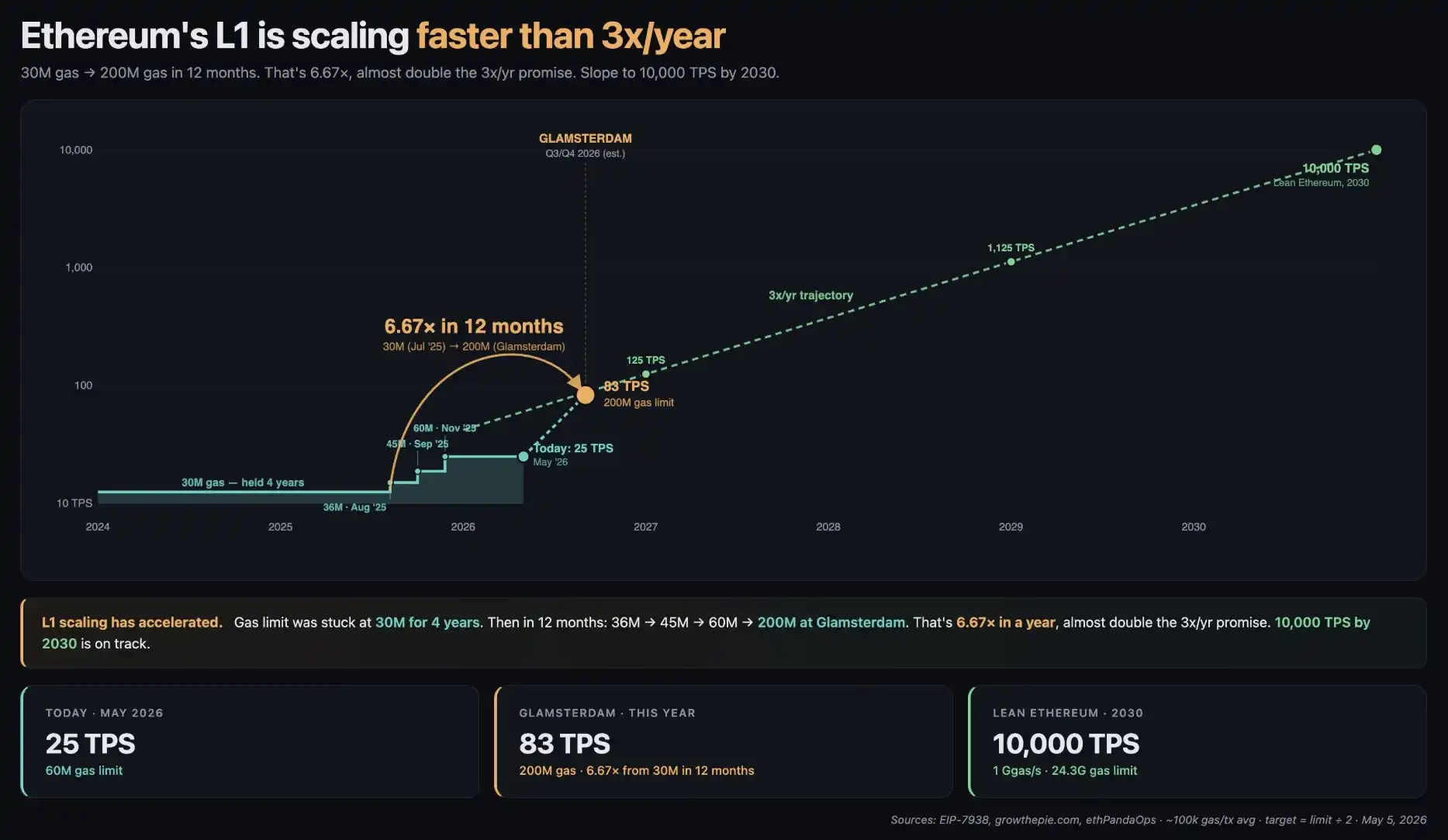
So, what exactly does this cool-sounding "Glamsterdam" (a combination of the consensus layer upgrade Gloas and the execution layer upgrade Amsterdam) change? How will it address past pain points, and what disruptive changes will it bring to our daily on-chain experience?

I. Why is it the "Largest-Scale Upgrade Since The Merge"?

If previous upgrades like Dencun and Fusaka primarily paved the way for L2 data availability (Blob), then Glamsterdam shifts the focus back to L1, initiating a major overhaul of L1 performance and architecture.

This is also the underlying reality of Ethereum's current "make L1 great again" ethos: how to allow L1 to handle more transactions without simultaneously increasing the cost of running nodes and the risk of network centralization.

However, for ordinary users, Ethereum upgrades are often simplified into one most intuitive question: Will Gas become cheaper? Will throughput increase? To be honest, the upcoming Glamsterdam is difficult to summarize simply with "fee reduction" or "scaling."

Overall, this upgrade involves multiple key aspects of Ethereum's underlying layer, including who builds blocks, how transactions are executed, how nodes read and synchronize state, and how much Gas different on-chain operations should pay. It essentially aims to redesign the fundamental paradigm for how Ethereum produces and processes blocks. According to the currently disclosed technical details, the most noteworthy core changes are mainly in three areas:

  • Enshrined PBS (ePBS): Restructures the relationship between block proposers and builders, eliminating reliance on external relays;
  • Block-Level Access Lists (BALs): Maps out transaction execution paths in advance, paving the way for parallel processing and faster node synchronization;
  • Gas Repricing: Introduces a more precise resource pricing model to control state bloat in high-throughput environments;
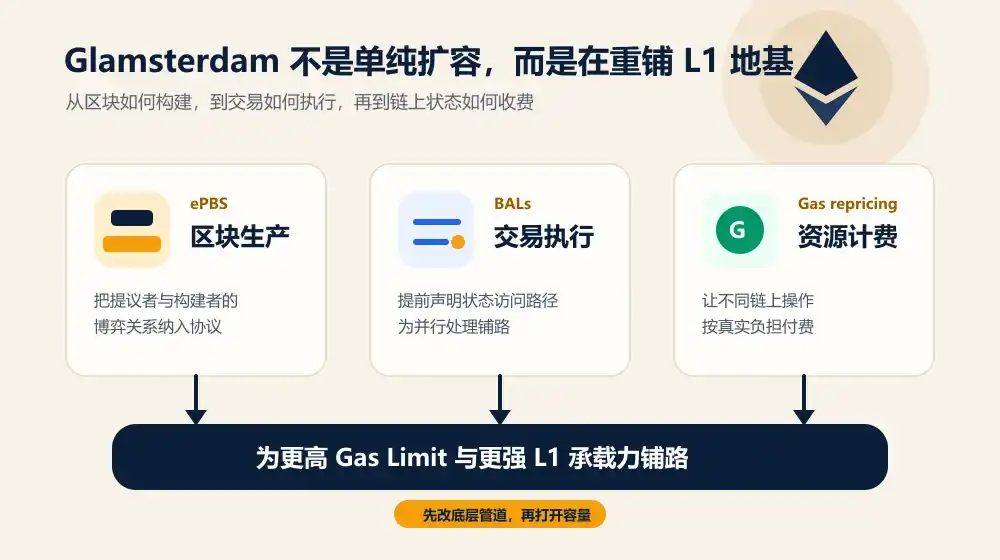
First, to understand enshrined PBS, one needs to know that blocks on Ethereum are not necessarily submitted by the Proposer themselves. Especially under the current MEV-Boost architecture, most Proposers outsource the work of collecting transactions, ordering them, and seeking MEV opportunities to professional Block Builders. The Proposer is primarily responsible for choosing the highest-bidding candidate block from several options and submitting it to the network.

This division of labor, where "Builder assembles, Proposer submits," is PBS (Proposer-Builder Separation).

The problem, however, is that this mechanism is not fully encoded into Ethereum's underlying protocol—Proposers and Builders must rely on off-protocol third-party software and MEV-Boost Relay services to complete block bidding, content delivery, and payment.

This means Relays must ensure Builders ultimately disclose the full block while also preventing Proposers from "stealing" block content in advance and refusing payment. Therefore, Relays act as fragile and centralized "trusted middlemen."

The ePBS (Enshrined PBS) proposed by EIP-7732 aims to solve this pain point by incorporating this博弈关系 directly into Ethereum's consensus protocol itself. It eliminates third-party relays, making Builders protocol-native participants. Builders first submit a block commitment and bid, the protocol automatically locks the corresponding payment, and a dedicated "Payload Timeliness Committee" judges whether the Builder timely disclosed the execution payload.

This decouples part of the processing of the consensus block and the execution payload, extending the propagation and processing window for the execution payload from about 2 seconds to approximately 9 seconds. These few extra seconds, while seemingly small, are crucial for Ethereum scaling—it means nodes have more time to receive and process larger blocks and more Blob data, thereby creating room for further increasing the Gas Limit.

Secondly, another core breakthrough of Glamsterdam on the execution layer is the Block-Level Access Lists (BALs) proposed by EIP-7928.

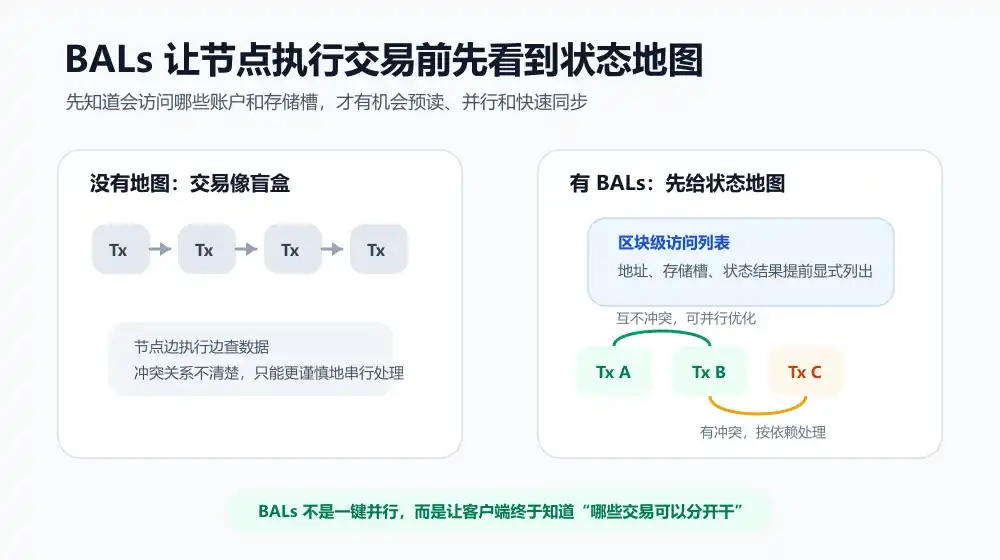
As is well known, currently, Ethereum nodes cannot directly learn from a block which accounts each transaction will read, which contract storage it will access, or which states it will modify before receiving it. Instead, they typically discover these data dependencies gradually during transaction execution.

This is like entering a large warehouse to pick goods without a complete inventory list. Workers must search and process simultaneously, so to avoid two people modifying the same batch of inventory, much of the work must be done strictly in a fixed order (single-threaded serial execution).

Block-Level Access Lists (BALs) act as a complete "state access map" attached to each block. They declare in the block header in advance which addresses and Storage Slots the set of transactions within that block will touch, as well as the state results after transaction execution. With this map, nodes can judge at a glance which transactions will access the same data and which are independent before execution:

For the independent parts, nodes can pre-fetch relevant state data from the hard drive and process transaction validation and state root calculation in parallel for some transactions, instead of cramming all work into a strictly serial queue. Additionally, since BALs also record state changes after transaction completion, some nodes can use these results for state reconstruction during network synchronization and catch-up, without having to execute every single transaction in the block from scratch in all scenarios (the author's personal understanding leans towards a sharding-like concept), potentially moving Ethereum towards a more parallel execution blockchain.

Therefore, in the long run, this is also a key underlying element for Ethereum's mainnet to break through its performance ceiling.
Finally, there is Gas repricing, which fundamentally recalibrates the Gas pricing for various on-chain operations through economic levers.

The reason is that the current Gas cost on Ethereum does not fully match the actual resource consumption borne by nodes. For example, a purely complex computation typically doesn't leave a long-term burden on nodes after execution. However, creating a new account, deploying a smart contract, or writing to a new storage slot generates data that needs to be permanently stored by all full nodes globally.

In the past, the fees for these state-creating actions did not fully reflect the permanent storage costs they incur (state explosion). If Ethereum maintained its original pricing after increasing the Gas Limit, more block space could rapidly transform into uncontrollable state data, eventually overwhelming node hardware.

EIP-8037, which has been confirmed for inclusion in Glamsterdam, aims to completely restructure these rules. This includes separating computation and state accounting, recalculating costs based on the volume of new state data added, distinguishing between general computation Gas and state Gas. It also controls state explosion, meaning operations that create many new accounts, deploy large redundant contracts, or frequently write new state may see increased costs. Conversely, applications primarily consuming immediate computational resources without persistently increasing state will have a more attractive fee structure.

Ultimately, the Gas reform in Glamsterdam cannot be simplistically understood as a "comprehensive fee reduction." Instead, it clarifies how much immediate computational resource a transaction consumes and what long-term storage burden it leaves on the network, then makes different operations pay in a way closer to their true physical cost.

Overall, these three parts, while seemingly independent, jointly point toward the same ultimate goal: to renovate the underlying core infrastructure in advance for Ethereum's mainnet to further and significantly increase Gas Limit and processing capacity.

II. Why Not Just Make Blocks Bigger?

Many might wonder: since it's slow and expensive, why not just increase the Gas Limit and double the block capacity directly?

This is a frequently asked question. In theory, the most direct way to increase mainnet capacity is indeed to raise the maximum Gas allowed per block. A higher Gas Limit means more transactions and computations can fit into one block.

However, the Gas Limit is not a number that can be increased indefinitely. Blindly enlarging blocks triggers a domino effect: nodes need to receive more data, execute more transactions, and calculate new state within the same timeframe. If processing speed can't keep up, nodes with weaker configurations are more likely to fall behind, block propagation and validation may experience delays, ultimately increasing the risk of network forks and centralization.

Meanwhile, more transactions also mean more accounts, contracts, and storage data permanently written into Ethereum's database. This data doesn't automatically disappear after transactions end but accumulates in Ethereum's state database, leading to faster state bloat.

Therefore, Ethereum scaling is not a simple math problem; it needs to solve three problems simultaneously:

  • First, how to give nodes more time to propagate and process larger blocks;
  • Second, how to reduce performance bottlenecks caused by sequential transaction execution;
  • Finally, how to prevent more block space from rapidly transforming into uncontrollable state bloat;

This is the core logic of Glamsterdam. Instead of blindly scaling first and forcing nodes to bear the brunt, it first restructures the methods of block production, transaction execution, and resource pricing, clearing the underlying pipeline, then naturally opens the door for increasing mainnet capacity.

Specifically, ePBS reorganizes the block processing flow within a slot, giving nodes more time to propagate and validate larger blocks; BALs improve client efficiency in reading, executing, and synchronizing by explicitly providing state access relationships; Gas repricing is responsible for limiting unsustainable state growth.

During the collaborative Glamsterdam test in April 2026, core developers conducted focused stress tests around multi-client implementations and explicitly set the technical goal of a credible capacity lower bound of 200 million Gas after the upgrade. Supporting this target is the combined underlying foundation provided by ePBS, BALs, and state Gas repricing.

Of course, 200 million Gas is closer to the system's carrying capacity post-upgrade and the direction for future evolution. It does not mean the mainnet will immediately jump its Gas Limit to this level on the day Glamsterdam activates.

What's truly important is that Ethereum is shifting from past "cautious, tentative scaling" toward "preparing in advance for more substantial mainnet scaling through underlying structural reconstruction."

III. How Will Ordinary Users and the Ethereum Ecosystem Be Affected?

From an ordinary user's perspective, the most relevant question regarding the Glamsterdam upgrade is still whether transaction fees will decrease.

Overall, the answer leans more towards likely decreasing and becoming more stable, rather than all transactions instantly becoming cheaper.

Since ePBS and block-level access lists create conditions for a higher Gas Limit, it's foreseeable that the number of transactions each block can accommodate will definitely increase. If on-chain demand remains constant, the increased supply of block space naturally helps alleviate congestion and reduces the probability of sudden Base Fee spikes.

However, for individual transactions, the impact may vary depending on the operation. For example, simple ETH transfers may benefit from base Gas optimizations; and since BALs provide state paths in advance, wallet accuracy in estimating Gas fees will significantly improve. The糟糕体验 of past failed transactions due to inaccurate wallet Gas estimates during market volatility—yet still paying fees—will become history.

On the other hand, operations like deploying contracts, batch-creating accounts, or writing large amounts of new state may see increased costs due to state repricing. Therefore, Glamsterdam is more likely to result in decreased costs for simple transactions, more stable fees during congested periods, while state-intensive applications start paying a more accurate price for the long-term network resources they occupy.
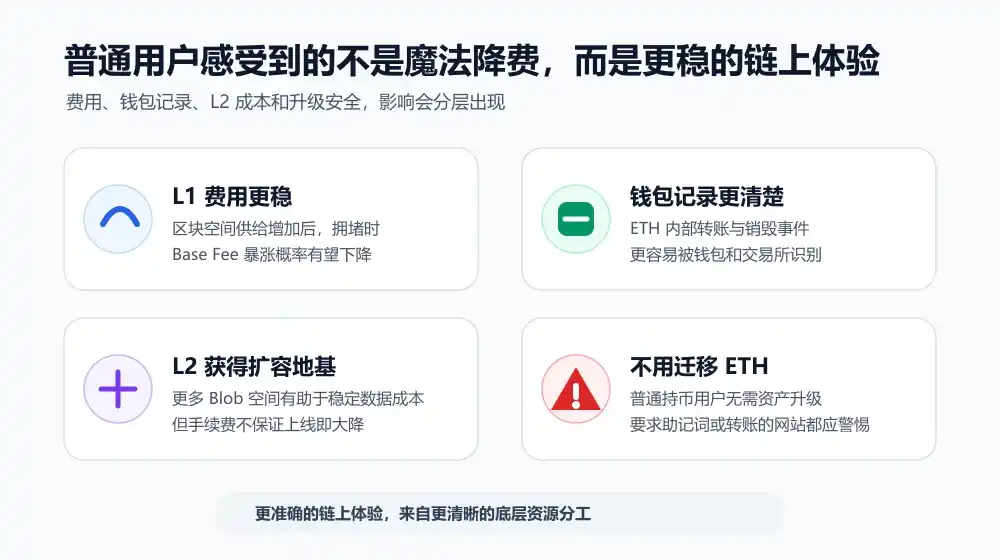
For users primarily using L2s, this upgrade is not irrelevant. By extending the data propagation window for execution payloads from about 2 seconds to about 9 seconds, ePBS can not only support larger mainnet blocks but also leaves more room for Ethereum to handle more Blob data. After Blob capacity continues to expand, Rollups will have more space to submit transaction data, which in the long run helps stabilize L2 data costs.

Furthermore, for wallets, exchanges, and cross-chain bridges, a more user-perceivable change might come from EIP-7708. Currently, ERC-20 token transfers typically generate standardized Transfer logs. However, some native ETH transfers between smart contracts do not leave equally clear event logs. Wallets and trading platforms often need to rely on additional internal transaction tracing tools to identify these ETH flows.

EIP-7708 requires non-zero ETH transfers and ETH destruction operations to generate standard logs, allowing wallets, exchanges, and cross-chain bridges to more reliably identify deposits, withdrawals, and internal ETH movements within contracts. In the future, users' ETH asset records may become more complete, and some internal transfers that previously required complex transaction tracing to display might be more easily recognized directly by wallets.

For node operators and stakers, the impact is more direct. Glamsterdam changes both execution and consensus layer block processing methods, so nodes and validators need to upgrade to client versions supporting Glamsterdam before mainnet activation. Ordinary token holders do not need to migrate ETH or perform any so-called "asset upgrades" or "token swaps."

Looking further ahead, what Glamsterdam truly affects is how Ethereum rebalances scaling and decentralization. After all, once block capacity increases, if the hardware cost required to run a node rises significantly in tandem, while mainnet throughput increases, the network may become increasingly reliant on large institutions.

The combination of ePBS, block-level access lists, and state Gas repricing attempts to form another scaling path: not simply demanding nodes handle more work in the same timeframe, but reorganizing the block production flow, providing transaction dependency information in advance, and charging different resources according to their actual burden.

This is also the most fundamental difference between Glamsterdam and a simple Gas Limit increase. It does not attempt to solve all of Ethereum's problems with a single EIP but simultaneously reforms three interrelated mechanisms: block production, transaction execution, and state growth.

In Conclusion

In the long term, what Glamsterdam profoundly influences is the narrative direction of how Ethereum rebalances between "high-performance scaling" and "absolute decentralization."

This is also the初心 or inertia of Ethereum that we are becoming increasingly familiar with—facing the步步紧逼 of high-performance monolithic blockchains, it chooses not to take the简单粗暴 route of raising hardware requirements. Instead, it selects a path that strives to maintain its decentralized底色, offering greater underlying resilience. Just like this time, through the combination拳 of rewriting the block pipeline (ePBS), explicitly providing transaction dependencies in advance (BALs), and making different resources pay precisely according to their physical burden (Gas repricing), it is still to carve out greater mainnet capacity while ensuring ordinary people can run nodes and participate in validation.

From this perspective, every划算 Gas fee we pay in the future, the more accurate and clear internal ETH statements in our wallets, and the broader space for fee reductions on L2s may all deeply benefit from the foundation that Glamsterdam lays for Ethereum in the second half of 2026.

Trend Kriptolar

İlgili Sorular

QWhat is Glamsterdam and why is it considered the largest Ethereum upgrade since The Merge?

AGlamsterdam is a major upcoming upgrade for Ethereum, combining the consensus layer upgrade 'Gloss' and the execution layer upgrade 'Amsterdam'. It is considered the largest since The Merge because it fundamentally restructures Ethereum's block production pipeline and execution engine. It introduces core changes like enshrined PBS (ePBS), block-level access lists (BALs), and gas repricing, which together aim to significantly enhance L1 performance and capacity while managing decentralization risks.

QHow does Enshrined PBS (ePBS) aim to improve Ethereum's scalability?

AEnshrined PBS (ePBS, introduced via EIP-7732) integrates the proposer-builder separation directly into Ethereum's consensus protocol, removing the need for external, centralized relay services. It decouples the consensus block from the execution payload, extending the processing window for execution payloads from about 2 seconds to roughly 9 seconds. This gives nodes more time to receive and process larger blocks and more blob data, which is a critical step for safely increasing the gas limit and overall network capacity.

QWhat problem do Block-Level Access Lists (BALs) solve, and what benefits do they provide?

ABlock-Level Access Lists (BALs, proposed in EIP-7928) solve the problem of nodes not knowing which accounts or storage slots a transaction will access until it is executed. BALs provide a pre-declared 'map' of all state accesses and results for the transactions in a block. This allows nodes to identify non-conflicting transactions beforehand, enabling some parallel processing and faster state synchronization. In the long term, this is a foundational step towards breaking Ethereum's performance ceiling by moving towards more parallel execution.

QWill the Glamsterdam upgrade make all Ethereum transactions cheaper for users?

ANot necessarily. While the upgrade's components (ePBS and BALs) create conditions for a higher gas limit, which could reduce congestion and base fees during peak times, the gas repricing (EIP-8037) introduces a more accurate cost model. Simple transfers may become cheaper, but operations that create significant new permanent state data (like deploying large contracts) will likely see increased costs. The overall effect is expected to be more stable fees and a pricing structure that better reflects the real resource cost of different transactions.

QWhat is the primary long-term goal of the Glamsterdam upgrade?

AThe primary long-term goal of Glamsterdam is to enable a substantial increase in Ethereum's mainnet capacity and throughput (e.g., targeting a credible capacity of 200M gas) without compromising its decentralization. It achieves this not by simply raising the gas limit, but by simultaneously redesigning core mechanisms: ePBS restructures block production timing, BALs optimizes transaction execution, and gas repricing controls unsustainable state growth. This combined approach aims to find a new balance between high performance and maintaining a decentralized network where individuals can still run nodes.

İlgili Okumalar

Circle CEO Responds to the OUSD Challenge: Stablecoin is a Winner-Takes-All Business, and We Won't Slow Down

In response to questions about the OUSD stablecoin initiative, Circle CEO Jeremy Allaire argues that the stablecoin market is a "winner-take-most" platform business driven by powerful network effects, and Circle has no plans to slow down. He outlines three key drivers behind USDC's dominant position: 1. **Protocol/Software Layer Network Effects**: The value of a stablecoin network grows as more developers and services integrate it, creating compounding utility and user preference. Circle has spent nearly a decade building this ecosystem with USDC, now accelerated by mainstream adoption and enhanced by software stacks like CCTP and Gateway for interoperability. 2. **Liquidity Network Effects**: Liquidity begets more liquidity. USDC has achieved top-tier global liquidity—ranking among the top three digital assets alongside BTC and USDT—through nearly a decade of building deep primary and secondary market access across regions and venues. 3. **Regulatory and Policy Integration**: Establishing a global stablecoin requires deep regulatory engagement, licensing, and compliance across key markets—a significant, long-term investment where Circle is a leader. Allaire cites Artemis data showing USDC facilitated 80% of all dollar stablecoin on-chain transaction volume in Q1 2026, with USDT at 20% and all others negligible. He addresses OUSD's purported advantages: "free" minting/burning is often not sustainable in practice; redistributing all revenue can starve essential infrastructure investment; and large consortium models historically struggle with inefficiency and slow execution, unlike focused strategic partnerships. He reaffirms Circle's strong ongoing partnership with Coinbase on USDC and notes Circle collaborates with dozens of other stablecoin issuers through its expanding platform (Arc, CCTP, CPN, etc.). While welcoming OUSD to the ecosystem, Allaire asserts that Circle's vast, trusted network and continued investment make USDC the foundational digital dollar infrastructure for the world.

链捕手2 saat önce

Circle CEO Responds to the OUSD Challenge: Stablecoin is a Winner-Takes-All Business, and We Won't Slow Down

链捕手2 saat önce

İşlemler

Spot

Popüler Makaleler

ETH 2.0 Nedir

ETH 2.0: Ethereum için Yeni Bir Dönem Giriş ETH 2.0, Ethereum 2.0 olarak da bilinir, Ethereum blok zincirinde önemli bir yükseltmeyi işaret eder. Bu geçiş yalnızca bir yüz değiştirme değil; ağın ölçeklenebilirliğini, güvenliğini ve sürdürülebilirliğini temelinden geliştirmeyi hedeflemektedir. Enerji yoğun Proof of Work (PoW) konsensüs mekanizmasından daha verimli olan Proof of Stake (PoS) mekanizmasına geçişle birlikte, ETH 2.0 blok zinciri ekosistemine dönüştürücü bir yaklaşım vaat etmektedir. ETH 2.0 Nedir? ETH 2.0, Ethereum'un yeteneklerini ve performansını optimize etmeye odaklanmış özel, birbirine bağlı güncellemelerin bir derlemesidir. Yenileme, mevcut Ethereum mekanizmasının karşılaştığı kritik zorlukları, özellikle işlem hızı ve ağ tıkanıklığı ile ilgili sorunları ele almak üzere tasarlanmıştır. ETH 2.0'ın Amaçları ETH 2.0'ın ana amaçları, üç temel unsuru geliştirmeye odaklanmaktadır: Ölçeklenebilirlik: Ağın saniye başına işleyebileceği işlem sayısını önemli ölçüde artırmayı hedefleyen ETH 2.0, mevcut yaklaşık 15 işlem/saniye sınırlamasını aşmayı ve potansiyel olarak binlerce işleme ulaşmayı planlamaktadır. Güvenlik: Geliştirilmiş güvenlik önlemleri, özellikle siber saldırılara karşı daha iyi direnç sağlama ve Ethereum'un merkeziyetsiz görünümünü koruma açısından ETH 2.0 için hayati öneme sahiptir. Sürdürülebilirlik: Yeni PoS mekanizması, sadece verimliliği artırmakla kalmayıp aynı zamanda enerji tüketimini de önemli ölçüde azaltma hedefiyle tasarlanmış olup, Ethereum'un operasyonel çerçevesini çevresel kaygılarla uyumlu hale getirmektedir. ETH 2.0'ın Yaratıcısı Kimdir? ETH 2.0'ın yaratılması Ethereum Vakfı'na atfedilebilir. Ethereum'un gelişimini destekleme konusunda kritik bir rol oynayan bu kar amacı gütmeyen kuruluş, dikkat çekici kurucu ortağı Vitalik Buterin tarafından yönetilmektedir. Daha ölçeklenebilir ve sürdürülebilir bir Ethereum vizyonu, bu yükseltmenin arkasındaki itici güç olmuştur ve protokolü geliştirmek için kendini adamış küresel bir geliştici ve meraklı topluluğunun katkılarını içermektedir. ETH 2.0'ın Yatırımcıları Kimlerdir? ETH 2.0 yatırımcıları ile ilgili detaylar kamuoyuna açıklanmamış olsa da, Ethereum Vakfı'nın blok zinciri ve teknoloji alanında çeşitli kuruluşlar ve bireyler tarafından desteklendiği bilinmektedir. Bu ortaklar arasında merkeziyetsiz teknolojilerin ve blok zinciri altyapısının geliştirilmesine karşılıklı ilgi duyan girişim sermayesi şirketleri, teknoloji firmaları ve hayır kurumları yer almaktadır. ETH 2.0 Nasıl Çalışır? ETH 2.0, onu öncüsünden ayıran bir dizi önemli özelliği tanıtmasıyla dikkat çekmektedir. Proof of Stake (PoS) PoS konsensüs mekanizmasına geçiş, ETH 2.0'ın en belirgin değişikliklerinden biridir. İşlem doğrulama için enerji yoğun madenciliğe dayanmak yerine, PoS kullanıcıların ağa yatırdıkları ETH miktarına göre işlemleri doğrulayıp yeni bloklar oluşturmalarına olanak tanır. Bu, enerji verimliliğinin artırılmasına yol açarak tüketimi yaklaşık %99,95 oranında azaltmakta ve Ethereum 2.0'ı önemli ölçüde daha çevre dostu bir alternatif haline getirmektedir. Shard Zincirleri Shard zincirleri, ETH 2.0'ın diğer bir kritik yeniliğidir. Bu daha küçük zincirler, ana Ethereum zinciri ile paralel olarak çalışarak birden fazla işlemin aynı anda işlenmesine olanak tanır. Bu yaklaşım, ağın genel kapasitesini artırarak Ethereum'u rahatsız eden ölçeklenebilirlik sorunlarını ele alır. Beacon Zinciri ETH 2.0'ın temelinde, ağı koordine eden ve PoS protokolünü yöneten Beacon Zinciri yer almaktadır. Bu, bir tür organizatör olarak işlev görür: doğrulayıcıları denetler, shard'ların ağa bağlı kalmasını sağlar ve blok zinciri ekosisteminin genel sağlığını izler. ETH 2.0 Zaman Çizelgesi ETH 2.0'ın yolculuğu, bu önemli yükseltmenin evrimini gösteren birkaç önemli dönüm noktası ile tanımlanmıştır: Aralık 2020: Beacon Zinciri'nin başlatılması, PoS'un tanıtımını işaret etmiş ve ETH 2.0’a geçiş için sahneyi hazırlamıştır. Eylül 2022: "The Merge" tamamlanması, Ethereum ağının başarılı bir şekilde PoW'den PoS çerçevesine geçiş yaptığı kritik bir anı temsil etmekte ve Ethereum için yeni bir dönemi müjdelemektedir. 2023: Shard zincirlerinin beklenen dağıtımı, Ethereum ağının ölçeklenebilirliğini daha da artırmayı hedeflemekte ve ETH 2.0'ı merkeziyetsiz uygulamalar ve hizmetler için sağlam bir platform haline getirmeyi pekiştirmektedir. Ana Özellikler ve Faydalar Geliştirilmiş Ölçeklenebilirlik ETH 2.0'ın en önemli avantajlarından biri, geliştirilmiş ölçeklenebilirliğidir. PoS ve shard zincirlerinin kombinasyonu, ağın kapasitesini artırarak, eski sistemle kıyaslandığında çok daha fazla işlem hacmi karşılayabilmesini sağlamaktadır. Enerji Verimliliği PoS'un uygulanması, blok zinciri teknolojisinde enerji verimliliği yönünde büyük bir adım teşkil etmektedir. Enerji tüketimini ciddi şekilde azaltarak, ETH 2.0 yalnızca işletme maliyetlerini düşürmekle kalmaz, aynı zamanda küresel sürdürülebilirlik hedefleriyle daha yakın bir uyum sağlar. Geliştirilmiş Güvenlik ETH 2.0'ın güncellenmiş mekanizmaları, ağ genelinde güvenliğin artırılmasına katkıda bulunmaktadır. PoS'un uygulanması ve shard zincirleri ile Beacon Zinciri aracılığıyla geliştirilen yenilikçi kontrol önlemleri, potansiyel tehditlere karşı daha yüksek bir koruma sağlar. Kullanıcılar için Düşük Maliyetler Ölçeklenebilirlik geliştikçe, işlem maliyetleri üzerindeki etkiler de belirgin hale gelecektir. Artan kapasite ve azalan tıkanıklığın, kullanıcılar için düşük ücretler anlamına gelmesi beklenmekte ve Ethereum'u günlük işlemler için daha erişilebilir hale getirmektedir. Sonuç ETH 2.0, Ethereum blok zinciri ekosisteminde önemli bir evrimi işaret etmektedir. Ölçeklenebilirlik, enerji tüketimi, işlem verimliliği ve genel güvenlik gibi temel sorunları ele alırken, bu güncellemenin önemi abartılamaz. Proof of Stake'e geçiş, shard zincirlerinin tanıtımı ve Beacon Zinciri'nin altyapı çalışmaları, Ethereum'un merkeziyetsiz piyasalarının artan taleplerini karşılayabileceği bir geleceği göstermektedir. Yenilik ve ilerleme ile şekillenen bir sektörde, ETH 2.0, blok zinciri teknolojisinin daha sürdürülebilir ve verimli bir dijital ekonomi için yol açmadaki yeteneklerinin bir kanıtıdır.

193 Toplam GörüntülenmeYayınlanma 2024.04.04Güncellenme 2024.12.03

ETH 2.0 Nedir

ETH 3.0 Nedir

ETH3.0 ve $eth 3.0: Ethereum'un Geleceği Üzerine Derinlemesine Bir İnceleme Giriş Hızla evrilen kripto para ve blok zinciri teknolojisi ortamında, ETH3.0, sıklıkla $eth 3.0 olarak adlandırılmakta, önemli bir ilgi ve spekülasyon konusu haline gelmiştir. Bu terim, netleştirilmesi gereken iki temel kavramı kapsamaktadır: Ethereum 3.0: Bu, mevcut Ethereum blok zincirinin yeteneklerini artırmayı hedefleyen olası bir gelecekteki güncellemeyi temsil eder, özellikle ölçeklenebilirlik ve performansı iyileştirmeye odaklanmaktadır. ETH3.0 Meme Token: Bu ayrı kripto para projesi, Ethereum blok zincirini kullanarak meme merkezli bir ekosistem oluşturmayı amaçlamakta ve kripto para topluluğu içinde etkileşimi artırmaktadır. ETH3.0'ün bu yönlerini anlamak, yalnızca kripto meraklıları için değil, aynı zamanda dijital alandaki daha geniş teknolojik trendleri gözlemleyenler için de hayati öneme sahiptir. ETH3.0 Nedir? Ethereum 3.0 Ethereum 3.0, zaten kurulmuş olan Ethereum ağına önerilen bir güncelleme olarak duyurulmaktadır; bu ağ, kuruluşundan bu yana birçok merkeziyetsiz uygulamanın (dApp'ler) ve akıllı sözleşmelerin belkemiği olmuştur. Tasarlanan iyileştirmeler, esasen ölçeklenebilirlik üzerine yoğunlaşmakta – shardlama ve sıfır bilgi kanıtları (zk-proofs) gibi ileri teknolojileri entegre etmektedir. Bu teknolojik yenilikler, saniyede eşi benzeri görülmemiş sayıda işlem (TPS) gerçekleştirmeyi kolaylaştırmayı amaçlamakta olup, muhtemelen milyonlara ulaşarak mevcut blok zinciri teknolojisinin karşılaştığı en büyük sınırlamalardan birine çözüm getirmektedir. İyileştirme yalnızca teknik değil, aynı zamanda stratejiktir; Ethereum ağını, merkeziyetsiz çözümlere olan artan talep ile belirginleşen bir geleceğe hazırlamak için tasarlanmıştır. ETH3.0 Meme Token Ethereum 3.0'ın aksine, ETH3.0 Meme Token, internet meme kültürünü kripto para dinamikleriyle birleştirerek daha hafif ve eğlenceli bir alanda hareket etmektedir. Bu proje, kullanıcıların Ethereum blok zincirinde meme alım, satım ve ticaret yapmalarına izin vererek, yaratıcılık ve ortak ilgi alanları aracılığıyla topluluk etkileşimini teşvik eden bir platform sunmaktadır. ETH3.0 Meme Token, blok zinciri teknolojisinin dijital kültürle nasıl kesişebileceğini göstererek, hem eğlenceli hem de finansal olarak sürdürülebilir kullanım senaryoları oluşturmayı hedeflemektedir. ETH3.0'un Yaratıcısı Kimdir? Ethereum 3.0 Ethereum 3.0'a yönelik girişim, esas olarak Ethereum topluluğundaki bir geliştirici ve araştırmacı konsorsiyumu tarafından yönlendirilmektedir ve bunlar arasında Justin Drake de bulunmaktadır. Ethereum'un evrimine yönelik içgörüleri ve katkılarıyla tanınan Drake, Ethereum'u “Beam Chain” olarak adlandırılan yeni bir konsensüs katmanına geçirme konusundaki tartışmalarda öne çıkan bir figür olmuştur. Geliştirmeye yönelik bu iş birliği yaklaşımı, Ethereum 3.0'ın tek bir yaratıcının ürünü olmadığını, aksine blok zinciri teknolojisini ilerletmeye odaklanmış kolektif bir dehanın tezahürü olduğunu göstermektedir. ETH3.0 Meme Token ETH3.0 Meme Token'ın yaratıcısına dair detaylar şu anda izlenemez durumdadır. Meme tokenların doğası, genellikle daha merkeziyetsiz ve topluluk odaklı bir yapıya yol açmakta olup, bu da spesifik bir atıf eksikliğini açıklayabilir. Bu durum, yeniliğin genellikle iş birliği yerine bireysel çabalardan ortaya çıktığı kripto topluluğunun genel felsefesiyle uyumludur. ETH3.0 Yatırımcıları Kimlerdir? Ethereum 3.0 Ethereum 3.0'a olan destek, esasen Ethereum Vakfı ve hevesli bir geliştirici ve yatırımcı topluluğu tarafından sağlanmaktadır. Bu temel birliktelik, yıllar süren ağ operasyonlarıyla inşa edilen güven ve itibarından yararlanarak önemli bir meşruiyet sağlamaktadır. Kripto para dünyasının hızla değişen ikliminde, topluluk desteği, gelişim ve benimsemeyi yönlendirmede kritik bir rol oynamakta ve Ethereum 3.0'ı gelecekteki blok zinciri ilerlemeleri için ciddi bir rakip haline getirmektedir. ETH3.0 Meme Token Mevcut kaynaklar, ETH3.0 Meme Token'ı destekleyen yatırım temelleri veya kuruluşları hakkında net bilgiler sağlamasa da, bu durum meme tokenlar için tipik olan finansman modelini göstermektedir; bu model genellikle tabandan destek ve topluluk katılımına dayanır. Bu tür projelerdeki yatırımcılar genellikle toplum odaklı yenilik potansiyeli ve kripto topluluğunda bulunan iş birliği ruhuyla motive olmuş bireylerden oluşmaktadır. ETH3.0 Nasıl Çalışır? Ethereum 3.0 Ethereum 3.0'ın ayırt edici özellikleri, önerilen shardlama ve zk-proof teknolojisinin uygulanmasında yatmaktadır. Shardlama, blok zincirini daha küçük, yönetilebilir parçalara veya “parçalara” ayırma yöntemidir; bu parçalar işlemleri ardışık değil, eşzamanlı olarak işleyebilir. Bu işlem yükünün merkeziyetsizliği, tıkanıklığı önlemeye yardımcı olur ve ağın yoğun yük altında bile yanıt verebilir olmasını sağlar. Sıfır bilgi kanıtı (zk-proof) teknolojisi, işleme katılan temel verileri ifşa etmeden işlem doğrulaması sağlamasıyla başka bir sofistike katman ekler. Bu yön, sadece gizliliği artırmakla kalmaz, aynı zamanda ağın genel verimliliğini de artırır. Bu güncellemeye, ağın yeteneklerini ve faydasını daha da artırarak sıfır bilgi Ethereum Sanal Makinesi (zkEVM) entegrasyonunun da eklenmesi gündeme gelmektedir. ETH3.0 Meme Token ETH3.0 Meme Token, meme kültürünün popülaritesinden yararlanarak kendini farklılaştırmaktadır. Kullanıcıların sadece eğlence için değil, aynı zamanda potansiyel ekonomik kazançlar için meme ticareti yapmalarına olanak tanıyacak bir pazar yeri oluşturur. Stake etme, likidite sağlama ve yönetim mekanizmaları gibi özelliklerin entegrasyonu sayesinde, proje topluluk etkileşimini ve katılımını teşvik eden bir ortam oluşturur. Eğlence ve ekonomik fırsatların eşsiz bir karışımını sunarak, ETH3.0 Meme Token, kripto tutkunlarından gündelik meme meraklılarına kadar çeşitli bir kitleyi çekmeyi hedeflemektedir. ETH3.0 Zaman Çizelgesi Ethereum 3.0 11 Kasım 2024: Justin Drake, ölçeklenebilirlik iyileştirmeleri etrafında şekillenen yaklaşan ETH 3.0 güncellemesine işaret ediyor. Bu duyuru, Ethereum'un gelecekteki mimarisi hakkında resmi tartışmaların başlangıcını simgeliyor. 12 Kasım 2024: Ethereum 3.0'a yönelik beklenen önerinin, Bangkok'taki Devcon'da açıklanması planlanıyor ve bu, daha geniş topluluk geri bildirimi ve gelişim için olası sonraki adımların zeminini hazırlıyor. ETH3.0 Meme Token 21 Mart 2024: ETH3.0 Meme Token, CoinMarketCap'ta resmi olarak listeleniyor, bu da kamusal kripto alanına adım atarak meme merkezli ekosisteminin görünürlüğünü artırıyor. Ana Noktalar Sonuç olarak, Ethereum 3.0, gelişmiş teknolojiler aracılığıyla ölçeklenebilirlik ve performansla ilgili sınırlamaların üstesinden gelmeye odaklanan Ethereum ağındaki önemli bir evrimi temsil etmektedir. Önerilen güncellemeleri, gelecekteki talepler ve kullanılabilirlik için proaktif bir yaklaşımı yansıtmaktadır. Öte yandan, ETH3.0 Meme Token, kripto para alanındaki topluluk odaklı kültürün özünü kapsamakta, meme kültürünü kullanarak kullanıcı yaratıcılığını ve katılımını teşvik eden etkileşimli platformlar oluşturmayı hedeflemektedir. ETH3.0 ve $eth 3.0'un farklı amaçlarının ve işlevlerinin anlaşılması, kripto alanındaki gelişmeleri takip eden herkes için hayati öneme sahiptir. Her iki girişim de benzersiz yollar çizerek, blok zinciri yeniliğinin dinamik ve çok yönlü doğasını birlikte vurgulamaktadır.

191 Toplam GörüntülenmeYayınlanma 2024.04.04Güncellenme 2024.12.03

ETH 3.0 Nedir

ETH Nasıl Satın Alınır

HTX.com’a hoş geldiniz! Ethereum (ETH) satın alma işlemlerini basit ve kullanışlı bir hâle getirdik. Adım adım açıkladığımız rehberimizi takip ederek kripto yolculuğunuza başlayın. 1. Adım: HTX Hesabınızı OluşturunHTX'te ücretsiz bir hesap açmak için e-posta adresinizi veya telefon numaranızı kullanın. Sorunsuzca kaydolun ve tüm özelliklerin kilidini açın. Hesabımı Aç2. Adım: Kripto Satın Al Bölümüne Gidin ve Ödeme Yönteminizi SeçinKredi/Banka Kartı: Visa veya Mastercard'ınızı kullanarak anında Ethereum (ETH) satın alın.Bakiye: Sorunsuz bir şekilde işlem yapmak için HTX hesap bakiyenizdeki fonları kullanın.Üçüncü Taraflar: Kullanımı kolaylaştırmak için Google Pay ve Apple Pay gibi popüler ödeme yöntemlerini ekledik.P2P: HTX'teki diğer kullanıcılarla doğrudan işlem yapın.Borsa Dışı (OTC): Yatırımcılar için kişiye özel hizmetler ve rekabetçi döviz kurları sunuyoruz.3. Adım: Ethereum (ETH) Varlıklarınızı SaklayınEthereum (ETH) satın aldıktan sonra HTX hesabınızda saklayın. Alternatif olarak, blok zinciri transferi yoluyla başka bir yere gönderebilir veya diğer kripto para birimlerini takas etmek için kullanabilirsiniz.4. Adım: Ethereum (ETH) Varlıklarınızla İşlem YapınHTX'in spot piyasasında Ethereum (ETH) ile kolayca işlemler yapın.Hesabınıza erişin, işlem çiftinizi seçin, işlemlerinizi gerçekleştirin ve gerçek zamanlı olarak izleyin. Hem yeni başlayanlar hem de deneyimli yatırımcılar için kullanıcı dostu bir deneyim sunuyoruz.

3.7k Toplam GörüntülenmeYayınlanma 2024.12.10Güncellenme 2026.06.02

ETH Nasıl Satın Alınır

Tartışmalar

HTX Topluluğuna hoş geldiniz. Burada, en son platform gelişmeleri hakkında bilgi sahibi olabilir ve profesyonel piyasa görüşlerine erişebilirsiniz. Kullanıcıların ETH (ETH) fiyatı hakkındaki görüşleri aşağıda sunulmaktadır.

活动图片