How Risky is the "Death Spiral" of MSTR and STRC?

Foresight News2026-06-05 tarihinde yayınlandı2026-06-05 tarihinde güncellendi

Özet

Summary: This article explores the perceived "death spiral" risk between MicroStrategy (MSTR), its Bitcoin holdings, and its perpetual preferred stock (STRC), drawing comparisons to the LUNA-UST collapse. While both systems feature price anchors, high yields for holders, and potential feedback loops, their core mechanisms differ fundamentally. The MSTR-STRC structure relies on continuous financing to sustain its high dividend payouts, primarily through stock ATM offerings. A negative feedback cycle could occur: falling MSTR stock price makes raising equity capital harder, increasing pressure to sell Bitcoin, which undermines STRC confidence and further depresses MSTR. However, unlike LUNA-UST's automated, direct linkage, the MSTR-STRC loop is weaker and has brakes: STRC dividends can be deferred or rates lowered, and STRC holders have a $100/share liquidation preference in bankruptcy, providing a price floor. The company's sustainability hinges on its ability to continue financing. Its current ~$900 million USD reserves cover only about 6.3 months of its ~$1.71 billion annual interest/dividend burden. The next six months are critical, aligning with both the potential bottom in Bitcoin's four-year cycle and the depletion timeline of its reserves. While a LUNA-style catastrophic collapse is deemed highly unlikely due to structural differences, the key question is whether MicroStrategy can navigate this period through healthy deleveraging to restart its capital engine.


Author: @100y_eth (Four Pillars)

Compiled by: AididiaoJP, Foresight News


MicroStrategy (MSTR) recently sold 32 bitcoins (worth only $2.5 million), which triggered a market cap evaporation of over $100 billion in Bitcoin. STRC (its perpetual preferred stock) fell from a reference price of $100 to $94, and MSTR's stock price also dropped from $150 to $123.


MSTR, BTC, and STRC are deeply intertwined. In a bullish market, this structure is a powerful capital engine, allowing Strategy (MicroStrategy) to aggressively accumulate Bitcoin; but once the market deteriorates, as it has recently, the three form a vicious cycle of mutual negative feedback.


This reminds people of the LUNA-UST incident from years past. So, is the MSTR-STRC structure truly sustainable?


Key Takeaways


UST and STRC appear similar on the surface: their prices are anchored to a specific reference value, holders can obtain high yields, and both carry death spiral risks. However, they are fundamentally different in their price stabilization mechanisms, legal recourse rights, interest/dividend payment methods, and internal operational structures.


For Strategy to maintain sustainability, it must continuously raise funds. This relies on both market confidence and its own creditworthiness. In the worst-case scenario, even if it cannot continue financing, it will not experience a direct "death spiral" like LUNA-UST.
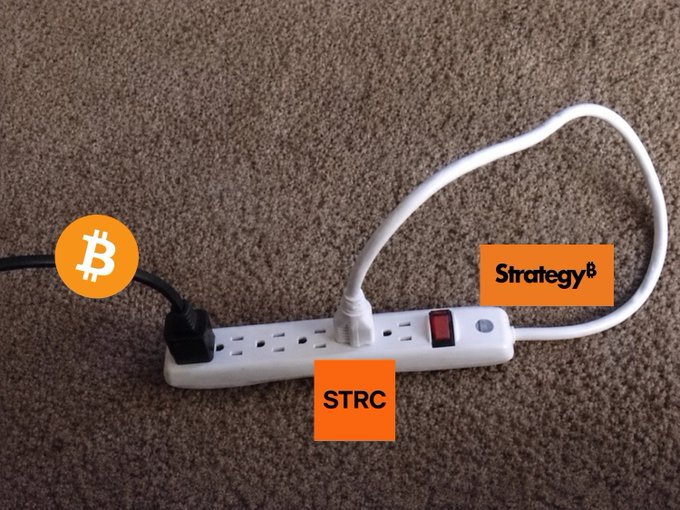


Strategy's current net leverage ratio is about 11%, with an amplification factor of approximately 42%. Even if MSTR and STRC enter a negative feedback loop, as long as the Bitcoin price remains above about $26,000, preferred shareholders still have a high probability of preserving their principal; and as long as Bitcoin does not fall below about $8,000, the probability of bankruptcy due to debt is very low.


The next six months will be a critical period. According to Bitcoin's four-year cycle theory, a bottom could be seen in the second half of this year, and Strategy's US dollar reserves are only sufficient to last about six months. The core question is: can Strategy restart its capital engine through healthy deleveraging within these six months?


LUNA-UST Quick Recap


The LUNA-UST collapse was four years ago. Let's quickly review its operating mechanism.


Price Stabilization Mechanism
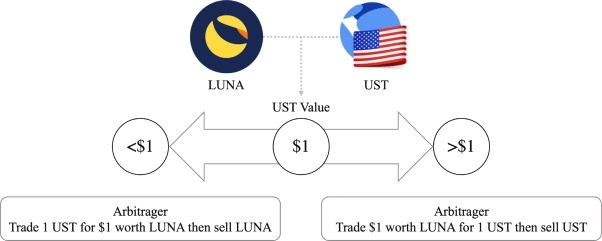


UST was an algorithmic stablecoin with no collateral, maintaining its $1 peg through an algorithm. The core rule was: 1 UST could always be exchanged for $1 worth of LUNA.


  • When UST < $1: Users could burn UST worth less than $1 to receive $1 worth of LUNA. The arbitrage opportunity pushed the UST price back up while reducing UST supply.
  • When UST > $1: Users could provide $1 worth of LUNA to receive more valuable UST. Arbitrage pushed the UST price down while increasing UST supply.


Vicious Cycle Scenario


The more UST issued, the less LUNA supply, which should have been a positive driver for LUNA's price. Terraform Labs indeed amplified this effect by aggressively expanding UST use cases.
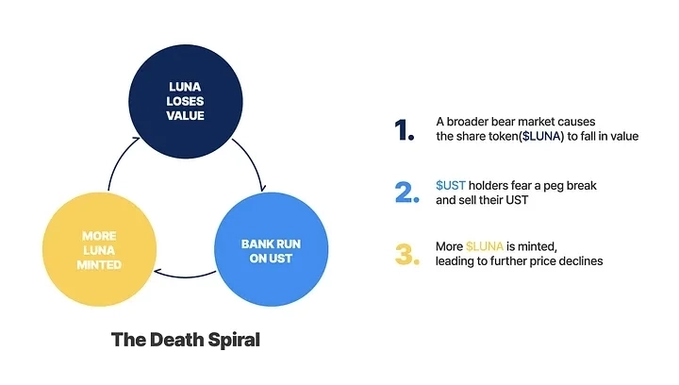


However, once confidence collapsed, the same mechanism reversed into a death spiral:


LUNA price drops → UST confidence collapses → UST price drops → LUNA massively increases supply → LUNA price drops further...


The LUNA-UST Collapse


The direct trigger for the collapse was a loss of confidence. At the time, Terraform Labs was migrating UST liquidity on Curve from the 3pool to the 4pool, thinning liquidity in the 3pool. An attacker sold $85 million worth of UST, breaking the peg and triggering panic.


A large amount of UST was withdrawn from Anchor Protocol (which offered about 20% APY for deposits), instantly overwhelming the market with selling pressure. Before the crash, 71% of UST was deposited in Anchor. When the unsustainability of the 20% yield was exposed, even a $450 million injection by the Luna Foundation Guard was powerless to stop it.
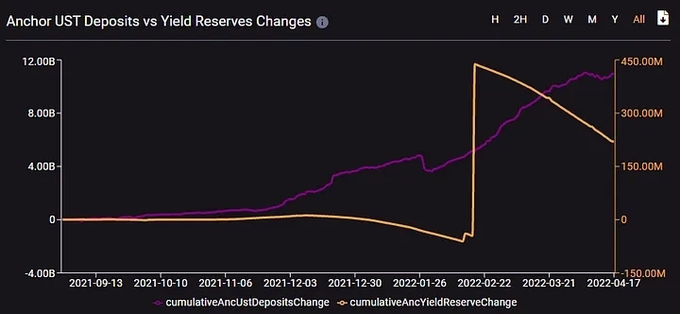


Ultimately, LUNA supply exploded from about 350 million tokens to 65 trillion tokens (a 17,000-fold increase), with its price approaching zero.


Detailed Analysis of the MSTR-STRC Structure


Strategy's core goal is to increase BPS (Bitcoin per Share). To achieve this, it raises funds through various financial engineering tools like convertible bonds, perpetual preferred stock, and ordinary share ATM offerings, then uses the raised capital to accumulate more Bitcoin.


Financing Methods


  • Ordinary Share ATM Offerings: Issuing small amounts of MSTR Class A ordinary shares for sale on the market. This causes ADSO (assuming fully diluted shares outstanding) dilution, but when mNAV > 1.22, it can actually increase BPS.
  • Convertible Bonds: Low-interest borrowing with conversion options, but carries principal repayment pressure.
  • Perpetual Preferred Stock: Dividends and liquidation priority are higher than ordinary shares but lower than creditors. No principal repayment pressure, but dividend burden is close to 10%. Current series include STRF, STRC, STRE, STRK, STRD, etc. Only STRK is convertible preferred stock; the others are non-convertible. Non-convertible preferred stock does not dilute ADSO and is Strategy's preferred financing method.


Strategy currently needs to pay about $1.712 billion in annual interest and dividends, primarily funded from its US dollar reserves, which are mainly replenished through ordinary share ATM offerings. Recently, it also paid dividends by selling 32 BTC, drawing market attention.


STRC Price Stabilization Mechanism


STRC is designed with a $100 reference price.


  • When STRC > $100: Strategy can lower the dividend rate to depress the price, or issue more STRC to increase supply. It also holds the right to redeem at $101/share, effectively capping STRC's upside.
  • When STRC < $100: Strategy can increase the dividend rate to push the price up. Simultaneously, STRC has a $100/share liquidation preference, providing price support.


Currently, STRC's annualized dividend rate is 11.50% (based on the $100 reference price).


Vicious Cycle Scenario


MSTR and STRC influence each other, forming a self-reinforcing feedback loop. A deteriorating market can lead to a vicious cycle:


MSTR price drops → mNAV decreases → Difficulty of ordinary share ATM financing increases → Pressure to sell BTC rises → STRC confidence drops → STRC price drops → MSTR price drops further...


However, the key difference is: Strategy is not obligated to pay STRC dividends in cash monthly. Cash payments require a board declaration and sufficient funds; otherwise, dividends can accumulate. Additionally, Strategy can theoretically lower the dividend rate to SOFR (Secured Overnight Financing Rate). In extreme cases, it can gradually reduce the dividend rate and defer payments until conditions improve.


LUNA-UST vs MSTR-STRC: Fundamental Differences
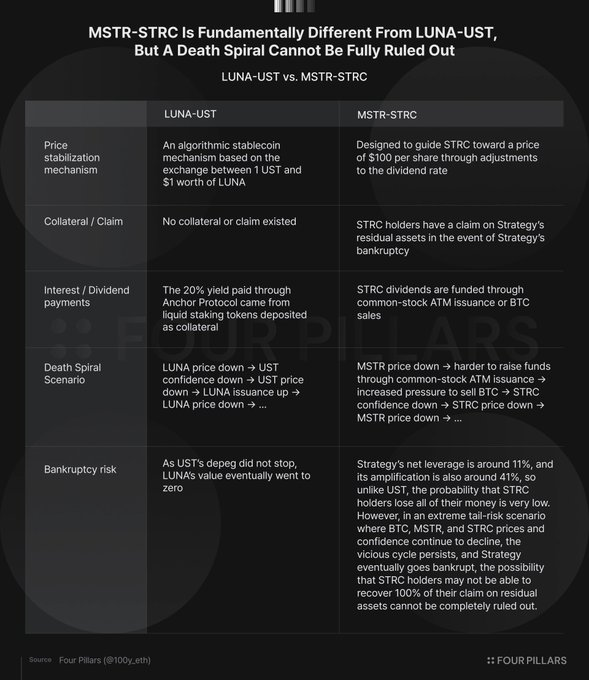


UST and STRC share three apparent similarities: price anchored to a specific level, holders can obtain high yields, and both carry death spiral risks. However, their internal operating mechanisms are entirely different.


Price Stabilization Mechanism


UST stabilized by adjusting LUNA supply; STRC stabilizes by adjusting its own dividend rate. UST's peg mechanism directly affected LUNA's price and supply, while STRC's mechanism does not directly affect MSTR's price and supply.


However, since STRC dividends are primarily funded by MSTR ATM offerings, if MSTR's value falls causing mNAV to drop below 1.22, Strategy's ability to maintain dividends would be questioned.


Collateral / Recourse Rights


UST was completely uncollateralized, and its price could go to zero; STRC, as preferred stock, is also uncollateralized, but in case of company bankruptcy, STRC holders have priority recourse rights to remaining assets (liquidation preference of $100/share).


Interest / Dividend Source
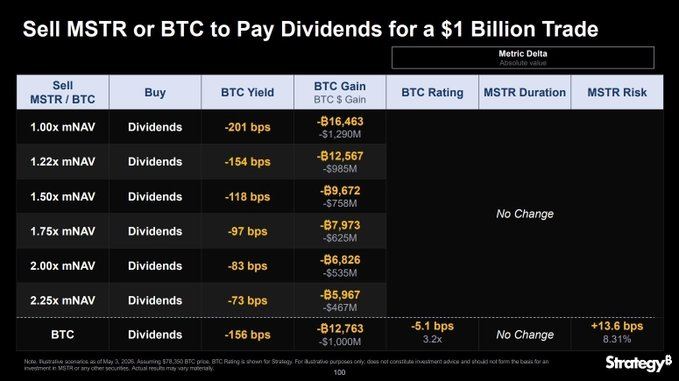


UST itself did not generate interest; the 20% yield came from Anchor Protocol's lending interest and staking rewards (natural market demand).


STRC dividends are primarily funded by ordinary share ATM offerings; in extreme cases, selling BTC is also possible. From a BPS perspective, ATM offerings are beneficial when mNAV > 1.22, while selling BTC is preferable when below 1.22. Overall, however, the "naturalness" of STRC's dividend source is weaker than Anchor's lending + staking rewards.


Death Spiral Differences


The LUNA-UST death spiral was direct and automatic: UST drop → LUNA supply increase → LUNA further drop.


The MSTR-STRC death spiral is more complex and has two major braking mechanisms: First, the direct linkage is weaker; MSTR does not automatically increase supply like a protocol to pay STRC dividends. Second, there are legal recourse rights; even in bankruptcy, STRC holders have recourse to remaining assets, providing downside price support.


The common catalyst for both remains "confidence." As long as investors maintain confidence in MSTR (or LUNA back then), the structure can operate; once confidence collapses, real problems emerge. MSTR selling 32 BTC is not a major event rationally, but emotionally, it could become the trigger for a loss of confidence.


Is the MSTR-STRC Structure Sustainable?


Sustained Fundraising Ability is Core
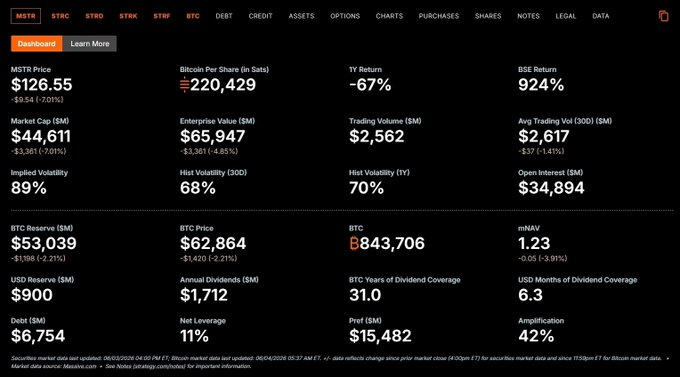


Strategy's current US dollar reserves are $900 million, with annual interest + dividend obligations of $1.712 billion. Without additional fundraising, reserves alone can sustain about 6.3 months.

If reserves are depleted, it could continue financing by issuing more shares / preferred stock, or sell BTC (theoretically sustainable for 31 years). However, the recent sale of just 32 BTC triggered a severe market reaction; the side effects of selling BTC are far greater than imagined.


Financing conditions are clear:


  • MSTR ATM offerings require mNAV > 1.22; otherwise, they reduce BPS.
  • STRC issuance requires the price to be maintained near $99-100; otherwise, financing costs become too high.


Both are highly dependent on market confidence: investors must believe in BTC's long-term appreciation and that Strategy can create value beyond simple holding. In the current market environment, raising funds through shares / preferred stock is difficult in the short term. Strategy can only rely on existing dollar reserves and wait for the market and confidence to recover.


What Happens in Bankruptcy?


Strategy's net leverage ratio is only 11% ((Debt - USD Reserves) / Bitcoin Reserves). The amplification factor including preferred stock is about 42%.


As long as the Bitcoin price does not fall below approximately $26,300 (the price corresponding to the total value of debt + preferred stock), preferred shareholders can preserve their principal through recourse to remaining assets. This is the biggest difference from LUNA-UST.


Convertible Bond Maturity Pressure
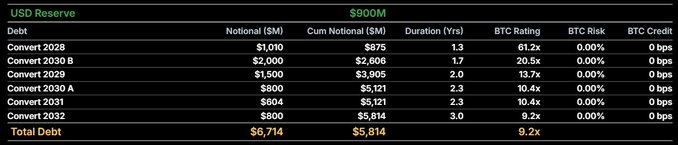


Strategy has no principal repayment obligation for perpetual preferred stock, but convertible bonds require principal repayment at maturity (current total debt $6.714 billion). Maturities begin in 2028. With current USD reserves of only $900 million, if unable to raise funds, it may need to sell BTC to repay debt. However, with a low net leverage ratio, the probability of bankruptcy due to debt is extremely low.


The Next Six Months are the Lifeline
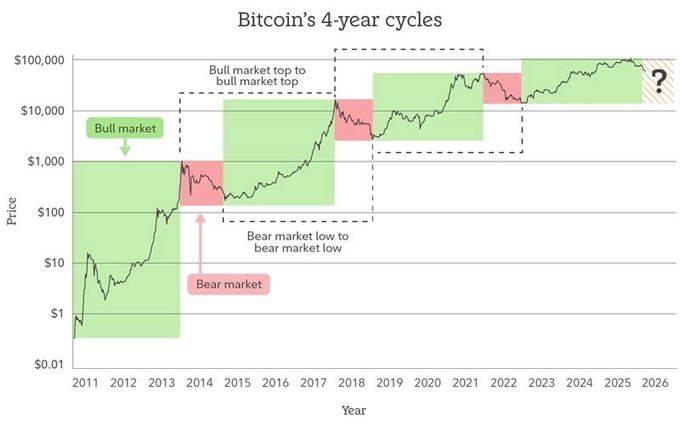


If Bitcoin's four-year cycle theory still holds, a bottom could be seen in the second half of this year, and Strategy's dollar reserves happen to be sufficient for only about six months.


Within these six months, whether Strategy can restart its capital engine through healthy deleveraging will determine its future fate.


Although the title and images are somewhat sensational, the MSTR-STRC and LUNA-UST mechanisms are fundamentally different. The probability of a similar catastrophic collapse is extremely low.


The real question is: Can Strategy survive the challenging next six months, restart its capital engine through healthy deleveraging, or will it merely become an interesting experiment in Bitcoin's history?


İlgili Sorular

QWhat is the core mechanism behind the potential negative feedback loop between MSTR, BTC, and STRC as described in the article?

AThe potential negative feedback loop is triggered when the market worsens. It starts with MSTR's stock price falling, which lowers its mNAV (market-adjusted Net Asset Value). This makes ATM (At-The-Market) equity issuance less effective or counterproductive for raising funds. This difficulty in financing increases the pressure to sell BTC to cover expenses. Selling BTC can weaken market confidence in STRC, causing its price to drop below its $100 reference. Falling STRC prices further undermine confidence in MicroStrategy's overall financial structure, putting additional downward pressure on the MSTR stock price, thus perpetuating the cycle.

QWhat are the two key 'braking mechanisms' that differentiate a potential MSTR-STRC crisis from the LUNA-UST death spiral?

AThe two key braking mechanisms are: 1) No Direct, Automatic Linkage: MSTR does not automatically issue more shares to pay STRC dividends like the LUNA protocol minted new tokens to redeem UST. Dividend payments can be deferred or the rate can be lowered. 2) Legal Recourse Rights: STRC is a corporate preferred stock. In a bankruptcy scenario, STRC holders have a legal claim on the company's remaining assets (with a $100 per share liquidation preference), providing a fundamental floor for its value, unlike UST which had zero collateral and could go to zero.

QAccording to the article, what is the most critical factor for the sustainability of MicroStrategy's capital structure?

AThe most critical factor is its ongoing ability to raise capital. The structure relies on continuous financing (via ATM equity sales, issuing new preferred shares like STRC, or convertible bonds) to cover the substantial annual interest and dividend payments (approx. $1.71 billion). This financing ability is heavily dependent on market confidence in Bitcoin's long-term appreciation and in MicroStrategy's ability to add value beyond simple holding. If this confidence erodes and financing dries up, the company must rely on its dollar reserves or sell BTC, which carries significant negative market sentiment risks.

QWhat specific condition must be met for MicroStrategy to effectively use ATM (At-The-Market) issuance of its common stock to strengthen its financial position?

AFor ATM issuance of MSTR common stock to be effective in increasing the Bitcoin-per-share (BPS) metric, the mNAV (market-adjusted Net Asset Value) must be greater than 1.22. When mNAV is above this threshold, issuing new shares at a premium to the underlying Bitcoin value actually accretes value per share. If mNAV falls below 1.22, issuing new equity would be dilutive to BPS and therefore counterproductive.

QWhy does the article identify the next six months as a critical period for MicroStrategy's strategy?

AThe next six months are critical due to a confluence of two timelines: 1) Financial Runway: MicroStrategy's current dollar reserves ($900 million) are only sufficient to cover its annual interest and dividend obligations for approximately 6.3 months without additional financing. 2) Market Cycle: The article references the Bitcoin four-year cycle theory, suggesting a potential market bottom could occur in the second half of the year. Therefore, the company must navigate this period of high financial obligation with limited reserves, aiming to 'healthily deleverage' and restart its capital engine before its reserves run out and (hopefully) as the market begins to recover.

İlgili Okumalar

Near Returns to the AI Stage: Transformation into a Public Chain Due to 'Payroll Difficulties,' Agent and Privacy Emerge as New Growth Narratives

NEAR Returns to AI Origins: From Payroll Struggles to Blockchain, Now Focusing on AI Agents and Privacy NEAR Protocol's journey began not with grand blockchain ambitions, but from a practical hurdle: its AI startup founders, including Transformer paper co-author Illia Polosukhin, couldn't efficiently pay international developers in 2017. This led them to pivot and build a high-performance, scalable blockchain. After years navigating various crypto narratives like sharding and cross-chain interoperability, NEAR is now leveraging its AI roots to re-enter the AI arena. A key driver is its "NEAR Intents" layer, which abstracts complex cross-chain transactions. Users simply state their goal (e.g., swap BTC for ETH), and a solver network finds the optimal route. This system has processed over $20B in cross-chain volume, generating significant fee revenue. A major growth area is private transactions via "Confidential Intents/Swaps," which hide trade details until settlement to protect against MEV and front-running. Remarkably, private swaps recently accounted for over 40% of NEAR's transaction volume, highlighting strong demand but also potential regulatory scrutiny. With its AI-founder pedigree, NEAR is positioning itself at the intersection of blockchain, AI agents, and privacy, aiming to become infrastructure for the emerging agent economy while navigating the challenges of its rapid adoption.

marsbit37 dk önce

Near Returns to the AI Stage: Transformation into a Public Chain Due to 'Payroll Difficulties,' Agent and Privacy Emerge as New Growth Narratives

marsbit37 dk önce

From Ethereum to AI's 'CROPS': What Exactly is This Set of 'Slow Variables' That Vitalik Repeatedly Emphasizes?

In recent discussions, Vitalik Buterin has frequently emphasized the concept of "CROPS," a framework defining core values for Ethereum's development. CROPS stands for Censorship Resistance, Capture Resistance, Open Source, Privacy, and Security. Initially outlined in the Ethereum Foundation's "EF Mandate," it represents a commitment to user sovereignty, ensuring that the network resists external control, remains open, protects privacy, and prioritizes security. The relevance of CROPS extends beyond Ethereum's foundational principles, becoming crucial in the context of AI integration. As AI agents begin handling wallet operations and automated transactions, the risk increases that users may cede control over their digital assets, privacy, and intentions to centralized AI service providers. A "CROPS AI" would therefore emphasize local execution where possible, privacy-preserving remote model calls (e.g., using zero-knowledge proofs), and transparent, verifiable processes to maintain user agency. Vitalik highlights a significant convergence between "CROPS Ethereum access layer" and "CROPS AI." Both address the same fundamental challenge: how users can access powerful services—be it blockchain data via RPCs or AI models—without exposing sensitive information or relinquishing ultimate control. This intersection points toward a future digital entry point that is more private, secure, and user-controlled. Ultimately, CROPS is not merely an abstract ideal but a practical guidepost. It steers development—from protocol resilience and wallet design to AI agent safety—towards a future where users retain self-sovereignty even as digital systems grow more complex and powerful. In an era of accelerating AI adoption, these "slow variables" of censorship resistance, openness, privacy, and security may define Ethereum's enduring value.

marsbit48 dk önce

From Ethereum to AI's 'CROPS': What Exactly is This Set of 'Slow Variables' That Vitalik Repeatedly Emphasizes?

marsbit48 dk önce

Silicon Valley 'Startup Guru' Steve Hoffman: Web3 + AI Could Be a Trap

Silicon Valley investor and "Godfather of Startups" Steve Hoffman warns that combining Web3 with AI is likely a trap, not a promising venture. In an interview, Hoffman argues that while AI is a foundational technology touching all industries, Web3 adds complexity, friction, and regulatory risk without solving mainstream consumer or business needs. He advises founders to focus on deep, specialized applications where startups can out-iterate giants, rather than on generic features easily replicated by large tech companies. Hoffman observes that Silicon Valley will lead foundational AI research, while China excels at rapid, large-scale application and commercialization, particularly in robotics. He stresses that AI-driven autonomous agents capable of collaborative, multi-step tasks are 2-4 years away, which will cause significant job displacement. The solution is not to slow AI but to redesign business models around human-AI collaboration and reform social systems like education and retraining. For startups, Hoffman recommends focusing on vertical, expertise-heavy domains to build defensibility. He sees major opportunities in AI fraud detection and cybersecurity. Key founder mindsets include systemic thinking over feature-focus, relentless customer centricity, building adaptive teams, and deeply understanding AI's capabilities and limits. Hoffman is also leading a non-profit initiative to establish university centers aimed at training future leaders in responsible, human-value-aligned AI innovation.

marsbit2 saat önce

Silicon Valley 'Startup Guru' Steve Hoffman: Web3 + AI Could Be a Trap

marsbit2 saat önce

Token Inefficient, Economy Tokenless

The article "Tokens Aren't Economical, Economics Aren't Tokenized" analyzes a pivotal shift in the AI industry from a technology-driven narrative to one dominated by capital efficiency. It highlights two concurrent trends: a severe capital shortage due to the exorbitant and recurring costs of compute (e.g., OpenAI's high burn rate) and a wave of corporate spin-offs where major tech companies are separating their AI units (like Kuaishou's Kling and Baidu's Kunlunxin). The core argument is that AI's "anti-internet" business model, where user growth increases costs rather than profits, has created a disconnect between high valuations and actual cash flow. Spin-offs address this by allowing AI assets to be valued independently. Within a parent company, they are seen as cost centers, but as standalone entities, they are priced based on their growth potential and scarcity in the primary market, leading to massive valuation premiums (e.g., Kling's estimated value tripling post-spin-off). The industry is at an inflection point, moving from "model worship" to "value realization." The competition is evolving from a pure compute (GPU) race to a broader focus on systemic efficiency and full-stack engineering (involving CPUs and orchestration) to achieve viable commercialization. The year 2026 is framed as a critical moment where the industry must definitively answer how to economically translate AI capability into tangible business value, reshaping the sector's future power structure.

marsbit2 saat önce

Token Inefficient, Economy Tokenless

marsbit2 saat önce

İşlemler

Spot
Futures
活动图片