Silk Road-linked Bitcoin wallets move $3M to new address

cointelegraph2025-12-10 tarihinde yayınlandı2025-12-10 tarihinde güncellendi

Özet

Cryptocurrency wallets associated with the defunct darknet marketplace Silk Road have transferred approximately $3.14 million in Bitcoin to a new address, marking their most significant activity in five years. The funds were moved from wallets still holding an estimated $38.4 million in BTC. This activity follows the January pardon of Silk Road founder Ross Ulbricht by former U.S. President Donald Trump. While the U.S. government previously seized billions in Bitcoin from Silk Road, industry observers believe Ulbricht may still control additional wallets containing tens of millions in unrecovered cryptocurrency.

Darknet marketplace Silk Road-linked cryptocurrency wallets are moving again, less than a year after US President Donald Trump granted its founder, Ross Ulbricht, a full pardon.

Silk Road-tagged cryptocurrency wallets awoke Tuesday to transfer approximately $3.14 million worth of Bitcoin (BTC), according to blockchain data platform Arkham.

The 176 transfers mark the wallet’s most significant activity in five years. Silk Road-related wallets executed only three small test transactions earlier this year.

The transfers were all made to an unknown cryptocurrency wallet “bc1qn.” The primary Silk Road–tagged wallets still hold about $38.4 million in Bitcoin, while the newly created address is holding only the $3.14 million received in the recent transactions.

Cointelegraph was unable to independently verify the owner of the new wallet and has reached out to Ulbricht for comment.
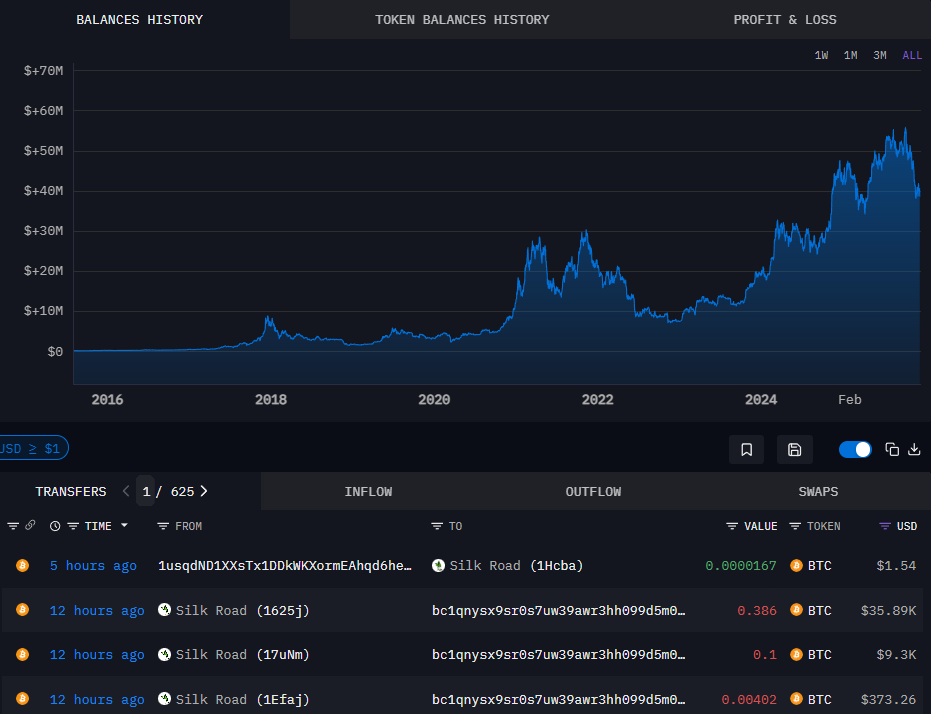
Silk Road wallets, token holdings. Source: Arkham

Related: Crypto nears its ‘Netscape moment’ as industry approaches inflection point

In January, Trump gave a full pardon to Silk Road founder Ross Ulbricht, who had been serving a double life sentence without parole.

Ulbricht was convicted in 2015 for his role in creating and operating Silk Road, a darknet marketplace that facilitated the anonymous trade of illicit goods using Bitcoin.

Source: Free_Ross

Following the pardon, supporters have contributed approximately $270,000 in Bitcoin donations to the Free Ross campaign, according to onchain data.

Related: ‘Elite’ traders hunt dopamine-seeking retail on prediction markets: 10x Research

Silk Road founder may still hold millions in unseized crypto wallets

While the US government seized at least $3.36 billion in Bitcoin from Silk Road, some industry watchers claim that Ross had multiple other Bitcoin wallets that weren’t discovered during the asset seizure.

Coinbase exchange director Conor Grogan revealed that 430 BTC, worth about $47 million, remains untouched in wallets likely linked to Ulbricht, which have been dormant for over 13 years.
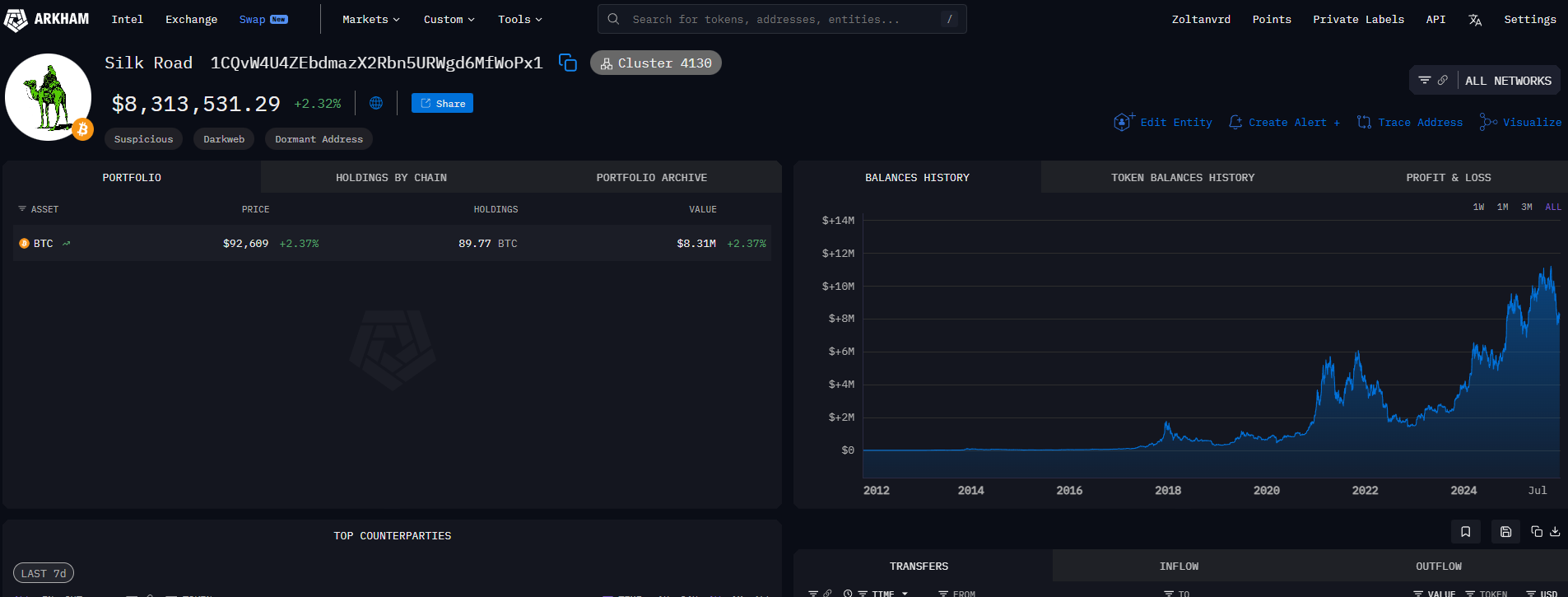
Silk Road wallet “1cqvW,” holdings. Source: Arkham

Another Silk Road-tagged wallet likely belonging to Ulbricht holds $8.3 million in Bitcoin. Barring three small test transactions in the past 10 months, the wallet has been inactive for 14 years, according to Arkham.

Magazine: $3.4B of Bitcoin in a popcorn tin — The Silk Road hacker’s story

İlgili Okumalar

Why Isn't Asia's Largest Bitcoin Treasury Company Metaplanet Buying the Dip?

Metaplanet, the Japanese company known as the "Asian MicroStrategy," has paused its Bitcoin accumulation strategy for ten consecutive weeks since September 30, despite the recent market correction. While giants like MicroStrategy continued buying—adding 10,624 BTC at an average of $90,615—Metaplanet shifted its focus to stock buybacks and capital structure improvements. This pause reflects a broader industry trend where Bitcoin treasury firms (DATs) are prioritizing risk management over aggressive accumulation. DATs have faced significant pressure, with median stock prices dropping 43% and some falling over 99%, leading Galaxy to warn of a "Darwinian phase" for the sector. Metaplanet’s tactical halt aims to protect shareholder value and avoid further dilution, especially after its mNAV fell below 1x. The company also seeks to avoid accounting losses under Japan’s conservative standards, as its Bitcoin holdings have over $500 million in unrealized losses with an average cost of $108,000. Instead, Metaplanet is leveraging Japan’s low-interest environment to develop innovative financing tools, such as the "Mercury" perpetual preferred stock offering a 4.9% yield—ten times local bank rates—with 73% of proceeds directed to Bitcoin purchases. It also uses Moving Strike Warrants (MSW) to raise capital without violating Japan’s market restrictions. The company benefits from unique advantages: yen depreciation enhances Bitcoin’s appeal as a hedge, and Japanese investors use tax-free NISA accounts to gain BTC exposure via Metaplanet stock. Major institutions like Capital Group have increased stakes, seeing lower financing costs and higher return potential compared to Western counterparts. However, short-term risks remain, including potential sell pressure if MSCI removes Metaplanet from its Japan Index due to high Bitcoin exposure. Ultimately, the pause is a strategic recalibration, not a retreat, highlighting the DAT sector’s maturation from aggressive accumulation to sustainable, risk-aware growth.

marsbit3 dk önce

Why Isn't Asia's Largest Bitcoin Treasury Company Metaplanet Buying the Dip?

marsbit3 dk önce

İşlemler

Spot
Futures
活动图片