Holy cow! RAM prices have gone crazy.
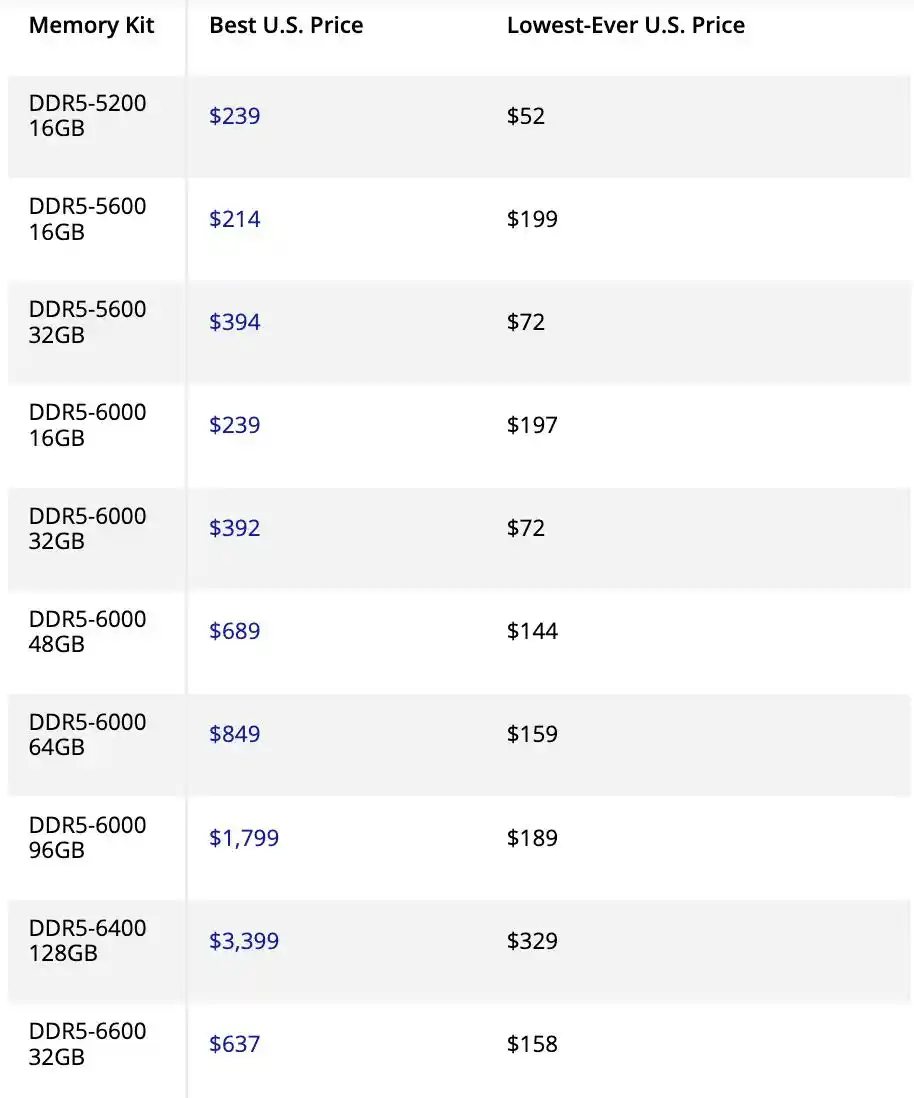
The floor price for a 128GB DDR5 memory kit used to be $329, an easy buy. Now, take another look – $3,399, a full tenfold increase.
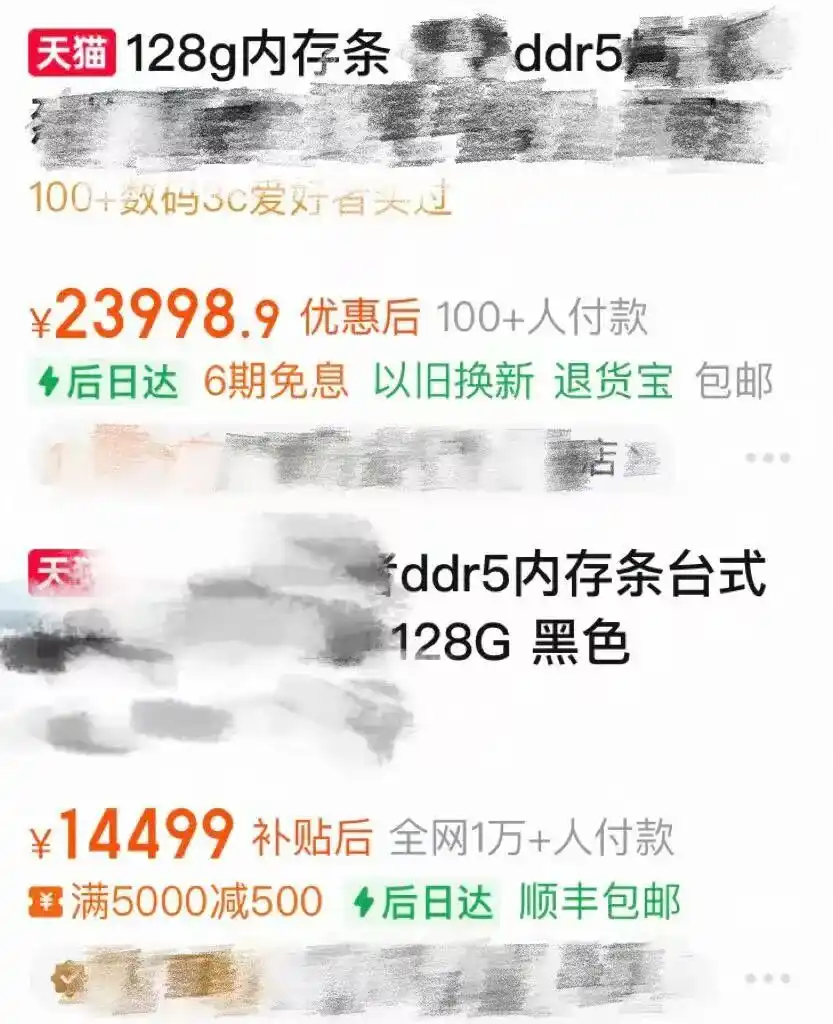
So we also went and searched on e-commerce platforms. Just how outrageous are these prices, you tell me.
Two or three years ago, memory was the most overlooked component in a PC build.
A mainstream memory stick could be had for a little over a hundred yuan. When making a build budget, you could easily meet the capacity needs for gaming, office work, or content creation by just setting aside a small portion.
What everyone agonized over was always which CPU generation to choose, what tier of graphics card to get, whether to upgrade the motherboard to a new model. Memory was often just an afterthought.
Then, in just one year, this thing has become the most expensive single component. The price tags on high-capacity memory are enough to make countless DIY enthusiasts gasp in shock.
It's honestly a bit hard to take!
500% Increase in 12 Months
Tom’s Hardware pulled retail historical price data from PCPartPicker, compiling a year-over-year comparison from August 2025 to August 2026. DDR5 memory prices have skyrocketed across the board, with high-capacity models seeing increases of nearly 500%.
The 2×16GB DDR5 dual-channel kits commonly used for mainstream gaming builds, which last year maintained a price around a hundred dollars, now range from $480 to $572 – three to four times more expensive.
The price hikes for larger capacity models are even more exaggerated. A 64GB DDR5-5600 (2×32GB) kit, which last year had a low under $200, now directly breaks through $1,100, a year-over-year increase of 485%.
And then there's the 96GB DDR5-6000, with a historical low of $189, now at $1,799...
DDR5 became so expensive that most people couldn't afford it, so everyone rushed to buy into older platforms like AM4 and LGA1700. But old memory didn't escape the涨价浪潮 wave either. DDR4 prices have been pushed up, rising 120% to 180% year-over-year across the board.
Moreover, this wave of price increases is not a local phenomenon.
According to monitoring data from Germany's ComputerBase, RAM prices in the European market have surged 345% compared to the same period last year. During the same period, SSDs and HDDs also rose by over 125%, collectively raising the storage cost of entire systems.
In domestic现货 channels, the situation on the wholesale side is equally staggering.
As an important distribution hub for electronic components in China, the quoted purchase prices for storage products at华强北 can directly reflect the magnitude of the market's price increase.
A 32GB DDR5 kit, marked at 900 yuan last year, is now directly quoted at 3800 yuan, more than quadrupling in a year.
A 16GB DDR5 kit went from 450 yuan to 1800 yuan. Even the 1TB SSD, a daily装机 necessity, climbed from 410 yuan to 950 yuan...
According to the Shanghai Securities Journal,华强北 distributors reported that current memory quotes have reached record highs in recent years. Purchase prices change daily, sometimes several times a day. Many small and medium-sized PC assembly shops dare not stock up, trying to minimize inventory risk.
The entire PC market has already felt the pressure.
In the past, for a mid-to-high-end gaming desktop, the CPU and graphics card took up the bulk of the budget. Now, for a配置 with equivalent performance, just the memory alone adds thousands of yuan in extra cost.
Many online PC assembly shops have even started offering semi-finished hosts without memory, throwing the memory choice back to the consumer, because the商家 also can't bear the cost pressure of storage components.
Who's Snapping Up All the Memory?
So the question arises, who's behind the抢 memory? The answer: AI.
AI large model training and inference businesses are highly profitable. Smart computing centers are being built疯狂 globally.
A single AI server consumes far more memory resources than a traditional server.
There are industry rumors that cloud providers, to ensure算力 supply, have already paid large deposits to lock in the vast majority of global DRAM production capacity for 2027 in advance.
In other words, in the next two years, the memory production capacity left for the普通 PC and smartphone manufacturers' consumer market is just the portion remaining after the big players fulfill their AI orders.
What普通 consumers get their hands on might even be considered the scraps left after产能分配.
Adding insult to injury is HBM (High Bandwidth Memory).
HBM is a core component of AI graphics cards, requiring multiple layers of DRAM wafers to be stacked and packaged together.
Producing one piece of HBM consumes大量晶圆 that could have been used to make ordinary DDR memory. The process is complex, yields are relatively low, but the profit per HBM chip is far higher than for consumer-grade memory sticks.
For major memory manufacturers, using the same wafer to make HBM yields收益数倍 that of普通 DDR颗粒. Naturally, companies tend to倾斜先进产能 towards higher-profit products.
Industry estimates suggest that the production capacity consumed to make one HBM wafer is enough to produce 3–4 ordinary DDR5 wafers.
This way,大量先进 DRAM产能 is转向 towards HBM and server memory. Consumer-grade products can only get a share of the remaining, limited resources.
Supply is severely squeezed. It would be strange if prices *didn't* rise.
SK海力士's CEO warned in a public interview that 2027 will be the worst year for memory supply in the industry's history, and the situation where demand outpaces capacity will drag on until 2030.
This账, really, can't be calculated细.
If calculated by weight, the value of mainstream DRAM chips has already surpassed half that of gold...
Professor Daniel Lemire from the University of Quebec in Canada did the math:
Priced per unit of capacity, current memory price levels have returned to those of the distant year 2007.
Over the past nearly twenty years, with半导体产业技术迭代, memory prices fell continuously, allowing普通用户 to use大容量内存. And nearly two decades of降价红利 have been almost entirely given back to the market in just one year.
Of course, many will ask, when will memory prices drop back down?
Judging from the statements of major原厂, it will be difficult in the short term.
On one hand, demand for HBM continues to rise, and shipments of AI servers maintain high-speed growth.
On the other hand, building new晶圆工厂 has a long construction cycle, and it also takes大量时间 from groundbreaking to production and释放产能.
Even if storage manufacturers increase capital expenditures, the new capacity cannot immediately land to fill the缺口.
Once everyone joked that memory was sold by the pound. Now, this涨价潮 has been going on for a year with涨, and there's no sign of it stopping anytime soon.
Give me back my白菜价啊...
Reference links:
[1]https://www.tomshardware.com/pc-components/ram/memory-prices-climb-500-percent-in-12-months-up-to-10x-the-lowest-ever-tracked-prices-128gb-of-ddr5-now-usd3-399
[2]https://www.digitimes.com/news/a20260106PD224/samsung-sk-hynix-dram-price-increase.html
[3]https://www.tomshardware.com/pc-components/ram/scientist-says-ram-pricing-has-reverted-to-normalized-2007-levels-memory-prices-have-been-falling-exponentially-for-decades-but-the-ai-shortage-undid-20-years-of-progress-in-a-matter-of-months
This article comes from the WeChat public account "QbitAI", author: 关注前沿科技