Will the STRC Issue Price Determined by ChatGPT Really Fall into a Death Spiral?

链捕手2026-06-23 tarihinde yayınlandı2026-06-23 tarihinde güncellendi

Özet

"Strategy's" (STRC) preferred share, a financial instrument designed by CEO Michael Saylor in consultation with AI to trade steadily at $100, faces mounting pressure. Since its July 2025 launch alongside a ~40% Bitcoin price drop, STRC has traded at a steep discount, hitting a low of $82.53. This discount pushes its effective dividend yield above 12.9%. The core debate revolves around whether STRC's structure is sustainable or a "centralized Ponzi scheme," as economist Peter Schiff claims. The mechanism relies on issuing new shares ("at-the-market" offerings) to fund Bitcoin purchases and dividend payments. However, the deep discount has paused these ATM offerings, slowing Bitcoin accumulation and forcing a minor sale of 32 BTC to cover obligations. Proponents, like The Smarter Web Company's Jesse Myers, argue the sell-off is a leveraged unwinding, not a fundamental failure. They note Strategy has ample resources to cover dividends for years if Bitcoin appreciates modestly. The deep discount also makes STRC attractive for yield-seeking buyers, as dividends are calculated on the $100 face value. The key test is whether Strategy can maintain dividends without sustained Bitcoin sales. A critical watchpoint is June 30th, when STRC switches to semi-monthly dividends. An automatic rule will likely raise the dividend rate further because the price remains below $95$, potentially creating a "death spiral": lower prices trigger higher yields, increasing the cash burden and forcing ...

Author: Chloe, ChainCatcher

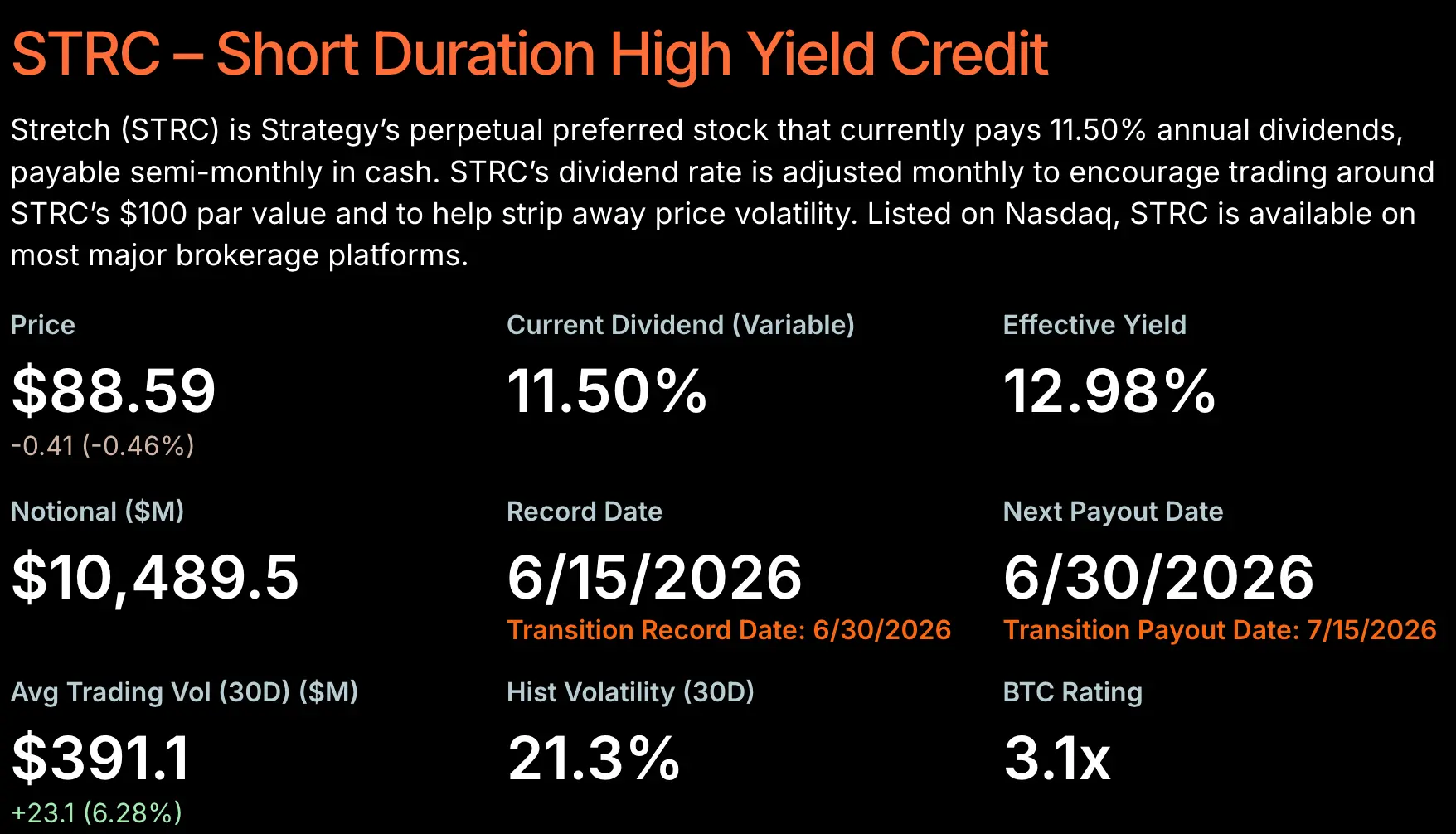
Since the launch of STRC by Strategy at the end of July 2025, Bitcoin has fallen by about 40%, nearly 50%. This preferred stock, designed to "trade at around its $100 par value," is now mired in a discount: last Thursday, it hit a historic low of $82.53 intraday, and even now, closing back at only $88.59, it remains about 13% below par. As the discount widens, STRC's effective yield has been pushed to over 12.9%, approaching 13%.
Jesse Myers, Bitcoin Strategy Lead at The Smarter Web Company, has stated, "Strategy is fine," while economist Peter Schiff has once again labeled the entire structure as a "classic centralized Ponzi scheme."

Thus, those old questions have been brought back to the table: Will Strategy be forced to sell Bitcoin? Is the flywheel it relies on for expansion actually a Ponzi scheme?

Was STRC's Mechanism Designed by AI?

To discuss STRC, we must first address a detail that is easily overlooked but has resurfaced during this downturn: this structure was the product of Saylor's conversations with AI.

The controversy stems from a May CoinDesk interview clip recirculating on X. In the clip, Saylor admits to extensively using artificial intelligence while developing Strategy's preferred stock product. He said that when creating Stretch, he designed these things using AI; he couldn't have done it alone. He spent hours discussing and refining ideas back and forth with the AI.

According to him, he constantly threw various structural proposals at the AI, testing whether unconventional ideas were legally sound. When he proposed, "I want a preferred stock that pays monthly dividends and is stable at $100," the AI responded: No one has ever done this in history, but it is completely legal and completely reasonable.

Interestingly, as STRC fell below par and the market began questioning whether this mechanism could hold, many foreign media outlets simply went back to ask AI—including ChatGPT, Grok, and Claude—if STRC could return to $100.

Will Strategy Sell More Bitcoin?

Not long ago, Strategy sold 32 BTC, worth about $2.5 million, to meet its dividend obligations. This amount is negligible compared to its overall Bitcoin reserves, but it proves one thing: when the financing efficiency led by STRC declines, cash obligations can indeed force limited selling of Bitcoin.

More alarmingly, buying momentum has frozen. Strategy's pace of accumulating Bitcoin has noticeably slowed: In April this year, it spent $2.54 billion to buy 34,164 BTC in a single week; in May, it added about 24,869 BTC with $2.01 billion. But by June, weekly purchases had shrunk to around $100 million. For the week ending June 8, it bought 1,550 BTC ($101 million); for the week ending June 15, it bought 1,587 BTC ($100 million), bringing its total holdings to 846,842 BTC.

Furthermore, the widening discount not only pushes up the yield but also suspends the "at-the-market" (ATM) issuance mechanism—issuing new shares into the public market at current prices to raise cash in batches. This financing channel is a key part of sustaining the entire Bitcoin flywheel.

However, bulls do not buy into this "death spiral" narrative. Jesse Myers believes this wave of STRC selling looks more like leveraged unwinding than a deterioration in fundamentals. He estimates that if conditions remain unchanged, Strategy's current state is sufficient to pay STRC dividends for up to 32 years; and as long as Bitcoin appreciates by about 2% annually, this obligation can be covered indefinitely. Moreover, the equity issuance tool itself has not disappeared. Even if ATM issuance is temporarily paused, Strategy still retains multiple backup financing options, including restarting the issuance of MSTR common stock, using cash reserves, and only resorting to selling Bitcoin if necessary.

On the bearish side is Schiff's classic script. He argues that if Saylor raises the yield to 13%, he must sell more MSTR at a larger discount to finance it; if he doesn't raise the yield, the STRC price will continue to fall. In his view, the only way to stop this death spiral is to cancel the dividends outright, but that would immediately crush STRC, dragging down MSTR and Bitcoin along with it.

Is This Flywheel a Ponzi Scheme?

Schiff's accusation is straightforward: STRC is a "classic centralized Ponzi" because its operation depends on whether Strategy can continue to raise new funds through another round of equity issuance or simply sell Bitcoin to fulfill its obligations. Even trader DonAlt has publicly questioned why STRC's price action after falling below par "trades like a Ponzi."

Strategy has not directly responded to such accusations, only continuing to position STRC as preferred stock backed by its Bitcoin DAT strategy. A more concrete move was changing STRC's dividend payment from monthly to semi-monthly, meaning twice a month.

The core argument from the opposing side is "leveraged unwinding." Myers points out that the problem lies not with the structure itself, but with the fact that STRC traded near $99 to $100 for a long time, enticing investors to deploy heavy leverage, with many assuming the instrument would remain firmly above $95. Once the price slipped, margin calls and forced liquidations amplified and accelerated this decline.

Analyst Scott Melker offers another perspective: the discount may actually attract yield-seeking buyers. Because STRC's dividends are calculated based on the $100 liquidation preference, not the market price. With an 11.5% dividend rate, someone buying at $90 gets an effective yield of about 12.8%, and at $85, about 13.5%. The deeper the discount, the higher the effective yield, which is itself a lure.

So the question of "whether it's a Ponzi" ultimately depends on which explanation the market believes. One narrative is that this mechanism can only keep turning by constantly pulling in new money, with funds from new entrants used to pay earlier entrants—a hallmark of a Ponzi scheme. The other narrative is that the instrument itself is fine; it's just that people previously thought it was stable and heavily leveraged, and when the price slid this time, these players were forced to cut losses, amplifying the decline—a one-time washout, not a problem with the instrument itself.

Semi-Monthly Dividends Officially Take Effect; The Answer May Be Revealed by June?

Looking back at the above, since this mechanism was designed by Saylor using AI, many foreign media outlets simply threw the same question back at AI: Can STRC return to $100, and what should Strategy do to rebuild market confidence? The common answer from ChatGPT, Grok, and Claude is, "Returning to $100 comes with conditions."

ChatGPT believes a return to $100 is still possible but requires stronger market confidence, sustainable dividend coverage, and a recovery in Bitcoin's price—all three combined. It emphasizes that the quickest repair path is to make investors believe again that dividends can be maintained without relying on selling assets. If more Bitcoin sales are actually needed later, confidence may deteriorate further.

Grok is the most reserved, bluntly stating, "Maybe, but it will be extremely difficult." In its view, the market is essentially asking: Can the engine that fuels this Bitcoin-buying machine still run? It believes a sustained rally in Bitcoin would be the most effective catalyst; conversely, prolonged weakness will weigh on both STRC and MSTR.

Claude points out that preferred stocks can indeed often recover from a discount to par, but the precondition is that investors regain belief in the issuer's ability to fulfill long-term obligations. "Recovery is possible, but the market needs to see evidence that this structure can operate even in adversity, not just work effectively when Bitcoin is rising."

So, is this strategy flawed? Whether it's the bearish Schiff, the bullish Myers, or top AI models, they all point to the same decisive variable: whether Strategy can continue to meet its dividend obligations without selling Bitcoin.

The flywheel is still spinning but clearly slower: ATM issuance is paused, the Bitcoin buying speed has shrunk from tens of billions of dollars per week earlier this year to about $100 million per week in June; the sale of those 32 BTC further proves that when equity issuance falters, the door of "selling Bitcoin to pay dividends" is already open. As for whether it's a Ponzi or a one-time leveraged washout, it depends on whether STRC can climb back to par and what Strategy ultimately uses to pay dividends.

The most concrete observation point falls on June 30: on that day, STRC's shift to semi-monthly dividends officially takes effect, but the real focus is on the rule that automatically adjusts the dividend rate based on price—suggesting a rate hike if the monthly average is below $95, and stopping only when it reaches above $99. Currently, it is deeply mired below $95, almost guaranteeing another rate hike. The dividend rate has already climbed from 9% in August 2025 to 11.5%.

This is the core of Schiff's death spiral: the lower the price, the more the mechanism automatically pushes the dividend rate higher, the larger the cash bill becomes, and ultimately, it can only be filled by issuing more shares or selling more Bitcoin. Whether this mechanism is a "stabilizer" or an "accelerator," the answer lies hidden in the price and interest rates to come.


İlgili Sorular

QWhat is the current trading situation of the STRC preferred share, and why is it significant?

AThe STRC preferred share, designed to trade near its $100 par value, is currently trading at a significant discount, hitting a low of $82.53. As of the article, it closed at $88.59, about 13% below par. This deep discount has pushed its effective yield above 12.9%. The significance lies in this departure from its intended stable price and the resulting high yield, which raises questions about the sustainability of the issuing company's strategy and its obligation to pay dividends.

QHow was the STRC product structure developed according to Michael Saylor?

AAccording to Michael Saylor in a CoinDesk interview, the structure for the STRC preferred share product was developed with extensive use of artificial intelligence. He spent hours in a back-and-forth dialogue with AI, testing unconventional structural ideas for legal viability. The AI confirmed that a preferred share with monthly dividends and a stable $100 price, while historically unprecedented, was completely legal and reasonable.

QWhat is the core argument of the 'death spiral' narrative for STRC, as mentioned by economist Peter Schiff?

AEconomist Peter Schiff's 'death spiral' argument posits that as the STRC price falls below par, its automatic mechanism increases the dividend yield to attract buyers. This creates a larger cash obligation for the issuer, Strategy. To meet this obligation, Strategy must issue more shares (like MSTR) at a discount or sell Bitcoin. This potential selling pressure could further depress Bitcoin's price, hurting Strategy's core asset value and making it harder to support STRC, creating a vicious cycle. Schiff argues the only way to stop it is to cancel dividends, which would crash STRC's value.

QWhat alternative explanation is given for STRC's price decline, countering the 'death spiral' or 'Ponzi' claims?

AAn alternative explanation, offered by proponents like Jesse Myers, is 'leveraged liquidation.' This view suggests the problem is not with the STRC structure itself, but with investor behavior. Because STRC traded stably near $100 for so long, many investors used high leverage, expecting minimal price volatility. When the price began to fall, it triggered margin calls and forced liquidations among these leveraged holders, which amplified and accelerated the downward price movement, creating a sharp sell-off that doesn't necessarily reflect a fundamental flaw in the product.

QWhat is a key upcoming date or mechanism that will test the STRC structure, according to the article?

AA key upcoming test is the implementation of the semi-monthly dividend and, more importantly, the automatic dividend rate adjustment rule tied to STRC's average price. Starting around June 30th, if the monthly average price is below $95, the mechanism recommends increasing the dividend rate. With STRC trading deeply below $95, another rate hike is almost certain. This will directly test whether the automatic adjustment acts as a stabilizing 'flywheel' or an accelerating 'death spiral' by increasing the cash burden on Strategy as the price falls.

İlgili Okumalar

Second Half of U.S. Crypto Policy: The Clarity Act Aims for 60 Votes, CFTC's "One-Person Commission" Becomes Biggest Variable

In a pivotal year for US crypto policy, the "CLARITY Act" is advancing in the Senate but faces a high hurdle, needing 60 votes to pass. Key challenges include bridging partisan divides on ethics and swaying undecided Republican senators within a tight legislative calendar of only about 40 working days. The policy "second half" involves intense negotiations on a broader framework for Web3 and DeFi, including crypto tax reforms and the Blockchain Regulatory Certainty Act. A significant uncertainty is the understaffed CFTC, operating with four commissioner vacancies, which complicates regulatory clarity. Meanwhile, the departure of key "crypto champions"—SEC Commissioner Hester Peirce and Senator Cynthia Lummis—will impact ongoing policy efforts. Industry experts are cautiously optimistic but realistic. Sara K. Weed notes that while progress is being made, CLARITY is unlikely to pass this Congress, pushing agencies like the SEC and CFTC to provide more guidance. Sulolit Mukherjee suggests meaningful crypto tax legislation is more likely to be attached to larger must-pass bills. Rashan Colbert discusses the jurisdictional debate over prediction markets, emphasizing the need for a regulatory framework that fosters their development as financial tools rather than treating them broadly as gambling. The clock is ticking, but opportunities remain for substantive progress through continued bipartisan dialogue and pragmatic efforts.

marsbit7 dk önce

Second Half of U.S. Crypto Policy: The Clarity Act Aims for 60 Votes, CFTC's "One-Person Commission" Becomes Biggest Variable

marsbit7 dk önce

Dan Koe's New Essay: Escaping the Fate of the Wage Slave, How to Survive the AI Replacement Wave?

Dan Koe argues that the true threat in the AI era isn't technology itself, but a reliance on others for one's livelihood and happiness. The core problem is "wage slavery"—spending life on unfulfilling work. To survive and thrive, one must escape this by building their own enterprise. The key is developing five elements: Agency (initiative), Taste (discernment), Persuasion, Persistence, and Iteration. These boil down to problem-solving skills and experiential knowledge, which cannot be learned passively but only through doing your own projects. The solution is to become "unemployable" by shifting your identity. This requires: 1) Radically changing your environment to force growth, 2) Choosing a medium (like content creation) that provides real feedback through trial and error, and 3) Mastering either code or, preferably, media (content). Content creation is more valuable because its subjective nature and need for human perspective create a durable advantage over generic AI output. To start, define your life's work by answering foundational questions about your innate knowledge, unique abilities, and contrarian beliefs. Then, immediately act by publishing your first piece of content. The cycle of creating, receiving feedback, and iterating is the essential path to developing the skills needed for an independent, meaningful career and financial resilience.

marsbit43 dk önce

Dan Koe's New Essay: Escaping the Fate of the Wage Slave, How to Survive the AI Replacement Wave?

marsbit43 dk önce

Research Report Analysis: Morgan Stanley Details SanDisk SNDK, The Truth About Cloud Data Center Pricing Power and AI Inference Benefits

Morgan Stanley raised its price target for SanDisk (SNDK) from $1100 to $1750 on June 22, maintaining an Overweight rating. The upgrade is driven by AI inference demand reshaping the NAND market, particularly for KV Cache and context window storage in cloud data centers. These cloud clients exhibit price inelasticity and sign long-term contracts, granting SanDisk significant pricing power. SanDisk's New Business Model (NBM) agreements, covering over one-third of FY27 bit shipments with 3-5 year terms and fixed price/price collar structures, are crucial. They are projected to sustain gross margins around 80% even at floor prices, providing a buffer against cyclical downturns. Morgan Stanley forecasts gross margins to surge from 30.3% in FY25 to 86.7% in FY27e. With NAND supply expected to remain tight into 2026/2027 and cloud/data centers becoming the largest end-market, SanDisk holds supply-side pricing power. The company targets 15-19% bit growth via technology transitions, not capacity expansion. Revenue is projected to grow ~6.6x from FY25 to FY27, with EPS rising from $2.74 to $14.73, driven by high-margin cloud business. Key upside catalysts include faster enterprise SSD adoption and edge AI growth. Downside risks involve slower industry growth, competitor capex increases, market share loss, and competition from Chinese players like YMTC. The investment thesis rests on AI-driven structural demand, NBM's margin protection, and sustained supply tightness. The $1750 target implies ~28x FY27e P/E.

marsbit1 saat önce

Research Report Analysis: Morgan Stanley Details SanDisk SNDK, The Truth About Cloud Data Center Pricing Power and AI Inference Benefits

marsbit1 saat önce

A Threefold Performance Leap! NEAR Achieves 200ms Physical Block Time Limit with SPICE

NEAR's core development team, Near One, has announced its next major protocol evolution: SPICE (Separation of Consensus and Execution). Currently in development, SPICE represents the most significant upgrade before the full implementation of Nightshade 3.0. Its core innovation is decoupling the consensus layer, responsible for ordering transactions, from the execution layer, which processes them. This allows the consensus layer to run at full speed without waiting for transaction execution to complete. Once deployed, SPICE is projected to triple NEAR's block production speed, achieving a 200ms block time, which is considered the physical limit due to the speed of light and network latency. This leap will dramatically reduce transaction latency and finality, with transactions confirming in roughly 0.4 seconds—faster than a typical card payment. The upgrade also enables more complex, long-running transactions and significantly improves user experience for applications like NEAR Intents and near.com. Beyond raw speed, SPICE enhances network scalability and security. It enables deeper parallelism, efficiently distributing workload across shards and improving resource utilization. The simpler block structure and lighter contracts also facilitate formal verification and security auditing. Furthermore, SPICE lays the critical groundwork for future Nightshade 3.0 features, most notably atomic cross-shard transactions, which would simplify complex contract logic and eliminate development hurdles caused by asynchronous execution. The Near One team is actively developing SPICE, targeting deployment in the coming months.

Foresight News2 saat önce

A Threefold Performance Leap! NEAR Achieves 200ms Physical Block Time Limit with SPICE

Foresight News2 saat önce

İşlemler

Spot
Futures
活动图片