MAYAChain Halts Network Following $1.7 Million Exploit

cryptonews.ru2026-08-19 tarihinde yayınlandı2026-08-19 tarihinde güncellendi

Özet

Maya Protocol, a cross-chain decentralized exchange (DEX), has halted its network after an attacker exploited a series of software vulnerabilities, making off with approximately $1.7 million in crypto assets. According to pseudonymous co-founder Aalux, the attacker stole roughly 20 Bitcoins worth $1.4 million and an additional $300,000 in other assets. The protocol has been fully paused to prevent further damage while vulnerabilities are addressed. A preliminary technical analysis links the incident to six interrelated bugs in trading accounts, outbound transaction processing, and pool liquidity calculations. The attacker allegedly used a single transaction with 23 messages to trigger a false theft detection, artificially inflate a low-liquidity pool, and withdraw 48.87 million CACAO tokens from the Maya Asgard module. Approximately $1.36 million of the stolen funds were transferred to external blockchains, with another $291,000 in CACAO and trading positions remaining on MAYAChain. During the incident, the CACAO token price plummeted 88.7% from around $0.115 to $0.013. While the total value across protocol pools dropped by $10.9 million, this figure includes arbitrage activity and token devaluation, not solely the assets directly stolen by the attacker.

The cross-chain decentralized exchange (DEX) Maya Protocol has halted its network after an attacker exploited a series of software vulnerabilities and made off with approximately $1.7 million worth of crypto assets.

On Wednesday, pseudonymous Maya Protocol co-founder Aalux reported that the attacker stole about 20 Bitcoin worth $1.4 million and an additional $300,000 in other assets. He stated that the protocol completely halted the network, prevented further damage, and began patching the vulnerabilities to resume swaps.

A preliminary technical analysis published by Aalux links the incident to six interconnected bugs in trading accounts, outbound transaction processing, and pool liquidity calculations. According to the analysis, the attacker used a single transaction with 23 messages to trigger a false theft detection, artificially inflate a low-liquidity pool's volume, and withdraw 48.87 million CACAO tokens from the Maya Asgard module.

The report says about $1.36 million was transferred by the attacker to external blockchains. A further approximately $291,000 in CACAO and trading positions on MAYAChain remained with the attacker.

Independent blockchain security researcher Vini Barbosa summarized the outcome, noting that CACAO dropped 88.7% during the incident—from around $0.115 to $0.013.

According to the analysis, the total value locked (TVL) in the pools decreased by $10.9 million. However, this figure includes arbitrage activity and CACAO depreciation, not just the assets stolen by the attacker.

Related Material: BitBox Fixed 'Serious' Wallet Vulnerabilities That Could Have Put Funds at Risk

end-content

İlgili Sorular

QWhat action did the cross-chain decentralized exchange Maya Protocol take after the exploit?

AMaya Protocol halted its network to prevent further damage and began fixing the vulnerabilities before resuming swaps.

QAccording to the co-founder Aalux, what was the approximate value of Bitcoin stolen in the exploit?

AApproximately 20 Bitcoins, worth about $1.4 million, were stolen in the exploit.

QWhat was the primary method used by the attacker in the exploit, as detailed in the preliminary analysis?

AThe attacker used a single transaction containing 23 messages to trigger a false theft detection, artificially increase the volume of a low-liquidity pool, and withdraw 48.87 million CACAO tokens from the Maya Asgard module.

QHow much did the CACAO token price fall during the incident according to independent security researcher Vini Barbosa?

AThe CACAO token price fell by approximately 88.7%, dropping from around $0.115 to $0.013.

QWhat is the total estimated loss in pool value from the incident, and what does this figure include beyond the stolen assets?

AThe total estimated loss in pool value is $10.9 million. This figure includes arbitrage activity and the depreciation of CACAO, not just the assets stolen by the attacker.

İlgili Okumalar

Bank of Russia: 12 Largest Banks to Connect Digital Ruble from September 1, 2026

The Central Bank of Russia (CBR) announced that all 12 of the country's systemically important banks will be ready to offer clients digital ruble accounts and transactions starting September 1, 2026. According to Alla Bakina, director of the CBR's national payment system department, these banks cover over 80% of the domestic payment market. The digital ruble is described as a new form of the existing currency, functioning as a cashless payment method but held directly in a user's wallet on the CBR platform. Nine other banks designated as significant payment market participants are also expected to provide access, with most aiming to complete integration by autumn 2026. Starting from the September launch date, major retail chains with annual revenue exceeding 120 million rubles will be required to accept digital ruble payments, though adoption for citizens remains voluntary. The rollout follows a delayed pilot phase, with mass implementation postponed from 2025. The CBR's model currently offers basic account functionality without interest accrual, unlike China's digital yuan, which began paying interest in early 2026. The announcement positions Russia among dozens of countries testing Central Bank Digital Currencies (CBDCs), though the digital ruble's potential role in cross-border settlements, particularly within BRICS, remains an open question for its future international relevance.

cryptonews.ru3 dk önce

Bank of Russia: 12 Largest Banks to Connect Digital Ruble from September 1, 2026

cryptonews.ru3 dk önce

MSX US Stock Daily Observation: Baidu 2026 Q2 Earnings: AI Revenue Accounts for Half of Core Business for Two Consecutive Quarters, 283% GPU Cloud Growth Boosts Business Transformation

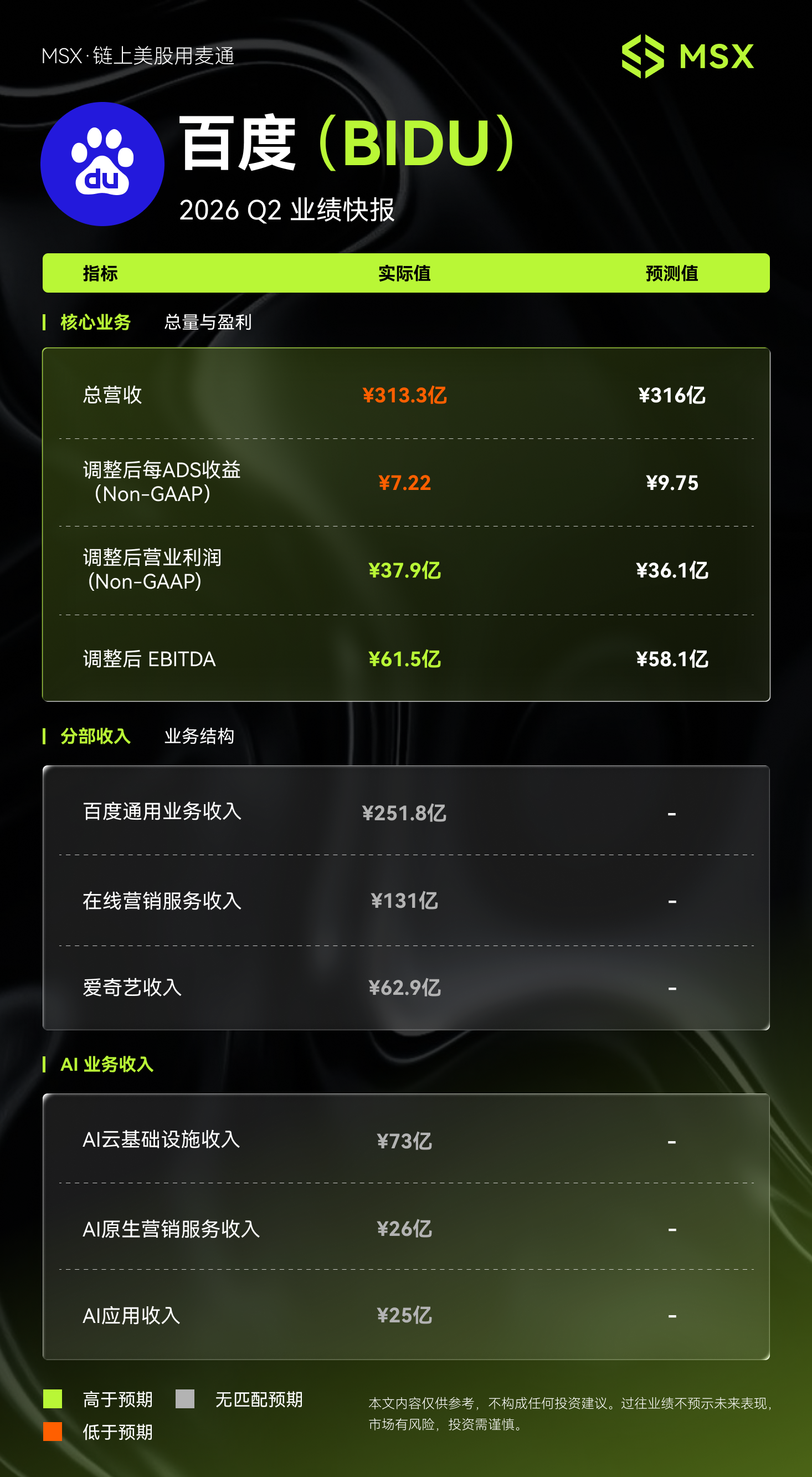
**MSX Daily US Stock Observation: Baidu 2026 Q2 Earnings Report** Baidu's Q2 2026 earnings present a clear picture of a company in transition. Total revenue declined slightly to RMB 313.25 billion, missing market expectations. This was driven by a continued double-digit contraction (-19%) in its core online marketing (advertising) business. The key highlight is the structural shift within the company's operations. AI-related revenue reached RMB 125 billion, accounting for approximately half of Baidu's core business income for the second consecutive quarter. Within AI, growth is heavily skewed towards infrastructure: AI cloud infrastructure revenue grew 50% year-over-year to RMB 73 billion, with GPU cloud revenue surging 283%. In contrast, AI application and AI-native marketing services revenue grew only 3% and remained flat, respectively, indicating slower commercialization on the application side. Profitability metrics were mixed. While adjusted operating profit and EBITDA exceeded expectations, demonstrating cost control, adjusted earnings per ADS of RMB 7.22 fell short by about 26%. This gap is largely attributed to depreciation and amortization costs linked to significant AI infrastructure investments, which continue to pressure bottom-line profit realization. The company holds a substantial cash position of RMB 2831 billion, providing runway for continued investment. The critical challenge ahead is translating the explosive growth in AI infrastructure (like GPU cloud) into stronger monetization from AI applications to bridge the gap between operational profit and per-share earnings.

Odaily星球日报8 dk önce

MSX US Stock Daily Observation: Baidu 2026 Q2 Earnings: AI Revenue Accounts for Half of Core Business for Two Consecutive Quarters, 283% GPU Cloud Growth Boosts Business Transformation

Odaily星球日报8 dk önce

Bitwise CIO: Three Major Cognitive Errors Common Among Crypto Investors Today

Bitwise CIO Matt Hougan highlights three key misconceptions he believes many crypto investors currently hold, presenting them as opportunities for those who see beyond them. First, investors significantly underestimate the total addressable market for crypto applications. While many view platforms like Uniswap only as tools for trading crypto assets (a ~$2 trillion market), their true potential lies in tokenizing and trading *all* asset classes—such as stocks and bonds—which represent markets hundreds of trillions of dollars in size. Second, there's a persistent overestimation of traditional financial institutions' ability to dominate crypto-native sectors. Examples like PayPal's stable币 (with ~1% market share vs. Tether/Circle's 88%) and Fidelity's custody business (trailing Coinbase) show that crypto-native firms often win due to faster iteration, focused expertise, and established user trust within the crypto ecosystem. Third, investors linearly extrapolate future on-chain transaction volumes from today's data, severely underestimating potential growth. The shift to 24/7 trading for tokenized assets could multiply trading hours by 5x. When combined with AI agents that may execute trades far more frequently than humans, transaction volumes could grow by 10x to 100x, massively boosting revenue for underlying blockchains and applications. Hougan concludes that the gap between the rapid pace of industry change and slower mainstream perception updates creates significant investment opportunities.

marsbit11 dk önce

Bitwise CIO: Three Major Cognitive Errors Common Among Crypto Investors Today

marsbit11 dk önce

İşlemler

Spot
活动图片