Tether Launches Bitcoin Mining OS, Fueling $HYPER’s $31.2M Presale

bitcoinist2026-02-03 tarihinde yayınlandı2026-02-03 tarihinde güncellendi

Özet

Tether, the major stablecoin issuer, is expanding its influence in Bitcoin infrastructure by launching MOS, a proprietary mining operating system that integrates IoT technology to optimize energy efficiency. This move signals a strong institutional commitment to Bitcoin's foundational growth. However, Bitcoin's inherent limitations in transaction speed and scalability for DeFi applications remain a challenge. Addressing this, Bitcoin Hyper ($HYPER) is gaining attention as a Bitcoin Layer 2 solution that combines Bitcoin's security with the high-speed performance of the Solana Virtual Machine (SVM). It enables fast, low-cost transactions and smart contracts in Rust, making Bitcoin more usable for DeFi. The project's presale has raised over $31.2 million, indicating significant investor interest, particularly from larger entities, ahead of its Token Generation Event (TGE). The tokenomics include immediate staking post-TGE with a 7-day vesting period to reduce sell pressure. This development represents a growing trend to enhance Bitcoin's utility alongside infrastructure improvements.

Tether isn’t just a stablecoin issuer anymore. It’s rapidly becoming a dominant force in Bitcoin infrastructure.

The company’s recent launch of MOS, its proprietary mining operating system, marks a massive shift in how institutional capital interacts with the network.
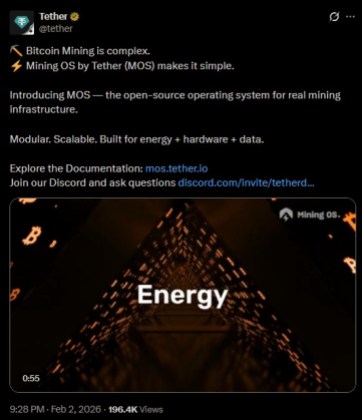
By fusing Internet of Things (IoT) technology with mining hardware, Tether is optimizing energy efficiency in a way that screams long-term commitment. It’s not just about holding $BTC; it’s about building the rails.

That validates the ‘Bitcoin as infrastructure’ thesis. When the world’s largest stablecoin issuer, sitting on over $100B in liquidity, pivots to mining logistics, it de-risks the network for everyone else. But while Tether tackles hardware inefficiencies, a glaring gap remains on the software side: Bitcoin simply can’t handle complex, high-speed transactions natively.

Consequently, focus is shifting toward solutions that can unlock Bitcoin’s $1T+ capital for decentralized finance (DeFi). The liquidity is there. The rails? Too slow. This search for scalability has pushed massive capital toward Layer 2 protocols.

Right now, smart money is circling Bitcoin Hyper ($HYPER), a project merging Bitcoin’s security with the Solana Virtual Machine’s (SVM) speed to bridge institutional security with retail velocity.

You can buy $HYPER here.

Bitcoin Hyper Bridges the Gap Between Security and SVM Speed

Bitcoin’s core limitation has always been the ‘trilemma’ trade-off: it sacrifices speed for absolute decentralization. While reliable for settlement, frankly, it’s functionally useless for modern DeFi applications that require sub-second finality.

Bitcoin Hyper ($HYPER) tackles this by integrating the Solana Virtual Machine (SVM) directly as a Layer 2 execution environment.

This isn’t just narrative fluff, it’s a technical leap. By using the SVM, Bitcoin Hyper lets developers write smart contracts in Rust (the language powering Solana’s ecosystem) while anchoring the final state to Bitcoin’s Layer 1. This modular approach separates execution from settlement.
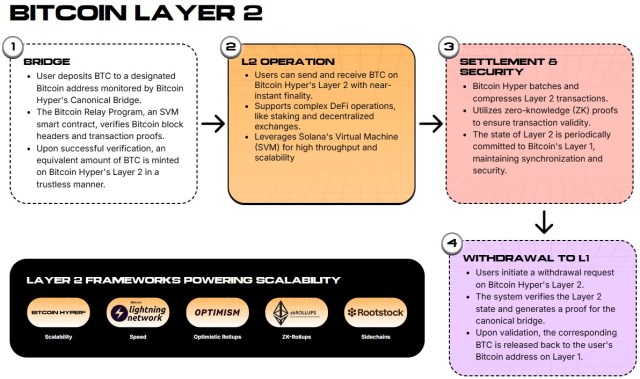
Transactions happen in real-time on the SVM layer, delivering the snappy, low-cost experience users expect, while security remains tied to Bitcoin.

For developers, this removes the friction of learning archaic scripting languages like Bitcoin Script. For users, it means interacting with Bitcoin DeFi without exorbitant fees or 10-minute waits. The protocol includes a Decentralized Canonical Bridge to keep value transfers trust-minimized.

That infrastructure is crucial for high-frequency trading and gaming dApps, stuff that was previously impossible on the Bitcoin network.

Explore the Bitcoin Hyper ecosystem.

Whale Accumulation Signals Confidence as Presale Clears $31M

The appetite for high-performance Bitcoin Layer 2s is real. Just look at the capital flows surrounding the Bitcoin Hyper presale. Official data shows the project has raised over $31.2M, a figure that underscores demand despite market chop. With tokens priced at $0.013675, the valuation offers an early-stage entry point compared to established competitors like Stacks.

Sophisticated actors appear to be positioning themselves ahead of the Token Generation Event (TGE). The implication? Larger entities are betting the “SVM on Bitcoin” narrative will outperform standard EVM-based Layer 2s.

The tokenomics look designed for the long haul. Bitcoin Hyper offers immediate staking after TGE (though APY rates are still under wraps). There’s a catch: a 7-day vesting period for presale stakers. But that’s likely a feature, not a bug, intended to mitigate immediate sell pressure.

As Tether industrializes Bitcoin mining, projects like Bitcoin Hyper are industrializing Bitcoin utility, creating a dual engine for the network’s next growth phase.

Check out the Bitcoin Hyper presale.

Disclaimer: This article is for informational purposes only and does not constitute financial advice. Cryptocurrency investments, including presales and Layer 2 tokens, carry high risks. Always perform your own due diligence before investing.

İlgili Sorular

QWhat is the main focus of Tether's new initiative mentioned in the article?

ATether is expanding beyond stablecoin issuance by launching its proprietary Bitcoin mining operating system (MOS), focusing on optimizing energy efficiency and becoming a dominant force in Bitcoin infrastructure.

QHow does Bitcoin Hyper ($HYPER) aim to solve Bitcoin's scalability issue?

ABitcoin Hyper integrates the Solana Virtual Machine (SVM) as a Layer 2 execution environment, enabling high-speed, low-cost transactions while anchoring security to Bitcoin's Layer 1, thus addressing Bitcoin's limitations for DeFi applications.

QWhat technical advantage does Bitcoin Hyper offer to developers?

AIt allows developers to write smart contracts in Rust (the language used in Solana's ecosystem) instead of Bitcoin Script, reducing friction and enabling the creation of high-frequency trading and gaming dApps on Bitcoin.

QHow much capital has the Bitcoin Hyper presale raised, and what does it indicate?

AThe Bitcoin Hyper presale has raised over $31.2 million, indicating strong demand and confidence in the 'SVM on Bitcoin' narrative, with whale accumulation signaling institutional interest.

QWhat is one key feature of Bitcoin Hyper's tokenomics designed for long-term stability?

AThe tokenomics include immediate staking after the Token Generation Event (TGE) with a 7-day vesting period for presale stakers to mitigate immediate sell pressure and encourage long-term holding.

İlgili Okumalar

Crypto’s Investable Universe Is Shrinking: NYDIG

According to NYDIG's Head of Research Greg Cipolaro, the crypto industry's investable universe is shrinking as markets mature. He argues that only a limited set of blockchain applications can attract sustained capital, suggesting the broader Web3 vision may need recalibration. Investors are now focusing on applications that extend traditional financial products onto blockchain infrastructure, including Bitcoin, tokenized assets, stablecoins, select DeFi infrastructure, and general-purpose blockchains like Ethereum. Cipolaro emphasizes that blockchain’s core attributes—trustlessness, permissionlessness, and censorship resistance—align best with financial use cases, where they provide clear advantages over centralized systems. He notes that most non-financial applications, such as gaming or social media, don’t require global immutable ledgers and are more efficiently served by centralized alternatives. This shift has led to capital concentration around fewer, stronger narratives, increasing Bitcoin’s market dominance while reducing investment in speculative altcoins. Cipolaro views this trend as market consolidation rather than collapse, with a focus on economically sustainable applications. A smaller, more durable market grounded in financial utility may enhance long-term stability and attract institutional interest. The crypto space may ultimately function as a specialized financial technology layer rather than a comprehensive Web3 overhaul. The next phase of development will likely emphasize real-world utility, regulatory clarity, and prudent capital allocation over rapid narrative expansion.

TheNewsCrypto57 dk önce

Crypto’s Investable Universe Is Shrinking: NYDIG

TheNewsCrypto57 dk önce

Don't Just Focus on Trading Volume, Learn to Understand the 'True and False Prosperity' of Perpetual Contracts

Title: Look Beyond Trading Volume: Understanding the Real Growth of Perpetual Contracts Perpetual contracts (perps) have become a dominant force in crypto trading, with their volume now accounting for about 75% of decentralized exchange activity, up from 44% in February 2025. This surge occurred even as the total crypto market cap fell nearly 40% between August 2025 and February 2026, indicating a shift towards derivatives for speculation and hedging during volatility. However, volume alone can be misleading. It may reflect high-frequency, incentive-driven activity rather than meaningful capital deployment. A more nuanced view comes from combining volume with Open Interest (OI)—the total value of outstanding contracts. While cumulative perps volume doubled in the past six months to $14 trillion (exceeding the previous four years' total), OI grew by about 50%, from $13B to ~$18B before settling at $13B. The OI/Volume ratio, a measure of capital efficiency, rose from 0.33x to 0.49x over the past year. This growth wasn’t linear: it peaked at ~0.72x from June to mid-October 2025, then dropped to ~0.38x after a major liquidation event in October wiped out $19B in leveraged positions. At the platform level, Hyperliquid leads in capital efficiency with an OI/7-day volume ratio over 45% and a take rate of 3.2 bps, effectively converting trading activity into sustained positions and fee revenue. Aster follows with a 34% ratio but a lower take rate of 1.6 bps, prioritizing capital retention over revenue. edgeX and Lighter both show 21% efficiency, with edgeX matching Hyperliquid’s take rate. The key insight is that true growth in perps markets is signaled not just by volume but by rising OI/Volume ratio, reflecting patient capital and confidence in these platforms. Sustainable success will come from optimizing conviction and value capture, not just incentivized trading volume.

marsbit1 saat önce

Don't Just Focus on Trading Volume, Learn to Understand the 'True and False Prosperity' of Perpetual Contracts

marsbit1 saat önce

İşlemler

Spot
Futures
活动图片