Building the Bright Path While Secretly Crossing Chencang: Is Walsh Paving the Way for a September "Rate Cut"?

marsbit2026-06-29 tarihinde yayınlandı2026-06-29 tarihinde güncellendi

Özet

The title "Building the Plank Road Openly While Secretly Crossing at Chencang: Is Walsh Paving the Way for a September 'Rate Cut'?" suggests Federal Reserve Chair Kevin Walsh's hawkish stance may be a deliberate smokescreen. Academy Securities analyst Peter Tchir argues in a report that markets, currently pricing a 75% chance of a September hike, are missing a potential path to a September rate cut that Walsh himself might be quietly preparing. Tchir posits that Walsh's hawkish rhetoric aims to suppress long-term yield risks (with the 10-year Treasury yield falling recently) while creating room for a narrative shift based on upcoming data. The potential political endgame, according to this view, could be rate cuts in September and October, ahead of the midterm elections. This hinges on a political logic where the Trump administration's preference for lower rates remains unchanged. A core part of Tchir's argument involves redefining inflation metrics. He contends the Fed under Walsh may deprioritize the PCE index, criticizing its lagging components like Owners' Equivalent Rent (OER). Instead, he points to alternative, more real-time indicators like the New Tenant Repeat Rent Index (NTRR) and the Truflation daily index, which shows core inflation around 1.45%. He suggests the Fed could shift its data narrative to justify policy easing. Furthermore, Tchir downplays AI-driven inflation fears. He argues that consumer price sensitivity, evidenced by negative market reactions to ...

Original Author: Zhao Ying

Original Source: Wall Street News

Federal Reserve Chairman Kevin Walsh's hawkish posture might be nothing more than an elaborately designed smokescreen.

In a recent report, Academy Securities analyst Peter Tchir suggests that while the market has currently priced in a 75% probability of a September rate hike and expects a cumulative 1.25 hikes by year-end, it is missing the real path leading to a September rate cut—a path perhaps being quietly laid by Walsh himself.

Tchir points out that Walsh has sent a clear enough signal: suppressing tail-end risks in long-term interest rates through hawkish rhetoric (the 10-year Treasury yield has retreated from 4.46% to 4.37% this week), while reserving space for a subsequent narrative shift based on data. In his view, the end point of this series of maneuvers could be a rate cut in September, another in October, landing just in time before the midterm elections.

This judgment remains a personal opinion for now, and Tchir himself acknowledges its uncertainty. Yet his line of argument is tightly knit, covering the redefinition of inflation data, the battle for narrative control over the neutral rate, and the core premise that the White House's policy goals have never changed.

Hawkishness Just an Act? Political Logic Points to Rate Cuts

The starting point of Tchir's argument is a political-economic interpretation of Walsh's motivations.

He believes the policy objectives of the Trump administration have never fundamentally shifted. The President himself has repeatedly stated his deep understanding of real estate and the importance of low interest rates to the property market. Against this backdrop, it's difficult to imagine Trump being satisfied with his own appointed Fed chairman maintaining a persistently hawkish stance—unless this is itself a negotiated strategy.

Tchir paints a hypothetical scenario: Walsh convinces Trump that sending dovish signals now would be disastrous. Letting him appear hawkish can cap long-term yields, maintain the appearance of Fed independence, while simultaneously pushing Wall Street analysts and the media fully towards hike expectations. Then, as data gradually "cooperates," pivot to rate cuts under the "data-dependent" rationale, and conveniently blame the inflation problem on the previous Fed "using wrong data and acting too late."

He adds that Walsh's father-in-law is a major donor to Trump, a background perhaps not entirely irrelevant.

Taking Aim at Inflation Data: PCE Isn't This Fed's Yardstick

The most substantive part of Tchir's argument is his systemic questioning of the current inflation measurement framework.

He explicitly states, PCE is not the preferred inflation gauge for Walsh's Fed. He believes PCE was more of a Bernanke-era preference, and Walsh does not lose sleep over PCE data at night.

His criticism is particularly sharp regarding the measurement of housing inflation. The "Owners' Equivalent Rent" (OER) in CPI didn't peak until mid-2023, reaching about 8%; whereas Zillow's rental data hit a high near 16% as early as early 2022. He points out that the Cleveland Fed has already developed the "New Tenant Repeat Rent" (NTRR) index, whose trend closely aligns with Zillow's, yet this more realistic indicator has received almost no attention.

His conclusion: The Fed could entirely, without introducing external data, shift to using the indicators developed by the Cleveland Fed itself, thereby providing a data-based justification for rate cuts.

Truflation and "Two-Point-Something Is Good Enough"

Beyond PCE, Tchir also cites Truflation's real-time inflation data. According to his introduction, Truflation constructs a daily inflation index based on massive real-time datasets, with its core inflation rate currently around 1.45%, consistently below 1.8% since February this year.
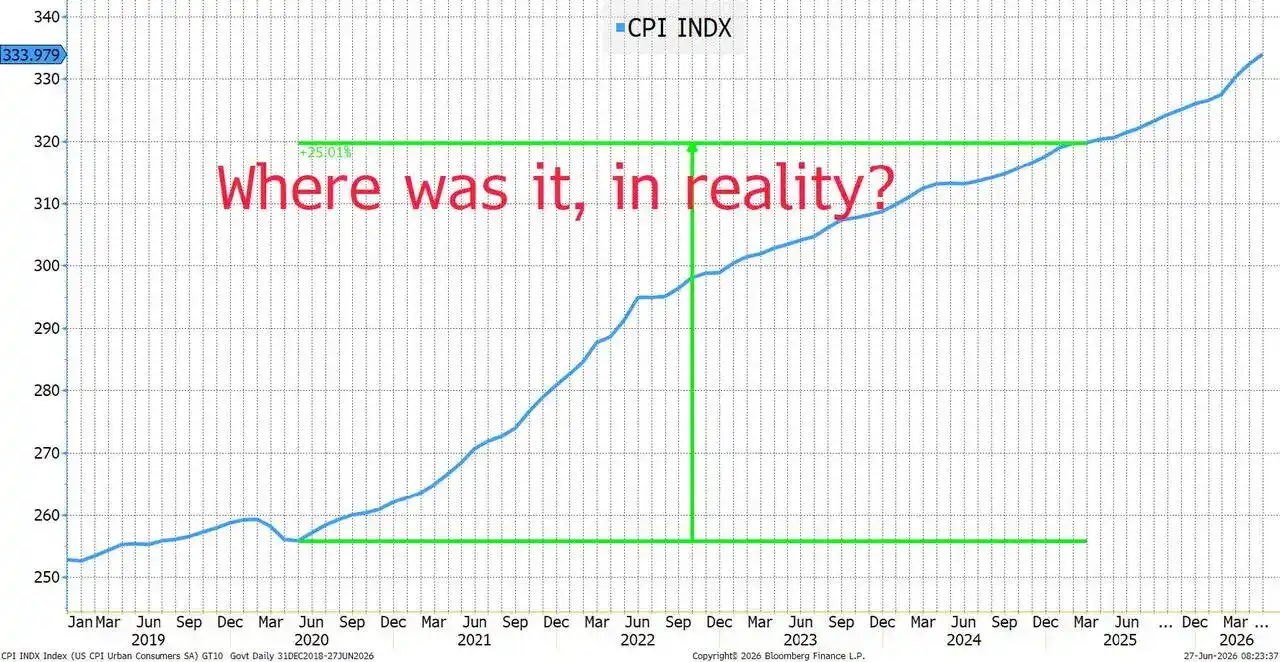
He also notes that Walsh's recent remarks hinted that the "big number" (the integer) of the inflation figure is more important than the precise value. Tchir infers from this that the market may be gradually being "conditioned"—to accept the cognitive framework that "two-point-something" is equivalent to approaching the 2% target. He marks the inflation target line on his chart as 2.9%, not the traditional 2%.

He believes that once the data narrative is switched, the technical barriers to rate cuts will significantly lower.

Tchir also mentions the work of former Fed insider Miran on the neutral rate issue. He believes that while no one in the market is discussing the neutral rate currently, this topic will resurface at an opportune moment.

His logic is: The neutral rate itself is difficult to measure precisely, with a substantial estimation range. If the new Fed leadership can argue that the previous judgment on the neutral rate was too high, then this alone could provide theoretical grounds for 50 to 100 basis points of rate cuts, while assigning blame to the "old Fed's error."

Apple Price Hikes and AI Inflation: Rate Hikes Are Aiming at the Wrong Target

Addressing market concerns about AI-driven inflation, Tchir offers a counter-interpretation.

He points out that Apple (AAPL)'s stock fell after announcing recent price hikes, a market reaction that precisely shows consumer tolerance for price increases is being questioned. If a top consumer brand like Apple struggles to have its price hikes digested by the market, the pricing power of ordinary consumer goods companies would only be weaker—contradicting the narrative of persistent inflation heating up.

He also cites feedback from a chip company: memory prices have not surged due to AI demand, with some products even cheaper than five years ago. He believes that AI and data center construction spending are indeed inflationary, but this is a completely different dimension from the affordability issues faced by ordinary consumers.

More critically, he argues that rate hikes have almost no dampening effect on AI/data center spending—those tech companies trading at 100x multiples are completely insensitive to a 50-basis-point rate move. Those truly hurt by rate hikes are ordinary borrowers with no connection to AI inflation.

Based on the above judgments, he believes the market will begin to reprice rate cut expectations, with the most certain opportunity lying in the short end of the yield curve—going long on short-term Treasuries, betting on lower front-end yields. For the long end, he maintains a neutral to slightly bullish stance, believing Treasury Secretary Bessent wants the 10-year yield back in the "3-handle," and Walsh has already removed tail-end risks for the long end through hawkish rhetoric.

In the equity space, he recommends a significant overweight in the energy sector, especially global nuclear power assets; within the Defense & Security (ProSec) theme, overweight biotech/pharmaceuticals and underweight chips. He is cautious on AI and data center valuations and warns that potential secondary issuance pressure from large tech companies could weigh on their stock prices.


İlgili Sorular

QAccording to the article, what is the analyst Peter Tchir's main argument about Federal Reserve Chairman Kevin Walsh's hawkish stance?

APeter Tchir argues that Federal Reserve Chairman Kevin Walsh's hawkish stance might be a carefully designed smokescreen. He suggests that by making hawkish statements, Walsh aims to suppress the tail risk of long-term interest rates, while also reserving space to shift the data narrative later. Tchir believes the ultimate goal of this strategy could be to pave the way for a potential interest rate cut in September and again in October, coinciding with the timing of the midterm elections.

QWhat is Peter Tchir's key criticism regarding the current inflation measurement system used by the Fed?

APeter Tchir criticizes the Fed's reliance on the PCE index, stating that it is not the preferred inflation gauge for the current Fed leadership under Walsh. He argues that data lags, especially in housing inflation, make metrics like PCE outdated. He points to the Cleveland Fed's 'New Tenant Repeat Rent Index' (NTRR), which aligns more closely with real-time rental data from sources like Zillow, as a more accurate indicator that the Fed could switch to in order to justify rate cuts.

QWhat alternative inflation data does Peter Tchir cite to support the case for lower inflation, and what does it indicate?

APeter Tchir cites Truflation, a real-time inflation index built on massive datasets. According to his report, Truflation's core inflation rate is currently around 1.45% and has consistently stayed below 1.8% since February of this year. This data suggests that inflation is significantly lower than what the official, lagging indicators might imply.

QHow does Peter Tchir dismiss concerns about AI-driven inflation?

APeter Tchir dismisses concerns about AI-driven inflation by making two key points. First, he argues that the inflation from AI and data center construction is a different dimension from the affordability issues faced by general consumers. Second, he contends that interest rate hikes are ineffective at curbing AI/data center spending because the tech companies undertaking these investments are insensitive to small rate changes. Instead, he believes higher rates primarily hurt ordinary borrowers who are unrelated to the AI sector.

QWhat investment recommendations does Peter Tchir make based on his analysis in the report?

ABased on his analysis, Peter Tchir recommends investors re-price their expectations for rate cuts. He sees the most certain opportunity in the short end of the yield curve, suggesting going long on short-term Treasury bonds to bet on falling front-end yields. In equities, he advises a significant overweight in the energy sector (especially global nuclear power assets). Within the Defense & Security (ProSec) theme, he recommends an overweight in biotech/pharma and an underweight in semiconductors. He is cautious about the valuations of AI and data center stocks.

İlgili Okumalar

Token Uneconomical

"Token Inefficiency" explores the rising economic burden of AI model token usage in enterprises, where escalating costs often fail to match tangible productivity gains. Major companies like Microsoft, Uber, and Meta are facing "token inefficiency"—characterized by budget overruns for tools like Claude Code with unclear returns. This inefficiency stems from supply-side factors like strategic model price hikes by leaders (e.g., Anthropic) and price increases in budget-friendly models, alongside technical waste in Agent systems through context traps, tokenizer inflation, redundant skill calls, and multi-Agent coordination overhead. A deeper demand-side challenge limits token value: their primary utility remains confined to highly digitalized domains like programming, which benefits from automatic, low-cost feedback loops. Extending tokens to physical world tasks or less digitalized industries faces the "Sim-to-Real Gap," where real-world validation is costly and slow, unlike in code compilation. The article warns that this inefficiency concentrates financial risk in mid-tier model developers, potentially fueling circular financing schemes and shadow credit bubbles. It also highlights societal externalities, as data center expansion strains local power grids and inflates utility costs for residents. To achieve a positive net token economy, the path forward requires dual efforts: technical optimizations (context compression, skill reduction, model routing, budget constraints) and business-side discipline (governance, cost attribution, ROI focus). The ultimate goal is shifting from showcasing AI capabilities to maximizing value per token, finding scalable commercial applications that justify the investment and bridge the digital-physical divide.

marsbitŞimdi

Token Uneconomical

marsbitŞimdi

Stock Price Halved in 45 Days, Is Circle Actually the "DeFi Barometer"?

Over a 45-day period, Circle's stock price plummeted by approximately 50% to around $63, coinciding with a significant $70 billion decline in the circulation of its USDC stablecoin from its peak. In contrast, Tether's USDT saw a much smaller reduction. Analyst Ed Engel posits that Circle acts as a barometer for DeFi activity, as a high correlation exists between USDC supply and ETH price movements. The vast majority of USDC is concentrated within crypto exchanges and DeFi protocols for yield generation, rather than for widespread daily use in payments or commerce, unlike USDT which has stronger real-world adoption in various regions. The recent contraction in DeFi Total Value Locked (TVL), following security incidents like the Kelp DAO attack, appears to mirror Circle's declining stock performance. While Circle is actively promoting USDC's use as a settlement asset on platforms like Hyperliquid and in institutional payment corridors—where its organic transfer volume surpasses USDT's—these efforts have not sufficiently driven growth in USDC's overall supply. The company's revenue remains heavily tied to DeFi's expansion. For Circle's investment narrative to change, it must either significantly reduce its reliance on the volatile DeFi sector or demonstrably prove that real-world adoption can substantially and sustainably increase USDC circulation. In the near term, market confidence hinges on DeFi addressing its inherent risk-reward imbalances.

marsbit33 dk önce

Stock Price Halved in 45 Days, Is Circle Actually the "DeFi Barometer"?

marsbit33 dk önce

İşlemler

Spot
活动图片