Bitcoin whale count tops 20K – Is a BTC supply crunch ahead?

ambcrypto2026-03-20 tarihinde yayınlandı2026-03-20 tarihinde güncellendi

Özet

Bitcoin (BTC) price declined toward $70,000, down 20.2%, but large holders continued accumulating, with wallets holding ≥100 BTC increasing by 753 to over 20,000. This reflects strategic buying during weakness, as strong hands absorb supply from weaker participants. Meanwhile, exchange balances decreased by about 5,500 BTC over 30 days, indicating coins are moving to custodial wallets. ETF inflows, totaling over $56.64 billion, reinforce this trend, with BlackRock’s IBIT holding nearly 765,000 BTC. The alignment of whale accumulation and institutional demand is tightening liquid supply, reducing sell-side pressure, and increasing the likelihood of a supply squeeze and potential upward price movement once demand strengthens.

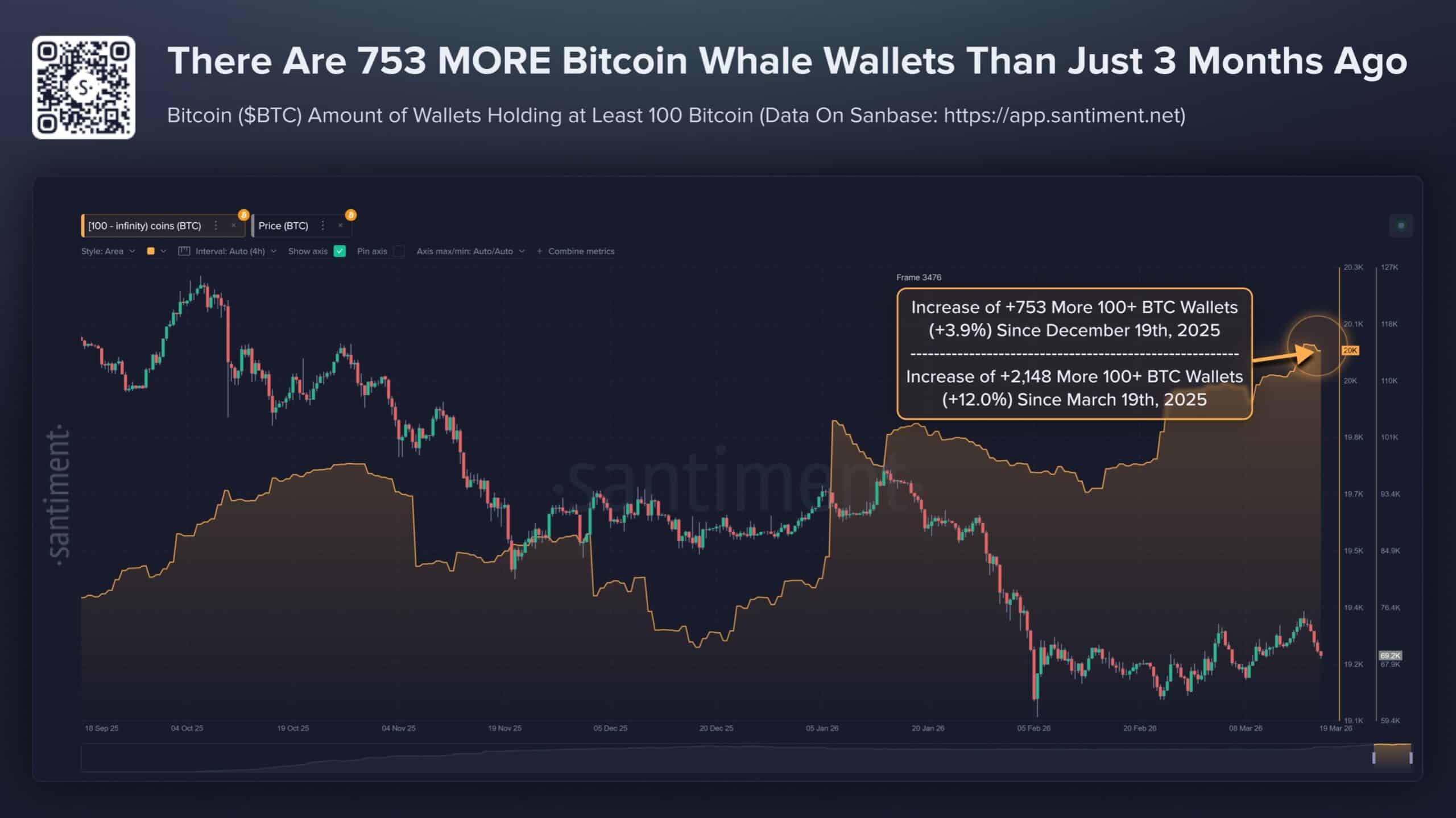
Bitcoin [BTC] declined towards $70,000 at press time, losing 20.2%, yet large holder behavior shifted upward, forming a clear divergence. As price prints lower highs through January and February, ≥100 BTC wallets rise to 20,087–20,102, adding 753 addresses.

This steady expansion during weakness shows strategic accumulation, as strong hands absorb supply released by weaker participants. As selling pressure slows, price begins stabilizing, while wallet growth remains elevated, reinforcing underlying demand.
Source: Santiment

At press time, the 100–1,000 cohort reached 18,073 wallets holding 5.193 million BTC, while addresses holding over 1,000 BTC controlled 7.14 million. As older supply stays inactive and new entities enter, liquid supply tightens, reducing downside volatility while increasing the probability of a supply squeeze that can drive a sharp upward repricing once demand returns.

Bitcoin supply tightens as ETF and whale demand align

As Bitcoin’s supply tightens under whale accumulation, ETF flows began reinforcing the same structural shift rather than offsetting it. Cumulative inflows surpassed $56.64 billion, or 713,880 BTC, while AUM nears $96.76 billion, reflecting sustained institutional entry.

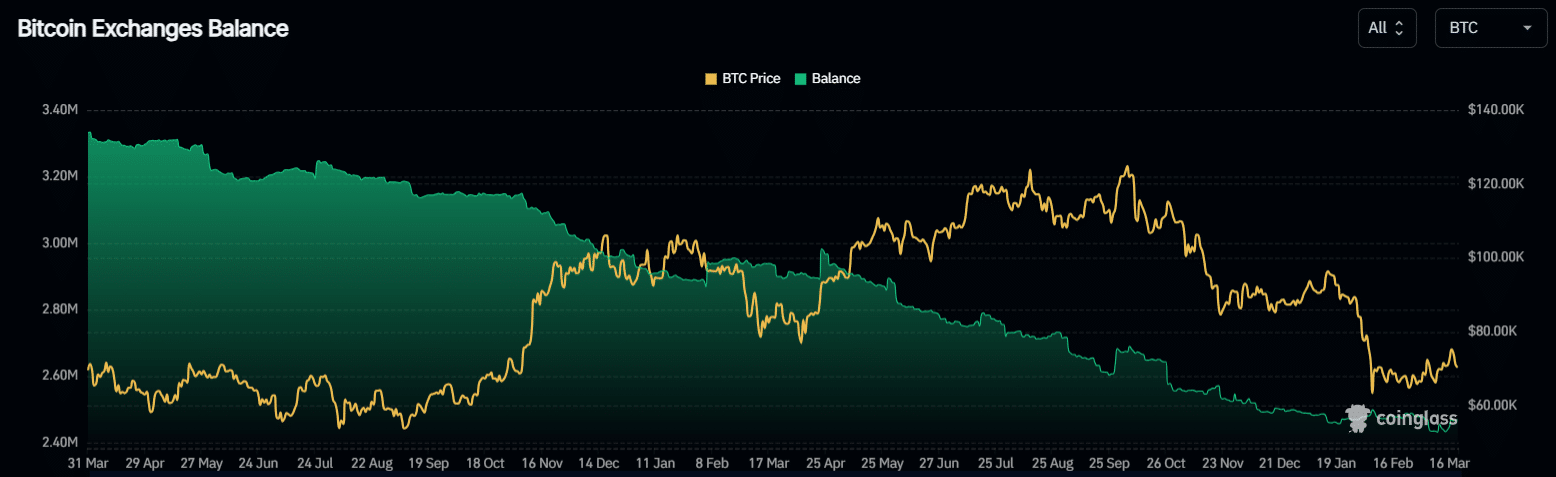
Although short-term flows fluctuate, including a -$90.20 million session, creations remain, indicating fresh demand rather than internal rotation. As this demand builds, Exchange Balances held near 2.47 million BTC, at press time but trended lower by about 5,500 BTC over 30 days, showing coins steadily leaving liquid venues.
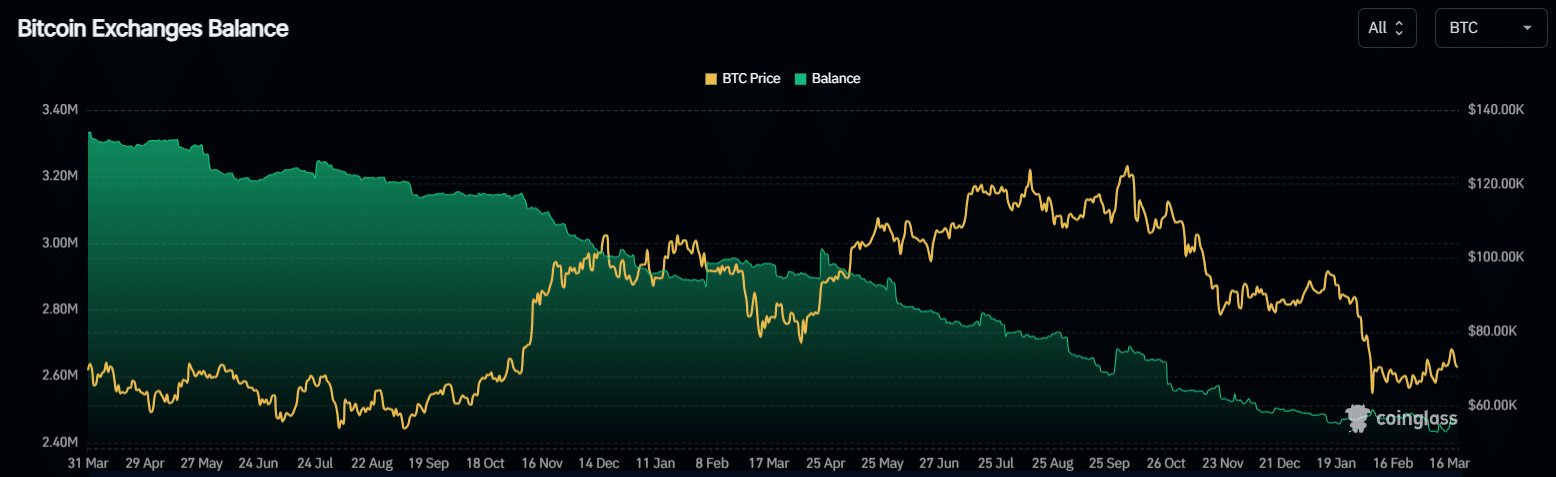
Source: CoinGlass

As buy-side pressure persists through positive spot CVD, both ETF flows and whale behavior align, absorbing available supply. This alignment reduces market slack, limits sell-side depth, and increases the likelihood of a demand-driven breakout as liquidity conditions tighten further.


ETF inflows map directly to Bitcoin supply drain

As ETF inflows expand, they translate directly into on-chain accumulation, strengthening the link between institutional demand and spot supply. BlackRock’s IBIT approaches 765,000 BTC, while FBTC holds around 187,000 BTC, lifting total custodial balances sharply.

As coins exit exchanges, they move into custodian wallets, tightening liquid supply. With ETF additions of 45,700 BTC aligning with platform outflows, capital flow remains efficient. This flow confirms real absorption, reducing available liquidity and reinforcing Bitcoin’s supply-driven market structure.


Final Summary

  • Bitcoin [BTC] shows coordinated whale accumulation and ETF-driven demand, tightening liquid supply as exchange reserves decline and custodial balances rise steadily.
  • Bitcoin faces reduced sell-side pressure and deepening supply constraints, increasing the likelihood of a demand-led breakout as liquidity conditions continue tightening.

İlgili Sorular

QHow many Bitcoin whale addresses (≥100 BTC) were added during the recent decline, and what does this indicate?

A753 new whale addresses (≥100 BTC) were added, bringing the total to 20,087–20,102. This indicates strategic accumulation by large holders during price weakness, as they absorb supply sold by weaker participants.

QWhat is the significance of the alignment between ETF inflows and whale accumulation?

AThe alignment between ETF inflows (over $56.64 billion cumulative) and whale accumulation reinforces structural supply tightening. Both mechanisms absorb available Bitcoin from the market, reducing liquid supply and increasing the probability of a demand-driven price surge.

QHow much Bitcoin is held by the 100–1,000 BTC cohort and addresses with over 1,000 BTC?

AThe 100–1,000 BTC cohort holds 5.193 million BTC, while addresses with over 1,000 BTC control 7.14 million BTC. Combined, these large holders significantly reduce liquid supply, contributing to potential supply constraints.

QWhat trend is observed in Bitcoin exchange balances, and what does it imply?

AExchange balances decreased by approximately 5,500 BTC over 30 days, trending lower to around 2.47 million BTC. This implies coins are steadily moving off liquid trading venues into custodial or long-term storage, tightening available supply and reducing sell-side pressure.

QHow do ETF inflows directly impact Bitcoin's on-chain supply?

AETF inflows (e.g., BlackRock’s IBIT holding 765,000 BTC and Fidelity’s FBTC holding 187,000 BTC) directly drain Bitcoin from exchanges into custodian wallets. This process reduces liquid supply, confirms real demand absorption, and reinforces a supply-driven market structure prone to volatility spikes.

İlgili Okumalar

Binance Rarely Publishes Article to Regulate Market Makers, Targeting 'Active Market Making' Manipulation Tactics

Binance has published a rare official blog post outlining red lines for market makers in the crypto space. While not explicitly naming any specific projects, the article is widely seen as targeting the controversial "Active Market Maker" model, where market makers borrow large amounts of tokens from projects to artificially pump prices before dumping them on retail traders. The post defines legitimate market making as providing balanced buy and sell orders to maintain liquidity and stable prices. It then lists six key risk signals, including: selling tokens contrary to vesting schedules; one-sided selling; coordinated dumping across platforms; high volume without price movement; extreme volatility in low liquidity conditions; and imbalanced volume and liquidity. Binance explicitly prohibits practices such as large-scale dumping that causes abnormal price declines, profit-sharing and guaranteed return arrangements, collusion with third parties to manipulate prices, and unclear token lending agreements. The article is believed to be a response to recent market manipulation incidents, such as the extreme volatility seen with SIREN token, where a single entity allegedly controlled 88.5% of the supply, leading to a 131% pump followed by a 59% crash. Binance warns it will take swift action against violations, including blacklisting offending market makers, and has provided a channel for reporting misconduct.

Odaily星球日报6 dk önce

Binance Rarely Publishes Article to Regulate Market Makers, Targeting 'Active Market Making' Manipulation Tactics

Odaily星球日报6 dk önce

Delphi Labs Founder: Two Weeks Deep in China's AI, Shenzhen Hardware Shocks Me, Software Valuations Scare Me

Delphi Labs co-founder José Maria Macedo spent two weeks in China meeting AI founders, VCs, and public company CEOs. His key takeaways: - **Hardware ecosystem in Shenzhen is impressive**, with systematic reverse-engineering of Western products and rapid iteration cycles. Companies like Bambu Lab are highly profitable and scaling fast. - **Software ecosystem is weaker than expected**. Chinese open-source models are strong, but closed-source models lag behind Western counterparts. GPU access remains constrained, and revenue gaps are significant (e.g., Anthropic’s $6B ARR vs. Chinese model companies at tens of millions). - **Founder profiles are highly accomplished** (top universities, Big Tech experience) but often lack rebellious, original vision. The education and VC systems favor execution over true innovation. - **Valuation bubbles exist** at both early and late stages. Some private AI companies are valued at 400x ARR, far exceeding Western multiples. Humanoid robotics is also overheating, with many pre-revenue companies targeting high-valuation IPOs. - **Information asymmetry favors Chinese founders**, who are highly informed about Western markets and tech trends. Many are building globally first, combining Chinese engineering with Western go-to-market strategies. Macedo believes the real alpha lies in finding non-traditional founders who break the "resume template" optimized by local VCs.

marsbit7 dk önce

Delphi Labs Founder: Two Weeks Deep in China's AI, Shenzhen Hardware Shocks Me, Software Valuations Scare Me

marsbit7 dk önce

Wall Street Collectively Pessimistic About 2026: Could an Oil Crisis Trigger an Economic Recession?

In late March, multiple major financial institutions—Moody's Analytics, Goldman Sachs, J.P. Morgan, and EY-Parthenon—raised their 12-month recession probability forecasts for the U.S. to over 30%. Moody’s gave the highest estimate at 48.6%, followed by EY-Parthenon at 40%, J.P. Morgan at 35%, and Goldman Sachs at 30%. A key common factor is the sharp rise in oil prices, with Brent crude surpassing $100 per barrel in early March—the first time in four years—due to supply disruptions in the Strait of Hormuz, a critical global oil transit route. Historical data indicates that four out of the five major oil price shocks since the 1970s led to economic recessions. Although the current price increase of around 80% is the smallest among them, the scale of supply disruption is described by the IEA as the largest since the 1970s energy crises. J.P. Morgan estimates that every sustained 10% increase in oil prices reduces U.S. GDP growth by 15–20 basis points. Larry Fink, CEO of BlackRock, outlined two extreme outcomes: either geopolitical resolution leads to oil prices falling to $40 and global growth, or prolonged conflict keeps prices above $100—possibly near $150—triggering a global recession. He ruled out a 2008-style systemic financial meltdown, citing stronger bank buffers. Beyond oil, declining consumer confidence and weak employment data are amplifying concerns. The convergence of pessimistic forecasts from different methodological approaches may itself influence economic behavior, potentially becoming a self-fulfilling prophecy as businesses and consumers become more cautious.

marsbit17 dk önce

Wall Street Collectively Pessimistic About 2026: Could an Oil Crisis Trigger an Economic Recession?

marsbit17 dk önce

İşlemler

Spot
Futures
活动图片