The End of the Arbitrage Era: Wall Street Withdraws from Bitcoin Basis Trading

marsbit2026-01-26 tarihinde yayınlandı2026-01-26 tarihinde güncellendi

Özet

The era of easy profits from Bitcoin basis trades is ending as Wall Street pulls back from this once-lucrative strategy. The cash-and-carry trade, which involved buying spot Bitcoin while selling futures to capture the price difference, has seen its annualized returns plummet from around 17% a year ago to just 4.7% today—barely covering funding and execution costs. This compression is largely due to increased market efficiency following the approval of spot Bitcoin ETFs, which attracted massive institutional inflows that quickly arbitraged away the premium. As a result, CME’s Bitcoin futures open interest has fallen below that of Binance for the first time since 2023, signaling a shift in market participation rather than a loss of confidence. While CME was the preferred venue for institutional basis trading, Binance’s dominance in perpetual contracts remains steady. The market is maturing: investors now have more tools—including ETFs to direct exchange access—to express directional views, reducing arbitrage opportunities. Despite lower interest rates, demand for leverage has decreased, and traders are increasingly using options and hedging strategies instead of directional bets. The decline in basis trading reflects a broader “tactical reset” as the market evolves toward more complex strategies beyond simple arbitrage.

Original Title: Wall Street Pulls Back From Bitcoin』s Money-Spinning Basis Trade
Original Author: Sidhartha Shukla,Bloomberg
Compiled by: Peggy,BlockBeats

Editor's Note: The bitcoin basis arbitrage, once seen as a "sure win," is quietly losing its appeal: the open interest on CME and Binance is shifting, and the spread has narrowed to the point where it barely covers funding and execution costs.

On the surface, this is about arbitrage opportunities being squeezed; at a deeper level, the crypto derivatives market is maturing. Institutions no longer need to rely on "arbitrage" for returns, and traders are shifting from leverage to options and hedging. The simple era of high returns is fading, and new competition will occur in more complex and sophisticated strategies.

Below is the original text:

A quiet but significant change is taking place in the crypto derivatives market: signs are emerging that one of the most stable and profitable trading strategies is now failing.

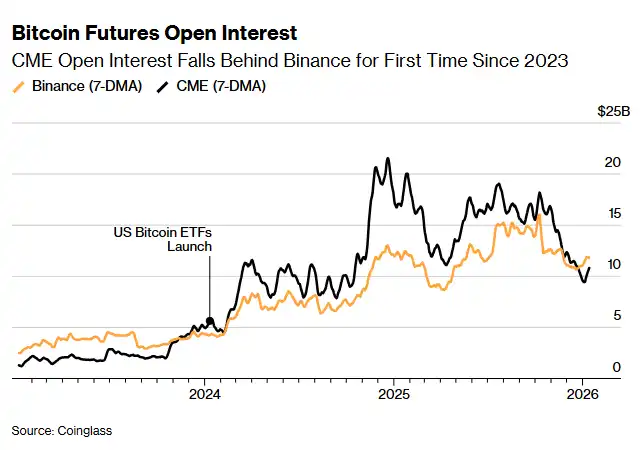
The "cash-and-carry" trade commonly used by institutions—buying bitcoin spot while selling futures to profit from the spread—is collapsing. This not only indicates that arbitrage opportunities are rapidly shrinking but also signals a deeper change in the structure of the crypto market. The open interest in Bitcoin futures on the Chicago Mercantile Exchange (CME) has fallen below that of Binance for the first time since 2023, further illustrating that as spreads narrow and market access becomes more efficient, the highly profitable arbitrage opportunities of the past are being rapidly eroded.

After the launch of spot bitcoin ETFs in early 2024, CME一度 became the preferred venue for Wall Street trading desks to execute this strategy. This operation is highly similar to the "basis trade" in traditional markets: buying bitcoin spot through an ETF while selling futures contracts to profit from the spread between the two.

In the months following the ETF approval, this so-called "delta-neutral strategy" often yielded double-digit annualized returns, attracting billions of dollars in capital—capital that was indifferent to the direction of bitcoin's price movement, caring only about capturing the yield. But it was precisely the ETF that drove the rapid expansion of this trade that also sowed the seeds of its demise: as more and more trading desks rushed in, the arbitrage spread was quickly erased. Today, the returns from this trade can barely cover funding costs.
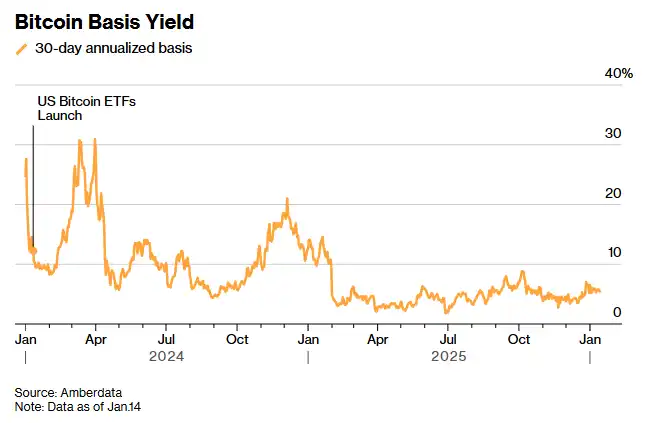
According to data compiled by Amberdata, the annualized yield for a one-month tenure is currently hovering around 5%, near recent lows. Greg Magadini, head of derivatives at Amberdata, said that around this time last year, the basis was close to 17%, but has now fallen to about 4.7%, barely enough to cover the threshold of funding and execution costs. Meanwhile, the one-year US Treasury yield is around 3.5%, making the trade's appeal fade quickly.

Against the backdrop of持续 narrowing basis, according to data compiled by Coinglass, the open interest规模 of CME Bitcoin futures has fallen from a peak of over $21 billion to below $10 billion; while Binance's open interest has remained relatively stable, at around $11 billion. James Harris, CEO of digital asset management firm Tesseract, said this change reflects more of a pullback by hedge funds and large US accounts, rather than a broad retreat from crypto assets after bitcoin prices peaked in October.

Crypto exchanges like Binance are the main venues for trading perpetual contracts. These contracts are settled, priced, and have their margin calculated continuously, often updated multiple times a day. Perpetual contracts, often abbreviated as "perps," account for the largest share of crypto market trading volume. Last year, CME also launched futures contracts with smaller notional values and longer tenors, covering crypto assets and equity indices, offering futures positions close to the spot market, allowing investors to hold contracts for up to five years without frequent rolling.

Tesseract's Harris said that historically, CME has been the preferred venue for institutional capital and "cash-and-carry" trades. He added that CME's open interest being overtaken by Binance "is a significant signal that the structure of market participation is shifting." He described the current situation as a "tactical reset," driven by lower yields and thinner liquidity, rather than a loss of market confidence.

According to a note from CME Group, 2025 is a key inflection point for the market: as the regulatory framework gradually clarifies, investor expectations for this space improve, and institutional capital begins to expand from单纯 betting on bitcoin to tokens like Ethereum, Ripple's XRP, and Solana.

CME Group stated: "Our average daily nominal open interest for Ethereum futures in 2024 was about $1 billion, and by 2025, this number has grown to nearly $5 billion."
Although the Federal Reserve's interest rate cuts have reduced funding costs, this has not driven a sustained rally in the crypto market since the collective crash of various token prices on October 10. Current borrowing demand is weak, decentralized finance (DeFi) yields are low, and traders are more inclined to use options and hedging tools rather than directly adding leverage to bet on direction.

Le Shi, Managing Director of Hong Kong at market maker Auros, said that as the market matures, traditional participants now have more channels to express directional views, from ETFs to direct access to exchanges. This increase in choice has narrowed the price differences between different trading venues, naturally compressing the arbitrage space that once drove the growth of CME's open interest.

Le said: "There is a self-balancing effect here." He believes that when market participants continuously flock to the trading venue with the lowest cost, the basis narrows, and the incentive to conduct cash-and-carry trades也随之减弱.

On Wednesday, bitcoin fell as much as 2.4% to $87,188 before paring losses. This decline一度 erased all gains for the year to date.

Bohumil Vosalik, Chief Investment Officer of 319 Capital, said the era of近乎 risk-free high returns may be over, which will force traders to turn to more complex strategies in decentralized markets. For high-frequency and arbitrage-type institutions, this means they need to look elsewhere for opportunities.

[Original link]

İlgili Sorular

QWhat is the main reason Wall Street is pulling back from Bitcoin basis trades?

AThe main reason is that the arbitrage spread has narrowed significantly, making the returns from the cash-and-carry trade barely cover the funding and execution costs, thus reducing its attractiveness.

QHow has the open interest in CME Bitcoin futures changed compared to Binance, and what does this indicate?

ACME's Bitcoin futures open interest has fallen below Binance's for the first time since 2023, dropping from a peak of over $21 billion to under $10 billion, while Binance's has remained stable at around $11 billion. This indicates a shift in market participation structure, with hedge funds and large US accounts withdrawing from basis trades, rather than a broad retreat from crypto assets.

QWhat was the annualized yield of the Bitcoin basis trade a year ago compared to now?

AA year ago, the basis trade annualized yield was close to 17%, but it has now decreased to approximately 4.7%, which is barely enough to cover funding and execution costs.

QWhat broader market shift does the decline of the basis trade signal according to the article?

AThe decline signals that the crypto derivatives market is maturing, with participants moving towards more complex strategies like options and hedging, rather than simple leveraged directional bets or arbitrage. It reflects increased market access and efficiency, narrowing price differences between venues.

QWhat new developments has CME Group noted in institutional crypto trading beyond Bitcoin?

ACME Group has observed institutional capital expanding beyond Bitcoin to include Ether, Ripple's XRP, and Solana. For example, the average daily notional open interest for Ether futures grew from about $1 billion in 2024 to nearly $5 billion in 2025.

İlgili Okumalar

Stop Paying Attention to These Zombie Projects

The crypto market in 2025 is marked by extreme contradictions: while over 20 million tokens have been launched, more than 57% have failed. A new wave of "zombie projects"—backed by top VCs and listed on major exchanges—continues to operate with minimal product development or real-world utility. This analysis highlights several疑似僵尸化 projects: - **Sleepless AI**: Once a Binance Labs incubator star, its token fell 99% from its peak. It promises AI-driven emotional companions but shows no substantial technical updates or iOS/Android app launches, raising suspicions of being a repackaged Web2 product. - **Hooked Protocol**: Its Learn-to-Earn model initially attracted users through subsidies, but token value collapsed 99% after incentives faded. Its shift to "AI-powered education" appears more like marketing than tangible tech progress. - **Saga**: Positioned as a "one-click chain launch" solution, it pivoted repeatedly between gaming and AI narratives due to lack of adoption. A $7M security breach and 99% token drop further eroded trust. - **Dymension**: Despite claiming 10,000+ RollApps, most show no activity. TVL remains low at $1.3M, and the token price dropped 99%, reflecting a ghost ecosystem. Zombie projects persist due to: 1. Capital-driven listings prioritizing narrative over substance. 2. Opaque team backgrounds enabling low-exit accountability. 3. "Narrative parasitism"—rebranding to chase trends without real development. In 2026, investors must prioritize verifiable deliverables, organic user retention beyond subsidies, and teams with consistent focus—not frequent pivots. Real value comes from projects solving actual problems, not exploiting hype.

marsbit1 dk önce

Stop Paying Attention to These Zombie Projects

marsbit1 dk önce

İşlemler

Spot
Futures

Popüler Makaleler

ERA Nasıl Satın Alınır

HTX.com’a hoş geldiniz! Caldera (ERA) satın alma işlemlerini basit ve kullanışlı bir hâle getirdik. Adım adım açıkladığımız rehberimizi takip ederek kripto yolculuğunuza başlayın. 1. Adım: HTX Hesabınızı OluşturunHTX'te ücretsiz bir hesap açmak için e-posta adresinizi veya telefon numaranızı kullanın. Sorunsuzca kaydolun ve tüm özelliklerin kilidini açın. Hesabımı Aç2. Adım: Kripto Satın Al Bölümüne Gidin ve Ödeme Yönteminizi SeçinKredi/Banka Kartı: Visa veya Mastercard'ınızı kullanarak anında Caldera (ERA) satın alın.Bakiye: Sorunsuz bir şekilde işlem yapmak için HTX hesap bakiyenizdeki fonları kullanın.Üçüncü Taraflar: Kullanımı kolaylaştırmak için Google Pay ve Apple Pay gibi popüler ödeme yöntemlerini ekledik.P2P: HTX'teki diğer kullanıcılarla doğrudan işlem yapın.Borsa Dışı (OTC): Yatırımcılar için kişiye özel hizmetler ve rekabetçi döviz kurları sunuyoruz.3. Adım: Caldera (ERA) Varlıklarınızı SaklayınCaldera (ERA) satın aldıktan sonra HTX hesabınızda saklayın. Alternatif olarak, blok zinciri transferi yoluyla başka bir yere gönderebilir veya diğer kripto para birimlerini takas etmek için kullanabilirsiniz.4. Adım: Caldera (ERA) Varlıklarınızla İşlem YapınHTX'in spot piyasasında Caldera (ERA) ile kolayca işlemler yapın.Hesabınıza erişin, işlem çiftinizi seçin, işlemlerinizi gerçekleştirin ve gerçek zamanlı olarak izleyin. Hem yeni başlayanlar hem de deneyimli yatırımcılar için kullanıcı dostu bir deneyim sunuyoruz.

262 Toplam GörüntülenmeYayınlanma 2025.07.17Güncellenme 2025.07.17

Tartışmalar

HTX Topluluğuna hoş geldiniz. Burada, en son platform gelişmeleri hakkında bilgi sahibi olabilir ve profesyonel piyasa görüşlerine erişebilirsiniz. Kullanıcıların ERA (ERA) fiyatı hakkındaki görüşleri aşağıda sunulmaktadır.

活动图片