Shiba Inu has experienced a drop in holders as on-chain activity declines.
Regardless, ETH whales have continued to accumulate the token.
Token burning is growing rapidly as use cases for SHIB increase.
Sensational meme coin Shiba Inu has seen an overnight drop in active holders as it appears holders of the asset are continually fleeing the crypto asset. However, Ethereum whales in recent times have seized the opportunity to accumulate more of the asset.
60,000 Holders Lost
Over the past 30 days, Shiba Inu has dropped to $0.00002358, a plunge of about 7%. Analysts have attributed the decline to the reduced activity on the network. Notably, the network has experienced a decline in the number of holders in the last 10 days in contrast to the 3 months of growth it has experienced in its user base.
Etherscan shows that the network currently has 1,138,243 holders compared to 1,199,789 holders just over a week ago, a staggering drop of over 60,000 holders representing a loss of about 4.8%. As a result, there has been a significant decline in on-chain activity, likely the cause of the recent dip.
SHIB Experiences Price Decline As ETH Whales Continue To Accumulate The Meme Coin
Source: CoinMarketCap
There are speculations that some SHIB holders are moving over to Bitgert, preferring the project to SHIB because it has developed its blockchain. Whatever may be the case, the price dips have created attractive opportunities for Ethereum whales to swoop in and further accumulate the asset.
A whopping 3 trillion SHIB has been accumulated by Ethereum whales over the last 5 days. WhaleStats data revealed that the 207th largest Ethereum whale had purchased 271,370,420,630 SHIB worth about $6.5 million in a single transaction.
SHIB is currently trading around the $0.0000245 price point. CoinMarketCap data shows that the asset is up 1.44% in the last 24 hours, recovering from some of the overnight upsets. Its daily trading volume is also up 5.73% at around $545.3 million.
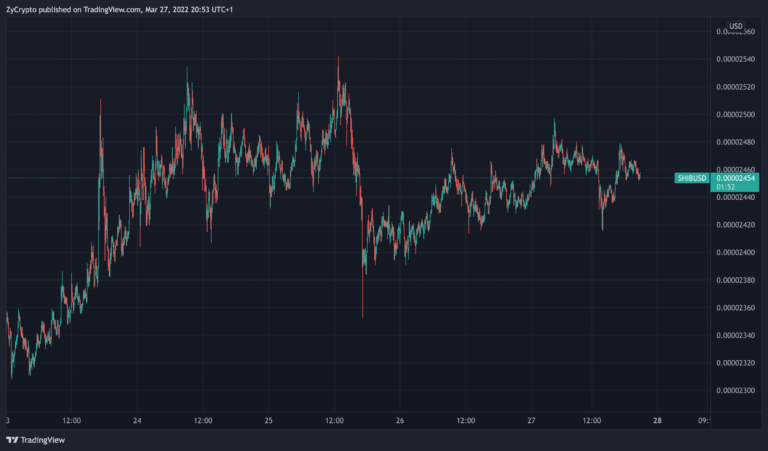
SHIBUSD Chart by TradingView
SHIB Burns And Project Developments
One of the major reasons Ethereum whales are interested in the popular meme coin is the growing rates of token burning and the development of new projects. In a tweet days ago, CEO of Bigger Entertainment, Steven Cooper, disclosed that the Shiba Inu community had burned 263.4 billion SHIB since last October.
By burning SHIB tokens, the community increases the scarcity of the asset, which can positively impact the price with the right demand. At the same time, use cases for the token are increasing with institutions like the AMC theatres accepting the meme coin for payments, and there are plans for the Shiba Inu community to build around the metaverse.
Shiba Inu last year was the most popular cryptocurrency, beating even Bitcoin to the title. The sensational meme coin surged an unbelievable 45,000,000% within the year on the sheer drive of the community alone.