Bitcoin price rallies to $19K, but analyst says a $17.3K retest could happen next

Cointelegraph2023-01-13 tarihinde yayınlandı2023-01-13 tarihinde güncellendi

Özet

Bitcoin price hit a year-to-date high near $19,000 as pro traders used leverage to propel the pump, but derivatives data hints at reasons for BTC price to retest $17,300.

Bitcoin price has gained 15% in the past 13 days, and during this timeframe, traders’ bearish bets in BTC futures were liquidated in excess of $530 million compared to bulls.

After rallying to $19,000 on Jan. 12, Bitcoin reached its highest price since the FTX exchange collapse on Nov. 8. The move was largely fueled by the United States Consumer Price Index (CPI) expectation for December, which matched consensus at 6.5% year-over-year — highlighting that the inflationary pressure likely peaked at 9% in June.

Furthermore, on Jan. 11, FTX attorney Andy Dietderich said $5 billion in cash and liquid cryptocurrencies had been recovered — fueling hopes of partial return of customer funds in the future. Speaking to a U.S. bankruptcy judge in Delaware on Jan. 11, Dietderich stated that the company plans to sell $4.6 billion of non-strategic investments.

Let’s look at derivatives metrics to understand whether professional traders are excited about Bitcoin’s rally to $19,000.

Margin use increased as Bitcoin price rallied to $18,300 and above

Margin markets provide insight into how professional traders are positioned, and margin is beneficial to some investors because it allows them to borrow cryptocurrency to leverage their positions.

For instance, one can increase exposure by borrowing stablecoins to buy Bitcoin. On the other hand, Bitcoin borrowers can only short the cryptocurrency as they bet on its price declining. Unlike futures contracts, the balance between margin longs and shorts isn’t always matched.

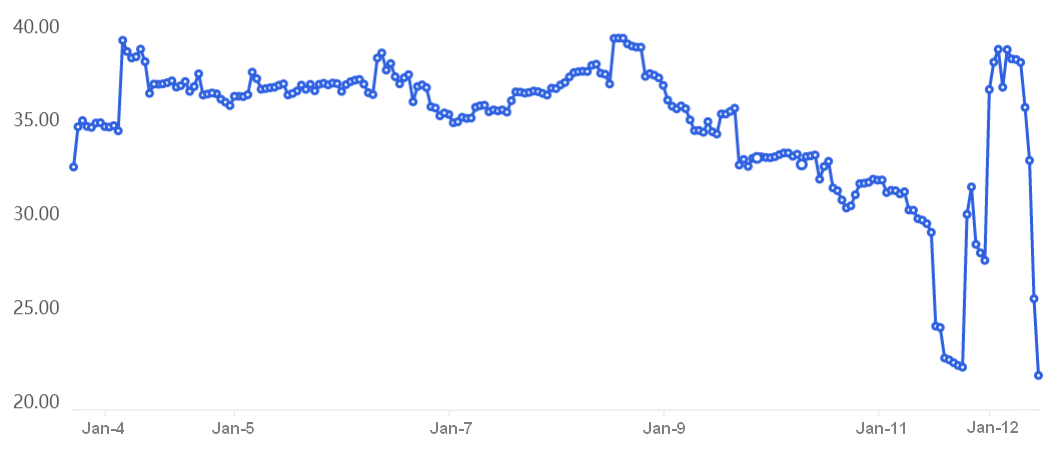
The above chart shows that OKX traders’ margin lending ratio firmly increased on Jan. 11, signaling that professional traders added leverage longs as Bitcoin rallied toward $18,300.

More importantly, the subsequent 2% correction on Jan. 12 that led Bitcoin to a $17,920 low marked the complete margin reversal, meaning whales and market makers reduced their bullish positions using margin markets.

Presently at 21, the metric favors stablecoin borrowing by a wide margin, indicating that bears are not confident about opening Bitcoin margin shorts.

Futures traders ignored the Bitcoin price pump

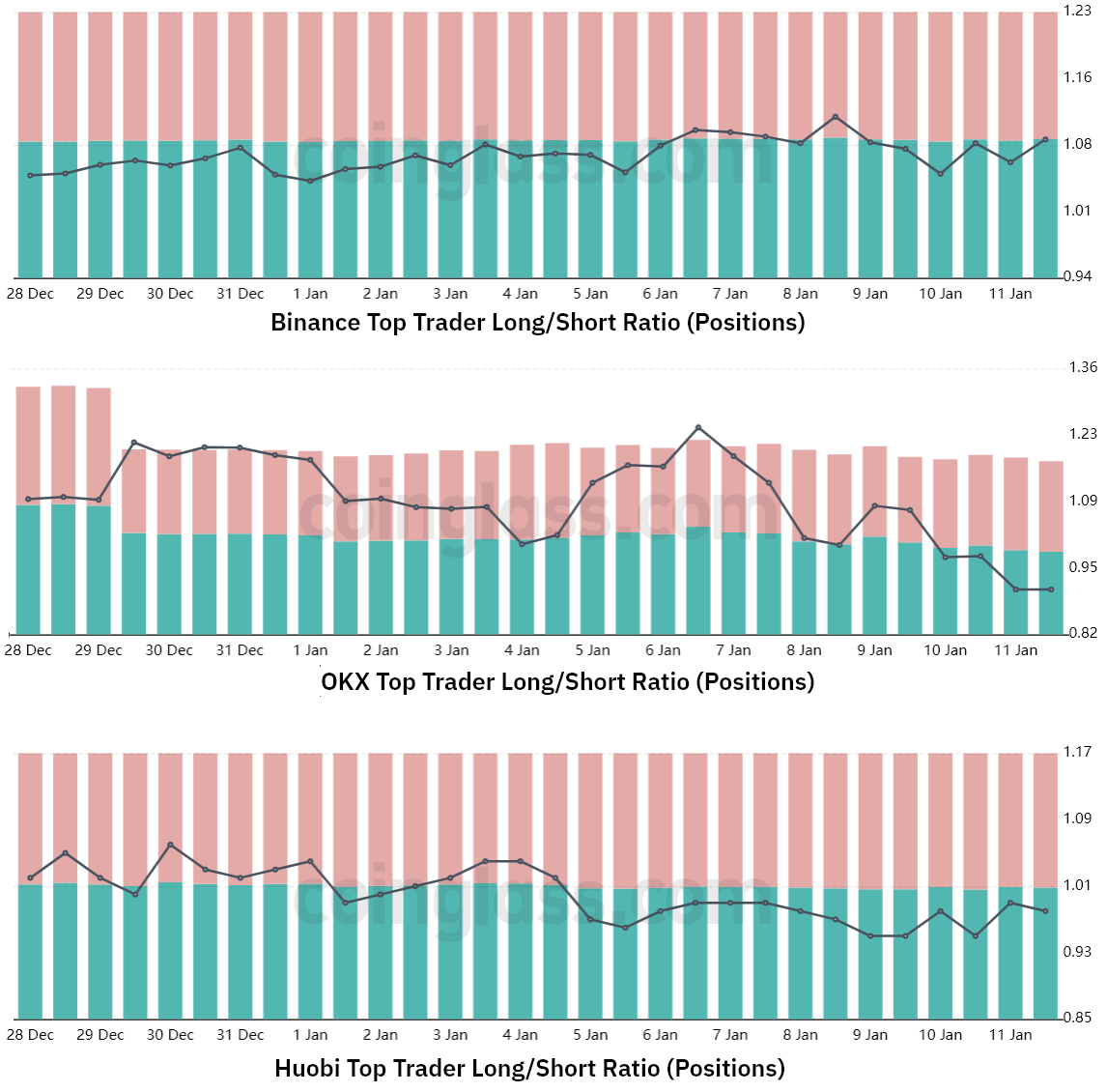
The long-to-short metric excludes externalities that might have solely impacted the margin markets. In addition, it gathers data from exchange clients’ positions on the spot, perpetual and quarterly futures contracts, thus offering better information on how professional traders are positioned.

There are occasional methodological discrepancies between different exchanges, so readers should monitor changes instead of absolute figures.

Exchanges' top traders Bitcoin long-to-short ratio. Source: Coinglass

Even though Bitcoin broke above the $18,000 resistance, professional traders have kept their leverage long positions unchanged, according to the long-to-short indicator.

For instance, the ratio for Binance traders stood firm at 1.08 from Jan. 9 until Jan. 12. Meanwhile, top traders at Huobi reduced their leverage longs as the indicator moved from 1.09 to the present 0.91. Lastly, at crypto exchange OKX, the long-to-short slightly increased favoring longs, moving from 0.95 on Jan. 9 to the current 0.97.

Traders using futures contracts were not confident enough to add leveraged bullish positions despite the price increase.

Bitcoin price could retest $17,300

While the margin data shows that sizable leverage was used to push Bitcoin above $18,000, it suggests that the situation was only temporary. Most likely, those professional traders deposited more margin and consequently reduced their leverage after the event. In essence, the metric looks very healthy because it indicates that margin markets are not overbought.

As for the top trader’s long-to-short, the absence of demand for leverage longs using futures contracts is somewhat concerning, but at the same time, it leaves room for additional purchasing power.

From a derivatives standpoint, even if Bitcoin retests $17,300, the bulls should not be concerned because the derivatives indicators show little demand from short sellers and no excessive leverage from buyers.


İlgili Okumalar

The Full Story Behind Encryption Unicorn Blockstream's Deep Entanglement in Serious Fraud Allegations

This article details allegations of serious fraud surrounding the crypto company Blockstream, founded by Bitcoin pioneer Adam Back. Investigation account NatInfoSec accuses Blockstream of raising billions through its Blockstream Mining Note (BMN) products, which offer high fixed yields of up to 20% from purported mining revenue. The core allegations are: 1) Blockstream's public mining hash rate (15 EH/s) appears insufficient to cover the massive payout obligations from sold BMN notes, raising questions about the true source of investor payouts. 2) Key executive Christopher William Cook, central to the mining operations, has a prior federal conviction for mail fraud, a fact not disclosed to investors. Cook's background and lavish lifestyle are highlighted as red flags. 3) The structure allows payouts from any source of BTC, not necessarily mining revenue, which critics argue gives it Ponzi-like characteristics. The controversy also touches on Bitcoin Standard Treasury Company (BSTR), a related entity planning a SPAC上市. Critics question whether BMN's liabilities and Cook's record should be disclosed in BSTR's filings. BitMEX Research offered a tempered analysis, confirming Cook's criminal record is likely true and the high yields concerning, but found other claims like insufficient抵押证据 less substantiated. Community debate centers on the need for verifiable proof of Blockstream's mining output and revenue. The article concludes that while fraud is not proven, BMN presents significant, unresolved questions regarding its actual scale, the source of its high fixed returns, the verifiability of its mining operations and payouts, and the full disclosure of associated risks and personnel backgrounds. Blockstream has not yet issued a formal response.

链捕手56 dk önce

The Full Story Behind Encryption Unicorn Blockstream's Deep Entanglement in Serious Fraud Allegations

链捕手56 dk önce

a16z: In the AI Era, Company Competition for Talent Starts with Job Title Naming

The article discusses how companies in the AI era are competing for talent through strategic "title arbitrage," or the renaming of key roles to reflect and attract new, high-value capabilities. It uses Palantir's creation of the "Forward-Deployed Engineer" (FDE) as a prime example. This title reframed client-facing technical work from a peripheral "implementation" role into a core, high-status engineering function. The move was strategic, allowing Palantir to attract talent that blended technical skill with business acumen and to dominate the market's perception of this capability. The piece argues that job titles are an organizational language that signals the value and authority of certain work. Effective new titles, like "Data Scientist" or "Site Reliability Engineer," emerge when a role's strategic importance genuinely outgrows its old name. Conversely, mere title inflation without substantive change is ineffective. For AI companies, particularly in B2B, this is a crucial strategy. AI transformation creates new high-leverage roles (e.g., "Legal Engineer," "GTM Engineer") that combine domain expertise with technical automation. By naming these roles, a company can help clients internally legitimize these change-makers. This, in turn, builds market mindshare, associating the company with the new capability. In conclusion, as AI blurs the lines between product and service, the ability to accurately name and organize the critical, client-adjacent work that defines product learning will be a key competitive advantage. The first to define this new organizational language plants a flag in the market's mind.

marsbit2 saat önce

a16z: In the AI Era, Company Competition for Talent Starts with Job Title Naming

marsbit2 saat önce

İşlemler

Spot
Futures
活动图片