ApeCoin Becomes The Most Traded Token Among Ethereum Whales

CryptoPotato2022-03-25 tarihinde yayınlandı2022-03-25 tarihinde güncellendi

Özet

The Bored Ape Yacht Club took the NFT scene by surprise and now its token Apecoin has just become the favorite among crypto whales.

Talking about NFT is talking about the Bored Ape Yacht Club (BAYC) collection, which has provided 145,000%+ profits for anyone who bought at the minimum price less than a year ago. And a similar thing is happening with its new token Apecoin.
ApeCoin (APE) has become the most traded token by Ethereum whales over the past 24 hours, reaching a holder count of over 36,500 wallets just 6 days after being listed on the largest cryptocurrency exchanges.
This means that the bet on APE is as important as the one on the NFT collection per se.
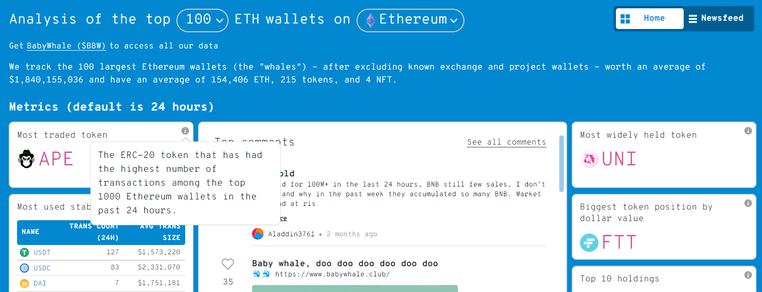
Apecoin Data. Image Whalestats Why Has ApeCoin Been So Successful?
As CryptoPotato recently reported, APE Coin is the native cryptocurrency of the BAYC ecosystem. Since its launch, each BAYC holder was awarded 10,094 APEs ($128,000) for each NFT they held as a reward. Those with a Mutant Ape (MAYC) received 2,042 APEs ($26,068).
In other words, they rewarded their buyers’ loyalty by giving them 62% of the total supply of APE tokens.
Introducing ApeCoin ($APE), a token for culture, gaming, and commerce used to empower a decentralized community building at the forefront of web3. 🧵
— ApeCoin (@apecoin) March 16, 2022
On the other hand, Yuga Labs, BAYC’s parent company, will keep a total supply of 16% to continue developing new products and tools such as the game “Otherside,” which is expected to be launched by the end of 2022.
In addition to this and thanks to their social media fame, Yuga Labs has obtained the rights for two of the most iconic NFT collections of all time, such as CryptoPunks and Meebits.
Some big news to share today: Yuga has acquired the CryptoPunks and Meebits collections from @LarvaLabs, and the first thing we’re doing is giving full commercial rights to the NFT holders. Just like we did for BAYC and MAYC owners. pic.twitter.com/lAIKKvoEDj
— Yuga Labs (@yugalabs) March 11, 2022
The BAYC And Its Debut in Crypto Gaming
Another critical factor in the success of BAYC has undoubtedly been the marketing strategy that Yugal Labs deployed, turning the new native cryptocurrency into the token used by several crypto games for their NFT transactions.
For example, Animoca Brands, a software company dedicated to developing and distributing free-to-play games, announced the adoption of ApeCoin for a secret project being developed alongside BAYC. The day after the announcements, Yuga Labs posted a video showing the company’s star character drinking a beverage that teleports him to another world where the CryptoPunks and other NFT characters are portrayed.
See you on the Otherside in April. Powered by @apecoin pic.twitter.com/1cnSk1CjXS
— Yuga Labs (@yugalabs) March 19, 2022
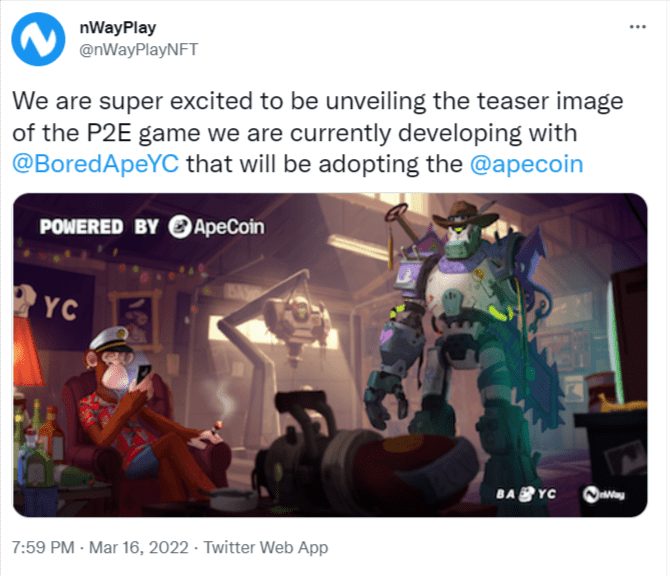
nWayPlay, is another game developer that announced its collaboration with BAYC to create a new crypto game that will adopt the APE token and offer Play to earn (P2E) functionalities to its users. Although the game is not yet available, the quality of images it offers suggests that it will give a lot to talk about in the ecosystem.
The team behind BAYC has had a very demanding and promising start to the year, so we will likely continue to see news that will help drive the adoption of the project, which is practically selling itself.


İlgili Okumalar

Lost 10 Billion, Yet Valued at 46.7 Billion? The True Value Revelation of Japan's Crypto Exchange 'Doomsday License'

**Summary: The Priceless "Doomsday License" – Why Japan's SBI Paid $289M for a Losing Exchange** In mid-2026, Japanese financial giant SBI Holdings acquired cryptocurrency exchange Bitbank for ¥46.7 billion (~$289 million). This valuation is puzzling on paper: Bitbank, while a long-established, licensed exchange, reported a ¥970 million loss in 2025 on shrinking revenues. The key lies not in profitability, but in a regulatory "franchise scale." SBI's purchase was for Bitbank's scarce, irreplaceable assets: its Japanese FSA license, 960,000 user accounts, and a fully compliant yen on-ramp. This acquisition came just two weeks after Japan passed a landmark amendment reclassifying crypto assets as "financial instruments" under stricter laws, dramatically raising penalties for unlicensed operations. Analysts predict up to half of Japan's ~30 licensed exchanges may exit, transforming existing licenses into non-renewable strategic resources. The deal's ~8x revenue multiple mirrors a global trend of "compliance arbitrage," where acquiring regulated entities is faster and cheaper than navigating complex, years-long licensing processes. The Japanese narrative is part of a worldwide pattern. In 2026 alone, the crypto sector saw $11.8 billion in M&A, with giants like Mastercard and Bullish acquiring regulated digital asset firms. As jurisdictions like the US, Singapore, and Hong Kong solidify frameworks, regulatory compliance shifts from a cost center to the most durable moat. The core lesson is that in maturing markets, the true value shifts from trading volume to "licensed scale." For early, compliant platforms, stringent regulation becomes a defensive asset, not a constraint. SBI's strategy of consolidating licensed Japanese exchanges illustrates this. The window to acquire such "tickets to the future financial world" at a reasonable cost is rapidly closing as global capital recognizes that in the regulated era, the license itself is the ultimate prize.

marsbit9 dk önce

Lost 10 Billion, Yet Valued at 46.7 Billion? The True Value Revelation of Japan's Crypto Exchange 'Doomsday License'

marsbit9 dk önce

Interpreting the Latest Report from the Ethereum Foundation: Why Are Governments and Giants Focusing on Ethereum?

Decoding the Ethereum Foundation's Latest Report: Why Governments and Giants Are Eyeing Ethereum? Authored by Lanhu Notes, this piece unpacks a key report from the Ethereum Foundation's global policy team. The report, released on July 2, makes a case for why governments and institutions should view Ethereum as the optimal platform for deployment. It highlights Ethereum's unique position as the closest existing platform to a "digital public infrastructure" – a neutral, open, and uncontrolled protocol for handling value, contracts, and coordination, akin to TCP/IP for the internet. The core arguments are: 1. **Maximal Neutrality & No Single Control Point**: Ethereum has no central owner, backdoor, or kill switch. It's maintained by thousands of independent nodes and hundreds of thousands of validators globally, making it resistant to unilateral control by any single entity—a critical feature for sovereign and institutional users. 2. **Proven Resilience & Unmatched Security**: Since its 2015 launch, Ethereum has maintained a perfect uptime record. Its security is backed by approximately $76 billion in staked ETH (as of March 2026), making any attack economically irrational and prohibitively expensive (estimated over $50 billion). 3. **Large-Scale Real-World Adoption**: The network hosts over $159 billion in stablecoins. Major financial institutions like BlackRock and JPMorgan are already using it for real-world asset (RWA) tokenization. Governments, including Bhutan and India, are deploying it for applications like national digital identity and tamper-proof land registries. 4. **Comparative Advantages**: Ethereum offers greater transparency and lower costs than traditional intermediaries. It is more open and neutral than permissioned/private chains. Compared to other public blockchains, it boasts superior maturity, the largest developer ecosystem, the biggest economy, and the highest proven security. In summary, the report positions Ethereum, backed by data, real-world use cases, and clear comparisons, as the emerging neutral public layer for global value settlement and coordination.

marsbit10 dk önce

Interpreting the Latest Report from the Ethereum Foundation: Why Are Governments and Giants Focusing on Ethereum?

marsbit10 dk önce

Aave V4 to Move Wall Street Securities Financing On-Chain: Composability Layer Transforms from Risk Point to Backbone

Aave V4 aims to bring Wall Street securities financing on-chain, targeting the massive traditional markets for repo, securities lending, and margin financing. It proposes three core products: securities-backed loans, atomic repo settlements, and securities lending. This shifts the narrative from "RWA as collateral" to building foundational "on-chain securities finance infrastructure." The key innovation lies in its third-layer approach: composability. V4 doesn't alter underlying asset credit but systematically connects all on-chain assets to leverage and liquidation mechanisms, making composability the system's backbone instead of just a risk point. Aave's dominant market share and its relatively prudent engineering for its Horizon institutional RWA lending market support this ambition. However, a critical design choice introduces a new risk dimension. The "centralized liquidity Hub + multiple Spoke" architecture and Horizon's shared liquidity pools prioritize capital efficiency by allowing new assets instant access to deep liquidity. The trade-off is the loss of risk isolation: a problem with one collateral type in a stress period can draw from the same stablecoin pool backing all others, spreading risk across the entire market. This risk is not theoretical, as demonstrated by a 2026 incident where compromised collateral from a bridge attack created bad debt on Aave. As the system scales—with Horizon targeting over $1B—it remains untested in a genuine credit or liquidity crisis. The first significant bad debt or forced liquidation in RWA markets will likely be triggered by a price/net asset value dislocation of a tokenized asset during stress, not by an underlying default. The implications are clear: institutions providing collateral must account for potential NAV-price gaps; liquidity providers must understand they are exposed to all collateral in a shared pool; and protocols must explicitly choose between risk isolation and capital efficiency. The market still focuses primarily on credit risk, while tokenization continues to concentrate new risks in the liquidity and composability layers.

marsbit14 dk önce

Aave V4 to Move Wall Street Securities Financing On-Chain: Composability Layer Transforms from Risk Point to Backbone

marsbit14 dk önce

Ethereum Forms Three Major Power Centers, Commercial Lifeline Held in the Hands of Major ETH Holders

Ethereon has established a new tripartite power structure to separate its core protocol development from commercialization efforts. The Ethereum Foundation, having lost several executives, now focuses solely on maintaining protocol principles like neutrality and censorship resistance. To handle business outreach and technical advancement, two new independent entities have been formed: Ethereum Institutional, which is dedicated to promoting Ethereum's tokenization and stablecoin use to major banks and asset managers, and Ethlabs, a research group focused on improving on-chain settlement and strengthening ETH's monetary narrative. Both organizations are funded by major ETH holders Bitmine and Sharplink, who collectively control over 5.4% of ETH's circulating supply. This structure aims to resolve the conflict between the Foundation's neutral stance and the need for aggressive commercialization. The success of this model is tied directly to ETH's price performance. Bullish prospects rely on Ethereum's dominant position in stablecoins, DeFi, and tokenized assets, with potential growth fueled by institutional adoption facilitated by the new entities. Bearish risks highlight ETH's price volatility and the dependency of the new organizations on their funders' financial health, which is itself linked to ETH's value. The future trajectory of this institutional framework will be largely determined by which of these market trends prevails.

Foresight News15 dk önce

Ethereum Forms Three Major Power Centers, Commercial Lifeline Held in the Hands of Major ETH Holders

Foresight News15 dk önce

İşlemler

Spot
活动图片