WSJ: Elon Musk’s Twitter Poll Shows Users Want Him to Step Down as CEO

Wall Street Journal2022-12-20 tarihinde yayınlandı2022-12-26 tarihinde güncellendi

Özet

After billionaire asks on social-media platform whether he should stay or go, 58% of respondents say he should go

Twitter Inc. faced new uncertainty after a majority of respondents voted in an online poll for Elon Musk to step down as chief, amid broader concerns about how the billionaire is managing his businesses.

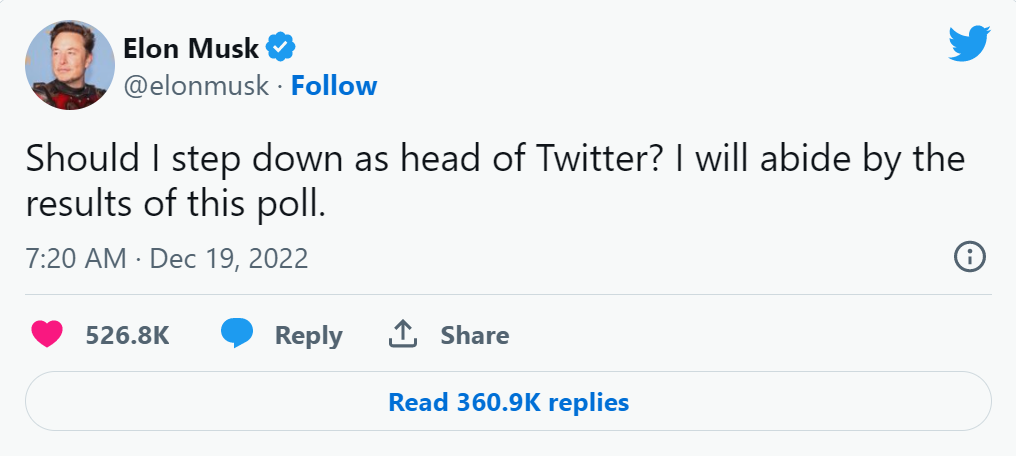
In the 12-hour poll, which Mr. Musk initiated and which closed after 6 a.m. ET Monday, 58% of the more than 17 million Twitter users who voted said he should leave as head of Twitter. Mr. Musk had said when he launched the Twitter poll on Sunday that he would abide by the results.

The result shows how Mr. Musk’s ownership of Twitter has put him in a bind. He has embroiled himself in a series of controversial statements and decisions at the social-media platform that have alienated some users and advertisers, compounding financial problems at a company he bought in a deal valued at $44 billion in late October. Meanwhile, some shareholders in Tesla Inc., which he also runs, have complained that he is distracted by Twitter at the same time the electric-vehicle maker’s share price has been falling and he has been selling parts of his stake.

Mr. Musk now must find someone to take a job running Twitter that he has said no contenders seem qualified for—and even if he finds such a person, Mr. Musk would remain unavoidably involved as the company’s owner.

There is little precedent for Mr. Musk relinquishing control at his major businesses, although he has a deputy at his SpaceX rocket company, where he is chief executive. With Twitter, most of the prior leadership was either fired or left after he took over.

“No one wants the job who can actually keep Twitter alive. There is no successor,” Mr. Musk tweeted Sunday.

Twitter didn’t respond to a question on the poll’s outcome.

Mr. Musk on Monday responded to someone on Twitter who had suggested the results might have been rigged. “Interesting,” Mr. Musk tweeted.

Mr. Musk has warned about Twitter’s financial condition, saying last month that the company had suffered “a massive drop in revenue” and was losing more than $4 million a day. He later raised the possibility of bankruptcy.

Irrespective of whom Mr. Musk might appoint to be the titular head of the company, his own massive financial stake in the business means he remains closely tied to stemming losses at a company that the new owner himself has said he overpaid for.

Mr. Musk’s team this past week reached out for potential fresh investment for Twitter at the same price as the original $44 billion deal, a Twitter investor said.

Some Tesla shareholders have complained that Mr. Musk’s recent focus on Twitter is hurting the auto maker. This month he sold more than $3.5 billion of Tesla stock in his second round of sales since buying Twitter. It wasn’t clear what prompted Mr. Musk to sell additional Tesla stock.
Meanwhile, concerns are growing that Twitter’s problems might infect other parts of Mr. Musk’s business empire. Oppenheimer

The billionaire’s leadership at Twitter has been tumultuous and weighed on sentiment toward his other businesses, particularly car maker Tesla. Shares in the auto maker have fallen more than 56% this year, frustrating some individual investors who partly blame Mr. Musk’s focus on Twitter for the decline. Mr. Musk’s Twitter involvement also has dented Tesla’s brand image.

Tesla shares initially advanced on Monday after the suggestion that Mr. Musk would stop running Twitter, although they closed lower along with the broader market.

There have been questions since Mr. Musk first showed interest in buying Twitter about how he would juggle running the company while also pursuing all his other endeavors.

Bill Nelson, the National Aeronautics and Space Administration’s administrator, said this month he had asked SpaceX President

Mr. Musk said last month that he had too much work on his plate.

“I expect to reduce my time at Twitter and find somebody else to run Twitter over time,” he testified at a trial about his Tesla pay package last month. He also said he has been spending most of his time of late focusing on Twitter. At the time, he wrote on Twitter, “I will continue to run Twitter until it is in a strong place, which will take some time.”

The outcome of the poll adds another disruption at the top of Twitter, which has suffered waves of leadership upheaval. Co-founder and former CEO Jack Dorsey handed over running the company a little over a year ago after a bruising battle with an activist investor. His successor, Parag Agrawal, lasted less than a year and was fired by Mr. Musk immediately after he took over the company in October. Mr. Musk also ousted several other top Twitter executives, and more have left since.

Mr. Musk has been the driving force at Twitter for nearly two months, with many advertisers having paused spending, mass layoffs and resignations, and content-moderation actions that have been abrupt and controversial among many users. This past week has been another one full of twists. Twitter suspended the accounts of several journalists, prompting criticism from some lawmakers and officials before Mr. Musk said Saturday that Twitter would begin reinstating the accounts.

Earlier Sunday, Twitter made another sudden change to its content-moderation rules, saying it would no longer allow “free promotion of certain social media platforms.” That also fueled criticism and questions, including from Mr. Dorsey, who previously endorsed Mr. Musk’s takeover. “Doesn’t make sense,” Mr. Dorsey tweeted Sunday.

The policy also irked Paul Graham, a well-known venture-capital investor who called it “the last straw” and signaled he was decamping Twitter for rival social-media platform Mastodon. Soon after, his account was suspended, before being restored.

Late Sunday, the tweets from @TwitterSupport and a note on the company’s website announcing the policy against promoting other social-media platforms appeared to have been deleted. Twitter’s head of trust and safety, Ella Irwin, said Monday that the company removed the new policy “in response to user feedback.” Ms. Irwin said that links to other social-media sites will be allowed until Twitter determines whether or not to implement a new policy prohibiting them.

Mr. Musk, who has said he intends to make the platform a bastion of free speech, appeared to acknowledge some concerns about the recent, abrupt content-policy changes. “Going forward, there will be a vote for major policy changes. My apologies. Won’t happen again,” he tweeted shortly before posting the poll about his leadership Sunday.

Sen. Elizabeth Warren (D., Mass.) on Sunday sent a letter to Tesla’s board chair, Robyn Denholm, suggesting that Mr. Musk’s involvement with Twitter could be to the detriment of the auto maker’s shareholders. The senator has battled before with Mr. Musk.

Tesla didn’t respond to a request for comment about the share sale or the senator’s letter.

İlgili Okumalar

From Corning to Ciena: The 10x Opportunity in the AI Optical Communication Chain

The transition from copper to optical communication in AI data centers is creating significant investment opportunities beyond just chipmakers. The entire photonics supply chain, from glass and fiber to connectors and test equipment, is critical. Corning, a key fiber supplier, has locked in multi-billion dollar, multi-year contracts with major cloud providers (Meta, Amazon, Google, Microsoft, OpenAI, NVIDIA), demonstrating pricing power and scale. Its profit growth is outpacing revenue growth. In the interconnect layer, Amphenol benefits from high growth in AI data centers, driven by strategic acquisitions and operational efficiency, while Credo Technology acts as a bridge between copper and optical solutions, though with high customer concentration risk. At the systems level, Ciena enables higher data capacity on existing fiber lines, with a strong backlog and cloud customer adoption. Further upstream, AXT is a bottleneck supplier of key indium phosphide wafers for lasers but faces geopolitical supply chain risks. VEO Solutions provides essential testing equipment for the entire photonics industry. A new pure-play photonics ETF (FOTO) offers a consolidated investment approach. The core thesis is that the physical limits of copper are driving an inevitable shift to optical technologies, with wealth flowing to essential, often overlooked, suppliers across the photonics value chain.

marsbit13 dk önce

From Corning to Ciena: The 10x Opportunity in the AI Optical Communication Chain

marsbit13 dk önce

Collector Crypt's DAU Is Only 800, Yet It's Already One of Crypto's Most Profitable Projects?

"Collector Crypt: A Highly Profitable Crypto Project with Only 800 Daily Active Users?" Collector Crypt (CARDS) is a crypto project tokenizing physical graded trading cards (primarily Pokémon) on Solana, achieving significant real-world profitability and growth. According to a Maelstrom Fund analysis, it generated approximately $53M in annualized profit in May, with a June run-rate nearing $109M, against a $550M FDV. Its core revenue driver is a digital pack-opening 'Gacha' system. The platform bulk-buys cards at a 5-15% discount. Users can open digital packs and choose to keep cards or sell them back to the platform at a 7-15% discount to market price. Most users sell back common cards, creating an efficient model: users get packs with a ~2% positive expected value, while Collector Crypt captures ~4.5% profit. The project aims to disrupt the inefficient $22.2B GMV (Q1 2026) eBay trading card market, which charges sellers 16-20% in total fees. Collector Crypt offers 2% fees, instant settlement, insured custody, and one-click trading. Beyond Gacha, future revenue streams include secondary market trading fees, infrastructure partnerships, and an eBay "snipe" tool. It holds ~$23M in card inventory and ~$10M in cash, and has already begun token buybacks. With a total supply of 2B tokens, effective circulation post-2027 unlocks is estimated at ~1.3B. Trading primarily on DEXs has so far limited large institutional entry. The project is expanding into sports cards and attracting Web2 users. Maelstrom Fund's price target is $4 by summer's end, positioning Collector Crypt at the forefront of migrating collectibles on-chain.

Foresight News25 dk önce

Collector Crypt's DAU Is Only 800, Yet It's Already One of Crypto's Most Profitable Projects?

Foresight News25 dk önce

New Chair, Old Inflation, Better-Than-Expected Jobs: How Are Global Assets Repriced After Wash's Debut?

New Fed Chairman Kevin Wash's first FOMC meeting delivered a "hold" decision, keeping rates at 3.50%-3.75%. The key signal was a major shift in communication: the policy statement was shortened, and forward guidance was removed. Wash emphasized the Fed will no longer pre-commit to future actions, instead refocusing markets on economic data itself. The updated "dot plot" revealed a hawkish tilt, with the median forecast for the policy rate rising to 3.8% by year-end, suggesting a potential 25-basis-point hike in 2026. PCE inflation forecasts were also significantly raised. This reflects the Fed's current dilemma: a resilient job market (May nonfarm payrolls beat expectations) coupled with persistent inflation (PCE remains well above 2%) makes rate cuts unlikely and hikes a possibility. Wash inherits a deeply divided committee and a challenging macro environment reminiscent of 1994—strong growth with latent stagflation risks. His primary test is balancing inflation control against economic stability. Markets are repricing assets accordingly. The dollar strengthened on higher rate expectations. Treasury ETFs face pressure from potential hikes but may attract haven flows if growth fears emerge. Gold's role is more as a hedge amid conflicting forces. AI infrastructure stocks face valuation compression from higher rates, but the sector's fundamental demand logic remains intact if cloud CapEx holds. Defense stocks offer some resilience due to long-term government contracts. Looking ahead, key data points will drive market moves: the June nonfarm payrolls (July 2) and CPI (mid-July) will be critical for setting the tone of the July FOMC meeting (July 28-29), where Wash may face his first real policy decision. Political pressure from the White House for rate cuts will also be a persistent theme testing Fed independence.

marsbit38 dk önce

New Chair, Old Inflation, Better-Than-Expected Jobs: How Are Global Assets Repriced After Wash's Debut?

marsbit38 dk önce

Stablecoin Salaries: Why Are They Becoming the First Choice for Cross-Border Workers?

Stablecoin Salaries: Why They're Becoming the Top Choice for Global Remote Workers The traditional global salary system carries hidden exchange rate risks for freelancers in countries like India, Argentina, and Turkey who earn in USD but spend in local currencies. When salaries are instantly converted to local currency, workers lose purchasing power if that currency depreciates against the dollar. For instance, an Indian designer converting a $2000 monthly salary to rupees lost over 10% in purchasing power last year due to the rupee's decline. Holding even a portion of income in USD or USD-pegged stablecoins can preserve value. Stablecoins offer a solution by breaking down barriers to holding dollars. Opening foreign USD bank accounts is difficult, and international wire transfers incur high fees (averaging 6.5%) and delays. In contrast, stablecoin transfers are fast and low-cost. Furthermore, many countries with high inflation and depreciating currencies restrict citizens' access to foreign currency. Self-custody stablecoin wallets enable workers to hold dollar-equivalent assets without needing bank approval, bypassing these limits. These wallets integrate multiple functions: they allow users to convert only what's needed for daily expenses into local currency, keep the remainder in stablecoins, connect to on-chain lending or yield products, and even link to payment cards for direct spending. While challenges remain—such as the lack of deposit insurance and evolving regulatory frameworks—the trend is clear. Reports indicate a growing preference for USD or stablecoin payments among freelancers in high-inflation countries. This shift represents a fundamental restructuring of salary functions: payment currency, asset storage, yield generation, spending, and cross-border flow. It offers the freedom and flexibility that are core to money's purpose, signaling a profound change in the global financial landscape.

Foresight News53 dk önce

Stablecoin Salaries: Why Are They Becoming the First Choice for Cross-Border Workers?

Foresight News53 dk önce

İşlemler

Spot
Futures
活动图片