【重磅解读】 BTC多空比大幅回落,ETH短线回撤

jinjin说币2022-12-16 tarihinde yayınlandı2022-12-19 tarihinde güncellendi

Özet

BTC短线调整,仍然在支撑线上方。

1、BTC回调至支撑位

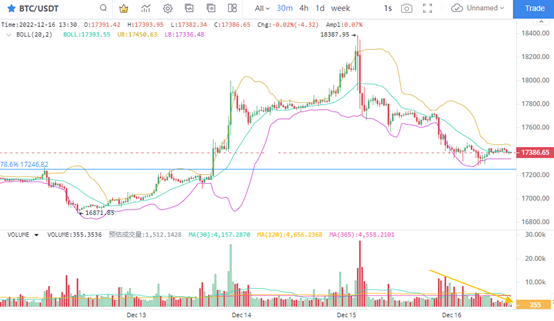
BTC价格在30分钟K线里中,价格放量回落以后成交量开始收缩,目前成交量已经处在极低水平。这表明,BTC在斐波那契78.6%对应的17246美元附近会进一步确认支撑效果。一旦确认支撑有效,BTC价格仍然会维持强势。BTC价格短线回落空间不大,预期美联储加息利空仍然在较长时间里影响BTC价格,短期对行情影响逐步消化。

2、主力抛售占比较低

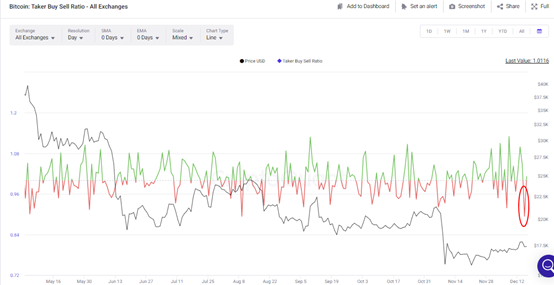
BTC合约多空比小幅回落,该指标已经在12月15日达到了0.894,数值为近期的低位。前期8月9日,BTC多空比也曾靠近0.894。这说明,投资者空头短线看跌情绪已经回升。12月16日多空比小幅反弹到0以上的文章,表明BTC近期震荡仍然在持续。

3、ETH短线回撤

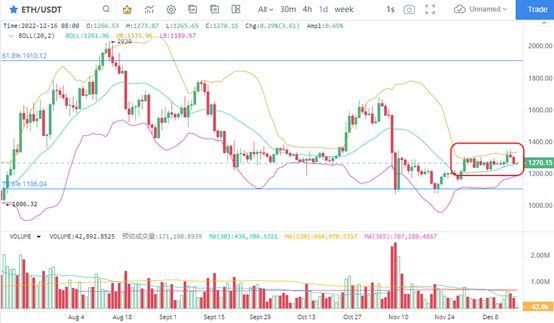
ETH的日K线图显示,随着调整的进行,价格近期波动空间并未持续提升,仅仅在小区间内波动。成交量方面,ETH短线交易量小幅反弹后回撤,与价格反弹回撤表现一致。目前布林线中轨已经支撑住ETH价格。布林线处在收口阶段,ETH仍然维持相对强势运行状态。

4、EOS冲高回落

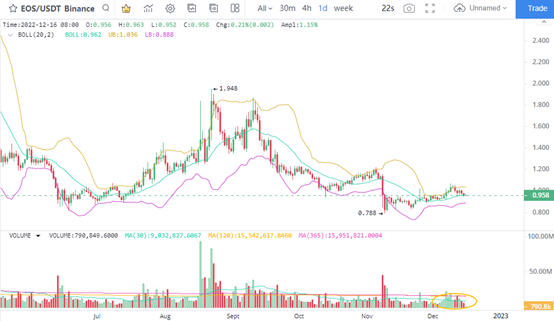
EOS短线冲高回落,价格处在布林线中轨对应的0.962美元以下运行。目前EOS在回撤期间的抛压不大,近3个月内的量价表现相对平稳。因此,目前仍然是缩量运行的低吸机会。受整体行情表现不佳影响,EOS虽然相对价格较低,但是仍然没能出现强反弹走势。而前期7/8月份价格反弹强度达到100%,说明价格弹性较好。

İlgili Okumalar

The "Impossible Triad" Is Fundamentally a Pseudo-Problem

The article argues that blockchain's fundamental limitation is not the scalability trilemma (decentralization, scalability, security), which has been largely solved, but the lack of **privacy** and, until recently, clear **legitimacy**. Blockchain is described as a slow, expensive, globally shared computer whose core value is censorship resistance and verifiability. While ideal for native digital assets like money (e.g., stablecoins), its default transparency acts as a **tax**, exposing all transactions and enabling MEV extraction, which deters serious institutional capital. Simultaneously, its permissionless nature created regulatory ambiguity. The piece contends that **privacy** is the missing critical feature. It rejects the false choice between total transparency and complete anonymity. Modern cryptography (like zero-knowledge proofs) enables **compliant privacy**: users can prove facts (solvency, KYC status, compliance) without revealing the underlying sensitive data (specific holdings, identities). This preserves auditability for regulators and eliminates the leak of financial information. With recent regulatory progress (e.g., the GENIUS Act) addressing legitimacy, adding default, provably compliant privacy becomes a pure upgrade. It transforms blockchain from a costly, public ledger into a confidential settlement layer, finally bridging the gap to mainstream institutional and individual adoption of on-chain finance.

链捕手12 saat önce

The "Impossible Triad" Is Fundamentally a Pseudo-Problem

链捕手12 saat önce

Optical Chips: Collective Capacity Expansion

The global optical chip industry is experiencing a massive wave of expansion driven by surging AI data center demand. Major players across the US, Japan, Europe, and China are aggressively investing to ramp up production capacity. In the US, Coherent is expanding its 6-inch Indium Phosphide (InP) semiconductor fab in Texas, supported by CHIPS Act funding and a $2 billion strategic investment from NVIDIA. Lumentum is building a new factory for InP optical devices, and Nokia is scaling its advanced photonic chip packaging and testing capabilities. NVIDIA's investments aim to secure future supply of critical lasers and optical interconnect products for AI infrastructure. Japan's JX Advanced Metals, a leading InP substrate supplier, plans a multi-billion yen investment to increase its capacity 7-10 times, strengthening its grip on the crucial upstream materials market. In Europe, IQE and Tower Semiconductor settled a patent dispute and signed a multi-year InP epitaxial wafer supply agreement, highlighting that next-generation silicon photonics platforms will integrate high-performance InP components. STMicroelectronics and Sivers Semiconductors are also expanding silicon photonics production and partnerships. China is rapidly building out its domestic supply chain. Dongshan Precision's subsidiary, Source Photonics, announced a $12 billion project to expand optical chip and module production. Companies like Sanan Optoelectronics and Yunnan Germanium are scaling up InP chip manufacturing and substrate production, moving towards vertical integration from materials to modules. While debate continues around the exact future architecture—whether CPO (Co-Packaged Optics), NPO, or pluggables will dominate—analysts like Morgan Stanley argue the underlying driver is unchangeable: the explosive growth in bandwidth demand. This will inevitably increase the volume of optical engines, lasers, and related content per GPU, regardless of the final technical path. The competition for "more light" in the AI era has intensified into a global, full-chain capacity race.

marsbit14 saat önce

Optical Chips: Collective Capacity Expansion

marsbit14 saat önce

İşlemler

Spot
Futures
活动图片