【重磅解读】BTC投资者蜂拥到交易所,MATIC高位发力

jinjin说币2022-12-01 tarihinde yayınlandı2022-12-02 tarihinde güncellendi

Özet

BTC价格活跃度维持高位,等待多头发力。

1、BTC触及压力位

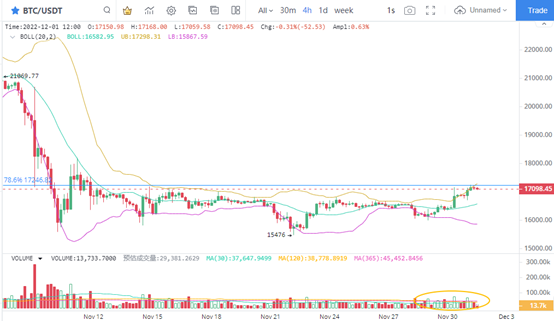
BTC短线维持强势的过程中,成交量已经触及到斐波那契78.6%对应的17246美元压力位。目前来看,4小时K线图中BTC量价表现稳健,还没有迹象表明价格会大幅度回落。因此,短线仍然可关注BTC向上突破的价格表现。支撑方面,4小时K线图中显示,近期BTC先后在1.54万美元和1.6万美元出现反弹表现。短线支撑较强,多头可按兵不动。

2、BTC交易所活跃度提升

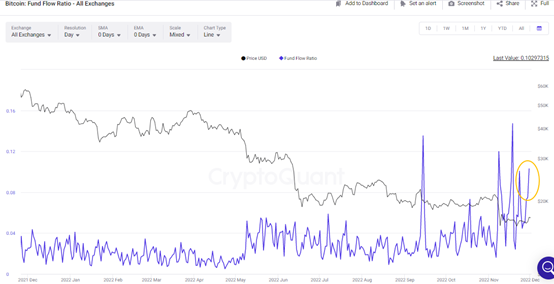
随着BTC的交易所交易量占比回升,目前指标数值回升到了11月30日的0.102附近。因此,涉及交易所的硬币转移与整个网络范围内的硬币转移的比率明显处在高位运行,BTC行情处在爆发前期。如果有更多的投资者参与到交易所的买卖中,BTC短线突破压力位将很快完成。而接下来,就是从17246美元开始的反弹机会。而区间反弹机会可从17246美元看到压力位28308美元。

3、ETH反弹至压力位

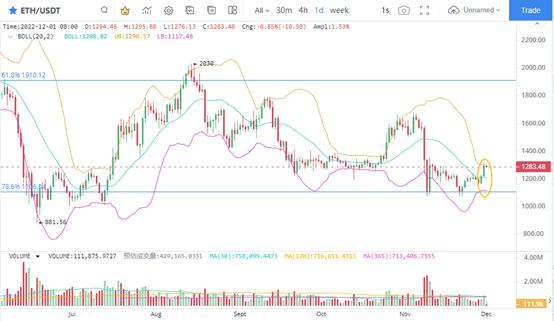
ETH的价格短线反弹到了布林线上轨附近,价格走势较强,目前仍然在区间内震荡。随着主流币多数维持强势,ETH价格仍然处在低位盘整阶段,关注价格继续回升的交易机会。布林线中轨对应的1208美元买入机会可适当关注。

4、MATIC融资利率持续回升

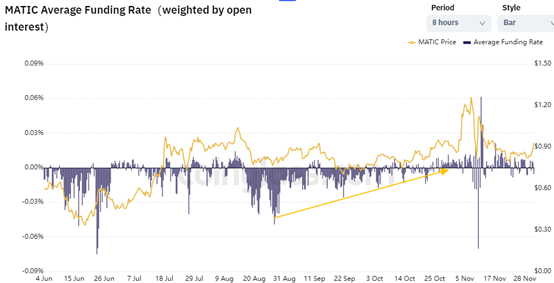
MATIC的融资利率表现稳定,从8月份的-0.08附近回升到0.03%,表明投资者对MATIC的买入热情在逐步升温。前期MATIC维持了非常低的融资利率,并且持续时间经常。近期MATIC价格表现明显好于整体主流币,可适当关注价格单边机会。

5、MATIC仍然高位放量

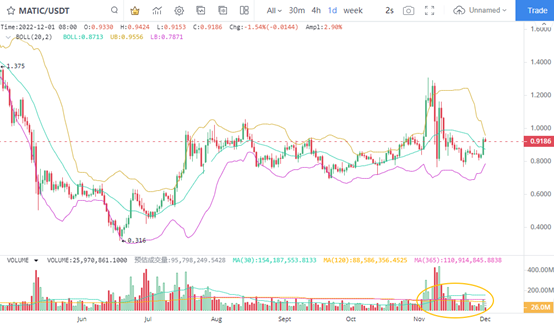
随着MATIC维持在高位0.8美元的价格平台运行,目前来看价格表现仍然强势。日K线图中,MATIC的交易量表现稳健,行情处在了高位蓄势待发阶段。MATIC目前价格表现好于多数主流币,明显先于BTC完成筑底表现。接下来,关注MATIC在单边趋势中的加仓信号。

İlgili Okumalar

Bitwise Chief Investment Officer: Revenue Reigns Supreme, The Valuation Logic for Crypto is Being Rewritten

The valuation logic of crypto assets is shifting from speculative models to a focus on real revenue and earnings, according to Bitwise CIO Matt Hougan. For years, a key criticism was that crypto tokens lacked fundamental value as they didn't generate cash flows for holders, partly due to a restrictive regulatory environment. This changed following the 2023 Ripple lawsuit and subsequent regulatory shifts, allowing projects to direct protocol revenues to token holders. Hyperliquid pioneered this model, using ~99% of its fee revenue to buy back and burn its HYPE token, creating a direct link between network activity and token value. Its success has inspired widespread adoption. Uniswap now uses all fee revenue to burn UNI, Aave has implemented automated buybacks, and new platforms like shturl.c and Lighter have built revenue-sharing mechanisms from inception. Even layer-1 blockchains like Solana and Aptos are adjusting fee models to benefit token holders. Hougan draws a parallel to early internet companies that eventually monetized their user bases. He argues that top crypto platforms possess significant pricing power and that the market undervalues them because many investors, both inside and outside crypto, have not yet recognized this fundamental shift. While tokens carry different risks than equities (e.g., governance-based revenue rights), the growing alignment of revenue with token value could lead to a significant re-rating of crypto asset valuations in the coming 12-24 months.

marsbit6 dk önce

Bitwise Chief Investment Officer: Revenue Reigns Supreme, The Valuation Logic for Crypto is Being Rewritten

marsbit6 dk önce

Shanghai Automotive Chip 'Little Giant' to IPO, Aiming to Raise 3.489 Billion Yuan

"Shanghai-based auto chip 'Little Giant' Gatsland Aims for IPO, Seeking to Raise 3.489 Billion CNY" Gatsland Microelectronics, a Shanghai-based automotive-grade millimeter-wave radar and ultra-wideband (UWB) chip company recognized as a national-level "Little Giant" specializing in core technologies, has filed for an IPO on Shanghai's STAR Market. Founded in 2014, the company is a key player in China's automotive semiconductor sector. It achieved a milestone in 2017 by mass-producing the world's first automotive-grade 77GHz mmWave radar RF front-end single-chip using CMOS process technology, breaking the industry's reliance on GaAs and SiGe multi-chip solutions. Gatsland claims to be the fourth-largest global and second-largest domestic supplier of automotive mmWave radar chips, and a leader in CMOS-based solutions. Financially, Gatsland has shown strong revenue growth, with figures rising from 206 million CNY in 2023 to 632 million CNY in 2025. However, the company remains unprofitable, reporting net losses for the reported periods, including a loss of 193 million CNY in 2025. Despite this, it maintains high gross margins, averaging around 47%, which are notably above industry peers. Over 97% of its recent revenue comes from automotive mmWave radar chips. The company's products, including its Alps and Kunlun platform chips, are used in advanced driver assistance systems (ADAS), autonomous driving, and in-cabin sensing. Its chips have been adopted by major Chinese automakers like BYD, Geely, and NIO, and it has begun supplying European Tier 1 suppliers and international OEMs including Volvo and Rivian. Gatsland's customer base is highly concentrated, with its top five direct clients accounting for over 99% of sales in recent periods. Its supply chain also relies significantly on overseas partners for wafer fabrication, packaging, and EDA tools. Notably, the National Integrated Circuit Industry Investment Fund Phase II ("Big Fund II") is among its shareholders. The management team, including founder and CEO Chen Jiashu, holds strong academic and industry backgrounds from institutions like UC Berkeley and companies such as Texas Instruments. For its IPO, Gatsland plans to raise approximately 3.489 billion CNY to fund R&D and production projects for next-generation mmWave radar and high-precision UWB chips, as well as a new innovation center. The company operates in a highly competitive landscape dominated by international giants like Infineon, NXP, and TI. While it has gained significant market share in China, Gatsland acknowledges it still faces gaps in comprehensive R&D strength and global customer reach compared to these established players.

marsbit7 dk önce
Shanghai Automotive Chip 'Little Giant' to IPO, Aiming to Raise 3.489 Billion Yuan

marsbit7 dk önce

Tether Finally Gets Audited by a Big Four Firm, But USDT's Transparency Issues Are Far From Over

Tether announced that KPMG U.S. has completed its first independent audit of Tether International's financial statements as of December 31, 2025, issuing an unqualified opinion—the highest level of assurance. The audit confirms Tether's assets exceeded liabilities by $6.814 billion at that date, with physical verification of gold bars and examination of underlying records. This represents a significant step beyond the quarterly reserve attestations Tether previously received, moving to a full financial statement audit that examines internal controls, transaction sampling, and accounting policies. However, the article highlights several ongoing transparency questions. The full KPMG audit report has not been publicly released, preventing independent verification of details like asset classification or related-party transactions. The audit covers a specific entity, "Tether International, S.A. de C.V.," leaving the scope concerning Tether's complex corporate structure unclear. Furthermore, the $6.8 billion excess reserves confirmed for end-2025 had shrunk to approximately $4.1 billion by Q2 2026. Risks within the reserve composition, particularly concerning secured loans, persist even with an audit. The audit's data is also already 8 months old, while USDT's circulation has grown rapidly. Strategically, the audit is seen as a move to bolster Tether's position amid U.S. regulatory developments like the GENIUS Act, which mandates audits for stablecoin issuers but leaves a path for foreign entities like Tether. While the KPMG opinion is a strong credibility signal, the article concludes that full transparency and regulatory compliance require further steps, starting with the publication of the complete audit report.

marsbit38 dk önce

Tether Finally Gets Audited by a Big Four Firm, But USDT's Transparency Issues Are Far From Over

marsbit38 dk önce

After Tokenized U.S. Treasury Bonds, Tokenized Stocks Are Becoming the New Battleground for RWA

**Tokenized Stocks Emerge as the New RWA Battleground** Following the initial surge of tokenized U.S. Treasuries, the tokenized stock market is rapidly expanding in both scale and quality. Unlike the currently stagnating treasury tokenization market, tokenized stock offerings are seeing significant growth and attracting major players from traditional finance, fintech, crypto exchanges, and native Web3 platforms. The U.S. SEC has outlined a framework for tokenized securities, which applies to stocks: **Issuer-Sponsored Tokenized Securities** (direct tokenization by the issuer, inheriting all shareholder rights but with strict compliance, e.g., Securitize); **Custodial Tokenized Securities** (tokenization of custodied interests, e.g., DTCC, Ondo's recent IVV/MU tokens); **Linked Securities** (tokenized debt notes backed by the stock, offering price exposure and greater on-chain utility, e.g., Ondo, xStocks, Robinhood's new Stock Tokens); and **Security-Based Swaps** (tokenized derivatives contracts, e.g., Robinhood's earlier Classic Stock Tokens). Key platforms are pursuing different strategies: * **Securitize** leads with an issuer-sponsored model, ensuring full rights but limiting on-chain interactions via its compliance-enforcing DS Protocol. * **Ondo** and **xStocks** use the linked security structure for broad accessibility on CEXs and DeFi, though this fragments liquidity and excludes U.S. users. * **Robinhood** recently launched linked security-based Stock Tokens, leveraging its user base and new Robinhood Chain. * Traditional infrastructure giants like **DTCC**, the **NYSE**, and **Nasdaq** are actively developing pilots and platforms for tokenized settlement and trading. * **Coinbase** has announced plans for tokenized stocks, likely using a structure that offers on-chain utility while excluding U.S. customers. Despite different approaches, all players are converging on tokenized stocks as the next major catalyst for the RWA sector. The evolving regulatory landscape and market adoption will shape this competitive new battlefield.

marsbit1 saat önce

After Tokenized U.S. Treasury Bonds, Tokenized Stocks Are Becoming the New Battleground for RWA

marsbit1 saat önce

İşlemler

Spot
活动图片