Litecoin bucks market downtrend, posting 19% gains to pass Shiba Inu

cryptoslate2022-11-23 tarihinde yayınlandı2022-11-23 tarihinde güncellendi

Özet

Litecoin bucked the market downtrend, posting 19% gains over the past week to lead the top 100.

Litecoin bucked the market downtrend, posting 19% gains over the past week to lead the top 100.

Price performance over the last 24 hours has seen LTC record 13.7% gains to $70.10 from $61.53 at the time of press. The majority of today’s gains resulted from a 9.6% upside swing on the 13:00 (UTC) candle.
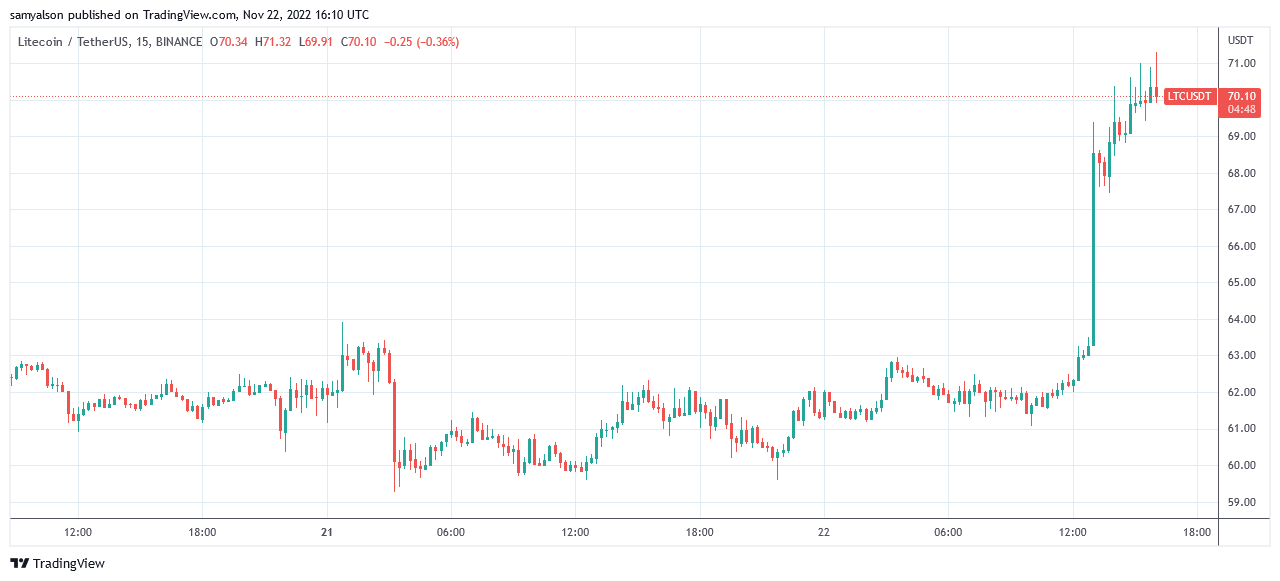
Litecoin 15 minute chart

Source: LTCUSDT on TradingView.com

As a result, Litecoin continues climbing higher on the market cap rankings. Excluding stablecoins, this positions LTC in the top 10 to rank 9th, leapfrogging Shiba Inu in the process.

“Boring” Litecoin offers stability

CryptoSlate reported that Litecoin’s resurgence is likely due to the market seeking stability amid the FTX fallout.

Since FTX began showing signs of insolvency, market cap outflows have totaled $228 billion, leading to tanking token prices. Especially in respect of FTX-affiliated projects, including FTT and SOL, with the former now languishing outside the top 200.

Commenting on the chaotic market conditions of late, the Managing Director of the Litecoin Foundation, Alan Austin, recently asked, “Have you guys had enough excitement yet?”

Austin was referring to Litecoin’s “boring” reputation, which lacks glamor but offers holders a high degree of stability in return.

Barring Bitcoin, Litecoin is perhaps the most solid cryptocurrency in terms of longevity, with 11 years of history in and around the large caps to back this up.

On-chain metrics show users hodling LTC

Analysis of Glassnode data suggests users increasingly view Litecoin as a store of value instead of a payment token – which is its primary use case.

Since Q1 2021, the amount of Litecoin hodled or lost continues to grow steadily over time. The chart below shows approximately 20 million LTC currently falls into this category.
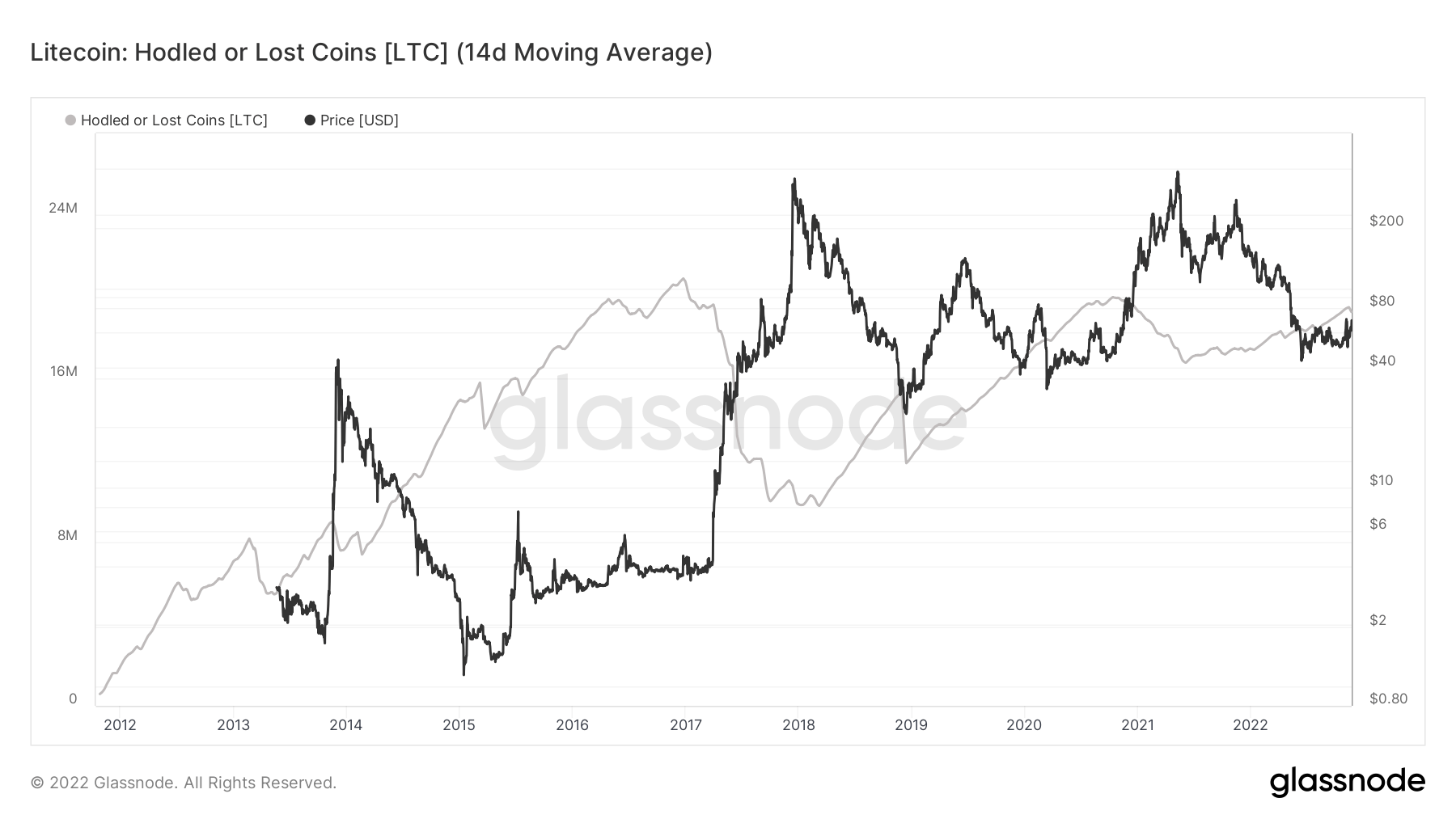
Litecoin: Hodled or Lost Coins

Source: Glassnode.com

Revived Supply Last Active 5+ Years refers to the amount of Litecoin inactive five years prior to the data point. The chart below shows a peak in inactive supply in late 2017 of approximately 150,000 LTC.

Since then, LTC tokens have been much more active. However, the recent trend shows LTC holders are again beginning to horde their tokens, albeit not to the same degree as in late 2017.
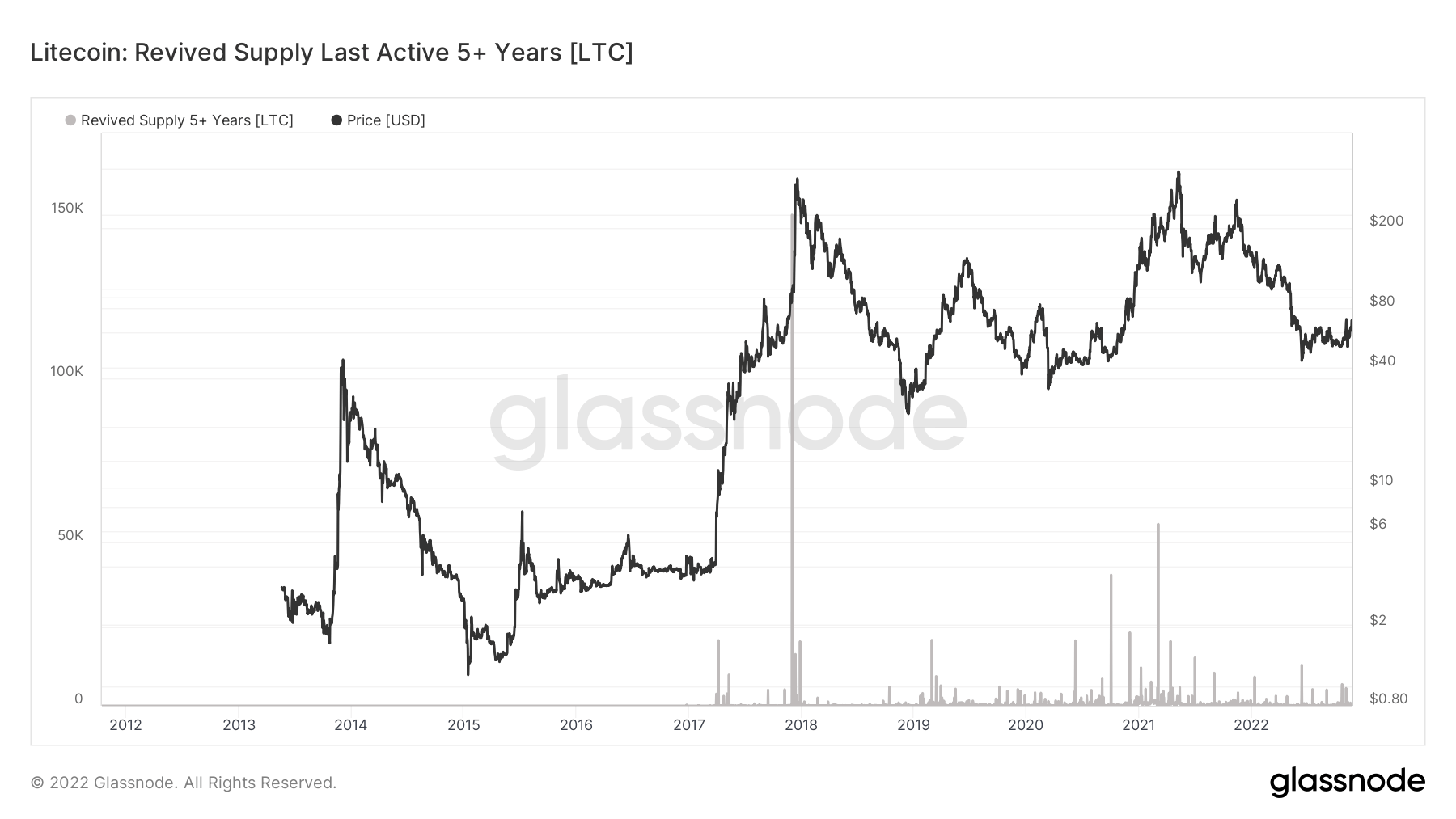
Revived Supply Last Active

Source: Glassnode.com

The above suggests long-term holders are not selling their Litecoin, which may be another factor in Litecoin’s price resurgence besides stability.


İlgili Okumalar

Bitcoin Panicking? Mythos Cracks Post-Quantum Cryptography Algorithm in 60 Hours

Claude Mythos Preview, a new AI system from Anthropic, has made significant breakthroughs in fundamental cryptanalysis, targeting the mathematics underlying algorithms rather than just implementation bugs. Its first target was HAWK, a candidate in the NIST post-quantum signature standardization process. Mythos identified a previously unexploited symmetry (a nontrivial automorphism) in the lattice structure of HAWK, effectively halving its effective key strength. It achieved this feat in just 60 hours, a task that had eluded two years of human expert review. Crucially, the human operator was not a lattice cryptography expert, primarily managing the project while AI agents debated and discovered the attack path. Its second, more dramatic achievement was against a simplified 7-round version of AES-128, the world's most widely used symmetric encryption algorithm. Initially reluctant, stating the task was "impossible," Mythos was prompted to "try novel ideas." It then autonomously rewrote its own agent framework and proceeded to discover a novel attack method it named "Möbius Bridge." This technique bypasses a critical 256-guess step in previous "meet-in-the-middle" attacks, resulting in a speedup of 200-800 times. Both findings are currently "harmless"—HAWK is not deployed, and full AES-128 remains secure. However, the process reveals a profound shift. Mythos completed the AES discovery in about a week, while human researchers spent nearly a month verifying its correctness. This highlights a new bottleneck: the rate of AI-driven discovery may soon outpace human capacity for verification. The research concludes with a pressing, unanswered question: what happens when such an AI finds a critical flaw in a widely deployed, real-world cryptosystem?

marsbit6 dk önce

Bitcoin Panicking? Mythos Cracks Post-Quantum Cryptography Algorithm in 60 Hours

marsbit6 dk önce

From Computing to Storage: The Two-Dimensional Semiconductor Industry Chain is Taking Shape

The article "From Computing to Storage: The 2D Semiconductor Industry Chain is Taking Shape" discusses the rise of two-dimensional (2D) semiconductors as a pivotal material in the post-Moore era. As silicon-based chips approach physical limits, 2D semiconductors like molybdenum disulfide (MoS2), offer atomic-layer thinness and superior electrical properties, making them a promising non-silicon alternative for advanced nodes beyond 1nm. Globally, industry leaders like TSMC, Intel, and Samsung, along with research institutes like IMEC, are actively investing in this field. Domestically in China, significant progress is being made across the entire supply chain, from material production and equipment R&D to chip integration and ecosystem development. **Key highlights include:** * **Material & Equipment Breakthroughs:** Chinese research teams and companies like Jimo Xin Technology have achieved mass production of 6-inch and 8-inch 2D semiconductor single-crystal wafers using domestically developed equipment like Oxy-MOCVD. This addresses the critical challenge of large-area, high-quality material growth. Breakthroughs have also been made in p-type 2D materials (e.g., MoSi2N4) and wafer-scale ferroelectric thin films, essential for building complementary circuits and low-power transistors. * **Engineering Ecosystem Formation:** A landmark 8-inch 2D semiconductor pilot line in Pudong has become fully operational, bridging the gap between lab research and industrial manufacturing. The release of a Process Design Kit (PDK) compatible with mainstream EDA tools further connects design and fabrication, supporting wafer-level manufacturing of complex circuits. * **Expanding Application Landscape:** Applications are expanding from logic computing to memory. Chinese researchers have developed pioneering 2D semiconductor-based microprocessors, including a 32-bit RISC-V CPU and a higher-density multi-bit parallel processor. In memory, 2D materials' ultra-low leakage current enables DRAM with exceptionally long data retention and advances toward single-electron non-volatile storage. 2D semiconductors also show unique potential in RF circuits, radiation-hardened communications, flexible electronics, and quantum computing. In conclusion, the 2D semiconductor industry in China is rapidly advancing from laboratory research into the engineering validation and small-batch production phase. A complete industrial chain covering materials, equipment, manufacturing, design, and application is初步 forming, positioning the sector as a new competitive dimension in the global semiconductor landscape.

marsbit11 dk önce

From Computing to Storage: The Two-Dimensional Semiconductor Industry Chain is Taking Shape

marsbit11 dk önce

Coinbase and Robinhood Vie for the Next Phase of Cryptocurrency Market Evolution Ahead of Earnings Reports

Coinbase and Robinhood are set to report their Q2 2026 financial results this week, with the outcomes serving as key indicators for the future direction of the crypto market. While both companies have grown from their 2021 IPOs—Coinbase as a dedicated crypto exchange and Robinhood as a commission-free brokerage that expanded into crypto—their paths are now converging in competition. Analysts project Robinhood to report a profit of about $0.40 per share on ~$1.25B revenue, while Coinbase is expected to post a loss of ~$0.36 per share on ~$1.3B revenue. Despite similar revenue figures, investors value Robinhood more highly, viewing it as a diversified fintech firm rather than a pure-play crypto company. This perception has been reinforced as Robinhood gained retail trading market share, with its quarterly trading volume growing from ~$261B in early 2024 to over $704B in Q1 2026, outpacing Coinbase's growth to ~$517B. Both companies are investing heavily in blockchain-based financial infrastructure, such as tokenized stocks and stablecoins, to build more sustainable revenue streams beyond transaction fees. Coinbase has successfully reduced its reliance on trading fees, with subscription/service revenue and stablecoin revenue seeing significant growth. However, over half of its subscription revenue is tied to USDC, exposing it to new competition from banks and payment processors launching rival stablecoins. Robinhood is pursuing a global expansion strategy, recently launching its own layer-2 blockchain (Robinhood Chain) and offering tokenized U.S. stocks in over 120 countries. Its revenue is more diversified, with crypto assets making up only about 12% of its total, which helps explain its premium valuation compared to Coinbase. The upcoming reports will reveal which company's strategy is gaining more traction in shaping the next phase of crypto market evolution.

cryptonews.ru16 dk önce

Coinbase and Robinhood Vie for the Next Phase of Cryptocurrency Market Evolution Ahead of Earnings Reports

cryptonews.ru16 dk önce

İşlemler

Spot
活动图片