【NFT热数据】Meebits交易价猛增6倍,艺术品占比68%

火必研究院2022-03-23 tarihinde yayınlandı2022-03-24 tarihinde güncellendi

Özet

以社区为中心的 NFT 交易平台 LooksRare 上线后,日交易量迅速超过 Opensea,公平的代币发行和更低的手续费让它获得广泛关注。

1、独立NFT买家数量和交易金额:

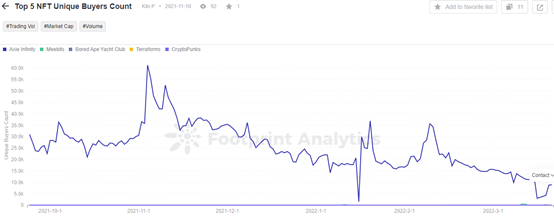
独立NFT买家数量虽然维持下降趋势,但是近期出现了止跌迹象。数值在3月21日,Axie infinity的独立买家数量维持在21201。虽然数值上还未持续止跌,但是绝对数值为2021年10月以来最低水平。
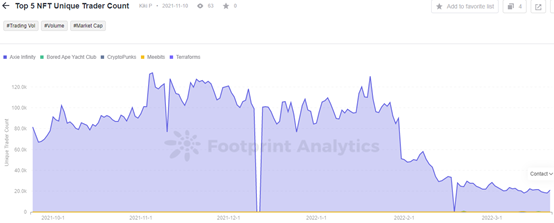
NFT独立交易量的数据底部特征高位明显。从2022年2月18日开始,独立的交易量数据已经维持在18400以上。从数值上看,龙头项目Axie的交易量底部特征已经出现。

2、NFT市场份额分布

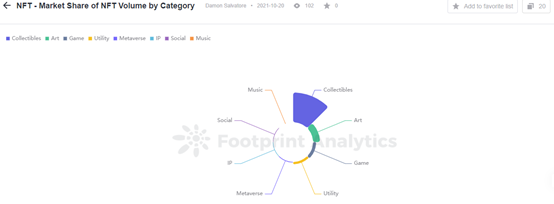
NFT应用集中于收藏品、游戏和艺术品和游戏领域

从NFT行业的下游行业分布来看,目前NFT的应用领域主要集中在收藏品、艺术品和游戏领域。按照NFT映射的资产的不同,NFT项目可分为以下几种类型:收藏品、艺术品、游戏、元宇宙、应用程序、体育运动、去中心化金融等。

从市场份额占比来看,收藏品、艺术品和游戏NFT占比分别为68%、16%、7.3%。

CryptoPunk位居第一主要是由于一幅僵尸CryptoPunk作品,该作品于2021年8月24日以1600枚以太坊(约530万美元)的价格售出,创下了该组作品第四高的成交纪录。
3、NFT月度交易量趋势

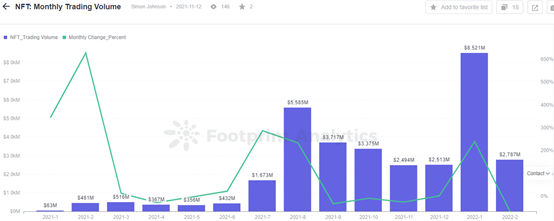
NFT交易量趋势在2021年表现为持续萎缩态势,特别是从2021年月达到峰值以后,逐月回落迹象形成,月度交易量从55.8亿美元回落到了25.1亿美元附近。2022年前两个月,交易量出现了较大波动,1月份交易量猛涨到历史最高85.2亿美元。
4、24小时收藏类NFT交易量排名:

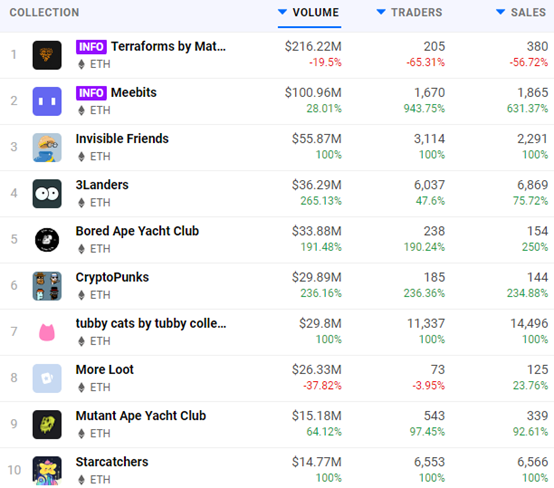
收藏类NFT交易量排名靠前的项目中,值得关注的是排名前三的Terraforms by Mathcastles、Meebits和dotdotdots。

Terraforms by Mathcastles是来自动态生成的链上 3D 世界的链上大地艺术,以太坊区块链上的 9,919 个 NFT。

交易量上,Terraforms by Mathcastles的24小时交易量排名第一达到2.16亿美元,但是交易量和交易人数方面持续明显下滑。

Meebits 是Larva Labs 推出的一个新项目,该项目拥有20,000 个程序生成的 3D 字符,可以在以太坊上交易。允许所有者使用“T姿势”版本的角色,并将其用于任何游戏引擎、3D 工作室或虚拟世界。

在计算机图形学中,术语“体积元素”,简称“体素”,英文为“Volume Pixel”,即“voxel”,是用于表示三维空间中矩形网格上的值。一如其名,体素是数字数据于三维空间分割上的最小单位,体素用于三维成像、科学数据与医学影像等领域。二维空间的最小单位——像素,是二维图像上像素的三维类比,体素在概念上类似像素。

在虚拟环境和游戏中,体素图形的引入十分引人注目,因为它可以构建完整的、可交互的世界。

Meebits的24小时交易量达到了1.01亿美元,排名第第二位。
5、单个NFT售价排名

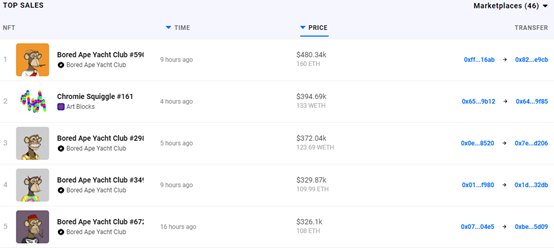
单个NFT售价方面,Bored Ape Yacht club的无聊猿系列在占比方面依然较大,前五位有4个NFT都为无聊猿。
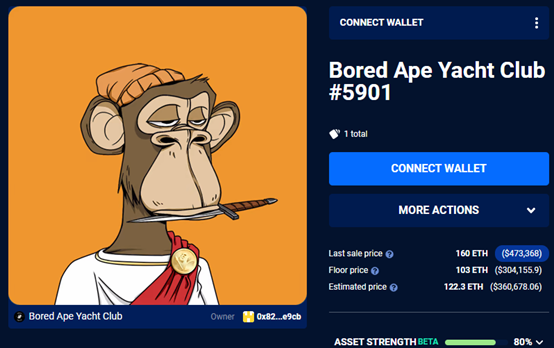
排名交易价格第一位的是无聊猿5901号,其地板价为103ETH,最后一次的交易价格达到160ETH(接近48万美元)。
6、不同NFT交易市场交易量

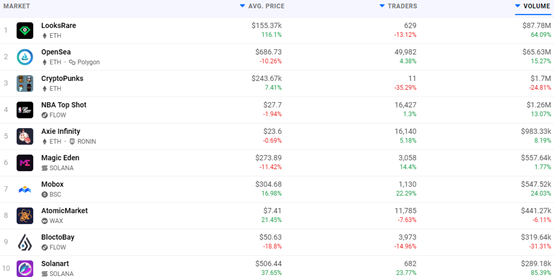
以社区为中心的 NFT 交易平台 LooksRare 上线后,日交易量迅速超过 Opensea,公平的代币发行和更低的手续费让它获得广泛关注。在 LooksRare 上,用户可通过在 LooksRare 上交易 NFT、质押 LOOKS 等方式赚取 LOOKS 和 WETH 代币。

交易量上看,LOOKSRare交易量达到了8778万美元,数值要高于Opensea。

过去一个月内,LooksRare的最低交易量稳定在340万美元,同时Opensea交易量最低可达4300万美元以上。总体来看,Opensea的交易所龙头低位依然难以撼动。
İlgili Okumalar

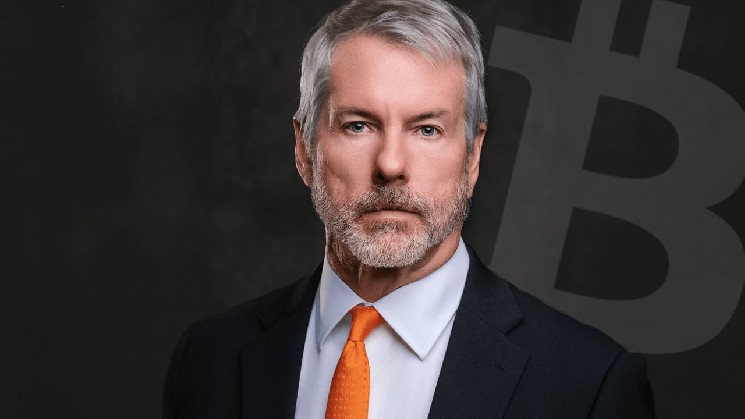
Michael Saylor Says Bitcoin Could Grow 100x, Warns Regulatory Changes Could Threaten Its Future

Michael Saylor, Executive Chairman of MicroStrategy, warns that the main challenge for Bitcoin is no longer external competition but internal governance disputes. As Bitcoin transitions from a digital asset to a potential foundation for global capital markets, he argues the primary threat is changes to its core consensus rules, which act as its "constitution." Saylor contends that altering these rules to benefit specific factions could undermine the entire ecosystem and the rights of its participants. He links this governance risk to Bitcoin's long-term growth potential, stating the asset could grow 100x to become a global capital base. However, he warns that a single corrupted rule could deprive future generations of unbuilt markets and economic freedom. Saylor cites examples like BIP-110, covenant-related features, and block size increases as potentially risky changes that could impose new costs or vulnerabilities. Saylor connects protocol decisions to Bitcoin's long-term security model, noting the increasing reliance on transaction fees as block rewards halve. The rise in corporate and institutional Bitcoin adoption, he argues, heightens the need for predictable rules and network stability. He expresses concern about "protocol capture," warning that allowing political influence over consensus changes could lead to perpetual conflict, scare away capital, stifle innovation, and prevent Bitcoin from reaching its full potential.

cryptonews.ru7 dk önce

Michael Saylor Says Bitcoin Could Grow 100x, Warns Regulatory Changes Could Threaten Its Future

cryptonews.ru7 dk önce

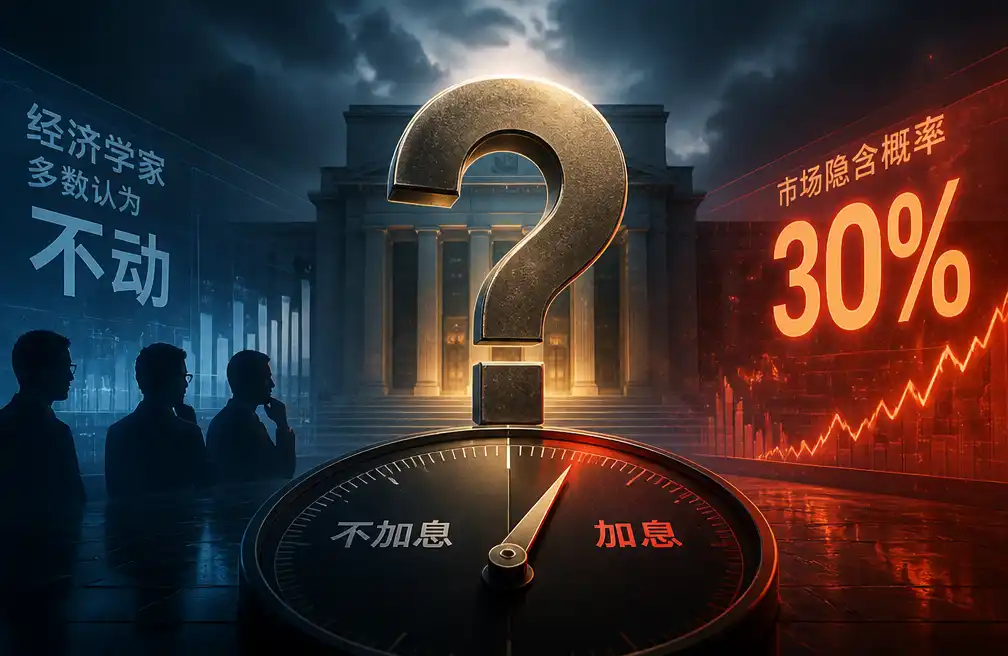
To Hike or Not Tonight: Economists Unanimous on 'No', Markets Price in a 30% Chance

Federal funds futures are repricing ahead of the July FOMC decision, as traders pay a higher premium for the risk of a surprise rate hike or more hawkish signals. This contrasts with economists, where a Reuters survey of 104 analysts unanimously expects rates to remain unchanged at 3.50%-3.75%, with 78 foreseeing no change through year-end. Yet, futures markets have priced in about a 30% probability of a 25-basis-point hike. The core debate, especially under new Fed Chair Kevin Warsh, centers on how the Fed will respond to the oil price shock from Middle East tensions. The market is not necessarily predicting a hike tonight but is hedging against two tail risks: an immediate rate increase, or a hold combined with communication that seriously opens the door for a September hike. This hedging activity has driven up open interest in Fed funds futures. Analysts are divided on how to weight the oil price surge in the Fed's reaction function. Hawkish voices (e.g., BofA) worry that completely dismissing the price pressure could challenge the Fed's inflation credibility in Warsh's first major test. Dovish views (e.g., Citi) argue the shock is primarily supply-driven and that overreacting with rate hikes could unnecessarily hurt growth, unless clear signs of secondary inflation emerge. Warsh's new tenure amplifies policy path uncertainty, as markets lack a stable baseline for his communication style. This environment forces traders to price in a wider range of outcomes, explaining the divergence between unanimous economist forecasts and market hedging. The key focus will be on Warsh's post-meeting commentary. If he downplays the oil shock and stresses anchored long-term expectations, hawkish pricing may recede. If he emphasizes the risk of broader price spillovers and prioritizes returning to 2% inflation, the market will interpret this as reopening the door for a September hike. This would sustain support for the USD, keep pressure on JPY (testing intervention thresholds), and challenge risk assets like stocks and crypto through higher discount rates and weaker sentiment. The baseline remains no action in July, but the communication will determine how far this repricing extends.

marsbit1 saat önce

To Hike or Not Tonight: Economists Unanimous on 'No', Markets Price in a 30% Chance

marsbit1 saat önce

İşlemler

Spot
活动图片