FTX Accused of Keeping Bitcoin’s Price Down

Trustnodes2022-11-21 tarihinde yayınlandı2022-11-21 tarihinde güncellendi

Özet

The rumor mill is accusing the now bankrupt crypto exchange FTX of selling bitcoin to buy other cryptos related to FTX.

The rumor mill is accusing the now bankrupt crypto exchange FTX of selling bitcoin to buy other cryptos related to FTX.

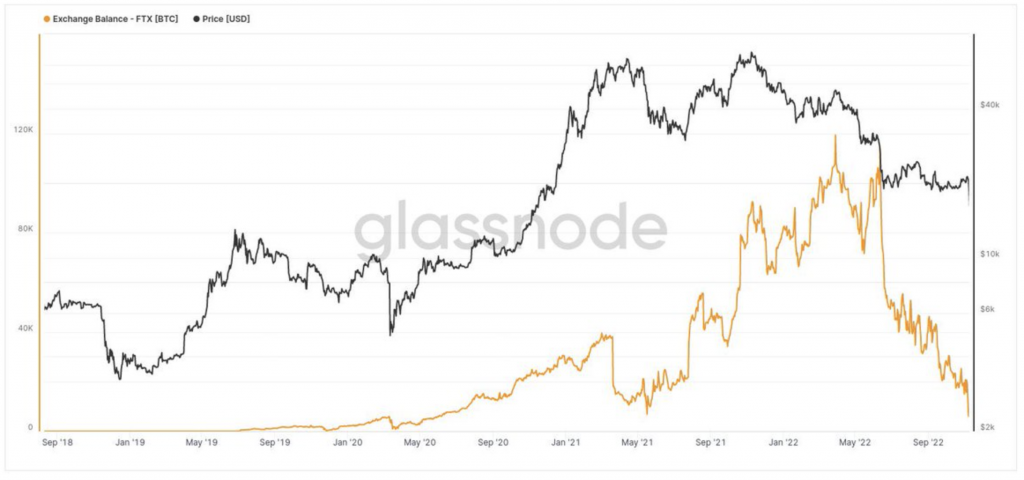
Their bitcoin holdings show a significant plunge in BTC assets during May last year when bitcoin’s price fell from circa $60,000 to $30,000.

The exchange then began accumulating bitcoin once more, up to 120,000 until June when they began plunging again down to now near zero.

This in itself does not necessarily show FTX sold bitcoin, but they did give Alameda a circa $10 billion loan, some of which was used to invest in startup equity in fiat, for which they may have converted crypto.

Alameda is also accused of trading against FTX clients with an open order book, effectively cheating as they could see all the trades.

There are suggestions there was no firewalling between Alameda and FTX, with Alameda trading on FTX while they were sat within visible distance of FTX’s order book.

In effect they knew at which price point anyone at FTX would be liquidated and how much collateral they have.

That is, they played poker while being able to see everyone’s cards, knowing exactly when to bet or fold, and they still went bankrupt.

“Clement at FTX HK leaked our positions and account details to many people throughout the year,” Zhu Su of Three Arrows Capital publicly said.

Rumors have long circulated, since at least 2019, that Alameda had a preferential data agreement with Bitmex where it acted as a market maker, and some say even at Deribit.

No concrete evidence was ever provided, but traders turned on Bitmex starting in 2019 due to what some perceived as convenient liquidations.

The allegations FTX sold bitcoin are newer, but Andrew Kang of Mechanism Capital, who was the first to publicly reveal there was a $6 billion hole at FTX, said:

“No wonder why the BTC pumps have been so pathetic. Whenever anyone bought spot on FTX, Alameda would just dump it after.”

Traders have noted that the 2022 bull has been more tempered in that there was no blow off top, with FTX now taking the blame.

“FTX and Alameda sold down the crypto markets with our assets to fund their unprofitable gambling. Markets would otherwise be much higher,” Kang said.

Zhu Su also revealed private conversations where he notes Alameda promised 15% in “high returns with no risk.” He is the deleted account:

After this convo at the time, @tackettzane, @rsalame7926 others proceeded to bash me nonstop for 2months, making it difficult to even do business. I turned to The Block, sending them all the evidence I had https://t.co/5bEmv9oXFC
— Zhu Su 🔺 (@zhusu) November 15, 2022

Little of this was publicly corroborated during the rise of FTX and Alameda. Alameda in particular was more a background faceless market maker that somehow dominated Bitmex with plenty of rumors surrounding that relationship, but no concrete evidence.

Now there’s more corroboration, but just how much they really affected bitcoin’s price remains unclear.

In ethereum however rumors that the Bahamas regulator turned some eth from FTX’s holdings into wBTC is blamed for the fall of eth’s ratio today.

This alleged hacked account has opened a very peculiar episode with the ‘hack’ announced by FTX’s Telegram channel.

It was never publicly confirmed by FTX’s Twitter account, which until that point was and still remains the one that makes the announcements.

Bizarre reports then came out the Bahamas regulator had ordered Sam Bankman-Fried to hack his own exchange to place the eth holdings under the Bahamas regulator.

That this ‘hack’ was FTX itself however became clear when Kraken announced they had frozen some accounts belonging to FTX official/s following reports some of the ‘hacked’ eth had been sent there.

Currently this ‘hacked’ FTX account has about 200,000 eth, with circa 50,000 eth moved recently.

FTX’s CEO Bankman-Fried remains still free, with it anyone’s guess now whether the downfall of this exchange may actually relieve pressure on bitcoin.


İlgili Okumalar

Research Report Analysis: Morgan Stanley Details SanDisk SNDK, The Truth About Cloud Data Center Pricing Power and AI Inference Benefits

Morgan Stanley raised its price target for SanDisk (SNDK) from $1100 to $1750 on June 22, maintaining an Overweight rating. The upgrade is driven by AI inference demand reshaping the NAND market, particularly for KV Cache and context window storage in cloud data centers. These cloud clients exhibit price inelasticity and sign long-term contracts, granting SanDisk significant pricing power. SanDisk's New Business Model (NBM) agreements, covering over one-third of FY27 bit shipments with 3-5 year terms and fixed price/price collar structures, are crucial. They are projected to sustain gross margins around 80% even at floor prices, providing a buffer against cyclical downturns. Morgan Stanley forecasts gross margins to surge from 30.3% in FY25 to 86.7% in FY27e. With NAND supply expected to remain tight into 2026/2027 and cloud/data centers becoming the largest end-market, SanDisk holds supply-side pricing power. The company targets 15-19% bit growth via technology transitions, not capacity expansion. Revenue is projected to grow ~6.6x from FY25 to FY27, with EPS rising from $2.74 to $14.73, driven by high-margin cloud business. Key upside catalysts include faster enterprise SSD adoption and edge AI growth. Downside risks involve slower industry growth, competitor capex increases, market share loss, and competition from Chinese players like YMTC. The investment thesis rests on AI-driven structural demand, NBM's margin protection, and sustained supply tightness. The $1750 target implies ~28x FY27e P/E.

marsbit11 dk önce

Research Report Analysis: Morgan Stanley Details SanDisk SNDK, The Truth About Cloud Data Center Pricing Power and AI Inference Benefits

marsbit11 dk önce

A Threefold Performance Leap! NEAR Achieves 200ms Physical Block Time Limit with SPICE

NEAR's core development team, Near One, has announced its next major protocol evolution: SPICE (Separation of Consensus and Execution). Currently in development, SPICE represents the most significant upgrade before the full implementation of Nightshade 3.0. Its core innovation is decoupling the consensus layer, responsible for ordering transactions, from the execution layer, which processes them. This allows the consensus layer to run at full speed without waiting for transaction execution to complete. Once deployed, SPICE is projected to triple NEAR's block production speed, achieving a 200ms block time, which is considered the physical limit due to the speed of light and network latency. This leap will dramatically reduce transaction latency and finality, with transactions confirming in roughly 0.4 seconds—faster than a typical card payment. The upgrade also enables more complex, long-running transactions and significantly improves user experience for applications like NEAR Intents and near.com. Beyond raw speed, SPICE enhances network scalability and security. It enables deeper parallelism, efficiently distributing workload across shards and improving resource utilization. The simpler block structure and lighter contracts also facilitate formal verification and security auditing. Furthermore, SPICE lays the critical groundwork for future Nightshade 3.0 features, most notably atomic cross-shard transactions, which would simplify complex contract logic and eliminate development hurdles caused by asynchronous execution. The Near One team is actively developing SPICE, targeting deployment in the coming months.

Foresight News1 saat önce

A Threefold Performance Leap! NEAR Achieves 200ms Physical Block Time Limit with SPICE

Foresight News1 saat önce

İşlemler

Spot
Futures
活动图片