80% of Tokens Fall Below Issue Price, IPO Financing Soars 48 Times—Crypto Capital Shift Has Occurred

marsbit2026-03-15 tarihinde yayınlandı2026-03-15 tarihinde güncellendi

Özet

The crypto industry is witnessing a significant capital shift from token offerings to traditional equity markets. In 2025, over 80% of tokens traded below their initial offering price due to high volatility, weak demand, and poor tokenomics, eroding investor confidence. Conversely, crypto IPOs surged 48x, raising $14.6 billion, while M&A activity hit a five-year high of $42.5 billion. Equity offerings, compared to tokens, demonstrate similar upside potential but with lower volatility and longer-term growth. Stocks command higher valuation premiums (P/S ratios of 7-40x vs. 2-16x for tokens) due to institutional access, index inclusion potential, and richer trading strategies. Key valuation factors include regulatory moats, revenue diversification, and sector sentiment. M&A activity is accelerating, driven by regulatory compliance and strategic expansion, with focus on trading infrastructure, exchanges, and stablecoins/payments. Major acquisitions were led by Coinbase, Kraken, and Ripple. Upcoming IPOs in 2026 include Kraken, Consensys, Ledger, Animoca, and Bithumb. The future lies in blending TradFi validation with crypto innovation, emphasizing sustainable revenue and long-term value creation.

Author: DWF Ventures

Compiled by: Deep Tide TechFlow

Deep Tide's Introduction: This report from DWF Ventures makes one thing clear with data: money hasn't left crypto, it has just shifted tracks. In 2025, over 80% of tokens traded below their initial offering price, while crypto IPO financing surged 48 times to $14.6 billion, and M&A reached a five-year high of $42.5 billion. This isn't just a matter of market mood; it's a systemic migration of capital structure, with a wave of IPOs including Kraken, Ledger, and Animoca on the way for 2026.

Core Conclusions

The old playbook for token offerings is over. High valuations and declining liquidity have hit investor confidence, and we are seeing a shift of funds towards equity.

Tokens and equity offer similar upside potential, but their risk structures are vastly different: tokens peak faster (within 30 days) and face greater volatility; equity, on the other hand, maintains steady gains over a longer time horizon.

Equity enjoys a higher valuation premium than tokens: this premium can be attributed to institutional access barriers, potential for index inclusion, and the richer trading strategies supported by equity.

Price-to-Sales (P/S) ratio provides a useful benchmark for company evaluation, but the dispersion in valuations reflects the importance of other factors, including regulatory moats, revenue diversification, shareholder value, and sector sentiment.

M&A activity hits a five-year high, consolidation accelerates: Acquiring capabilities is proving faster than building them, and regulatory compliance is driving strategic M&A.

The Current State of Token Offerings

The crypto industry has reached an inflection point. Billions of dollars are pouring in, institutional interest is at a peak, and regulation is becoming friendlier—yet for builders and users, everything feels gloomier than ever. The widening gap between institutional inflows and the morale of the crypto-native community is part of a larger problem—the original spirit of decentralization and cypherpunk experimentation seems to be fading with the influx and immense influence of centralized entities.

Crypto has also thrived in a high-risk, casino-like environment, which is being slowly stripped away as token performance plummets. This is also driven by extractive events that significantly impact retail investors, leading to liquidity withdrawal from the market.

According to a report by Memento Research, over 80% of tokens issued in 2025 are currently trading below their TGE price. Projects have been severely hit by high volatility and a general lack of token demand—due to high valuations that are difficult to justify and sustain. Upside is also scarce, with most tokens facing massive selling pressure from TGE—stemming from early profit-taking, lack of substantial confidence in the product, or poor token economic models (airdrops, CEX listings, etc.). This has dampened investor and retail interest, and events like 10/10 have further exacerbated crypto outflows, calling into question the industry's core infrastructure.
The Rise of IPOs

Meanwhile, in traditional markets, IPOs are gaining strong traction among crypto companies—2025 saw many notable listings, and more companies are filing for upcoming IPOs. Data shows that crypto IPO financing increased 48 times compared to 2024, raising over $14.6 billion in 2025. M&A deals experienced similar growth, with leading core companies seeking to diversify their offerings, which we explore further below. Overall, the strong performance of these companies demonstrates a robust market demand for digital asset exposure, a momentum likely to accelerate further into 2026.

The Flow of Liquidity

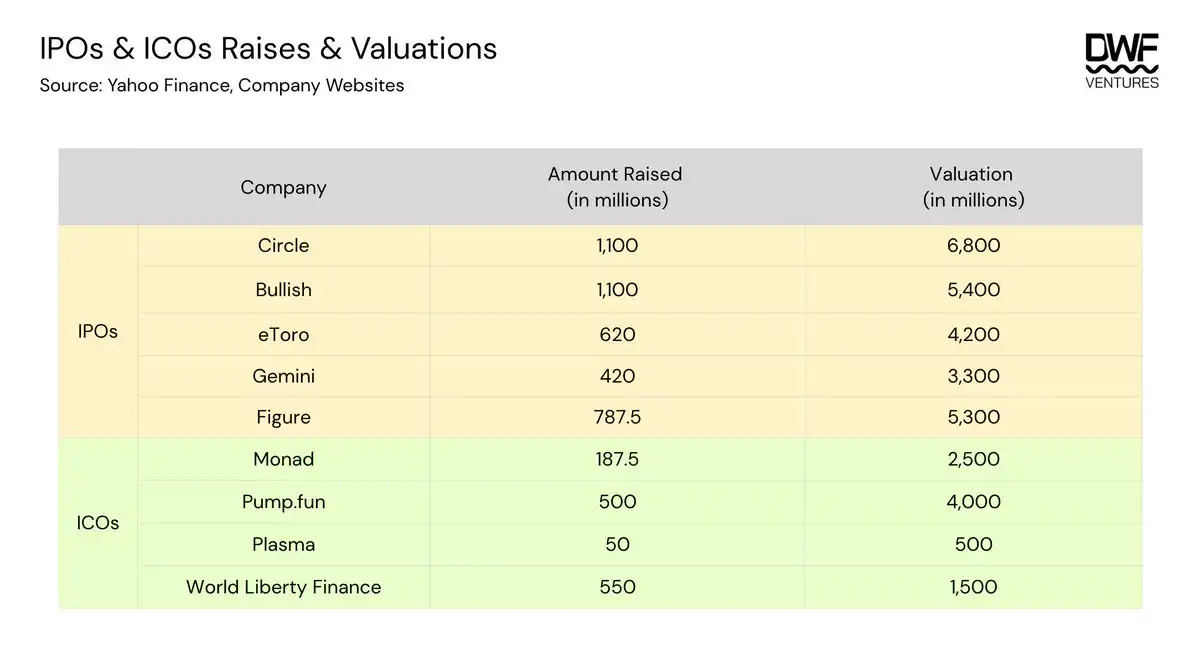
Over the past year, we have seen high-profile IPOs and ICOs both raise significant capital. The table below shows the funding amounts and initial valuations for various companies.

From this, we observe that IPO and ICO valuations are relatively close. Some ICOs, like Plasma, were specifically priced below the valuation for institutional investors, aiming to provide greater upside and participation opportunities for retail investors. On average, the public float for IPOs ranges from 12% to 20%, while for ICOs it ranges from 7% to 12%. World Liberty Finance is a clear exception, offering over 35% of the total supply for sale.

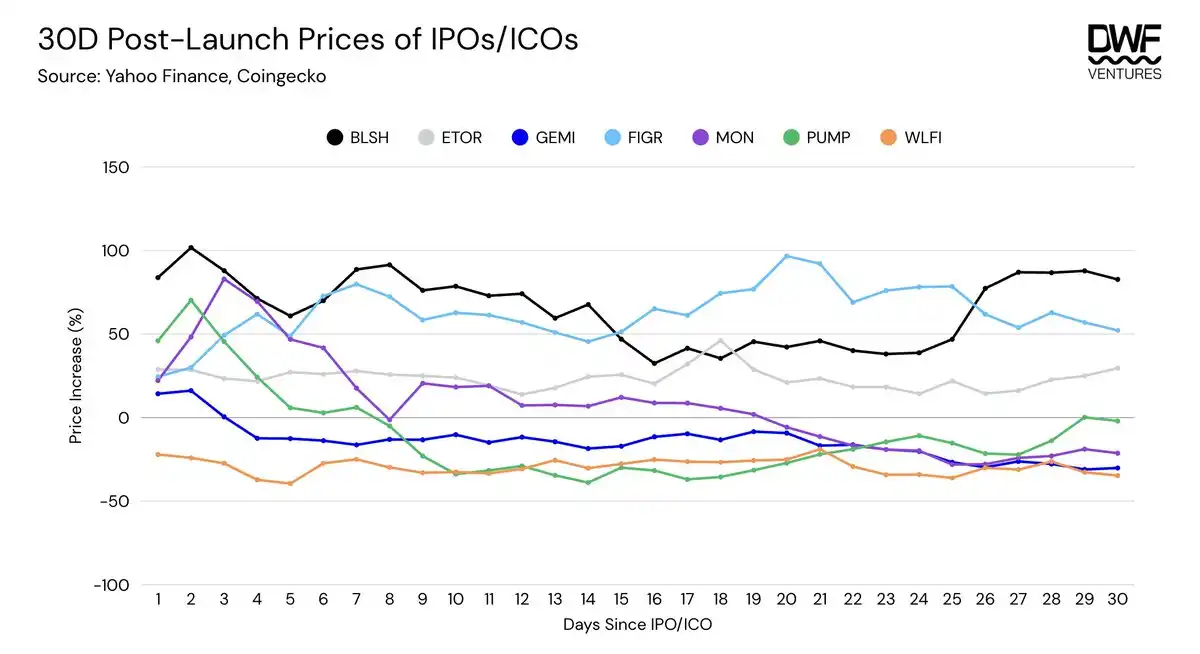
Analyzing the performance of ICOs and IPOs, tokens are associated with greater short-term volatility and a shorter time to peak (within 30 days). On the other hand, equities tend to record steady gains over a longer time horizon. Notably, however, the upside potential is similar for both.

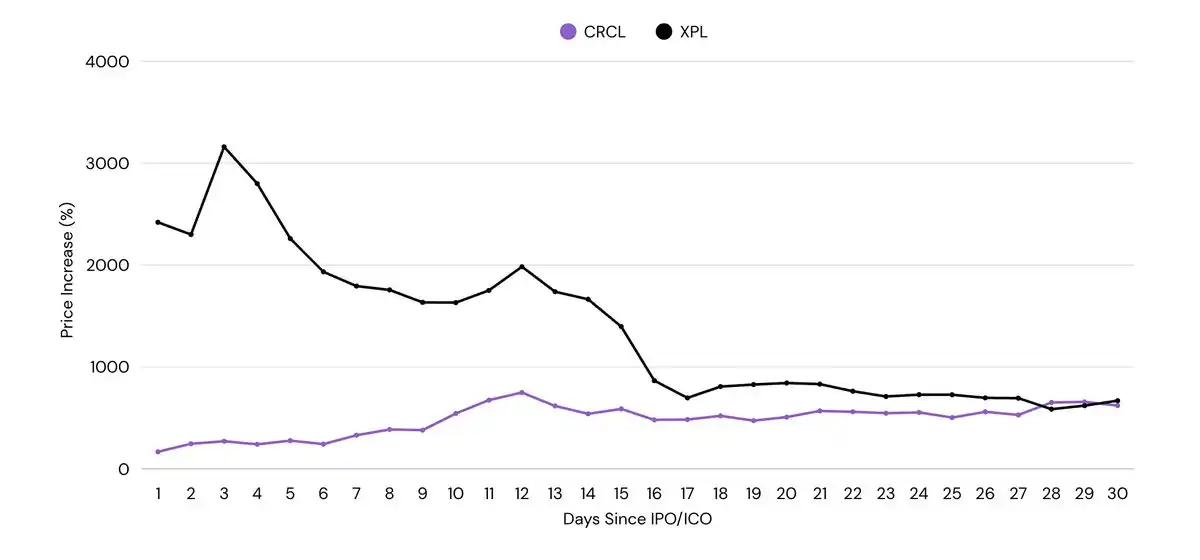
CRCL and XPL are exceptions, having experienced massive gains from the start, offering investors 10x to 25x upside. Nonetheless, their performance also followed the aforementioned trend—XPL retraced 65% from its peak within two weeks, while CRCL climbed steadily over the same period.
Revenue: Assessing the Equity Premium

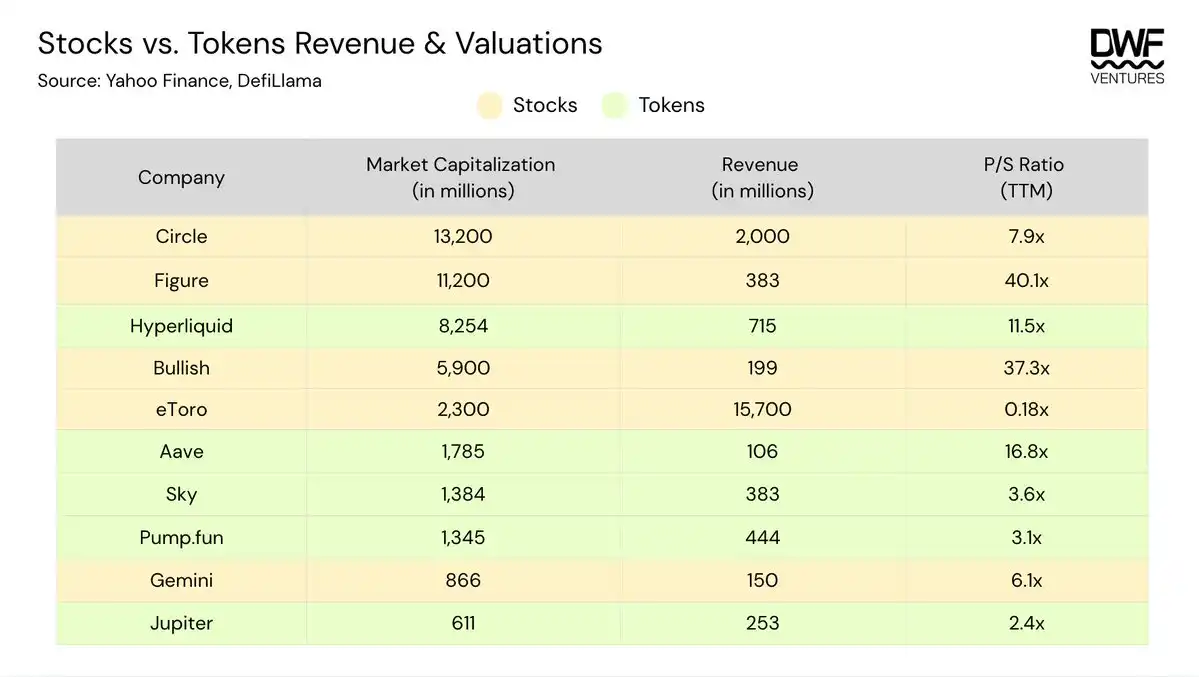
Delving into revenue figures, stocks overall enjoy a higher premium than tokens, with P/S ratios in the ranges of 7-40x and 2-16x, respectively. This can be attributed to enhanced liquidity from several factors:

Institutional Access: Despite growing positive sentiment around holding digital assets on balance sheets, this remains limited to funds with securities-only mandates (particularly pensions or endowments). Opting for an IPO allows companies to tap into this pool of institutional capital.

Index Inclusion: The growth tailwinds in public markets are far stronger than on-chain. Coinbase's inclusion in the S&P 500 in May 2025 as the first crypto company likely contributed to buying pressure from index-tracking funds/ETFs accumulating positions.

Alternative Strategies: Compared to on-chain tokens, equity enables a wider variety of institutional strategies, including options and leverage, whereas on-chain tokens often lack liquidity and counterparties.

Overall, the P/S ratio shows a company's valuation based on the last 12 months of revenue, helping to judge whether a company is undervalued or overvalued relative to its peers. However, factors beyond the numbers that reflect investor sentiment are not captured. Some factors to consider when evaluating stocks/tokens include:

Moats & Diversification: In the fast-evolving digital asset industry, this is crucial. The market is paying a premium for licenses and regulatory compliance, while diversified business models strengthen the value proposition of the core business beyond pure revenue numbers.

For example, Figure launched its own RWA lending pools, open to retail and institutional investors, and became the first SEC-approved yield-bearing stablecoin ($YLDS). Bullish is a regulated exchange that also owns other businesses like CoinDesk, enhancing its value beyond pure trading services. These factors likely contributed to higher premiums.

In contrast, eToro has an extremely low P/S, seemingly "undervalued" on the surface, but a deeper analysis reveals its revenue growth climbing in sync with costs, which is not optimal. Furthermore, the company is purely focused on providing trading services, lacking differentiation and having low margins. This indicates that building defensible moats and diversified business models are also key considerations for investors.

Shareholder Value: Returning capital to investors through buybacks is common in both stocks and tokens, especially for high-revenue companies.

For example, Hyperliquid has one of the most aggressive buyback programs, with 97% of revenue used for buybacks. Since genesis, the aid fund has bought back over 40.5 million HYPE tokens, representing over 4% of the total supply. Such aggressive buybacks impact the price, boosting investor confidence as long as revenue remains stable and the sector has room for growth. This leads to a higher P/S ratio but does not necessarily mean the token is "overvalued," as strong support from the team itself is real.

Sector Sentiment: High-growth sectors driven by institutional or regulatory dynamics naturally command a premium, as investors seek exposure.

For example, Circle's stock price soared quickly after its IPO in June 2025, with the P/S ratio peaking at around 27x. This could be attributed to the passage of the GENIUS Act—a framework dedicated to legitimizing stablecoin adoption and issuance, introduced shortly after Circle's listing, which would make Circle a major beneficiary as a leading player in the stablecoin infrastructure space.

M&A: The Great Consolidation

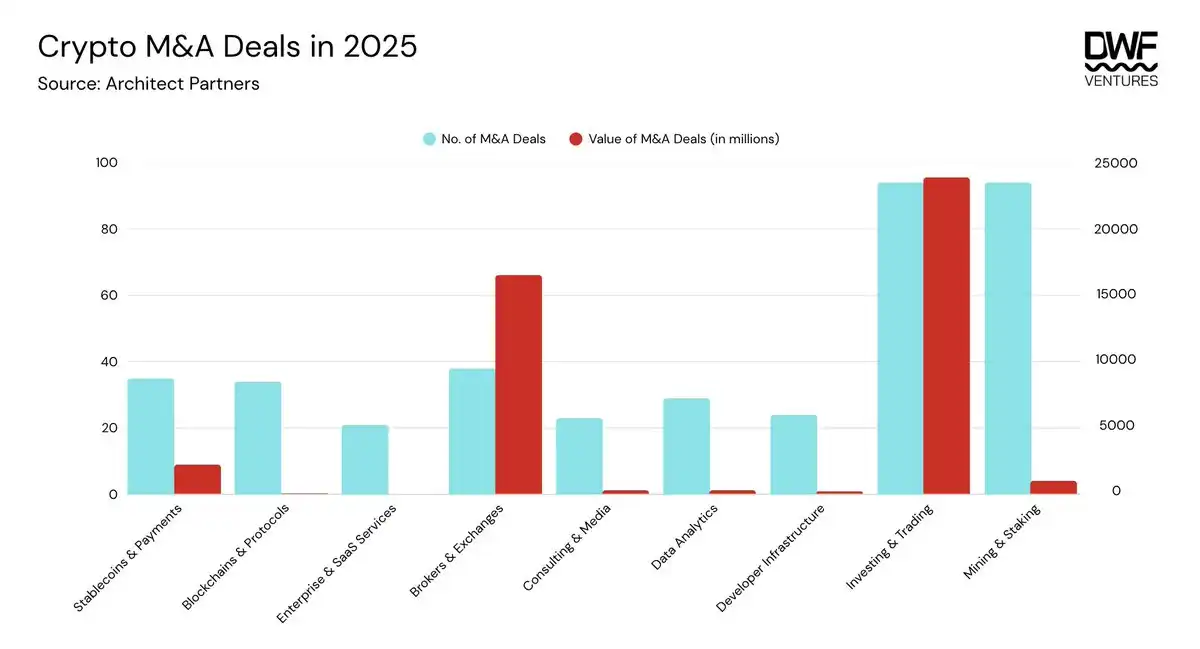
According to the report, crypto M&A activity hit a five-year high in 2025—driven by massive entry from TradFi institutions, coupled with more friendly regulatory sentiment. After the Trump administration rolled out a series of crypto-friendly policies, the Digital Asset Treasury (DAT) frenzy emerged, making holding digital assets on balance sheets less controversial. Companies also shifted focus to acquisitions, as it is a more efficient way to obtain specific licenses for better compliance. Overall, the introduction of appropriate regulatory frameworks laid the groundwork for M&A acceleration.
Looking back over the past year, we see a clear rise in the number of deals across categories. The following three categories have become priorities for institutions:

Investment & Trading: Encompassing trade settlement, tokenization, derivatives, lending, and DAT infrastructure;

Brokers & Exchanges: Regulated platforms focused on digital assets;

Stablecoins & Payments: Covering on/off-ramps, infrastructure, and applications.

These three categories together accounted for over 96% of the deal value in 2025, totaling over $42.5 billion.
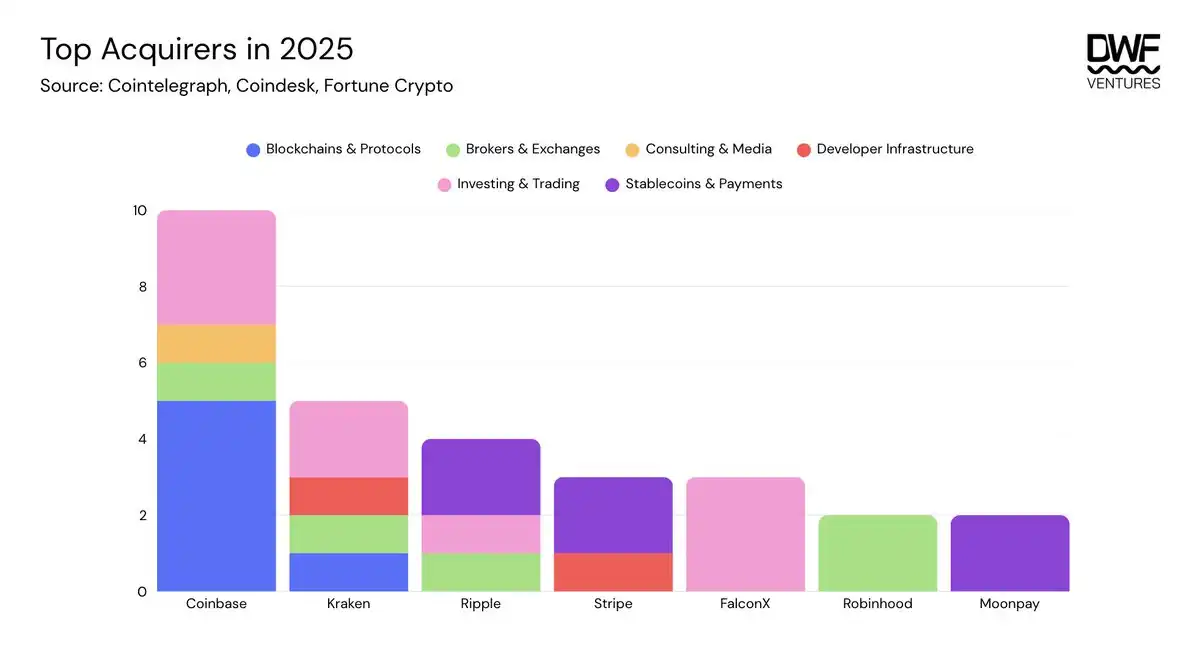
Top acquirers include Coinbase, Kraken, and Ripple, all involved in multiple categories. Among them, Coinbase's moves are particularly prominent, highlighting its ambition to become a "one-stop super app," with a core focus on bringing on-chain to the masses through acquisitions of both traditional and innovative DApps. This is driven by intensifying competition among exchanges and the quest for all-in-one traffic portals.

Companies like FalconX and Moonpay are deeply cultivating their own categories, building full-service capabilities through complementary acquisitions.
The Next Step for Token Offerings

Despite the current market environment and sentiment, we believe 2026 will continue to bring significant tailwinds to the digital asset space. We expect more companies to go public, which is a net positive for the industry overall—it provides access to a larger pool of capital and investors, making the overall pie bigger.

The next batch of IPO candidates includes:

Kraken: Filed an S-1 registration statement with the SEC in November 2025, with strong expectations for an IPO in early 2026;

Consensys: Reportedly working with Goldman Sachs and JPMorgan to prepare for a mid-2026 listing;

Ledger: Targeting a $4 billion valuation, advancing its IPO with Goldman Sachs, Jefferies, and Barclays;

Animoca: Plans to list on Nasdaq in 2026 via a reverse merger with Currenc Group Inc.;

Bithumb: Aims to list on Korea's KOSDAQ in 2026 with a $1 billion valuation, underwritten by Samsung Securities.

The way forward is not a choice between TradFi validation and crypto-native innovation—it is fusion. For builders and investors, this means prioritizing fundamentals and building useful products that generate real, sustainable revenue. A shift towards a long-term mindset may cause some turbulence, but those who adapt will be able to capture the next wave of value creation.

The token is dead, long live crypto.

İlgili Sorular

QWhat is the core conclusion of the DWF Ventures report regarding the shift in crypto capital flow?

AThe report concludes that the old model of token launches is over. Capital is shifting from tokens to equity due to high valuations and declining liquidity eroding investor confidence. While both tokens and equity offer similar upside potential, they have vastly different risk structures. Equity enjoys a higher valuation premium, attributed to institutional access, index inclusion potential, and support for richer trading strategies.

QAccording to the report, what percentage of tokens launched in 2025 were trading below their TGE price, and what were the cited reasons?

AOver 80% of tokens launched in 2025 were trading below their Token Generation Event (TGE) price. The reasons cited include high volatility, a general lack of token demand due to difficult-to-justify high valuations, significant selling pressure from early profit-taking, a lack of substantive confidence in the product, and poor tokenomics (e.g., airdrops, CEX listings).

QHow did crypto IPO fundraising and M&A activity change in 2025 compared to 2024?

ACrypto IPO fundraising in 2025 grew 48 times (48x) compared to 2024, raising over $14.6 billion. Mergers and Acquisitions (M&A) activity also surged, reaching a five-year high of $42.5 billion.

QWhat factors does the report attribute to the higher valuation premium for equity over tokens?

AThe higher valuation premium for equity is attributed to three main factors: 1) Institutional Access: IPOs allow companies to tap into a pool of institutional capital (e.g., pensions, endowments) that often have mandates restricting direct digital asset holdings. 2) Index Inclusion Potential: Public market growth drivers are stronger, and inclusion in major indices (like the S&P 500) creates buying pressure. 3) Richer Trading Strategies: Equity supports a wider variety of institutional strategies, including options and leverage, which are less liquid or available for on-chain tokens.

QWhich companies are mentioned in the report as being potential IPO candidates for 2026?

AThe report lists several potential IPO candidates for 2026, including Kraken (filed an S-1 in late 2025), Consensys (reportedly working with Goldman Sachs and JPMorgan), Ledger (targeting a $4B valuation with Goldman, Jefferies, and Barclays), Animoca Brands (planning a Nasdaq listing via a reverse merger), and Bithumb (targeting a $1B valuation on the Korean KOSDAQ).

İlgili Okumalar

The AI Agent Era Accelerates Its Arrival: Questflow Defines a New Paradigm of Financial Intelligence with On-Chain AI Brokerage

The AI Agent era is accelerating, with the CB Insights AI 100 list highlighting global investment confidence. The focus has shifted from whether AI works to its speed of deployment and ability to manage complex workflows, with autonomous AI Agents driving this transformation. At the forefront is Questflow, a Singapore-based startup redefining financial intelligence through its on-chain AI brokerage. Unlike tools that merely provide data dashboards, Questflow deploys AI Agents that proactively scan markets, form judgments, and execute trades via a conversational interface—operating 24/7 without requiring manual confirmation for each decision. This embodies the new AI paradigm of agents capable of executing multi-step workflows autonomously. Questflow's mission is to democratize institutional-grade trading intelligence. Historically reserved for the ultra-wealthy, this capability is now accessible starting from just $1 through Questflow's "AI Clone + Copy Trade" model. The platform charges only a 1% execution fee, aligning its incentives directly with users and eliminating traditional management or performance fees. The timing is opportune, aligning with key trends identified by CB Insights: the scalable deployment of AI Agents, accelerated AI adoption in financial services, and the maturation of on-chain infrastructure. With robust liquidity on platforms like Hyperliquid and Polymarket, alongside advancements in AI reasoning and non-custodial wallet security, Questflow is positioned to merge the roles of broker, fund, and exchange into a single, accessible platform for millions.

链捕手17 dk önce

The AI Agent Era Accelerates Its Arrival: Questflow Defines a New Paradigm of Financial Intelligence with On-Chain AI Brokerage

链捕手17 dk önce

Why Pricing Social Interactions is Doomed to Fail?

Titled "Why Putting a Price on Social Interaction Is Doomed to Fail," this article critiques attempts to monetize social networks directly through SocialFi models, arguing their inevitable failure stems from a fundamental misunderstanding of media dynamics. Using Marshall McLuhan's theory of "hot" and "cold" media, the author posits that social networks are inherently "cold" media. Their value isn't contained in individual posts but is co-created through user participation, interpretation, and fragmented, ongoing interaction (e.g., replies, shares). This ambiguity and need for user involvement are core to their function. The article asserts that SocialFi projects like Friend.tech failed because introducing real-time, tradable financial pricing (a definitive "hot" signal) into this "cold" environment doesn't add a layer—it replaces the medium's essence. The unambiguous price signal overshadows and nullifies the nuanced, participatory social signal. Users become traders, not participants, and when speculative profits vanish, the underlying social ecosystem—never genuinely cultivated—collapses entirely. This principle extends beyond crypto. The author argues platforms like Twitter have gradually "heated up" through metrics (likes, retweets counts, algorithmically defined value), shifting users from participants to performers and eroding organic engagement. The solution isn't to abandon capital but to manage its entry point. Successful models like Substack, Patreon, or Bandcamp allow capital to "condense" at specific, isolated nodes (e.g., subscriptions, one-time payments) without permeating and "heating" every social interaction. They preserve the core "cold," participatory medium while enabling monetization at designated boundaries. The NFT boom and bust serves as a stark parallel: the ancient "cold" medium of collecting (valued for story, community, gradual accumulation) was rapidly destroyed by platforms that introduced real-time floor prices, rarity scores, and trading dashboards, transforming collectors into speculators and vaporizing cultural value when prices fell. The core lesson: "Liquidity equals heat." Injecting high liquidity and definitive pricing into a "cold" participatory medium doesn't optimize it; it fundamentally alters and destroys its value-creating mechanism. The future lies not in pricing every social gesture but in finding precise, non-invasive points for capital to condense without overheating the entire ecosystem.

marsbit25 dk önce

Why Pricing Social Interactions is Doomed to Fail?

marsbit25 dk önce

Jensen Huang's CMU Speech: In the AI Era, Don't Just Watch, Build

Jensen Huang, CEO of NVIDIA and a first-generation immigrant, delivered the commencement address to Carnegie Mellon University's class of 2026. He shared his personal journey from a humble background to founding NVIDIA, emphasizing resilience, learning from failure, and the responsibility that comes with leadership. Huang framed the present moment as the dawn of the AI revolution, a shift he believes is more profound than previous computing waves. He described AI as fundamentally resetting computing—moving from human-written software to machines that understand, reason, and use tools. This will create a new industry for generating intelligence and transform every sector. While acknowledging AI's potential to automate tasks and displace some jobs, Huang distinguished between the *tasks* of a job and its core *purpose*. He argued AI will augment human capability, not replace humans. The real risk, he stated, is not AI itself, but people being left behind by those who effectively use AI. He presented AI as a generational opportunity for massive infrastructure investment—in chip factories, data centers, energy grids, and advanced manufacturing—that could re-industrialize nations like the U.S. and bridge the digital divide by making computing and intelligent tools accessible to all. Huang called for a balanced approach: advancing AI safely and responsibly, establishing prudent policies, ensuring broad access, and encouraging universal participation. He urged the graduates not to fear the future but to engage with optimism and ambition, reminding them of CMU's motto, "My heart is in the work." His core message was clear: this is their moment to actively build and shape the AI-powered future, not merely observe it.

marsbit1 saat önce

Jensen Huang's CMU Speech: In the AI Era, Don't Just Watch, Build

marsbit1 saat önce

İşlemler

Spot
Futures

Popüler Makaleler

T Nasıl Satın Alınır

HTX.com’a hoş geldiniz! Threshold Network Token (T) satın alma işlemlerini basit ve kullanışlı bir hâle getirdik. Adım adım açıkladığımız rehberimizi takip ederek kripto yolculuğunuza başlayın. 1. Adım: HTX Hesabınızı OluşturunHTX'te ücretsiz bir hesap açmak için e-posta adresinizi veya telefon numaranızı kullanın. Sorunsuzca kaydolun ve tüm özelliklerin kilidini açın. Hesabımı Aç2. Adım: Kripto Satın Al Bölümüne Gidin ve Ödeme Yönteminizi SeçinKredi/Banka Kartı: Visa veya Mastercard'ınızı kullanarak anında Threshold Network Token (T) satın alın.Bakiye: Sorunsuz bir şekilde işlem yapmak için HTX hesap bakiyenizdeki fonları kullanın.Üçüncü Taraflar: Kullanımı kolaylaştırmak için Google Pay ve Apple Pay gibi popüler ödeme yöntemlerini ekledik.P2P: HTX'teki diğer kullanıcılarla doğrudan işlem yapın.Borsa Dışı (OTC): Yatırımcılar için kişiye özel hizmetler ve rekabetçi döviz kurları sunuyoruz.3. Adım: Threshold Network Token (T) Varlıklarınızı SaklayınThreshold Network Token (T) satın aldıktan sonra HTX hesabınızda saklayın. Alternatif olarak, blok zinciri transferi yoluyla başka bir yere gönderebilir veya diğer kripto para birimlerini takas etmek için kullanabilirsiniz.4. Adım: Threshold Network Token (T) Varlıklarınızla İşlem YapınHTX'in spot piyasasında Threshold Network Token (T) ile kolayca işlemler yapın.Hesabınıza erişin, işlem çiftinizi seçin, işlemlerinizi gerçekleştirin ve gerçek zamanlı olarak izleyin. Hem yeni başlayanlar hem de deneyimli yatırımcılar için kullanıcı dostu bir deneyim sunuyoruz.

416 Toplam GörüntülenmeYayınlanma 2024.12.10Güncellenme 2025.03.21

T Nasıl Satın Alınır

Tartışmalar

HTX Topluluğuna hoş geldiniz. Burada, en son platform gelişmeleri hakkında bilgi sahibi olabilir ve profesyonel piyasa görüşlerine erişebilirsiniz. Kullanıcıların T (T) fiyatı hakkındaki görüşleri aşağıda sunulmaktadır.

活动图片