$7.8mln ETH deployed into DeFi – Is Ethereum Foundation setting the tone?

ambcrypto2026-03-19 tarihinde yayınlandı2026-03-19 tarihinde güncellendi

Özet

The Ethereum Foundation has deployed 3,400 ETH (worth approximately $7.8 million) into DeFi protocol Morpho, signaling strong institutional confidence in Ethereum’s staking and lending ecosystem. This follows an earlier deposit of 2,400 ETH and $6 million in stablecoins in October 2025. The move is seen as a strategic effort to encourage broader DeFi adoption and strengthen Ethereum’s financial infrastructure. This activity coincides with growing institutional interest, including BlackRock’s Staked ETH ETF (ETHB) recording its largest inflow of 28,810 ETH ($67.18 million) and Grayscale’s Ethereum Mini Trust locking 76,800 ETH in under a week. Total Value Locked (TVL) in DeFi has surpassed $100 billion, with Ethereum dominating nearly 60% of the market. The upcoming CLARITY Act is expected to further accelerate institutional participation, positioning Ethereum’s DeFi as a key area for long-term investment and a hedge during market volatility. The Ethereum Foundation still holds over $400 million in ETH, underscoring its ongoing influence.

Staking yields are one of the main bridges connecting TradFi and DeFi.

Put simply, staking yields let traditional investors earn “predictable” returns while getting exposure to the decentralized ecosystem, similar to earning interest in banks. That’s why many in TradFi see the CLARITY Act as a real disruptor, as it could speed up DeFi adoption and reshape capital flows.

Ethereum [ETH], however, seems to be ahead of the curve.

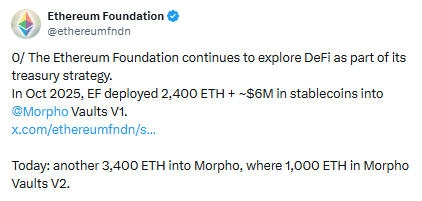
The Ethereum Foundation recently deployed 3,400 ETH into Morpho, including 1,000 ETH into Morpho Vaults V2. Back in October 2025, they had already added 2,400 ETH plus about $6 million in stablecoins into Morpho Vaults V1.
Source: X

From a strategic perspective, these moves carry real weight.

For instance, the Ethereum Foundation (a non-profit focused on network development) is showing that it’s actively putting capital to work in DeFi. By doing so, it signals confidence in Ethereum’s staking and lending ecosystem while also encouraging broader adoption across the network.

Notably, this strategy is playing out in real time.

On the 17th of March, the BlackRock Staked ETH ETF (ETHB) saw its largest inflow since inception, with a net flow of 28,810 ETH (about $67.18 million) and $0.3 billion in trading volume, highlighting growing institutional interest in Ethereum’s staking ecosystem.

And it doesn’t stop there.

Grayscale’s Ethereum Mini Trust has locked in 76,800 ETH in under a week alone. Technically, this shows that large ETH holders are allocating more and more capital into DeFi, with the Ethereum Foundation’s moves setting the pace.

Naturally, the question is: Does this give the network an edge as the CLARITY Act draws closer?

Ethereum treasuries deploy ETH, showing DeFi as a risk-off catalyst

Beyond network-level breakdowns, the DeFi sector is seeing unprecedented growth.

In fact, Total Value Locked (TVL) recently crossed $100 billion for the first time since February, demonstrating that staking continues to attract capital even in a broader risk-off environment.

Ethereum, which represents nearly 60% of the market, is clearly benefiting the most, making this trend a strong bullish signal for the network.

Against this backdrop, the CLARITY Act could become a meaningful catalyst for Ethereum, both technically and fundamentally. Backing this, the Ethereum Foundation is deploying millions into the financial infrastructure, showing that developers are laying the groundwork for broader DeFi adoption.
Source: Arkham

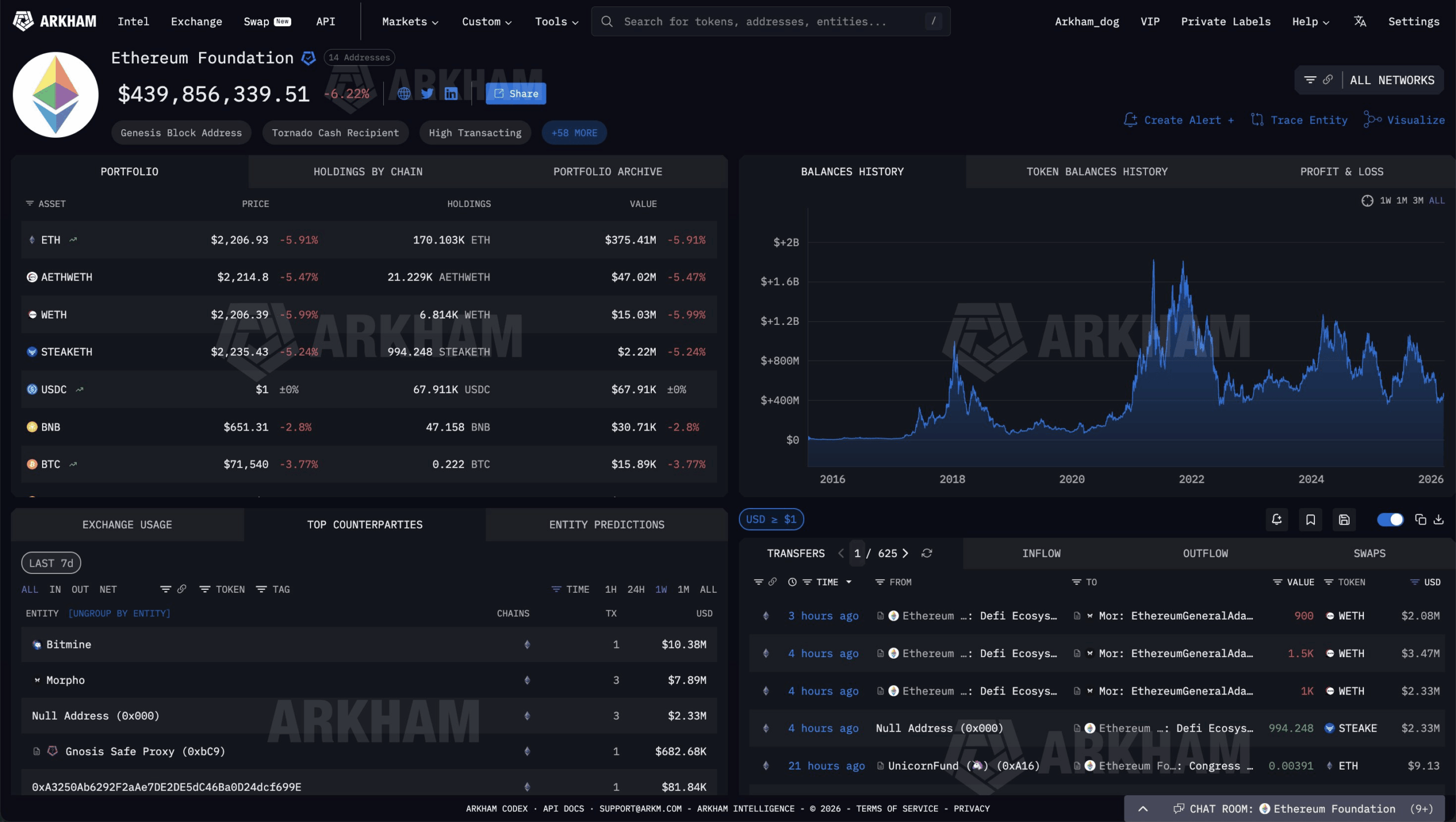
As the chart above shows, the Ethereum Foundation recently deposited $7.88 million of ETH to Steakhouse, a billion-dollar DeFi asset manager.

More importantly, the Foundation still holds over $400 million in ETH, highlighting its continued influence and strategic role in supporting the network’s growing market share.

According to AMBCrypto, this is just the start of a deeper trend.

As noted earlier, the CLARITY Act could act as a major catalyst, driving even greater institutional interest in Ethereum DeFi, with more ETH treasuries likely following BitMine’s playbook. Recent inflows into BlackRock’s ETHB only reinforce this momentum.

At the heart of it all, the Ethereum Foundation is clearly leading the way. Its recent “strategic” moves clearly signal the network’s direction, positioning Ethereum’s DeFi ecosystem as a key focus for long-term investors and a safety net during periods of intense volatility, supported by a 6% jump in ETH TVL so far this month.


Final Summary

  • Ethereum treasuries, including the Ethereum Foundation, are deploying hundreds of millions of ETH into DeFi protocols, signaling confidence and driving network growth.
  • Big inflows into BlackRock’s ETHB and Grayscale’s Ethereum Mini Trust show that traditional finance is increasingly participating in Ethereum staking, with the CLARITY Act likely acting as a catalyst.


İlgili Sorular

QWhat is the significance of the Ethereum Foundation deploying 3,400 ETH into Morpho, according to the article?

AThe deployment signals the Foundation's confidence in Ethereum's staking and lending ecosystem, actively putting capital to work in DeFi to encourage broader adoption and set a strategic tone for the network.

QHow does the article connect the CLARITY Act to the growth of Ethereum's DeFi ecosystem?

AThe CLARITY Act is seen as a potential major catalyst that could accelerate DeFi adoption and drive greater institutional interest in Ethereum, reshaping capital flows and providing regulatory clarity.

QWhat recent institutional developments highlight growing interest in Ethereum's staking ecosystem?

ABlackRock's Staked ETH ETF (ETHB) had its largest inflow with a net flow of 28,810 ETH (about $67.18 million), and Grayscale's Ethereum Mini Trust locked in 76,800 ETH in under a week, showing increased institutional participation.

QWhat does the Total Value Locked (TVL) crossing $100 billion indicate for the DeFi sector and Ethereum specifically?

AIt demonstrates that staking continues to attract capital even in a risk-off environment, with Ethereum benefiting the most as it represents nearly 60% of the market, making it a strong bullish signal for the network.

QHow much ETH does the Ethereum Foundation still hold, and what does this signify for its role in the ecosystem?

AThe Ethereum Foundation still holds over $400 million in ETH, highlighting its continued influence and strategic role in supporting the network's growth and market share through DeFi deployments.

İlgili Okumalar

SpaceX, OpenAI, Anthropic: The Three AI Giants Racing for IPO, Which One Is Worth Betting On?

SpaceX, OpenAI, and Anthropic are poised for historic IPOs within weeks, potentially raising a combined $180 billion—a sum exceeding the entire internet bubble's fundraising. The hosts of the Limitless Podcast argue this isn't just individual company financing but an unprecedented capital concentration for AI infrastructure, driven by an insatiable need for compute, data centers, power, and chips. SpaceX's IPO is notable for reportedly changing market index rules to allow faster inclusion, potentially funneling trillions in passive retirement funds into its stock, despite its unproven space-based data center business model. In contrast, Anthropic demonstrates explosive growth, with ARR reportedly hitting $45 billion and approaching profitability, fueled by strong enterprise adoption of products like Claude Code. Google's separate $80 billion raise highlights the immense capital pressure, even for giants. The discussion acknowledges bubble risks but leans optimistic. The hosts contend the massive spending is building essential physical infrastructure for the next technological era. A key bottleneck isn't capital but the real-world limits of chip manufacturing and construction speed. As long as demand for AI compute outstrips supply, this investment cycle represents a foundational build-out rather than a purely financial bubble. All three companies are seen as foundational bets on the future, with Anthropic often cited as the most immediately compelling due to its proven revenue trajectory.

marsbit2 saat önce

SpaceX, OpenAI, Anthropic: The Three AI Giants Racing for IPO, Which One Is Worth Betting On?

marsbit2 saat önce

From 'Old Guys' to 'New Favorites': How AI Is Revaluing Old Infrastructure from Dell to Nokia?

From "Vintage Tech" to "New AI Darlings": How AI Revalues Old Infrastructure One year ago, tech giants like Dell, Nokia, Cisco, and Western Data were seen as slow-growth, low-valuation stories, far from the AI spotlight dominated by players like Nvidia. Now, these legacy tech stocks are gaining market attention, sparking debate on whether this is genuine industry revaluation or a temporary narrative. As AI moves from model parameters to real-world data centers, the market is recognizing companies with proven delivery and infrastructure capabilities. This shift marks a change in the AI investment thesis: from pure model and GPU focus to the complex systems engineering required for deployment. Companies like Dell, HPE, and Corning are being revalued not for being "sexy" AI innovators, but for their decades of accumulated expertise in supply chains, enterprise delivery, and infrastructure—assets that have become critical in the AI buildout phase. The revaluation is unfolding across three key infrastructure lines: 1. **Servers & System Integration:** Dell and HPE are emerging as crucial system integrators or "general contractors" for AI data centers, translating GPU orders into complete, deployable server racks integrated with power, cooling, and networking. 2. **Networking & Connectivity:** AI's scale demands robust high-speed connections. Corning (fiber optics), Nokia (AI-RAN, 6G), and Cisco (data center switches) are gaining importance for enabling efficient data transfer within and between AI clusters. 3. **Storage:** Beyond high-speed memory (HBM/DRAM), the AI data explosion is driving demand for high-capacity hard drives (HDDs) from companies like Western Digital and Seagate to handle training data, logs, and cold storage cost-effectively. For this revaluation to be substantive and not just a narrative, three criteria are key: 1) Concrete AI-related order and revenue growth (e.g., Dell's AI server sales), 2) Upward revisions to company financial guidance, and 3) Sustainable improvements in profit quality, not just top-line revenue spikes. In essence, AI's transition to a real construction phase is re-pricing "old assets" against "new demand." The opportunity, however, is selective. Only those legacy firms that are demonstrably integrated into the capital expenditure chains of data center and enterprise AI deployment are likely to experience a true "logic re-rating" rather than just a temporary valuation bounce.

marsbit2 saat önce

From 'Old Guys' to 'New Favorites': How AI Is Revaluing Old Infrastructure from Dell to Nokia?

marsbit2 saat önce

İşlemler

Spot
Futures
活动图片