$66 Billion 'Bitcoin Machine' Strategy Depends on Capital Markets, Not BTC Price: Report

cryptonews.ru2026-08-25 tarihinde yayınlandı2026-08-25 tarihinde güncellendi

Özet

According to a recent analysis by Regime Intelligence, MicroStrategy's $66 billion Bitcoin holdings may be less vulnerable to a cryptocurrency market crash than to a sustained loss of access to capital markets. This risk could threaten the company's ability to fund roughly $1.76 billion in annual obligations without selling Bitcoin. The report states that MicroStrategy's reserves of 840,447 BTC are backed by approximately $22 billion in debt and preferred stock obligations, meaning its accumulation strategy relies on the firm's continued ability to raise new capital. Contrary to popular belief, the primary vulnerability is not a drop in Bitcoin's price or liquidity issues, but this persistent dependence on capital markets. The report notes that MicroStrategy's debt does not function like a typical margin loan on Bitcoin, as there is no BTC-price-linked margin call forcing liquidation if the price falls. A stress test indicated Bitcoin would need to fall about 96% before its BTC assets would no longer cover its convertible notes. However, the risk shifts: MicroStrategy must continue paying about $1.76 billion annually in preferred dividends and interest regardless of Bitcoin's price. The analyst suggests investors monitor the company's cash reserves and the price of its preferred stock. If financing conditions worsen, the accumulation strategy could reverse, forcing the company to sell Bitcoin to meet its obligations, especially in a prolonged BTC downturn where raising capi...

According to a recent analysis by Regime Intelligence, MicroStrategy's bitcoin reserves may be less vulnerable to a crypto market crash than to a prolonged loss of access to capital markets. Such a risk could jeopardize the company's ability to fund about $1.76 billion in annual obligations without selling bitcoin.

The report states that MicroStrategy's hoard of 840,447 $BTC is backed by approximately $22 billion in debt and preferred equity holder claims. This means the bitcoin accumulation model depends on the company's ability to continuously raise new capital to meet its obligations.

Contrary to popular belief, MicroStrategy's (MSTR) key vulnerability is not a drop in bitcoin's price or liquidity issues, but its ongoing dependence on access to capital markets. The report notes that MicroStrategy's debt does not function like a typical margin loan backed by bitcoin: there is no $BTC-linked margin call that would force the company to liquidate assets if the price falls.

A Regime Intelligence stress test showed that bitcoin would need to fall by approximately 96% before MicroStrategy's bitcoin assets and reserves would no longer cover its convertible bonds. However, the risk shifts to the other side of the balance sheet: MicroStrategy must continue to pay about $1.76 billion per year in preferred stock dividends and interest regardless of bitcoin's price.

"In my view, MSTR's main challenge is to keep the flywheel operating to cover the annual payments on debt and preferred equity," the report's author, Sherif Saad, told Cointelegraph.

He stated that investors should watch MicroStrategy's preferred stock price and its cash reserves, which currently cover roughly 2.6 years of its payout volume.

If financing conditions worsen, the bitcoin accumulation strategy could reverse, forcing the company to more actively draw on reserves and sell bitcoin to meet obligations.

"During a prolonged $BTC downturn, the problem is exacerbated if MSTR's stock price and mNAV both decline," he said, adding that raising capital would then become "incrementally more challenging or expensive."
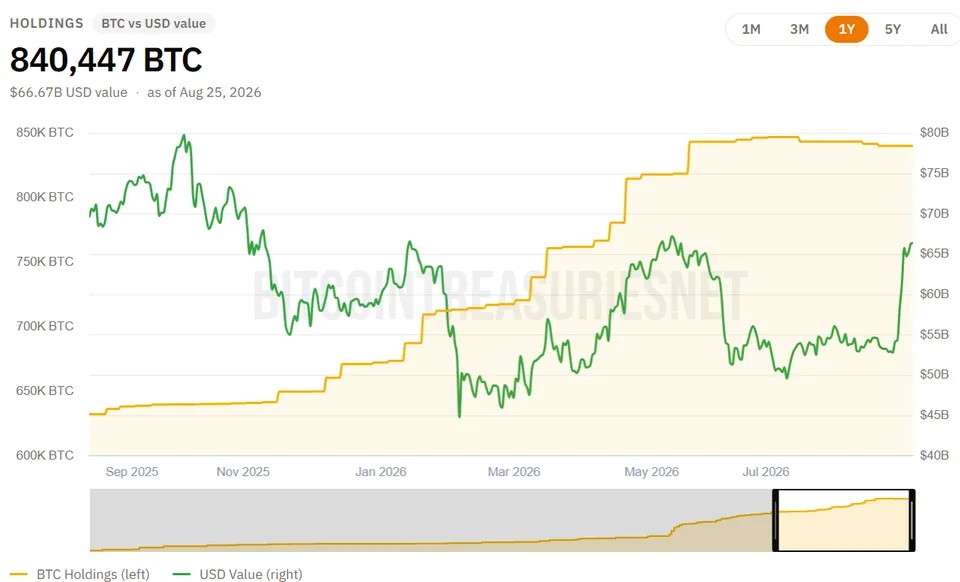
Following bitcoin's recent recovery, MicroStrategy's $BTC hoard is valued at $66.7 billion — above the company's net asset cost basis of $63.36 billion. Source: BitcoinTreasuries.NET

Related: Standard Chartered Analyst Expects $BTC at $100,000 as US Treasury Doubles Long-End Bond Buyback

Michael Saylor's Juggling Act

A significant part of the perceived risk surrounding MicroStrategy revolves around the company's willingness to use the bitcoin on its balance sheet, especially after Executive Chairman Michael Saylor spent years promoting a "never sell" stance. Therefore, it came as a surprise to some bitcoiners when MicroStrategy began selling $BTC this year to meet other business obligations.

Since May, the company has sold bitcoin four times, including a recent sale of 1,690 $BTC; the proceeds from these sales were used to fund preferred stock dividends, share buybacks, and to bolster the dollar reserve.

Despite these sales, MicroStrategy CEO Phong Le reminded investors that the company has accumulated "roughly 25 times more" bitcoin than it has sold this year. Earlier this month, he told CNBC that the company plans to resume bitcoin purchases later this year.

Related: Crypto Biz: $11.6 Billion Wake-Up Call Prompts Rethink on Self-Custodying Bitcoin

İlgili Sorular

QAccording to the Regime Intelligence report, what is the main vulnerability for MicroStrategy (MSTR) regarding its Bitcoin reserves?

AAccording to the report, MicroStrategy's main vulnerability is not a drop in Bitcoin's price or liquidity issues, but its persistent dependence on access to capital markets to finance its approximately $1.76 billion in annual obligations.

QHow much in annual obligations does MicroStrategy need to finance, and why is this a concern?

AMicroStrategy needs to finance approximately $1.76 billion in annual obligations for dividends on preferred shares and interest on debt. This is a concern because the company must meet these payments regardless of Bitcoin's price, relying on its ability to continuously attract new capital.

QWhat would need to happen to Bitcoin's price for MicroStrategy's Bitcoin assets to no longer cover its convertible bonds, based on the stress test?

ABased on the Regime Intelligence stress test, Bitcoin's price would need to fall by approximately 96% before MicroStrategy's Bitcoin assets and reserves would fail to cover its convertible bonds.

QWhat has been MicroStrategy's recent activity regarding buying and selling Bitcoin?

AMicroStrategy has sold Bitcoin four times since May, including a recent sale of 1,690 BTC, using the funds for financing dividends, share buybacks, and increasing its dollar reserves. However, the company's CEO noted it has accumulated roughly 25 times more Bitcoin than it sold this year and plans to resume purchases later this year.

QWhat should investors monitor closely regarding MicroStrategy's financial health, as suggested by the report's author?

AThe report's author suggests that investors should closely monitor the price of MicroStrategy's preferred shares and the company's cash reserves, which currently cover about 2.6 years of its annual payout obligations.

İlgili Okumalar

İşlemler

Spot
活动图片