[Key interpretation] The sharp drop of XRP financing interest rate indicates the risk, and BTC plans a sharp drop in the weekend market

Huobi2022-09-23 tarihinde yayınlandı2022-09-26 tarihinde güncellendi

Özet

BTC is brewing a sharp decline over the weekend, and the soaring XRP financing interest rate indicates risks.

1. BTC still operates at a large scale

Although the recent performance of BTC prices has retreated, the trading volume has not shrunk. The trading volume in the past three weeks is very high, which is the largest trading volume performance in the past year. This means that investors have not lost interest in the low price BTC. From the perspective of the holding cost of investors, the holding cost of BTC investors is more concentrated in the price area below $25000. In the past three weeks, the cost price of the currency held by investors was further concentrated below $22000. Therefore, in the short term, the BTC price hovers at a low level, the adjustment rhythm continues, and it will take longer for the price to leave the bottom area. In other words, the bottom of BTC rebounds to a large arc bottom. The longer the bottom lasts, the more opportunities investors have for low absorption.
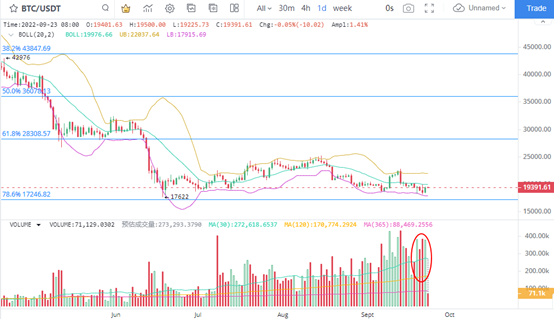
2. BTC average transaction inflow growth

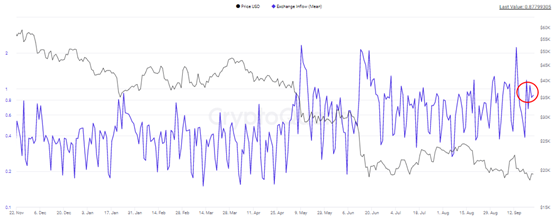
The average inflow of BTC remained at a high level. On September 23, the value remained around 0.877, indicating that although the overall value has not increased recently, the average transaction inflow has remained at a high level. This shows that the trend of the main funds flowing into the exchange has not ended. Therefore, the downside risk of BTC's recent low level operation has not been removed. For currency investors, they need to pay more attention to the trend of the market. Although the focus of BTC's currency holdings has decreased significantly, there are not many investors taking the initiative to pull the market, which has little impact on the market.
3. ETH rebounds fruitlessly

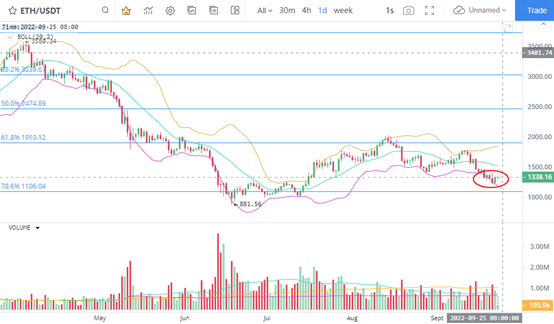
The trading volume of ETH during the short-term rebound was not high. Although the price was supported at the early $1200 position, there was little room for growth. Therefore, ETH did not completely get rid of the declining price trend in the declining trend of the daily K-line level. The price trend in the week is still falling, and the possibility of continuing to close down at the weekend is high. On the news side, during the recent completion of the Federal Reserve's interest rate hike, the retreat of ETH prices significantly linked to the trend of important assets such as the stock market and the dollar index. Therefore, when judging the market performance, negative sentiment still dominates the price direction during the week, and we should be alert to the callback performance.
4. XRP financing interest rate fell sharply

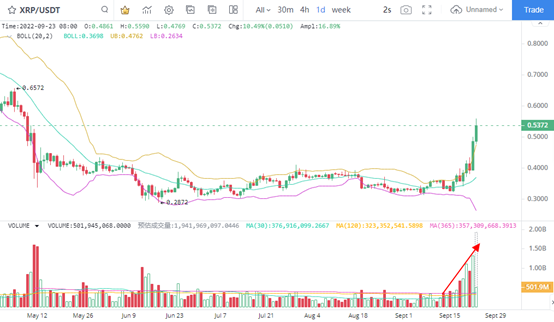
XRP's recent price performance is relatively strong, which is related to the continuous growth of trading volume. The daily K line chart shows that XRP trading volume has increased by as much as 300% recently, driving the XRP price to rebound from a low of $0.3 to a maximum of $0.559, with a maximum increase of 86%.

It is worth noting that XRP shows obvious large-scale adjustment performance no matter in the daily K line or the 30 minute chart. Therefore, XRP's recent price strength may continue. The decline of financing interest rate indicates that the selling pressure is increasing, which deserves investors' attention.
5. Withdrawal of financing interest rate

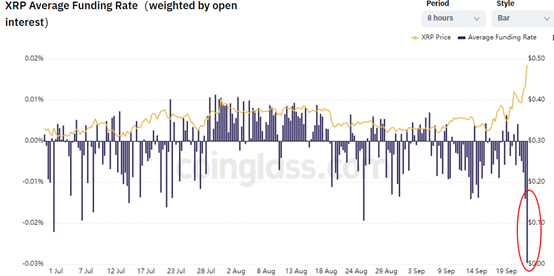
During the rapid decline of XRP financing interest rate, the value continued to drop to the lowest value of -0.003%. Therefore, it is judged that the selling pressure of XRP has increased significantly, and the impact on the price is also increasing. Although the financing interest rate has reached a new low, the absolute value is not low. XRP prices have just completed the bottom reversal pattern since May, and the growth potential may be further confirmed.

İlgili Okumalar

OpenAI's "Most Open" Move: Codex No Longer Exclusively Favors GPT

OpenAI has significantly opened up its Codex programming agent by introducing a "model provider" configuration layer that allows users to connect it with various open-source models, not just its proprietary GPT. Through a configuration file or a simple `--oss` command-line flag, Codex can now route requests to local services like Ollama or LM Studio, or to third-party APIs such as Mistral or DeepSeek. This move is seen as one of OpenAI's most "open" steps, potentially lowering costs and enhancing privacy for developers who can run code generation offline. However, integration isn't seamless for all models. Codex primarily uses OpenAI's newer Responses API, while many open-source models rely on the older Chat Completions interface. This creates compatibility issues, especially for advanced features like function calling. The developer community is already building "routing" or adapter layers (e.g., CC Switch, LiteLLM) to translate between these protocols, enabling hybrid setups where GPT handles planning and open-source models handle execution. Analysts interpret this as a strategic shift for OpenAI: from competing solely on model superiority to controlling the platform and interface standards. By making Codex a flexible, pluggable entry point for AI-assisted programming, OpenAI aims to become the central hub in the developer toolchain ecosystem, even as users gain the freedom to switch underlying models.

marsbit5 dk önce

OpenAI's "Most Open" Move: Codex No Longer Exclusively Favors GPT

marsbit5 dk önce

When 500 Million People Abandon ChatGPT

ChatGPT's Global AI Assistant Market Share Drops Below 50% Three and a half years after its groundbreaking launch, ChatGPT faces a pivotal moment. While it remains the largest AI assistant globally, its market share has fallen below 50% for the first time, reaching 46.4% as of May, according to Sensor Tower's 2026 AI landscape report. Google's Gemini (27.7%) and Anthropic's Claude (10.3%) are now its main competitors, with Grok, Perplexity, and others also gaining ground. The market has evolved from awe and initial adoption into a phase of product comparison, ecosystem integration, and commercialization. User behavior has matured significantly. Loyalty is low; users readily switch between assistants for specific tasks. Gemini benefits from deep integration within Google's ecosystem (Search, Gmail, Android), while Claude has carved a niche among productivity-focused users with strong retention, nearly matching ChatGPT's. User choice is now influenced by a complex mix of capability, ecosystem, price, use case, and even brand trust. Commercialization is accelerating. AI app downloads continue but growth is slowing, while user spending is rising. Over $4.2 billion was spent in-app during H1 2026. Claude leads in premium subscription conversion rates (13%). OpenAI is expanding its revenue streams, testing ads shown to 17% of ChatGPT users daily by May. This shift highlights the immense financial pressure of model training and inference costs. Despite revenue growth, OpenAI's cash burn is intense, reaching $3.7 billion in Q1 2026. The company projects this could rise to $25-57 billion in the coming years, underscoring the industry-wide challenge of scaling profitably. The symbolism is clear: ChatGPT no longer defines the AI assistant market alone. The era of a single dominant product is over. Gemini, Claude, and specialized tools are collectively shaping user habits and business models. As AI assistants move from novelty to utility—judged on accuracy, efficiency, and value—they are becoming embedded in everyday digital life. ChatGPT may have lost its majority, but AI as a whole is winning, entering a mature, competitive, and diverse new phase.

marsbit7 dk önce

When 500 Million People Abandon ChatGPT

marsbit7 dk önce

İşlemler

Spot
Futures
活动图片