6% Annualized Return: Musk Declares War on Traditional Banks

比推2026-03-06 tarihinde yayınlandı2026-03-06 tarihinde güncellendi

Özet

Elon Musk's X platform has launched "X Money," a financial product offering a 6% annual percentage yield (APY) on deposits, directly challenging traditional banks that offer near-zero rates. The product includes a metal debit card engraved with the user’s X handle, integrates with Visa Direct for instant transfers, and provides FDIC insurance up to $250,000 via Cross River Bank. The high yield is enabled by a low-cost, digital-native model without physical branches, leveraging X's over 500 million monthly active users. X Money threatens traditional banks, payment intermediaries like PayPal, and remittance services by potentially diverting deposits and reducing transaction fees. Regulatory hurdles remain, including pending approval in New York and compliance with the GENIUS Act, which prohibits stablecoin-related yields. The service is further integrated with Grok, X’s AI, aiming to offer real-time financial advice and seamless transactions within the platform. Success depends on regulatory clearance and effective execution, positioning X Money as a potential U.S. super-app akin to WeChat Pay.

Author: Cathy

Original Title: 6% Annualized Return, Musk Declares War on Traditional Banks


In early March 2026, American actor William Shatner—Captain Kirk from Star Trek—posted a screenshot on X.
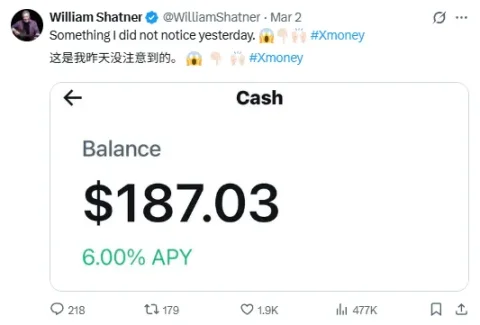
Nothing major—just him testing a new product called X Money.

In the screenshot was a line of numbers: Annualized Yield: 6%.

The post didn’t go viral, but it quietly sent shockwaves through financial circles.

Not because of William Shatner, but because of that 6%.

Open an ordinary savings account at JPMorgan Chase, and the deposit interest rate is 0.01%. At Wells Fargo, it’s about the same. Deposit $100, and a year later the big bank gives you one cent. With X Money, you get $6.

A difference of 600 times.

This is how Musk is waging war on traditional finance—not with a technical white paper, not with regulatory lobbying, but with a screenshot.

A Black Metal Card

The concept of X Money is easy to grasp: a digital wallet that can send, receive, and store money, paired with a physical debit card.

But every detail exudes ambition.

That debit card is made of black metal, laser-engraved with your X username (Handle). Not your legal name, not an account number, but your social identity on the X platform.

This design is no accident. It ties your social account to your spending power. Every time you pull out the card to pay, you’re not just showing a payment tool—you’re displaying your digital identity. The stickiness of the X ecosystem is built layer by layer in this way.

On the settlement side, X Money is integrated with Visa Direct. Traditional bank ACH transfers take 1 to 3 business days to clear; Visa Direct enables near-instant settlement. For the gig economy and content creators, this speed difference is a tangible improvement in experience.

Deposits are held by Cross River Bank (a member of the FDIC), with each user protected by up to $250,000 in federal deposit insurance.

To summarize the product in one sentence: 6% APY, laser-engraved black metal card, instant settlement, zero overseas fees, $250k insurance cap.

Just looking at the spec sheet, it’s hard to find fault.

How Can It Offer 6%?

This is the most critical question.

Where does the money for the 6% APY come from? X Money isn’t burning cash to subsidize users—at least, that’s not the current business logic. The answer lies in an inconspicuous difference in cost structure.

Traditional big banks maintain a complete physical network: branch offices, tellers, ATM fleets, IT systems decades old. These are huge fixed costs; no matter the deposit size, that overhead remains.

X Money, however, is a cloud-native, API-first platform with no physical branches and no legacy baggage. The front-end user experience is handled by X, while banking compliance and fund custody are handled by Cross River Bank. This embedded finance model—"front-end to the tech company, back-end to the licensed bank"—drastically reduces operational costs, and the savings are passed on to users.

This logic itself isn’t new. Robinhood, Ally Bank, and SoFi have taken the same path.

But X Money has something most traditional fintech companies lack: over 500 million monthly active users, with a user acquisition cost (CAC) close to zero.

No need to spend money to attract new users; just keep the money of users already on X within X.

Who Is Threatened

The competitors X Money aims to squeeze are more numerous than they appear.

First, the traditional deposit market.

The business model of big banks relies on one premise: depositors have no better options, or can’t be bothered to switch.

The 6% APY shatters that premise. When over 500 million X users have access to this rate, the pressure for capital migration becomes real. To retain depositors, banks will have to raise their own deposit interest rates, compressing net interest margins. About 60% of U.S. banking revenue comes from net interest income. This is no small matter—it’s a systemic shake-up of the profit structure.

Second, the payment middle layer.

Social payment players like Venmo, PayPal, and Cash App have grown accustomed to their positions in this field. But none of them has a social platform with over 500 million users as a traffic entry point.

The core logic of X Money is to build a "closed loop of funds": money comes in, circulates within the X ecosystem for content rewards, subscriptions, merchandise purchases, and doesn’t need to flow out. Once this loop is formed, the intermediary role of PayPal and others will be marginalized.

Finally, cross-border remittances.

According to World Bank data from Q1 2025, the average cost of global cross-border remittances is about 6.49%, and transfers often take days to arrive. Leveraging Visa Direct’s global network, X Money aims to significantly reduce this cost and achieve near-real-time settlement. The business of Western Union and MoneyGram in markets with dense X user bases, like India, Indonesia, and Brazil, is X Money’s most direct target.

The Regulatory Battlefield

However, whether these threats materialize depends largely on regulation.

X Payments LLC has already obtained money transmitter licenses (MTLs) in over 40 states and Washington, D.C. But one state remains unyielding: New York.

New York state lawmakers have publicly written to the Department of Financial Services (DFS), urging it to deny X a license. Reasons include: Musk’s historically adversarial stance toward regulators, vulnerabilities in X’s identity verification mechanisms, and a more sensitive allegation—that during Musk’s tenure leading the Government Efficiency Department (DOGE), his staff reportedly accessed consumer payment data from the Consumer Financial Protection Bureau (CFPB), data that theoretically contains competitors’ trade secrets.

A regulator simultaneously participating in competition—if this allegation is substantiated, it could trigger a series of antitrust lawsuits.

Another variable is the GENIUS Act. Signed into law in July 2025, this stablecoin legislation explicitly prohibits issuers of payment stablecoins from paying any form of yield or interest to holders.

Currently, the 6% APY paid on fiat deposits by X Money operates under traditional banking deposit agreements, which under current frameworks poses no direct issue. But if X intends to convert account balances into stablecoins in the future, or deeply integrate crypto assets like Dogecoin or XRP, the GENIUS Act’s yield ban would directly block that path.

Musk needs to prove to regulators that the 6% is compliant bank deposit interest, not a disguised unregistered security yield, nor prohibited stablecoin dividends.

Grok Enters the Fray

If the 6% APY is X Money’s entry ticket, Grok is the moat it aims to build.

X’s AI, Grok, is being deeply integrated with financial functions. Musk’s vision is for Grok to be not just a chatbot, but an "intelligent agent" capable of handling financial duties—recommending buys and sells based on real-time sentiment on the platform, automatically allocating funds among products of different risk levels, and even allowing users to jump directly to a trading interface via the "Smart Cashtags" feature while scrolling through posts.

This is a new product形态: consuming content and managing assets happen in the same interface.

Traditional wealth management firms charge fees based on information asymmetry and human services. When AI can process vast amounts of social data and market signals at millisecond speeds, that information advantage shrinks.

For creators, the change is more direct: tips, subscription shares, ad revenue go directly into the X wallet with 6% APY, without passing through intermediary bank accounts. X is positioning itself as the settlement hub for creators—their de facto "bank".

Summary

The success of WeChat Pay and Alipay in China made countless U.S. tech companies envious, yet none managed to replicate it. The reasons are multifaceted: more fragmented U.S. financial regulation, consumer habits favoring credit card cashback culture, and barriers between different platforms.

X Money is the closest attempt to date to achieve this goal.

It has a user base, AI capabilities, Visa’s global network, a founder who disregards established rules—and a host of regulators and politicians waiting to cause trouble for it.

The outcome of this clash between these two forces will become clearer over the next 18 months. If X Money can secure the New York license, maintain compliance within the boundaries of the GENIUS Act, and successfully operationalize Grok’s AI wealth management features—it might just complete the experiment of an American super-app.

If not, all that will remain is a sleek black metal card and a memory of a good 6% rate.

For traditional banks and payment giants, the difference between these two outcomes is existential.


Twitter:https://twitter.com/BitpushNewsCN

Bitpush TG Discussion Group:https://t.me/BitPushCommunity

Bitpush TG Subscription: https://t.me/bitpush

Original link:https://www.bitpush.news/articles/7617510

İlgili Sorular

QWhat is the key feature of X Money that is causing a stir in the financial industry?

AX Money offers a 6% annual percentage yield (APY) on deposits, which is 600 times higher than the typical 0.01% offered by major traditional banks like JPMorgan Chase and Wells Fargo.

QHow does X Money manage to offer such a high 6% APY compared to traditional banks?

AX Money operates as a cloud-native, API-first platform without physical branches, significantly reducing operational costs. It leverages its integration with Cross River Bank for compliance and funds custody, and benefits from nearly zero customer acquisition costs due to its over 500 million monthly active users on the X platform.

QWhich sectors or companies are most threatened by the launch of X Money?

AX Money threatens traditional deposit markets by pressuring banks to raise their deposit rates, social payment players like Venmo and PayPal by creating a closed-loop funds ecosystem within X, and cross-border remittance services like Western Union and MoneyGram by offering lower costs and near-real-time transfers via Visa Direct.

QWhat are the major regulatory challenges facing X Money?

AX Money faces regulatory hurdles, including pending approval for a money transmitter license in New York due to concerns over Musk's regulatory history and platform verification issues. Additionally, the GENIUS Act prohibits stablecoin issuers from paying yields, which could impact X Money if it integrates cryptocurrencies or stablecoins in the future.

QHow does Grok AI integrate with X Money to enhance its financial services?

AGrok AI is being deeply integrated with X Money to function as an intelligent financial agent, analyzing real-time social data to provide trading suggestions, automatically allocating funds across risk profiles, and enabling seamless transactions through features like Smart Cashtags, merging content consumption with asset management.

İlgili Okumalar

Near Returns to the AI Stage: Transformation into a Public Chain Due to 'Payroll Difficulties,' Agent and Privacy Emerge as New Growth Narratives

NEAR Returns to AI Origins: From Payroll Struggles to Blockchain, Now Focusing on AI Agents and Privacy NEAR Protocol's journey began not with grand blockchain ambitions, but from a practical hurdle: its AI startup founders, including Transformer paper co-author Illia Polosukhin, couldn't efficiently pay international developers in 2017. This led them to pivot and build a high-performance, scalable blockchain. After years navigating various crypto narratives like sharding and cross-chain interoperability, NEAR is now leveraging its AI roots to re-enter the AI arena. A key driver is its "NEAR Intents" layer, which abstracts complex cross-chain transactions. Users simply state their goal (e.g., swap BTC for ETH), and a solver network finds the optimal route. This system has processed over $20B in cross-chain volume, generating significant fee revenue. A major growth area is private transactions via "Confidential Intents/Swaps," which hide trade details until settlement to protect against MEV and front-running. Remarkably, private swaps recently accounted for over 40% of NEAR's transaction volume, highlighting strong demand but also potential regulatory scrutiny. With its AI-founder pedigree, NEAR is positioning itself at the intersection of blockchain, AI agents, and privacy, aiming to become infrastructure for the emerging agent economy while navigating the challenges of its rapid adoption.

marsbit33 dk önce

Near Returns to the AI Stage: Transformation into a Public Chain Due to 'Payroll Difficulties,' Agent and Privacy Emerge as New Growth Narratives

marsbit33 dk önce

From Ethereum to AI's 'CROPS': What Exactly is This Set of 'Slow Variables' That Vitalik Repeatedly Emphasizes?

In recent discussions, Vitalik Buterin has frequently emphasized the concept of "CROPS," a framework defining core values for Ethereum's development. CROPS stands for Censorship Resistance, Capture Resistance, Open Source, Privacy, and Security. Initially outlined in the Ethereum Foundation's "EF Mandate," it represents a commitment to user sovereignty, ensuring that the network resists external control, remains open, protects privacy, and prioritizes security. The relevance of CROPS extends beyond Ethereum's foundational principles, becoming crucial in the context of AI integration. As AI agents begin handling wallet operations and automated transactions, the risk increases that users may cede control over their digital assets, privacy, and intentions to centralized AI service providers. A "CROPS AI" would therefore emphasize local execution where possible, privacy-preserving remote model calls (e.g., using zero-knowledge proofs), and transparent, verifiable processes to maintain user agency. Vitalik highlights a significant convergence between "CROPS Ethereum access layer" and "CROPS AI." Both address the same fundamental challenge: how users can access powerful services—be it blockchain data via RPCs or AI models—without exposing sensitive information or relinquishing ultimate control. This intersection points toward a future digital entry point that is more private, secure, and user-controlled. Ultimately, CROPS is not merely an abstract ideal but a practical guidepost. It steers development—from protocol resilience and wallet design to AI agent safety—towards a future where users retain self-sovereignty even as digital systems grow more complex and powerful. In an era of accelerating AI adoption, these "slow variables" of censorship resistance, openness, privacy, and security may define Ethereum's enduring value.

marsbit43 dk önce

From Ethereum to AI's 'CROPS': What Exactly is This Set of 'Slow Variables' That Vitalik Repeatedly Emphasizes?

marsbit43 dk önce

Silicon Valley 'Startup Guru' Steve Hoffman: Web3 + AI Could Be a Trap

Silicon Valley investor and "Godfather of Startups" Steve Hoffman warns that combining Web3 with AI is likely a trap, not a promising venture. In an interview, Hoffman argues that while AI is a foundational technology touching all industries, Web3 adds complexity, friction, and regulatory risk without solving mainstream consumer or business needs. He advises founders to focus on deep, specialized applications where startups can out-iterate giants, rather than on generic features easily replicated by large tech companies. Hoffman observes that Silicon Valley will lead foundational AI research, while China excels at rapid, large-scale application and commercialization, particularly in robotics. He stresses that AI-driven autonomous agents capable of collaborative, multi-step tasks are 2-4 years away, which will cause significant job displacement. The solution is not to slow AI but to redesign business models around human-AI collaboration and reform social systems like education and retraining. For startups, Hoffman recommends focusing on vertical, expertise-heavy domains to build defensibility. He sees major opportunities in AI fraud detection and cybersecurity. Key founder mindsets include systemic thinking over feature-focus, relentless customer centricity, building adaptive teams, and deeply understanding AI's capabilities and limits. Hoffman is also leading a non-profit initiative to establish university centers aimed at training future leaders in responsible, human-value-aligned AI innovation.

marsbit2 saat önce

Silicon Valley 'Startup Guru' Steve Hoffman: Web3 + AI Could Be a Trap

marsbit2 saat önce

Token Inefficient, Economy Tokenless

The article "Tokens Aren't Economical, Economics Aren't Tokenized" analyzes a pivotal shift in the AI industry from a technology-driven narrative to one dominated by capital efficiency. It highlights two concurrent trends: a severe capital shortage due to the exorbitant and recurring costs of compute (e.g., OpenAI's high burn rate) and a wave of corporate spin-offs where major tech companies are separating their AI units (like Kuaishou's Kling and Baidu's Kunlunxin). The core argument is that AI's "anti-internet" business model, where user growth increases costs rather than profits, has created a disconnect between high valuations and actual cash flow. Spin-offs address this by allowing AI assets to be valued independently. Within a parent company, they are seen as cost centers, but as standalone entities, they are priced based on their growth potential and scarcity in the primary market, leading to massive valuation premiums (e.g., Kling's estimated value tripling post-spin-off). The industry is at an inflection point, moving from "model worship" to "value realization." The competition is evolving from a pure compute (GPU) race to a broader focus on systemic efficiency and full-stack engineering (involving CPUs and orchestration) to achieve viable commercialization. The year 2026 is framed as a critical moment where the industry must definitively answer how to economically translate AI capability into tangible business value, reshaping the sector's future power structure.

marsbit2 saat önce

Token Inefficient, Economy Tokenless

marsbit2 saat önce

İşlemler

Spot
Futures
活动图片

