Community-led Terra Classic (LUNC) now worth 12x more than Do Kwon-led Terra LUNA

cryptoslate2022-09-08 tarihinde yayınlandı2022-09-08 tarihinde güncellendi

Özet

Terra Classic (LUNC) has a current market cap of $3.3 billion, roughly 12x higher than Terra LUNA’s $258 million.

Terra Classic (LUNC) has a current market cap of $3.3 billion, roughly 12x higher than Terra LUNA’s $258 million.

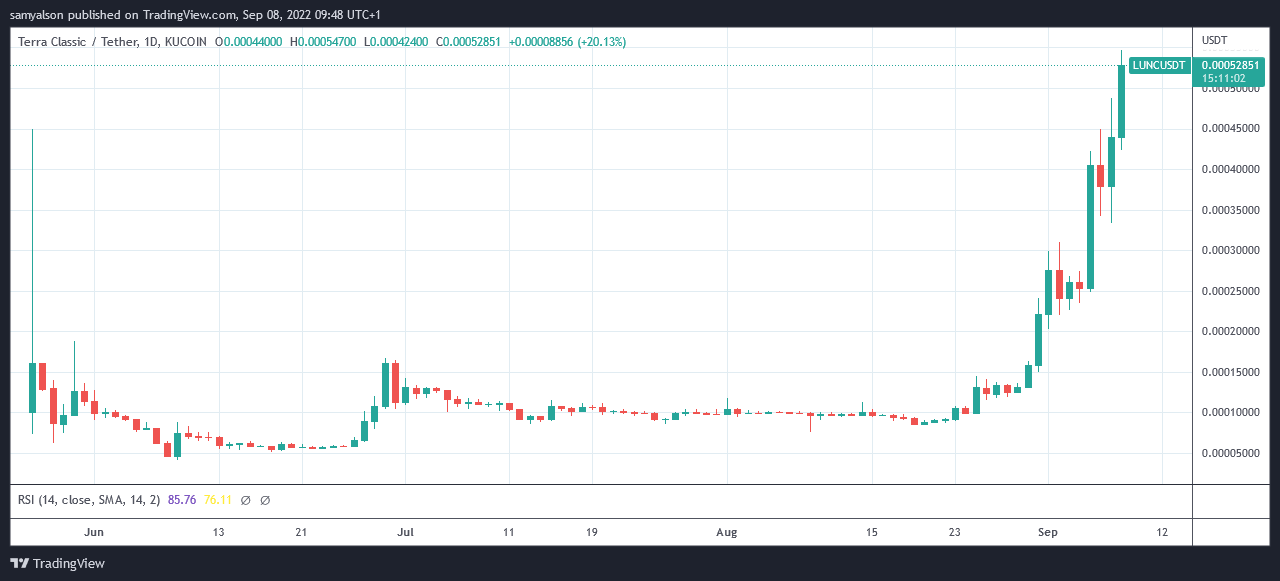
Plans to revive the previously “dead” Terra Classic chain have taken effect, leading to near 1,900% gains since bottoming at $0.00004885 on June 8. The community-led project has implemented several initiatives to boost demand, including token burning and attractive staking opportunities.
Terra LUNA
Terra LUNA

Source: LUNCUSDT on TradingView.com

According to LuncStaking_Bot, 8.8% of the LUNC supply is currently staked. This ratio has steadily increased since staking went live on August 27 — when only 2.6% of LUNC’s supply was staked.

Do Kwon misfires

The Terra ecosystem implosion was triggered when the UST stablecoin lost its dollar peg in May. UST operated under an algorithmic pegging mechanism to moderate supply and demand, hence its price, in conjunction with the LUNA token.

Falling below $1 incentivizes users to mint LUNA and burn UST. By dropping significantly below the peg price, vast quantities of LUNA were minted, increasing supply and tanking the token price.

The upshot was the mass exodus of capital leaving the ecosystem and the subsequent liquidity squeeze impacting the rest of the market. Since then, numerous fraud allegations have been leveled at Terra founder Do Kwon and his senior team. This included money laundering through shell companies and the siphoning of users’ funds. But most damning of all, Terra was a scam from the get-go.

The community accepted Do Kwon’s proposal to fork the chain and create Terra LUNA. The original chain was rebranded Terra Classic (LUNC) and left to the community for development and governance.

Many assumed LUNC would tail off and vanish, yet recent initiatives have seen its token price explode to climb the market cap rankings. LUNC is now ranked the 26th biggest chain, whereas Do Kwon-led LUNA ranks 116th.

FatManTerra slams Terra LUNA project

Terraform Labs associate Maslin Edwin posted a community update on September 7 detailing the latest developments in the Terra LUNA ecosystem.

It mentioned numerous updates, including new staking pools, wallet integrations, exchange listings, and information on recent governance proposals.

However, in response, FatManTerra tweeted that he finds it “amusing and sickening” that it’s business as usual with no acknowledgment of the harm caused by the Terra implosion.

He signed off, saying “we” will never forget what happened.

Trend Kriptolar

İlgili Okumalar

GPT-5.6 Countdown: Abandon the Illusion of a Single API, Computational Iteration Can't Outpace a Single Page of Compliance

In mid-June, three seemingly independent industry events—the compliance-driven throttling of Fable 5, the open-sourcing of GLM-5.2, and the leaked release timeline for GPT-5.6—are pushing the global AI industry toward a watershed moment. These shifts signal a fundamental restructuring of the industry's underlying logic. First, **"usability" has substantially overtaken "advanced capabilities"** as the primary weight, pushing the global large language model (LLM) supply chain into a "dual-track" phase of controlled closed-source and local open-source coexistence. Second, **the competitive moats of closed-source giants are shifting**. Their technical focus is moving from "language intelligence" toward "spatial intelligence (world models)"—a domain heavily reliant on computing power. Third, faced with常态化 transnational compliance risks, **a "model-agnostic" decoupled design has become a survival necessity for application-layer developers to maintain business continuity.** The article details how Anthropic's Fable 5, despite its advanced engineering feats, was restricted for non-U.S. citizens within 72 hours of launch, highlighting how geopolitical compliance can instantly limit even the most advanced models. In response, the open-source camp, exemplified by Zhipu AI's MIT-licensed GLM-5.2, is gaining market share by offering stable performance improvements and significant cost advantages (up to 70% savings for enterprises), while achieving full adaptation with domestic semiconductor platforms. Meanwhile, closed-source leaders like OpenAI are pivoting. The anticipated GPT-5.6 reportedly shifts focus from language to spatial intelligence and world models, aiming to rebuild a generational gap in areas like 3D understanding, simulation, and industrial design that demand immense compute. The core conclusion is that the LLM supply chain's logic has changed. Enterprises must now evaluate infrastructure based on a composite of technical performance and policy compliance. For developers, complete reliance on a single closed-source API poses unacceptable risk. Implementing a truly model-agnostic architecture—enabling swift switches to compliant, locally deployable open-source alternatives—is no longer just good practice but a fundamental baseline for business continuity.

marsbit1 saat önce

GPT-5.6 Countdown: Abandon the Illusion of a Single API, Computational Iteration Can't Outpace a Single Page of Compliance

marsbit1 saat önce

Is the 'Token Subsidy War' Among AI Giants Almost Over?

The article discusses the ongoing "token subsidy war" among AI giants like OpenAI and Anthropic, questioning whether it's nearing its end. It reveals that current AI subscription prices are heavily subsidized, with some plans offering tokens at up to 70 times the actual cost to attract and retain heavy users, especially developers and enterprises. This strategy mirrors past internet-era subsidy battles, but with a key difference: AI tokens lack "lock-in" effects. Unlike ride-hailing or food delivery apps, users can easily switch between AI providers as APIs become standardized, making it difficult for companies to raise prices post-subsidy. The piece highlights a structural asymmetry in the competition. Giants like Google, with massive advertising revenue, can afford to subsidize tokens indefinitely, akin to using "tokens as a weapon." In contrast, venture-backed companies like OpenAI and Anthropic face pressure to become profitable, especially as they approach IPO. The article cites Google Ventures founder Bill Maris, who suggests Google could slash token prices by 80%, putting immense pressure on competitors. Two potential endgames are presented: the "internet service" model (subsidize, monopolize, then raise prices) and the "utility" model (tokens become a standardized, low-margin commodity like electricity). Given the low switching costs, the latter seems more likely. The competition may not have a single winner but could instead accelerate AI's evolution into a foundational, infrastructure-level technology, akin to a public utility. For now, users continue to benefit from heavily subsidized token costs.

marsbit1 saat önce

Is the 'Token Subsidy War' Among AI Giants Almost Over?

marsbit1 saat önce

Beyond the Stadium: The Profitable Games Surrounding the World Cup

"Beyond the Pitch: The Profit Game Around the World Cup" The FIFA World Cup transcends being a sporting spectacle, evolving into a massive global arena for speculation and profit-seeking. The 2026 tournament has amplified this dynamic, creating a multi-layered ecosystem of financial opportunism alongside the football. **Prediction markets** have surged into the mainstream. Platforms like Polymarket and Kalshi saw trading volumes for World Cup contracts soar, attracting new users with their financial trading model and high-profile, chain-based wealth stories that overshadow traditional sports betting in terms of growth and narrative. However, **traditional sportsbooks** remain the dominant force, leveraging established user habits, legal markets, and comprehensive product offerings to handle the vast majority of speculative wagers, with projections suggesting record-breaking betting volumes. Capital markets also react. **"Concept stocks"** in countries like South Korea and Japan experience volatile price swings based on team performance and anticipated fan spending on items like chicken, beer, and viewing parties, effectively becoming a stock market reflecting fan sentiment. The **ticket resale market** has become a sophisticated arena for arbitrage. Prices fluctuate wildly based on team draws and star power, with sellers sometimes listing tickets they don't yet own in a practice akin to short-selling, while FIFA's own "Right to Buy" tokens add another layer of speculative trading. **Collectibles and merchandise** offer another avenue. Panini sticker albums, with their inherent scarcity and nostalgic value, can become high-value collectibles. Limited-edition or locally themed jerseys command significant premiums on secondary markets, and even counterfeit vendors profit from fans' desire for affordable match-day identity. The **cryptocurrency** space has seen a frenzy of speculative, unauthorized World Cup-themed meme coins on chains like Solana. These tokens, often exploiting team names and player imagery, experience extreme pump-and-dump cycles, creating stories of massive gains for a few early entrants and steep losses for many others. Finally, an entire industry thrives on **providing information and tools** to other speculators. Developers create platforms like SeatSidekick to track ticket inventory and prices, while paid Telegram groups and subscriptions sell betting tips and predictions, monetizing the widespread desire for an informational edge. In essence, the World Cup has become a compressed, global laboratory for speculation. While the games determine champions on the field, a parallel, complex network of financial transactions—spanning prediction contracts, bets, stocks, tickets, collectibles, crypto, and information services—settles its own scores in the global market.

marsbit2 saat önce

Beyond the Stadium: The Profitable Games Surrounding the World Cup

marsbit2 saat önce

İşlemler

Spot
Futures

Popüler Makaleler

LUNC Nasıl Satın Alınır

HTX.com’a hoş geldiniz! Terra Classic (LUNC) satın alma işlemlerini basit ve kullanışlı bir hâle getirdik. Adım adım açıkladığımız rehberimizi takip ederek kripto yolculuğunuza başlayın. 1. Adım: HTX Hesabınızı OluşturunHTX'te ücretsiz bir hesap açmak için e-posta adresinizi veya telefon numaranızı kullanın. Sorunsuzca kaydolun ve tüm özelliklerin kilidini açın. Hesabımı Aç2. Adım: Kripto Satın Al Bölümüne Gidin ve Ödeme Yönteminizi SeçinKredi/Banka Kartı: Visa veya Mastercard'ınızı kullanarak anında Terra Classic (LUNC) satın alın.Bakiye: Sorunsuz bir şekilde işlem yapmak için HTX hesap bakiyenizdeki fonları kullanın.Üçüncü Taraflar: Kullanımı kolaylaştırmak için Google Pay ve Apple Pay gibi popüler ödeme yöntemlerini ekledik.P2P: HTX'teki diğer kullanıcılarla doğrudan işlem yapın.Borsa Dışı (OTC): Yatırımcılar için kişiye özel hizmetler ve rekabetçi döviz kurları sunuyoruz.3. Adım: Terra Classic (LUNC) Varlıklarınızı SaklayınTerra Classic (LUNC) satın aldıktan sonra HTX hesabınızda saklayın. Alternatif olarak, blok zinciri transferi yoluyla başka bir yere gönderebilir veya diğer kripto para birimlerini takas etmek için kullanabilirsiniz.4. Adım: Terra Classic (LUNC) Varlıklarınızla İşlem YapınHTX'in spot piyasasında Terra Classic (LUNC) ile kolayca işlemler yapın.Hesabınıza erişin, işlem çiftinizi seçin, işlemlerinizi gerçekleştirin ve gerçek zamanlı olarak izleyin. Hem yeni başlayanlar hem de deneyimli yatırımcılar için kullanıcı dostu bir deneyim sunuyoruz.

110 Toplam GörüntülenmeYayınlanma 2024.12.12Güncellenme 2026.06.02

LUNC Nasıl Satın Alınır

Tartışmalar

HTX Topluluğuna hoş geldiniz. Burada, en son platform gelişmeleri hakkında bilgi sahibi olabilir ve profesyonel piyasa görüşlerine erişebilirsiniz. Kullanıcıların LUNC (LUNC) fiyatı hakkındaki görüşleri aşağıda sunulmaktadır.

活动图片