Recent surges in the stock price of Landon Optronics (300862.SZ) once again remind the market of a message: Don't just stand in the 'light'; remember to bring the tools that create the light.
The robust demand for optical modules driven by AI computing power has been the fundamental driver behind the recent fervor for concept stocks like 'Yizhongtian' and other optical module companies. However, the market previously paid relatively little attention to the core components of optical modules and, more importantly, the equipment used to manufacture these core components, especially equipment manufacturers, which are essentially the 'industrial mother machines' upstream of the optical module industry.
An important context here is that although Chinese companies hold 7 out of the top 10 spots among global optical module manufacturers, with an even higher market share in the high-speed data center (800G/1.6T) segment, in the realm of equipment manufacturers for producing optical module core components, mainstream companies are still foreign-based. 'Domestic' versions of these 'industrial mother machines' remain scarce.
The company Landon Optronics plans to acquire, Lanchuang Technology, primarily focuses on the R&D and sales of high-end vacuum coating equipment. This equipment is essential for manufacturing the core components of optical modules.
Broadly speaking, Lanchuang Technology can be classified within the optical communication field. However, it doesn't sell optical modules or finished filter products. Instead, it provides production equipment to filter factories, positioning itself in the upstream equipment segment of optical communications.
Landon Optronics first disclosed the aforementioned acquisition plan on July 28th, but the company's stock had already entered an upward trend starting July 21st. By August 18th, Landon Optronics' closing price rose from 15.32 yuan/share to 56.5 yuan/share, accumulating a gain of over 269%, with a total market capitalization of approximately 10.43 billion yuan.
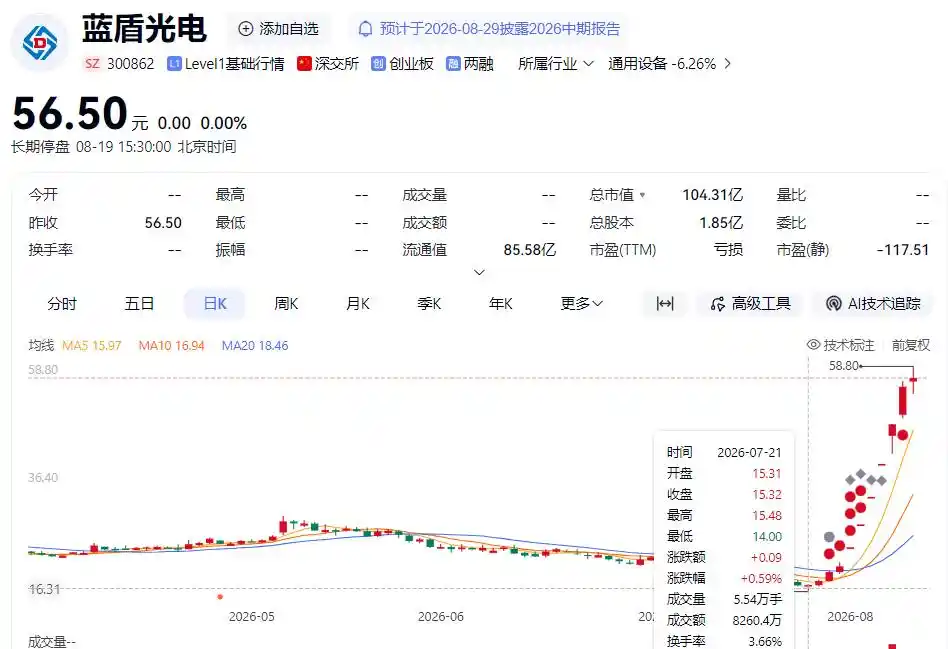
Image source: Tonghuashun
In response to the continuous stock price increase, Landon Optronics stated that from August 10th to August 18th, 2026, the company's stock price experienced 5 consecutive trading days of hitting the limit-up, surging 197.21% in the short term, significantly deviating from the company's fundamentals and accumulating substantial trading risks. Consequently, the company's stock was suspended from trading starting August 19th, 2026 (Wednesday), with an expected suspension period not exceeding 3 trading days.
01 Is Lanchuang Technology's Equipment Truly Scarce?
First, some background: Currently, most manufacturers capable of producing high-performance vacuum coating equipment are foreign companies, with very few in China.
Among mainstream overseas companies, Germany's Bühler Leybold Optics is a global benchmark for TFF filter equipment, with its core product being the Bühler Leybold IBS-1400 series ion beam sputtering systems. The US-based Veeco is a veteran overseas IBS equipment giant. Japan's Optorun holds a very strong position in the consumer electronics optics market.
Leading global TFF filter manufacturers generally configure their core production lines for mass-producing DWDM/LWDM ultra-narrowband thin-film filters with IBS ion beam sputtering coating equipment from Germany's Bühler Leybold or the US's Veeco. Filter manufacturers then combine this hardware with their proprietary film layer designs and process technologies to achieve product mass production.
When leading domestic filter factories built their high-end TFF production lines in the past, they also purchased IBS equipment from Leybold and Veeco.
According to Landon Optronics' 'Acquisition Proposal': Lanchuang Technology is one of the few domestic high-end equipment manufacturers that has achieved commercial mass production in the field of ultra-narrowband thin-film filters (TFF). It has successfully overcome key process bottlenecks like film surface defects, with its equipment's comprehensive output and technical stability ranking at the forefront of the industry.
Currently, Lanchuang Technology's main products or primary R&D directions include high-precision magnetron sputtering coating equipment, high-speed IBS (Ion Beam Sputtering) equipment, and ALD (Atomic Layer Deposition) equipment. These high-precision tools are necessary to produce the filters required in the optical communication field.
For example, the high-speed IBS ion beam sputtering equipment, which benchmarks against Germany's Leybold and the US's Veeco, can be used to produce DWDM/LWDM ultra-narrowband TFF filter blanks, serving as a key production asset for 800G/1.6T high-speed data center optical modules.
However, a distinction must be made: 800G/1.6T optical modules are developed in parallel using three major architectures: parallel multi-channel non-wavelength division multiplexing (WDM), TFF-Z-Block WDM, and AWG-PLC WDM. TFF is just one sub-solution among these.
Within the 8-channel LWDM/MWDM WDM architecture, TFF ultra-narrowband thin-film filters (assembled into Z-Block components) are the mainstream implementation scheme, used in modules requiring wavelength division multiplexing, such as 800G-FR8 and 1.6T-2FR4.
Looking at the entire 800G and 1.6T optical module market, the TFF route is not the only one. The market also contains a large number of DR/VR/SR parallel architecture optical modules that do not require WDM and thus do not use TFF filters at all. Within WDM scenarios, AWG (Arrayed Waveguide Grating) also exists as an alternative solution.
Lanchuang Technology's IBS/magnetron sputtering coating equipment can be used to manufacture TFF filters. However, its corresponding market is not just the 'entire 800G/1.6T optical module market.' It also caters to upstream equipment demand for the LWDM/MWDM WDM sub-track, while simultaneously targeting non-data center scenarios like telecom DWDM, instrumentation, and medical lasers.
The recent capital market enthusiasm for Landon Optronics' acquisition of Lanchuang Technology stems from the heat of the 'chasing light' concept. However, upon closer analysis, whether it warrants a two-to-three-fold stock price increase is a matter of individual judgment.
Additionally, recent actions by major optical module manufacturers, such as expansion of production capacity and upstream investments, have also heightened investor interest in Lanchuang Technology, as it is now considered a major player in upstream optical module equipment.
Just in June, Dongshan Precision disclosed that its subsidiary Source Photonics and its subsidiaries plan to implement optical chip and optical module expansion projects in locations like Changzhou, with a total investment of 1.2 billion USD;
Zhongji Innolight recently announced a planned investment of 1.747 billion yuan to acquire a 10.47% stake in China Shenzhou Technology, aiming to alleviate heat dissipation demands in the supply chain. Prior to this, its wholly-owned subsidiary, Zhongji Innolight (Shanghai) Investment Co., Ltd., had already invested heavily to become the fourth-largest shareholder of PCB leader Avary Holding (Shenzhen) Co., Ltd.;
Accelink Technologies raised 3.485 billion yuan for projects including 'Production Construction of Optical Connectivity and High-Speed Optical Transmission Products for Computing Power Centers,' aimed at expanding production of high-speed optical modules, while also supporting coherent products, optical switches, and high-density connectors;
Huagong Tech invested in EML chip design company Yunling Optoelectronics and is developing a CPO technology platform;
Mingpu Optoelectronic announced a private placement of up to 1.283 billion yuan, with 788 million yuan allocated to a high-speed optical module intelligent manufacturing project, building production lines for 800G/1.6T high-speed data center optical modules......
This trend of optical module manufacturers expanding production and investing has naturally attracted more 'light chasers' in the stock market.
02 Three A-Share Platforms Supporting Yuan Yonggang's 'Optoelectronics Blueprint'
The actual controllers of Landon Optronics are the husband-and-wife team, Yuan Yonggang and Wang Wenjuan. They are already 'veteran players' on the 'light-chasing' track, gradually building an industrial portfolio spanning optical modules, batteries, and high-end scientific instruments. Beyond Landon Optronics, the companies they control, Dongshan Precision and Anfu Technology, attract even more investor attention.
In the optoelectronics arena, Dongshan Precision is the core vehicle for Yuan Yonggang's strategic layout.
In 2025, Dongshan Precision acquired 100% of Source Photonics for up to 5.935 billion yuan, formally entering the optical module sector. Source Photonics ranks among the top ten global optical module suppliers.
Following the acquisition and consolidation, the optical module business significantly boosted Dongshan Precision's performance. For the first half of 2026, the company expects net profit attributable to shareholders to be between 2.9 and 3 billion yuan, a staggering year-on-year increase of 282.58% to 295.78%. The capital market responded accordingly; even after adjustments, Dongshan Precision's market capitalization remains around 360 billion yuan. With Yuan Yonggang directly holding approximately 16.53%, his stake corresponds to a market value of about 59.5 billion yuan.
Driven by the stock price surge of Dongshan Precision's optical module business, the Yuan Fugen (Yuan Yonggang's father) family recorded a paper wealth of 44 billion yuan in the '2025 Hurun Rich List,' ranking 130th nationally. In the '2026 Hurun Global Rich List,' the Yuan Fugen family's wealth had risen to 50.5 billion yuan, ranking 579th on the list.
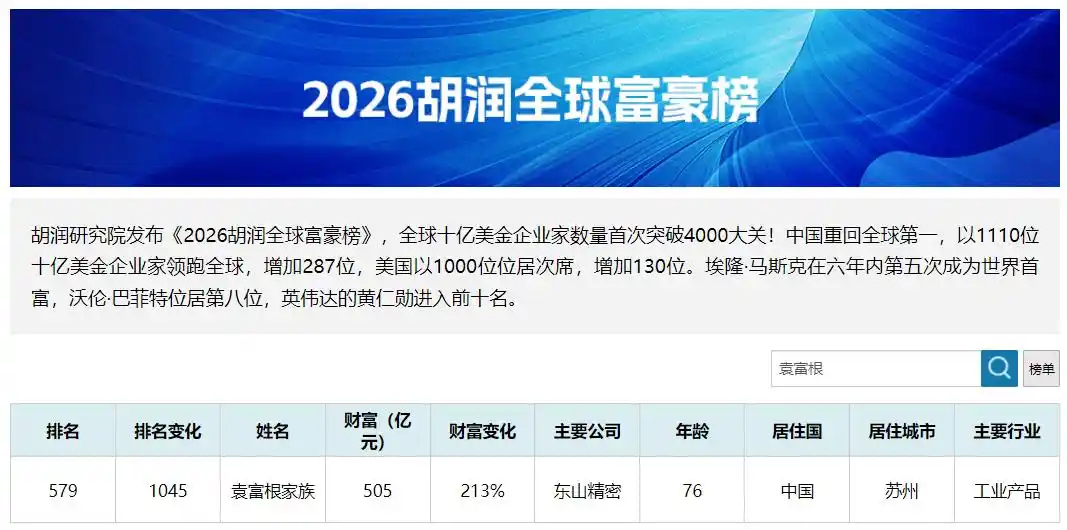
A similar script seems to be replaying with Landon Optronics. After Landon Optronics announced its acquisition proposal for Lanchuang Technology, this company, originally focused on environmental monitoring and meteorological observation analysis instruments, consecutively hit four 20cm daily limit-up boards. By the close on August 18th, its total market capitalization directly surpassed 10 billion yuan.
It's worth noting that Landon Optronics itself faces pressure on its fundamentals, reporting a net loss attributable to shareholders of 88.7665 million yuan in 2025 and a continued loss of 8.6643 million yuan in Q1 2026. In contrast, Lanchuang Technology shows strong growth, achieving a net profit of 102 million yuan in the first half of 2026. If the transaction is completed, Landon Optronics will add a high-end coating equipment business. Furthermore, leveraging Lanchuang Technology's equipment and processes could alleviate its instrument business's dependence on imported optical components, while also extending Yuan Yonggang's optoelectronics blueprint upstream into optical communication equipment.
Beyond this, Anfu Technology, controlled by Yuan Yonggang, has begun venturing into the optoelectronics chip sector alongside its core NANFU battery business. In 2025, it strategically invested in optical chip company Suzhou Yilanwei and also invested in domestic GPU manufacturer Xiangdixian, exploring a second growth curve.
Anfu Technology's market capitalization has increased over fourfold since Yuan Yonggang initially gained control, once surpassing 20 billion yuan at its peak. However, it also faces risks associated with high goodwill impairment.
Behind these multiple industrial plays, risks objectively exist. Dongshan Precision's large-scale expansion has increased its debt burden; Landon Optronics' restructuring faces regulatory approval uncertainties; Anfu Technology carries a looming goodwill of 2.9 billion yuan.
On one side lies the performance and valuation elasticity brought by capital mergers and acquisitions. On the other side are multiple tests, including technological iteration, debt, and goodwill. The ultimate integration effectiveness of Yuan Yonggang's optoelectronics chess game spanning 'equipment-components-optical modules' still awaits the test of time.
This article is from the WeChat public account 'Alpha Factory Research Institute', author: Alpha