Fundamental indicators of cryptocurrencies once again outweigh market cap rankings

cryptonews.ru2026-08-16 tarihinde yayınlandı2026-08-16 tarihinde güncellendi

Özet

Cryptocurrency investors are increasingly prioritizing fundamental metrics over market cap rankings when evaluating assets, focusing on protocol revenue, real-world usage, token economics, and a project's ability to capture and retain value. Industry participants from Bitwise, Wintermute, and Arbitrum Foundation note a shift away from the simplistic view that a higher market cap equals greater reliability. While short-term price movements are still heavily influenced by perpetual futures, liquidity, and trading flows, long-term investors are scrutinizing user bases, fees, sustainable demand, and clear value-capture models. Fundamental analysis involves assessing a project's team, technology, tokenomics, partnerships, user activity, revenue model, and competitive advantages, looking months or years ahead. Technical analysis remains relevant for short-term trading. Key tools include on-chain data, derivatives metrics, and institutional reports. Market cap is no longer the primary benchmark. Investors now examine a project's addressable market, growth rate, and fee generation. Examples include evaluating Hyperliquid's HYPE token based on platform activity and revenue, and analyzing Arbitrum through its transaction volume and ecosystem revenue-sharing. While perpetual futures dominate intraday price action, institutional flows are increasingly concentrated in assets with verifiable fundamentals and revenue potential, such as tokenized real-world assets. Metrics like fee reven...

Fundamental indicators of cryptocurrencies are increasingly becoming the main filter for investors: they look at protocol revenue, real-world usage, token economics, and a project's ability to retain created value, not just its position in the market capitalization table.

Market participants from Bitwise, Wintermute, and Arbitrum Foundation note that cryptocurrency is gradually moving out of the stage where tokens were evaluated on the principle of 'the higher in the ranking, the more reliable.' In the short term, prices are still largely driven by perpetual futures, liquidity, and trading flows. But over months and years, investors are paying closer attention to whether a network has users, fees, sustainable demand, and a clear model for capturing value.
Key takeaways:

  • Investors are increasingly evaluating tokens based on the size of the potential market, actual adoption, and the project's ability to convert activity into value.
  • Capital managers who are just entering the crypto industry are not limiting themselves to CoinMarketCap rankings and are delving deeper into individual networks and applications.
  • Hyperliquid became one of the early examples of this approach: the $HYPE token is evaluated through platform activity, its revenues, and economic parameters.

What is fundamental analysis of cryptocurrencies

Fundamental analysis of cryptocurrencies, in simple terms, is an attempt to understand what makes a project valuable in the first place. An investor looks not only at the token price, but at users, fees, revenues, technology, tokenomics, and the network's ability to retain created value.

Technical analysis answers a different question: how the price behaves on the chart right now. It helps assess levels, liquidity, perpetual futures, funding rates, and trader behavior. Fundamental analysis is more suitable for evaluating a project over months and years, while technical analysis is for finding entry points and short-term trades.

Fundamental and technical analysis: a brief comparison

  • Criterion: What is studied. Fundamental analysis looks at the protocol's business logic, users, fees, and token economics. Technical analysis looks at the price chart, volumes, liquidity, and derivatives.
  • Criterion: Horizon. Fundamental analysis is more useful over a horizon of months and years. Technical analysis is more often used intraday and for short-term trades.
  • Criterion: Main question. Fundamental analysis asks why an asset should have value. Technical analysis asks where the price might go in the near future.

What to check before evaluating a token

  • Developer team: Experience, public presence, ability to deliver on promises and develop the product.
  • Technology and innovation: What problem the network or application solves and whether the project has a noticeable advantage.
  • Tokenomics: Issuance, token distribution, incentives for participants, and value accumulation mechanism.
  • Partnerships and integrations: Whether they help attract users, capital, and real-world use cases.
  • User activity: Transactions, paying users, fees, and audience retention.
  • Economic model: Whether there are revenues, demand, and a clear link between protocol activity and token value.
  • Competitors: How the project differs from other networks, exchanges, applications, or infrastructure solutions.
  • Roadmap and development plans: How realistic the plans are and whether they support the long-term growth of the ecosystem.

Tools and metrics for fundamental analysis

For fundamental analysis, investors use not one indicator, but a set of sources and metrics. The market capitalization ranking helps to quickly understand the scale of an asset, but by itself it no longer answers the question of how strong a project is.

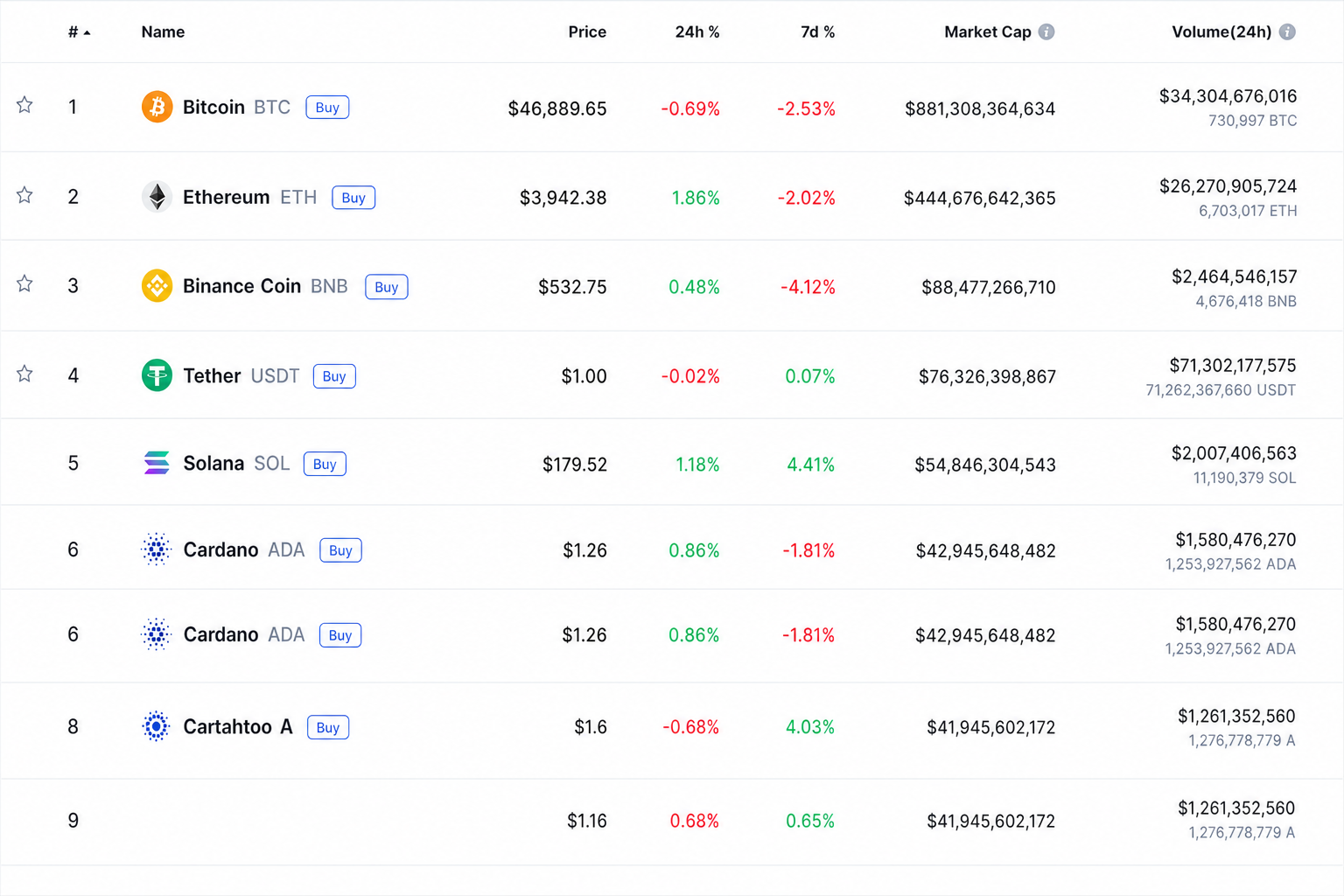
  • Rankings and aggregators like CoinMarketCap help assess a token's place in the market and compare its capitalization with other assets.
  • On-chain data shows transactions, fees, user activity, and capital that remains within the network.
  • Reports and reviews from managers and market makers, including Bitwise and Wintermute, help to see institutional flows and changes in demand.
  • Data on derivatives, perpetual futures, funding rates, and liquidations help separate short-term price movements from the long-term value of a project.

Market capitalization is the token price multiplied by the number of tokens in circulation. This indicator is important because it helps compare the scale of projects, but it does not replace the analysis of revenues, users, tokenomics, and sustainability of demand.

When evaluating a team, it's worth looking at who develops the project, whether the participants have relevant experience, how they communicate with the community, and whether they fulfill stated plans. When evaluating tokenomics, token distribution, incentives, issuance, token demand, and whether part of the created value is returned to the ecosystem are important.

Government policy and regulation affect the market through rules for investor admission, requirements for exchanges and custodians, tax regime, as well as the approach to stablecoins, tokenized assets, and DeFi instruments. The clearer the rules, the easier it is for large allocators to work with digital assets; sharp uncertainty, on the contrary, increases risk and can put pressure on liquidity.

Why market cap ranking has ceased to be the main benchmark

Bitwise CEO Hunter Horsley describes what is happening as the end of the 'CoinMarketCap ranking' era. In previous market cycles, new layer-1 networks were often evaluated as a scaled-down version of the largest blockchains: if a project was lower on the list, a discount was automatically applied to it.

Now this template works less well. Fundamental analysis comes to the fore: what market a project can capture, how fast its user base is growing, what fees it collects, and how much of the created value remains within the ecosystem. Market capitalization remains a noticeable benchmark, but it no longer replaces a full-fledged evaluation of the protocol's business.

Horsley cites Hyperliquid as an example. When evaluating $HYPE, investors can look not at how similar it is to another blockchain network, but at the trading activity of the derivatives platform, its profitability, and internal economics. Over the past year, the token has risen by about 20%.

When we talk to capital managers at companies that have recently entered this sector, they often don't even know what position an asset occupies on CoinMarketCap. For them, it's just not the main thing, said Hunter Horsley.

Perpetual futures still move the price intraday

Wintermute OTC trader Jasper De Maer emphasizes: fundamental indicators and market flows are important, but they work on different timeframes. Intraday, the price is still often determined by perpetual futures, funding rates, trader positioning, and liquidations.

For most major tokens, the volume of perpetual futures remains several times higher than spot trading. Therefore, technical analysis, liquidity data, and the behavior of the derivatives market retain significance for short-term trades. But for longer-term investments, investors are increasingly returning to revenues, demand, and the quality of user activity.

According to De Maer, over the past 12-18 months, interest has noticeably shifted from pure infrastructure to applications and application-specific blockchains. Such projects are closer to the familiar logic of fintech and venture capital: they are easier to compare by clients, turnover, fees, and user retention.

Fundamental metrics become especially important in decentralized finance, on perpetual futures exchanges, and in decentralized physical infrastructure networks. Mining also falls into this category, where investors have long been accustomed to looking at the cost of production, revenue, and the sustainability of the model, not just the coin price.

Fundamental indicators form the lower boundary of valuation and help create a shortlist of assets, and then trading flows determine the specific price, noted Jasper De Maer.

He adds that revenues and real-world usage help understand which tokens will survive downturns and enter the portfolios of large allocators. But these indicators rarely determine where the price will go today.

Institutional flows are changing the market structure

Wintermute data shows that the main change is not so much a shift from spot to derivatives, but rather who exactly is trading. In the first half of 2026, institutional counterparties accounted for about 72% of the company's spot OTC flow. A year earlier, their share was approximately 59%.

These flows are concentrated in the largest cryptocurrencies and in a limited set of tokens that can generate income. De Maer calls tokenized real assets a separate new category. In this logic, a token is increasingly perceived not only as a speculative instrument, but also as an asset on the balance sheet, whose value must be based on verifiable cash flows or retained capital.

At the same time, De Maer warns: it is not always easy to understand where the market is truly rewarding strong fundamentals, and where it is simply following a fashionable narrative. Tokens with revenue attract attention precisely because the fundamental theme is currently in demand, and these two effects are difficult to separate.

The gap is also noticeable between the crypto assets themselves and public companies related to the industry. In the first half of the year, cryptocurrencies fell by 36%, while crypto company stocks rose by 23%, according to a Bitwise review. This does not mean that the stock as a financial instrument will continue to outperform tokens, but it shows that the securities market and the digital assets market can operate in different modes.

Which metrics do investors consider more reliable

Brendan Ma, Head of Investment Strategy at Arbitrum Foundation, says analysts have become better at understanding revenue structure, transactional activity, and value capture mechanisms compared to a year ago. In his opinion, the most convincing are metrics that require costs to create and are verifiable on the blockchain.

Ma includes fee revenue, users who actually pay fees, and capital remaining in the network as such indicators. These can be stablecoin balances and tokenized assets. Such data is harder to fake than a simple number of addresses or total value locked.

The number of addresses and the total value locked metric can be inflated by incentives or bots. Therefore, transaction growth becomes more important when accompanied by an increase in fees and user retention. In this sense, economics as a science helps to look at blockchain not as a price quote table, but as a system of incentives, demand, and value distribution.

Ma cites Arbitrum as an example of project-level analysis. Throughout its history, the network has processed over 2.7 billion transactions, of which more than 500 million occurred in 2026. According to the foundation, Robinhood Chain generates about $40 million in annual revenue. Under the expansion program, 10% of that network's net protocol revenue is returned to the Arbitrum ecosystem.

Which assets look stronger based on fundamentals

According to the logic of Hunter Horsley, Jasper De Maer, Brendan Ma, and Zach Pandl, assets that look stronger are not just the most prominent tokens, but those with real usage, revenues, capital within the network, and a clear model for capturing value.

  • Bitcoin remains a separate macro asset, demand for which is linked to the search for alternatives to fiat currencies.
  • Ethereum and projects beyond it will undergo stricter scrutiny of their economic model, users, and revenues.
  • $HYPE is evaluated through Hyperliquid's activity, platform profitability, and internal economics.
  • Arbitrum shows how investors can look at transactions, revenue of connected networks, and the return of part of the revenue to the ecosystem.

Bitcoin, Ethereum, and the new chapter of digital assets

Hunter Horsley believes that index products can give investors broad access to the crypto market without the need to pick individual winners. Such solutions are offered by Bitwise, as well as other asset managers, including 21Shares.

Grayscale's Head of Research, Zach Pandl, separates Bitcoin and the rest of the market. In his assessment, Bitcoin remains a macro asset, demand for which is linked to the search for alternatives to fiat currencies. Here, macroeconomics, inflation, and investor attitudes towards monetary policy are important.

Other cryptocurrencies, including Ethereum and projects beyond it, will undergo stricter scrutiny of their underlying economic model. Investors will look at whether the network has real users, sustainable revenues, and a clear logic for value accumulation. In traditional finance, financial reporting plays a similar role: it helps understand to what extent a security or business is backed by real results.

Pandl expects the sector's prospects to remain strong because stablecoins, tokenized assets, and decentralized finance instruments will support demand for digital assets beyond Bitcoin in the coming years.

A small number of tokens with a strong fundamental base will play a key role in the next stage of digital asset development. Weak projects with poor indicators will be left behind, said Zach Pandl.

The main conclusion for the market is simple: capital is increasingly less willing to pay just for a place in the ranking. As the industry matures, verifiable economics, real users, and a project's ability to convert activity into long-term value become more important for investors than a loud narrative.

end-content

Trend Kriptolar

İlgili Sorular

QAccording to the article, why are fundamental indicators becoming more important than market cap rankings for cryptocurrency investors?

AFundamental indicators are becoming more important because investors are increasingly looking at a project's actual business metrics, such as protocol revenue, real usage, tokenomics, and its ability to capture and retain value, rather than just its position in a market cap ranking. Market cap alone no longer answers how strong a project truly is.

QWhat is the main difference between fundamental analysis and technical analysis in crypto, according to the article?

AThe main difference lies in their focus and time horizon. Fundamental analysis looks at the business logic of a protocol, its users, fees, and token economics to understand why an asset should have value, typically over months and years. Technical analysis examines price charts, volume, liquidity, and derivatives to predict short-term price movements, often used for intraday and short-term trading.

QWhat key metrics, as mentioned by Brendan Ma from Arbitrum Foundation, are considered more reliable for fundamental analysis and why?

AMetrics that require cost to create and are verifiable on-chain are considered more reliable. These include fee revenue, users who actually pay fees, and capital that stays within the network (like stablecoin balances and tokenized assets). These metrics are harder to fake compared to easily inflated ones like the number of addresses or total value locked (TVL).

QAccording to Jasper De Maer from Wintermute, what still drives intraday price movements in the crypto market?

AIntraday price movements are still largely driven by perpetual futures, funding rates, trader positioning, and liquidations. For most major tokens, the volume of perpetual futures trading remains several times higher than spot trading, making technical analysis and derivative market behavior significant for short-term trades.

QWhat shift in investor focus does Jasper De Maer note has occurred over the last 12-18 months?

AHe notes a noticeable shift in investor interest away from pure infrastructure projects towards applications and application-specific blockchains. These projects are closer to traditional fintech and venture capital logic, making them easier to compare based on customers, turnover, fees, and user retention.

İlgili Okumalar

Is RWA Still Meaningful Without DeFi?

The article "Would RWA Still Matter Without DeFi?" argues that tokenizing real-world assets (RWA) alone, like putting a barcode on a container, is not transformative. True value emerges when these tokenized assets are integrated into decentralized finance (DeFi) ecosystems, enabling valuation, financing, hedging, trading, and loss management in a programmable, automated manner. Tokenization provides digital representation, but DeFi provides utility through leverage, liquidity, and composability. The core challenge lies in aligning the different "time clocks" of blockchain (fast, 24/7), traditional markets (limited hours), and asset redemption (slow processes), which creates liquidation risks and gaps. Effective RWA integration requires more than a token; it needs a full stack: legally enforceable rights, reliable data oracles, clear transfer rules, executable secondary liquidity, appropriate collateral parameters, and credible loss resolution paths. Liquidity is defined not by total value locked (TVL) but by the ability to exit a position under stress within a required timeframe. Risk management for RWAs must be modeled as a dependency graph, monitoring interconnected nodes like issuers, custodians, oracles, and liquidity pools for early warning signs beyond just price data. While tokenized government bonds serve as an initial "ping test," the future lies in more complex assets like computing power and energy, which require bespoke risk models. Tokenized stocks paired with perpetual futures present a major test, combining global equity ownership with crypto-native leverage, necessitating robust architectural safeguards like isolation and dynamic collateral rules. The conclusion is that without DeFi, RWA tokenization offers limited value—improving distribution and transparency. The significant opportunity arises when tokenized assets become functional components within open, programmable capital markets, where they can be used as collateral and facilitate complex financial strategies. The token is merely the barcode; the market operating system is the real machine.

marsbit21 dk önce

Is RWA Still Meaningful Without DeFi?

marsbit21 dk önce

Government Intervention in the Bond Market: What Does It Mean?

On August 19, 2026, the U.S. Treasury unexpectedly announced it would at least double the size of its long-term Treasury buyback operations, starting September 9. The move triggered an immediate market reaction, with the 30-year yield falling 9 basis points. This intervention came against a backdrop of the 30-year yield hitting a 19-year high of 5.34% the previous day, driven by persistent inflation, high oil prices, deteriorating U.S. fiscal health with public debt surpassing $40 trillion, and a global "buyers' strike" for long-dated bonds. Treasury buybacks involve the government repurchasing older, less liquid bonds from the market via reverse auctions to improve market functioning, not to reduce overall debt. While the action provided tactical relief and signaled the Treasury's willingness to intervene, analysts caution it does not address core structural issues: massive fiscal deficits, high borrowing needs, and fading demand from traditional buyers like foreign central banks. For investors, the announcement offered short-term support for long-duration bond ETFs and boosted assets like gold, which rose 2.7%. However, it's unlikely to significantly lower mortgage rates or alter the challenging environment for long-term bonds. The key takeaway is the distinction between a tactical market operation and the unresolved structural pressures that continue to push yields higher, requiring close monitoring of upcoming economic data, Treasury auctions, and potential signals of more aggressive policy measures.

marsbit25 dk önce

Government Intervention in the Bond Market: What Does It Mean?

marsbit25 dk önce

After 'Bessent Put', How Far Is the U.S. from Restarting QE?

Following an unscheduled announcement from the U.S. Treasury Department on August 19th, investor discussions have intensified regarding the potential for future policy interventions in long-term bond markets. The Treasury increased the maximum size of its regular buyback operations for 10-to-30 year bonds from $2 billion to $4 billion, citing a desire to improve liquidity. This move came shortly after a surge in long-term yields, with the 30-year Treasury yield briefly touching 5.34%. Market analysts, rather than focusing on the modest operational size, have interpreted the timing—outside the normal quarterly communication window—as a significant signal. The move has been dubbed the "Bessent Put," implying the market's growing expectation that Treasury officials, led by Deputy Secretary Josh Bessent, may act to prevent a disorderly rise in long-term borrowing costs. This perception represents a potential shift in the market's view of the government's "policy reaction function." The underlying pressures on long-term bonds are multifaceted, including large fiscal deficits, increased Treasury supply, a rise in corporate debt issuance for AI infrastructure (creating a "crowding out" effect), and uncertainty around foreign holdings, particularly from Japan. Geopolitical risks in the Middle East further complicate the policy landscape, potentially creating conflicting pressures between fighting inflation and managing financing costs. However, the article clarifies that this Treasury buyback program is distinct from Quantitative Easing (QE). It is a debt management operation, not a Federal Reserve balance sheet expansion. While the announcement opens the door for market speculation about more forceful tools like Yield Curve Control (YCC) or a return to QE, analysts note that conditions would need to deteriorate significantly for such measures to be implemented. For now, the "Bessent Put" reflects a change in market expectations about possible policy boundaries, not an imminent launch of new monetary stimulus.

marsbit26 dk önce

After 'Bessent Put', How Far Is the U.S. from Restarting QE?

marsbit26 dk önce

Is Stablecoin Really Necessary for Cross-border Payments?

"Is Stablecoin Truly Necessary for Cross-Border Payments? While stablecoins are often praised as superior for cross-border transfers—especially if the recipient desires crypto—their advantage is less clear in traditional cross-currency scenarios (e.g., USD to Mexican Peso). The existing correspondent banking system is slow and costly (≈15% fees) due to multiple intermediaries. Modern fintech solutions like Wise have dramatically improved this by using a netting model: they hold local currency pools and settle payments domestically, avoiding actual cross-border fund movement. This offers near-instant transfers with low, transparent fees (averaging ~0.52%). The 'stablecoin sandwich' model (convert fiat to stablecoin, transfer on-chain, convert to local fiat) offers similar user experience but doesn't inherently provide major cost or speed advantages over fintech. Its on-chain transfer is cheap, but fiat conversion spreads remain. Stablecoin's real innovation is 'unbundling' the cross-border payment stack. Instead of requiring a proprietary global network like Wise, businesses only need reliable on- and off-ramps in specific corridors. This lowers market entry barriers, fosters competition among local providers, and can drive down costs, particularly for niche or underserved corridors (e.g., US to Africa). While vertical integration may reoccur, the open, permissionless nature of the underlying blockchain layer makes monopolistic pricing difficult. The long-term benefit is the potential redistribution of value—previously captured as intermediary rents—to consumers through lower costs."

marsbit30 dk önce

Is Stablecoin Really Necessary for Cross-border Payments?

marsbit30 dk önce

Ethereum Finally 'Bounces Back'! ETH Returns to the Golden Line, What's Different About This Rally?

Ethereum has surged above $2,300, a level not seen in over three months, marking a significant recovery and technical breakthrough by reclaiming key resistance levels, including the weekly EMA50 for the first time in the current bear market. The rally has been fueled by a combination of factors: improved market risk appetite, positive regulatory sentiment, and a major short squeeze where over 88% of recent ETH liquidations were short positions. The ETH/BTC ratio has also broken its long-term downtrend, indicating renewed strength for Ethereum relative to Bitcoin. Fundamentally, Ethereum spot ETFs have shown strong inflows, outperforming their Bitcoin counterparts in recent months. Wall Street institutions like Morgan Stanley and JPMorgan have notably increased their ETH exposure, while several banks have added or expanded positions in ETH ETFs. On-chain fundamentals remain robust, with the proportion of staked ETH reaching a new all-time high of nearly 33.7%. Data indicates long-term holding sentiment, as small wallet holdings increased while large outflows were often directed towards staking or contracts, not selling. However, potential headwinds include declining staking yields and community debate over proposals to adjust staking rewards at high participation levels. The upcoming Glamsterdam upgrade, featuring improvements to validator exit efficiency, could enhance liquidity and further attract institutional stakers. While the rebound is supported by sentiment, capital flows, and fundamentals, its sustainability hinges on continued positive developments.

marsbit30 dk önce

Ethereum Finally 'Bounces Back'! ETH Returns to the Golden Line, What's Different About This Rally?

marsbit30 dk önce

İşlemler

Spot

Popüler Makaleler

CAP Nasıl Satın Alınır

HTX.com’a hoş geldiniz! Cap (CAP) satın alma işlemlerini basit ve kullanışlı bir hâle getirdik. Adım adım açıkladığımız rehberimizi takip ederek kripto yolculuğunuza başlayın. 1. Adım: HTX Hesabınızı OluşturunHTX'te ücretsiz bir hesap açmak için e-posta adresinizi veya telefon numaranızı kullanın. Sorunsuzca kaydolun ve tüm özelliklerin kilidini açın. Hesabımı Aç2. Adım: Kripto Satın Al Bölümüne Gidin ve Ödeme Yönteminizi SeçinKredi/Banka Kartı: Visa veya Mastercard'ınızı kullanarak anında Cap (CAP) satın alın.Bakiye: Sorunsuz bir şekilde işlem yapmak için HTX hesap bakiyenizdeki fonları kullanın.Üçüncü Taraflar: Kullanımı kolaylaştırmak için Google Pay ve Apple Pay gibi popüler ödeme yöntemlerini ekledik.P2P: HTX'teki diğer kullanıcılarla doğrudan işlem yapın.Borsa Dışı (OTC): Yatırımcılar için kişiye özel hizmetler ve rekabetçi döviz kurları sunuyoruz.3. Adım: Cap (CAP) Varlıklarınızı SaklayınCap (CAP) satın aldıktan sonra HTX hesabınızda saklayın. Alternatif olarak, blok zinciri transferi yoluyla başka bir yere gönderebilir veya diğer kripto para birimlerini takas etmek için kullanabilirsiniz.4. Adım: Cap (CAP) Varlıklarınızla İşlem YapınHTX'in spot piyasasında Cap (CAP) ile kolayca işlemler yapın.Hesabınıza erişin, işlem çiftinizi seçin, işlemlerinizi gerçekleştirin ve gerçek zamanlı olarak izleyin. Hem yeni başlayanlar hem de deneyimli yatırımcılar için kullanıcı dostu bir deneyim sunuyoruz.

455 Toplam GörüntülenmeYayınlanma 2026.06.26Güncellenme 2026.06.26

CAP Nasıl Satın Alınır

Tartışmalar

HTX Topluluğuna hoş geldiniz. Burada, en son platform gelişmeleri hakkında bilgi sahibi olabilir ve profesyonel piyasa görüşlerine erişebilirsiniz. Kullanıcıların CAP (CAP) fiyatı hakkındaki görüşleri aşağıda sunulmaktadır.

活动图片