这家上市公司不为人知地控制了Ethena公司20%的ENA代币供应量

cryptonews.ru2026-08-16 tarihinde yayınlandı2026-08-16 tarihinde güncellendi

Özet

纽约上市公司StablecoinX在其截至6月30日的季度财报中披露,其持有Ethena治理代币$ENA总供应量的20%,份额价值以6月底收盘价计算约为2.184亿美元。该公司通过与TLGY Acquisition Corp.合并,于6月26日以股票代码USDE上市,将这笔加密资产纳入上市公司资产负债表。 $ENA是稳定币$USDe项目Ethena的治理代币。StablecoinX的巨额持仓并非被动投资,而是对该项目前景的集中押注。然而,会计规则要求按成本减减值记录此类数字资产,而非每日市值重估,这导致$ENA价格的剧烈波动会直接造成账面亏损。财报显示,公司季度净亏损3420万美元,主要源于$ENA资产减值3620万美元。 Ethena的算法稳定币$USDe通过加密资产对冲等机制维持与美元挂钩,其供应量在7月底已达39亿美元,协议累计产生手续费超8亿美元。StablecoinX的未来与$USDe的增长及$ENA的价格高度绑定。同时,公司正尝试拓展业务,包括运营跨链验证节点和开发面向企业的稳定币管理平台StablecoinX Harness,以减少对单一资产持仓的依赖。 该公司为股市投资者提供了间接参与加密生态的渠道,但也将风险集中于Ethena项目的表现、$ENA价格波动以及稳定币监管政策的变化。未来需关注其运营收入能否持续、$USDe的稳定性以及会计减值对公司财报的持续影响。

这家纽约公司在截至6月30日的季度业绩报告中披露了该持股比例。StablecoinX于6月26日以股票代码USDE开始交易,恰在与TLGY Acquisition Corp.合并完成的次日,从而将一家加密货币国库公司转变为公开上市的股票。

$ENA是Ethena的治理代币,一种用于对协议特定事项进行投票的资产,并在Ethena的框架内,可能让持有者获得生态系统经济的份额。简而言之,StablecoinX不仅仅是围绕Ethena开展业务。现在它已在谈判桌上占据一席之地。

对Ethena的重大押注

Ethena基金会提供了284.95百万个$ENA代币,而作为合并一部分的PIPE投资者则投入了约2.75亿美元的现金和代币。这不是被动投资。这是对支撑$USDe的项目的集中押注。

按照6月30日$ENA的收盘价0.07204美元计算,StablecoinX将其国库的市值评估为2.184亿美元。其资产负债表上显示为2.129亿美元,这是因为会计准则要求公司按扣除减值后的原始成本反映这些数字资产,而不是简单地按市值每日重估。

正是在这种会计处理的细微之处,潜在问题的初步迹象开始显现。$ENA价格的剧烈波动可能导致账面亏损,即使持有的代币数量不变。StablecoinX报告了3420万美元的季度亏损,主要原因是$ENA减值支出3620万美元,而调整后的亏损仅为188,204美元。

$USDe将美国国债与美元挂钩

$USDe力求交易价格保持在1美元左右,但并非完全依赖于传统的、由现金和美国国债组成的储备模型。Ethena使用对冲的加密货币头寸和其他抵押品,而sUSDe则是一个让用户获得系统生成奖励的版本。

其收益逻辑是清晰的。更多流通中的$USDe可能意味着更多的协议费用,并且Ethena声称预期的增长将通过其收入分享系统支持$ENA持有者。StablecoinX实质上将其上市公司的前景与这一循环绑定在一起,并持续运营。

截至7月31日,Ethena的$USDe供应量达到39亿美元。该公司报告自推出以来累计协议费用超过8亿美元,同时抵押率约为101.7%,这意味着其宣称的抵押品价值超过了当时流通中的$USDe总量。

投资者将持续对这些数字进行压力测试。盈余并非免受融资问题、交易故障、监管行动或突然的大规模资金外流等风险的永久保障。$ENA本身仍是一种波动性加密资产,其价格可能迅速将乐观的国库情景转变为资产负债表上的噩梦。

StablecoinX发展其业务运营部门

StablecoinX正试图表明,它不仅仅是一个在股票市场包装$ENA的载体。据该公司称,其去中心化验证节点(负责验证和转发不同区块链之间的消息)到8月12日已处理了超过30亿美元的累计跨链交易量。
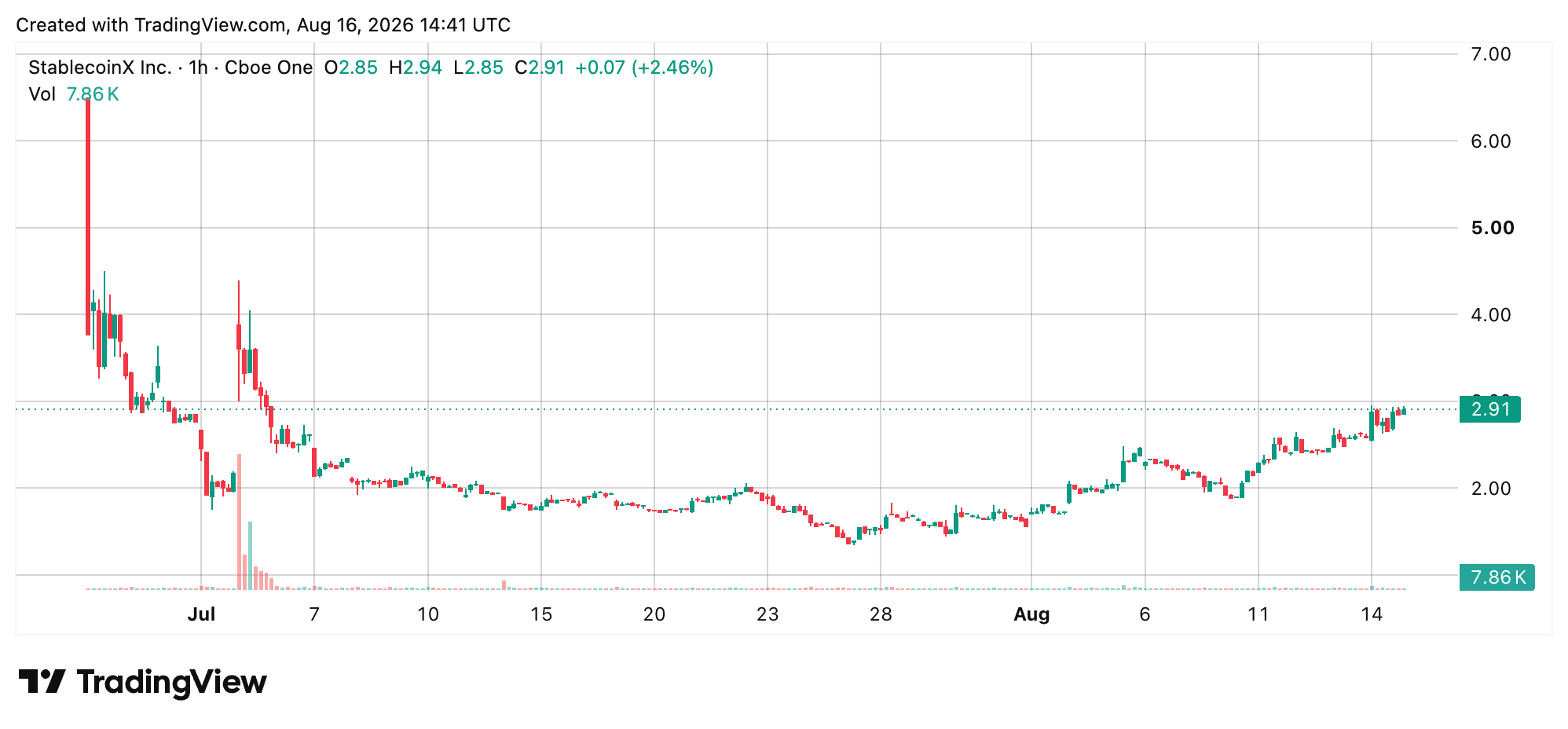
StablecoinX在市场上的交易代码为USDE。图片来源:Tradingview。

此外,该公司还推出了StablecoinX Harness平台的早期版本,旨在为企业提供一个统一的软件解决方案来处理稳定币,而不是需要集成多个服务。在6月的最后两周,公司从基础设施业务获得了62,372美元的收入,并于7月与首位Harness客户签署了合同。

管理层计划,如果市场和监管机构允许,将在2027年增加分销服务。这个部门旨在为投资者提供间接接触$USDe的途径——这一目标将使StablecoinX更深入地渗透到一个产品设计和监管审批可能迅速改变经济格局的行业。

稳定币投资者有了上市工具

StablecoinX为股票投资者提供了一个途径,可以接触某个加密生态系统,而无需直接持有$ENA。其代价是风险的集中:国库的财务状况、公司战略和股票市场吸引力都随着Ethena和$USDe的增长、$ENA的价格,以及监管稳定币的规则而涨跌。

随后的财报将揭示,运营业务能否超越基础设施收入的初期激增,$USDe能否保持其用户和弹性,以及新法规会如何影响发展路线图。投资者也将密切关注$ENA的投资组合、新的减值损失,以及USDE股价与公司数字资产国库(DAT)战略之间差距的扩大或缩小。

end-content

Trend Kriptolar

İlgili Sorular

Q哪家公司控制了20%的Ethena代币$ENA供应?

A一家名为StablecoinX的纽约上市公司,通过其与TLGY Acquisition Corp.合并后的实体,控制着约20%的Ethena治理代币$ENA的供应。

QStablecoinX通过何种方式将自身与Ethena项目深度绑定?

AStablecoinX通过其合并交易,将Ethena项目基金提供的2.8495亿枚$ENA代币以及PIPE投资者注入的大量现金和代币作为其核心数字资产库。其商业模式、股票市值和发展故事都与Ethena生态系统及稳定币$USDe的增长紧密相连,而非被动投资。

QStablecoinX持有的$ENA代币价值如何影响其财务报表?

A根据会计准则,StablecoinX需将持有的数字资产按成本减减值列示,而非按每日市价重估。因此,尽管$ENA代币数量不变,其价格剧烈波动会导致公司出现“账面”减值损失。例如,在截至6月30日的季度,公司报告了3420万美元的净亏损,主要源于对$ENA持有的3620万美元的减值冲销。

QEthena的稳定币$USDe与传统稳定币有何不同?

AEthena的稳定币$USDe目标锚定1美元,但它不依赖传统的现金和国债储备模型。它利用对冲的加密货币头寸和其他抵押品来维持其价值,并通过其sUSDe版本为用户提供系统产生的收益。

Q除了持有$ENA代币,StablecoinX还开展了哪些业务?

AStablecoinX正在发展多元化的运营业务线:1. 运营一个去中心化验证者节点,处理跨链交易。2. 推出了名为StablecoinX Harness的企业平台,为企业提供统一的稳定币操作解决方案。3. 计划在未来增加分销服务,让投资者能间接接触$USDe。

İlgili Okumalar

After Changxin, Yushu Takes the Lead: The Value and Weight of the First Humanoid Robot Stock

On August 19, 2026, Unitree Robotics (688836.SH), known as China's "first humanoid robotics stock," officially listed on the Shanghai Stock Exchange's STAR Market. The stock opened at 1,100 yuan, a surge of 629.44% from its 150.80 yuan IPO price, with its market capitalization briefly reaching 445 billion yuan. This highlights intense market enthusiasm for the humanoid robot sector. The IPO was characterized by high demand and low circulation, with only 7.44% of shares initially tradable. This scarcity, coupled with strong investor interest (record-high participation and a low 0.0181% lottery win rate), contributed to the dramatic price surge. Founder Wang Xingxing, holding over 31% of shares, saw his wealth exceed 110 billion yuan, making him China's wealthiest "post-90s" entrepreneur. Major institutional backers like Meituan, DeepSeek, Tencent, and Sequoia China also reaped substantial gains. Key to the valuation is Unitree's status as a profitable company in a field where many competitors are not. In 2025, it achieved 600 million yuan in adjusted net profit and delivered over 5,500 humanoid robots, ranking first globally in shipments. However, over 70% of its humanoid revenue still comes from R&D and education, with industrial applications accounting for only about 9%, indicating early-stage commercialization. The company faces competition from global players like Figure AI (est. $39-40B valuation), Boston Dynamics, and Tesla's Optimus, as well as domestic rivals like Zhiyuan and Ubtech. To become the "global humanoid robotics leader," its market cap would need to exceed 500 billion yuan. Market opinions on its future are divided: optimists cite its profitability, leading shipments, and strategic tie-up with DeepSeek; the cautious point to high valuations and unproven mass-market adoption; a neutral view expects a post-surge consolidation into an "earnings verification phase." Risks include high valuation digestion pressure, slower-than-expected commercialization in industrial/household settings, potential US FCC regulatory impacts on new models, intense competition, rapid technological iteration, and short-term stock volatility. The IPO marks a significant milestone, but Unitree's path to becoming a global leader remains challenging.

Odaily星球日报13 dk önce

After Changxin, Yushu Takes the Lead: The Value and Weight of the First Humanoid Robot Stock

Odaily星球日报13 dk önce

Token Economy Surges, Have Ordinary People Got a Slice of the Pie?

Token Frenzy: Is the Average Person Getting a Piece of the Pie? As AI adoption soars in China, daily Token consumption—the basic unit for AI text processing—has skyrocketed, exceeding 140 trillion. This "Token economy" is often measured like GDP, touted as a sign of progress. However, this metric primarily reflects supply-side activities: corporate investment, infrastructure scaling, and platform revenues. The crucial question of whether this growth translates into tangible benefits for ordinary citizens—higher wages, better jobs, improved public services, or increased leisure—remains largely unanswered. The article argues there's a fundamental mismatch. Policy, exemplified by subsidies in Beijing's Yizhuang district, often stimulates "demand" by incentivizing companies to consume more Tokens (an intermediate business cost), rather than by boosting household income or final consumer spending. This creates a closed loop where growth in Token usage justifies further production capacity expansion, without necessarily extending value to the broader population. Several disconnects are highlighted. High Token usage doesn't equal completed tasks, increased profits, or macroeconomic productivity gains. Even when corporate efficiency improves, the benefits may not trickle down due to existing economic structures favoring investment over household consumption. The risk is that AI, a genuinely productive technology, becomes another tool for supply-side expansion within a system adept at measuring output (like server capacity and call volumes) but less focused on distributing the gains widely. Drawing a parallel to Henry Ford's assembly line, the piece notes that Ford's revolution combined ruthless production efficiency with a social compact (higher wages, stability) that enabled mass consumption. Today's "Token economy" narrative enthusiastically champions the first part—process re-engineering and cost reduction—but lacks a credible mechanism for the second: ensuring that productivity gains lead to broader societal welfare. The ultimate challenge is not whether Tokens have value, but whether their economic benefits can escape a system that excels at building supply but struggles to cultivate its own demand.

marsbit1 saat önce

Token Economy Surges, Have Ordinary People Got a Slice of the Pie?

marsbit1 saat önce

Overnight Global Shock: Why Did AI Stocks Plunge Across the Board?

Overnight, U.S. AI-related stocks fell sharply, with the Nasdaq down 1.33% and the Philadelphia Semiconductor Index plunging nearly 5%. Panic spread globally, dragging down Asia-Pacific markets. Key negative drivers included: 1. **Geopolitical Tension & Macro Pressure:** Escalating U.S.-Iran tensions pushed oil prices higher, fueling inflation fears and expectations of prolonged high interest rates. Rising bond yields pressured high-valuation, capital-intensive AI stocks, especially as soaring AI infrastructure financing costs became evident. 2. **AI Commercialization Concerns:** OpenAI's Q2 results showed slowing revenue growth and widening losses, dampening market optimism about near-term AI application profitability. This shifted investor focus from pure capital expenditure narratives to actual commercial returns. 3. **Supply Chain Uncertainty:** U.S.-South Korea semiconductor investment disputes intensified. Market fears that Korean memory giants (Samsung, SK Hynix) face a dilemma—either divert capital to costly U.S. production or risk trade barriers—disrupted the critical HBM memory sector, amplifying sell-offs via leveraged ETFs. While long-term AI demand remains, the market is now scrutinizing real profitability, financing costs, and supply chain stability rather than paying premiums for unchecked growth stories. For markets like China's A-shares, the impact is primarily sentiment-driven, requiring distinction between short-term panic and fundamental deterioration.

marsbit1 saat önce

Overnight Global Shock: Why Did AI Stocks Plunge Across the Board?

marsbit1 saat önce

İşlemler

Spot

Popüler Makaleler

ENA Nasıl Satın Alınır

HTX.com’a hoş geldiniz! Ethena (ENA) satın alma işlemlerini basit ve kullanışlı bir hâle getirdik. Adım adım açıkladığımız rehberimizi takip ederek kripto yolculuğunuza başlayın. 1. Adım: HTX Hesabınızı OluşturunHTX'te ücretsiz bir hesap açmak için e-posta adresinizi veya telefon numaranızı kullanın. Sorunsuzca kaydolun ve tüm özelliklerin kilidini açın. Hesabımı Aç2. Adım: Kripto Satın Al Bölümüne Gidin ve Ödeme Yönteminizi SeçinKredi/Banka Kartı: Visa veya Mastercard'ınızı kullanarak anında Ethena (ENA) satın alın.Bakiye: Sorunsuz bir şekilde işlem yapmak için HTX hesap bakiyenizdeki fonları kullanın.Üçüncü Taraflar: Kullanımı kolaylaştırmak için Google Pay ve Apple Pay gibi popüler ödeme yöntemlerini ekledik.P2P: HTX'teki diğer kullanıcılarla doğrudan işlem yapın.Borsa Dışı (OTC): Yatırımcılar için kişiye özel hizmetler ve rekabetçi döviz kurları sunuyoruz.3. Adım: Ethena (ENA) Varlıklarınızı SaklayınEthena (ENA) satın aldıktan sonra HTX hesabınızda saklayın. Alternatif olarak, blok zinciri transferi yoluyla başka bir yere gönderebilir veya diğer kripto para birimlerini takas etmek için kullanabilirsiniz.4. Adım: Ethena (ENA) Varlıklarınızla İşlem YapınHTX'in spot piyasasında Ethena (ENA) ile kolayca işlemler yapın.Hesabınıza erişin, işlem çiftinizi seçin, işlemlerinizi gerçekleştirin ve gerçek zamanlı olarak izleyin. Hem yeni başlayanlar hem de deneyimli yatırımcılar için kullanıcı dostu bir deneyim sunuyoruz.

273 Toplam GörüntülenmeYayınlanma 2024.12.10Güncellenme 2026.06.02

ENA Nasıl Satın Alınır

Tartışmalar

HTX Topluluğuna hoş geldiniz. Burada, en son platform gelişmeleri hakkında bilgi sahibi olabilir ve profesyonel piyasa görüşlerine erişebilirsiniz. Kullanıcıların ENA (ENA) fiyatı hakkındaki görüşleri aşağıda sunulmaktadır.

活动图片