A financing round that can be called a bellwether has been born.
Today (August 13), DeepSea Wisdom announced it has completed a Series A financing of over 500 million yuan. The investor lineup is impressive—
New shareholders include Guanghe Venture Capital, Fortune Capital, GGV Capital, Capital Today, China Insurance Investment, CETC Investment, and Cathay Capital's Energy Technology Fund with TotalEnergies as the cornerstone LP. At the same time, a group of existing shareholders, including ZhenFund, Yunze Capital, Yunshi Capital, Gaoke Capital, and Xingzhi Capital, significantly increased their investments.
Investment community obtained a set of data: as of July this year, DeepSea Wisdom has secured sales contracts for new complete deep-sea robots worth several hundred million yuan. Orders awaiting signature in the next two months are also on the scale of several hundred million yuan, with an additional 1 billion yuan in potential orders under deep negotiation.
What the outside world may not know is that this Chinese deep-sea robot company has been making inroads globally. At its helm is a deep-sea technology veteran—Ma Yiming. Three years ago, he led DeepSea Wisdom to set sail from the Greater Bay Area, heading straight to the forefront of the world's marine industry. With one hardcore order after another, they have etched their footprint onto the global map of deep-sea technology.
Robots are diving into the deep sea, opening a grand narrative interwoven with global deep-sea exploration and robotics.
Top-Tier VCs/PEs Rally
A Bellwether
Examining this list of Series A investors is worth pondering.
First, there are four leading market-oriented VCs—Guanghe Venture Capital, Fortune Capital, GGV Capital, and Capital Today. This seems to be their first foray into the deep-sea sector, reflecting the primary market's judgment on the industry's inflection point.
This aligns with the view of "Startup Godfather" Professor Li Zexiang: The second half of AI needs to integrate with scenarios, i.e., AI + Hardware + Scenarios, which is a frontier of embodied intelligence. He believes that for different scenarios from sea, land to air, understanding user needs and pain points is essential, but the only constant factor is market implementation.
This is also why top-tier VCs collectively appear behind a deep-sea robot company. For them, this is not a random experiment but a strategic layout based on long-term research and evaluation, marking the landing of embodied intelligence in deep-sea scenarios.
"Our sincerity in 'visiting the thatched cottage three times' moved the company." Cai Wei, partner at Guanghe Venture Capital, recalls: When the team first contacted DeepSea Wisdom, the company's financing desire was not strong at the time. To this end, the Guanghe team took turns visiting the company, sharing their understanding of the industry from an investor's perspective with the founder; simultaneously, they helped provide advice on aspects such as introducing overseas clients, future development layout, product iteration, engineering systems, and technical roadmap, ultimately facilitating this investment.
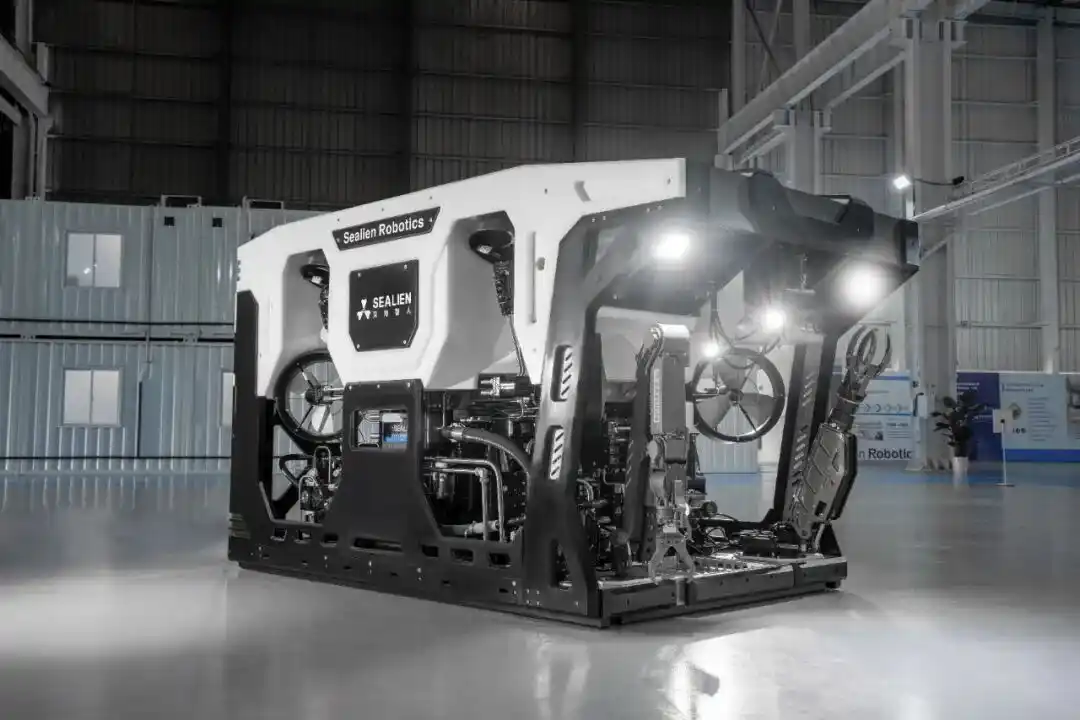
"Singularity" Deep-Sea Work-Class Robot
What the GGV Capital team sees is the infinite space beneath the ocean's surface—with the advancement of human science and technology, the boundaries of economic activities are constantly expanding. In recent years, the deep-sea economy has become a new strategic high ground for global competition: offshore oil and gas development, submarine communications, offshore wind power, and the expanding deep-sea mineral resource development, submarine data centers, and other multi-trillion-dollar industries have spawned a massive deep-sea robot market. "With its capabilities in AI and robotics hardware-software integration, as well as commercialization in scenarios like oil & gas, mining, and submarine data centers, the DeepSea Wisdom team has the potential to redefine deep-sea operational efficiency and service models through DeepMatrix, forming a new business model of continuous operation and long-term repurchase."
Then there's state-owned capital joining forces—China Insurance Investment and CETC Investment. Among them, China Insurance Investment serves as the manager of the China Insurance Investment Fund, with one of its purposes being "serving the national economic development strategy"; CETC Investment is a wholly-owned subsidiary of China Electronics Technology Group, positioning itself as a "strategic investment core support unit." The simultaneous appearance of two major state-owned entities in a financing round represents, to some extent, recognition from a national strategic perspective.
The industrial signal comes from Cathay Capital's entry. Investment community learned that the DeepSea Wisdom team specifically flew to Shanghai to meet with the Global Chairman of TotalEnergies' board. After in-depth evaluation of the company's technical strength, product capabilities, and industrialization prospects, the Cathay Energy Technology Fund, with TotalEnergies as its cornerstone LP, ultimately made the investment. Simultaneously, DeepSea Wisdom's technology and products have further reached TotalEnergies' deepwater projects worldwide, opening up further space for international industrial implementation.
The endorsement of a global energy giant speaks volumes—in global deepwater oil and gas development, TotalEnergies is one of the most influential players, known for its stringent selection criteria for deep-sea equipment suppliers.
Zhang Li, partner at Cathay Capital, candidly states that the uniqueness of DeepSea Wisdom lies in its grounding at one end in the hardest-to-replicate engineering systems for extreme environments, and at the other end, redefining a new paradigm for deep-sea operations through intelligent models and multi-robot collaboration. "We believe this is not just a growth opportunity for a deep-sea robotics company, but also represents an important direction for artificial intelligence entering the real industrial world and promoting changes in the paradigm of ocean development."
Furthermore, there is the significant follow-on investment from a group of existing shareholders. With the overall primary market currently being cautious, collective follow-on investments by existing shareholders often signify high recognition of the company's development pace and growth certainty.
Looking back at DeepSea Wisdom's financing journey, this trend is even clearer: as early as May 2023, the company completed an angel round led by ZhenFund and Shenzhen Hi-Tech Investment; in July 2024, it completed a Pre-A round led by Guangzhou Financial Holdings and Gaoke Capital; from April to June 2025, it secured another Pre-A+ round of over 100 million yuan led by Yunze Capital and Yunshi Capital.
The landing of this Series A financing exceeding 500 million yuan is a core signal from the primary market, voting with real money to confirm the long-term certainty value of the deep-sea sector. An early-stage investor感慨: "DeepSea Wisdom is the only company among our invested projects that can meet or exceed the goals set in every meeting by the next meeting. This kind of certainty is precious in hard-tech entrepreneurship."
A Case Study of a Deep-Sea Robot's Rise
Explosion in Overseas Orders
The simplest consensus in the venture capital circle is that investing is about investing in people.
Ma Yiming is undoubtedly the soul of DeepSea Wisdom. He graduated in 2013 from Harbin Engineering University with a degree in Naval Architecture and Ocean Engineering, thus forging an indissoluble bond with the deep sea. Since then, he has held long-term positions at internationally renowned deep-sea robotics companies, serving as the overall technical lead; he is also the first domestic industrial talent to systematically introduce European and American deep-sea robotics technology.
It is worth mentioning that he has also participated in formulating several national standards for underwater robots, contributed to completing the world's first commercial deep-sea mining robot "Nautilus," and led the completion of ultra-deepwater work-class ROV systems and China's first heavy-duty seabed operational robot, among other major R&D projects, promoting the introduction, innovation, and commercialization of core deep-sea robotics technologies.

Recalling the scene when he first entered the industry years later, Ma Yiming still remembers vividly: Completely different from the scattered, handmade "prototypes" commonly seen in university labs, rows of heavy-duty work-class deep-sea robots lined up in the workshop like steel behemoths. "It was a disruptive shock at the cognitive level, feeling like someone from a repair shop suddenly walking into Volkswagen's assembly line."
It wasn't until 2023 that the sense of shock buried deep in his heart years ago became the most direct driver for Ma Yiming's determination to independently develop deep-sea robots. Thus, he embarked on the entrepreneurial path, and DeepSea Wisdom came into being.
As is well known, depths of several thousand meters simultaneously impose five extreme constraints: pressure hundreds of times atmospheric, high salinity corrosion, dark and turbid environments, chaotic ocean currents, and acoustic communication delays. Surveying current domestic marine robotics companies, most focus on consumer-grade or light industrial-grade underwater robots, with operational depths generally under 100 meters, meaning they can only perform specific functions and are completely unsuitable for deep-sea operational needs.
Since its establishment, DeepSea Wisdom has consistently focused on rigid industrial scenarios in the deep sea, a rarity that is truly valuable. The reason is self-evident—work-class ROVs (Remotely Operated Vehicles), capable of operating in high-pressure deep-sea environments at kilometer-level or even multi-kilometer depths, are indispensable "national heavyweights" for deep-sea oil and gas development, submarine communications, offshore wind power, seabed infrastructure construction, and future deep-sea mining.
However, one cannot ignore a somewhat stark fact: this "national heavyweight" has long been dominated by European and American companies, leading to a reliance on international brands and overseas technology systems for China's high-end deep-sea robots. What DeepSea Wisdom aims to do is break this situation, achieving breakthroughs with original Chinese technology on a global scale.
The difficulty is可想而知. On one hand, the technological architectures of land-based robots and shallow-sea observation equipment cannot be directly reused; all power, control, and sealing systems must be forward-developed from scratch for the deep-sea environment, with single technical攻关 cycles generally measured in years. On the other hand, European and American manufacturers possess complete design, supply chain control, testing, validation, and project delivery standard systems covering hundreds of thousands of components, forming a chasm before domestic companies.
From the start, DeepSea Wisdom abandoned the short-term route of quickly building prototypes, taking time to沉淀 over 300 internal self-developed standard manuals, fully benchmarking against top international offshore specifications, and filling the短板 of domestic companies in成套 delivery systems. "This intangible digital asset has become a core competency that pure hardware integrators and algorithm teams cannot replicate in the short term."
Additionally,不同于 the industry's past model of purchasing core components and simple assembly, DeepSea Wisdom insists on full-chain forward self-development of the complete pressure-resistant structure, hydraulic manipulators, underwater navigation,底层 control systems, and intelligent algorithms. Simultaneously, it adopts a modular hardware architecture, with a universal base covering 90% of industry needs and the remaining 10% expanded with operational modules as needed, significantly reducing costs.
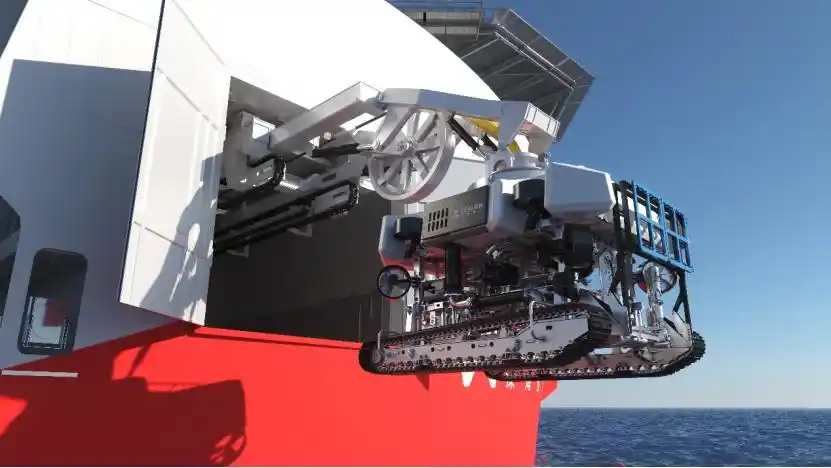
"Phoenix 600" Deep-Sea Suspended Work-Class Robot
Thanks to this, DeepSea Wisdom's first product, the "Taurus" deep-sea heavy-duty operational robot, took only 10 months from conceptual design to complete assembly and调试, whereas European and American companies typically spend 18-20 months. It is worth mentioning that the first "Taurus" achieved "zero-failure" continuous operation in its first application at the State Power Investment's Zhanjiang Wailuo offshore wind farm project.
To date, DeepSea Wisdom has built a product matrix covering full-depth deep-sea operational scenarios, including:
"Singularity" deep-sea work-class robot (operational depth: 6,000 meters);
"Phoenix" deep-sea suspended work-class robot (operational depth: 3,000 meters);
"Taurus" deep-sea heavy-duty work-class robot (operational depth: 1,000 meters);
Deep Matrix seabed-resident unmanned robot cluster solution, which also includes, as part of the solution, Autonomous Underwater Vehicles (AUVs), the deep-sea mission decision-making large model system SEAgent, etc.
A milestone event occurred in the summer of 2025 when DeepSea Wisdom successfully secured an order from Etisalat UAE Group, delivering a deep-sea robot "Phoenix 600" worth nearly ten million dollars; in October of the same year, based on the positive合作 experience with the first "Phoenix," Etisalat placed another order, achieving a continuous "1+2" procurement.
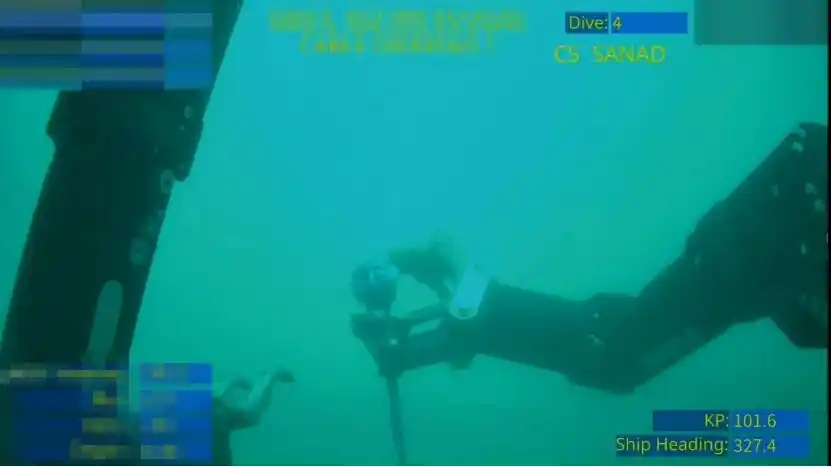
"Phoenix 600" Deep-Sea Real Operation
The story behind it is little known. Ma Yiming坦言 that at the time, the client was quite unfamiliar with DeepSea Wisdom. To address this, he personally led the team to Dubai to demonstrate the "Phoenix 600" in person for the client. The latter is a complete suspended deep-sea cable/pipeline burial robot system with a maximum diving depth of 3000 meters, representing the commercial deepest海域, with全套 design, testing, and delivery systems benchmarked against top European and American standards, fully independently developed by DeepSea Wisdom, and empowered by AI.
Etisalat's expert team subsequently came to China for in-depth due diligence: reviewing the full-process technical documentation of projects like "Taurus"; randomly抽查 visiting over a dozen core suppliers to检查 process documents and quality records; conducting marathon technical答辩 sessions with DeepSea Wisdom's mechanical, electrical, software, and hydraulic teams. The company's technical advantages were一目了然.
Ultimately, DeepSea Wisdom did not rely on low-price competition but won over the Middle Eastern client with a "zero-defect" technical solution, defeating a host of industry giants from the UK, Netherlands, Norway, and other countries, achieving a breakthrough of zero in China's commercial export of deep-sea robots. By the end of the same year, DeepSea Wisdom secured another order from a central state-owned enterprise for a submarine optical cable operational robot, marking the first time a domestic central SOE procured a fully国产化 local brand deep-sea robot—a非同寻常 significance.
Thus, DeepSea Wisdom has not only captured most of the commercial整机 orders in the domestic market but is also the only private enterprise in China that has successfully commercially sold deep-sea robot整机. Its sales clients cover the three highest-barrier mainstream fields: international oil and gas contractors, submarine optical cable communication contractors, and wind power contractors, spanning dozens of countries including the UK, Netherlands, Norway, Brazil, Australia, UAE, Egypt, Singapore, Malaysia, Indonesia, Angola, etc.
Looking back, the rise of DeepSea Wisdom is a complete narrative of a Chinese科技 sample: not taking the traditional path of "introduction-digestion-absorption-re-innovation," but choosing a more difficult road—building a complete system from scratch, using an independent technological路线 to create a new paradigm for human cognition and development of the deep sea.
Original Chinese Strength
Conquering the 10,000-Meter Deep Sea
The industrial序幕 has already拉开.
In 2025, the government work report for the first time listed "deep-sea technology" as a key area for strategic emerging industries, alongside commercial aerospace and the low-altitude economy; simultaneously, "strengthening海洋 development, utilization, and ecological protection" was formally written into the "15th Five-Year Plan" outline, with deep-sea exploration also positioned as an important抓手 for cultivating new quality productive forces and safeguarding national resource security. Not long ago, the Ministry of Natural Resources also proposed implementing deep-sea engineering, improving deep-sea access,探测, development, and safety capabilities, and accelerating the development and utilization level of deep-sea mineral resources and genetic resources.
Such a scene has深远影响. The development and innovation of deep-sea technology directly affect a country's ability to develop the deep sea,关乎 national energy autonomy, strategic resource security, and international competition for global海洋话语权.
Currently, the extent of human development of the oceans is less than 0.1% of the total ocean area. The space contained仅 in the deep-sea mining scenario is staggering—UBS estimated in a November 2025 report that the total potential value of global deep-sea mineral resources is on the order of 177-280 trillion US dollars.
In Ma Yiming's view, "The business we are engaged in is essentially forging a foundational capability for the country and humanity—a capability to freely enter, comprehensively understand, and effectively develop the blue疆域 covering 71% of the Earth's surface." The team清楚 that their path is not simply overlaying AI algorithms onto robots, but enabling deep-sea robots to possess environmental perception, task understanding, autonomous decision-making, collaborative execution, and continuous evolution capabilities in extreme environments, thereby achieving truly meaningful marine embodied intelligence.
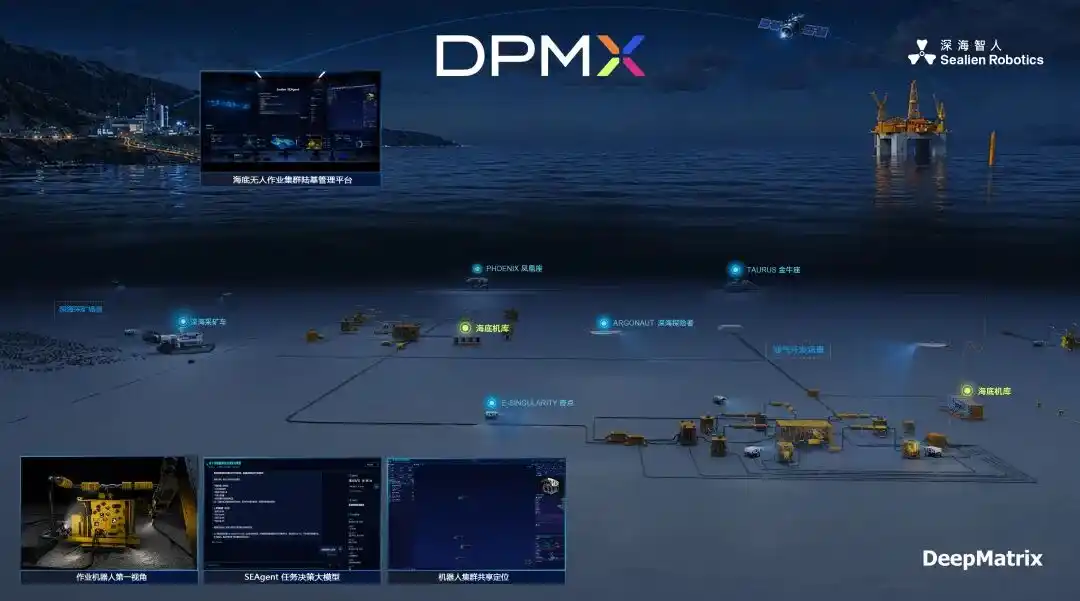
As early as December last year, DeepSea Wisdom began planning its technology roadmap for the next 5-10 years, launching the Deep Matrix seabed-resident unmanned robot cluster solution. Using the "全电驱动型常驻海底机器人集群 + SEAgent海洋具身智能大脑" system, it aims to彻底重构 the underlying模式 of deep-sea development and build a全新生态 for deep-sea development.
Subsequently, in March this year, DeepSea Wisdom released its first deep-sea robot mission decision-making large model—SEAgent, capable of natural language parsing, information completion, task admission judgment, and structured output,打通 the intelligent entry point for human operational requirements into the robot system, and具备 continuous learning evolution capabilities. This marks the advancement of deep-sea robots from单体 to "海洋具身智能 + multi-intelligent-agent collaboration."
Simply put, in future scenarios like deep-sea mining, deep-sea robots will no longer require expensive mother ships for long-term accompaniment or大量持证 operators for real-time remote control, nor be limited by weather windows; humans will only need to提出 operational goals from shore bases, and underwater clusters will autonomously complete all exploration, survey, installation, maintenance, asset inspection, and emergency response work.
DeepSea Wisdom roughly estimates that deploying a DeepMatrix resident cluster in a single offshore oil and gas field could save tens of billions of dollars in vessel and labor costs over the field's full 25-year operational lifecycle, potentially reducing每桶海洋油气开采成本 by $5-10. By 2029, it is expected to complete the world's first commercial全自主 seabed cluster落地,率先 achieving规模化 unmanned operations in deep-sea oil and gas field scenarios. The market space for deep-sea mining will be several times that of oil and gas field scenarios for DeepMatrix resident clusters.
Data shows that the current global seabed services market规模 is 1.5 trillion yuan, with an industry annual growth rate exceeding 20%. Facing this high-growth blue ocean, DeepSea Wisdom's goal is equally clear—to reshape the industry格局 with fully unmanned deep-sea robot solutions and become the领航者 of this deep blue.
If hardware determines the depth to which humans can reach the deep sea, then intelligent systems will determine the height at which we can develop and utilize it. DeepSea Wisdom is using the multi-wheel drive of "hardware + deep-sea embodied large model + scenario" to build the生态底座 for deep-sea development. This original definition of the underlying paradigm for deep-sea development carries不言而喻 scarcity value.
As Cai Wei, partner at Guanghe Venture Capital, analyzes, the deep sea is one of the most challenging application scenarios for artificial intelligence moving into the real world. "DeepSea Wisdom's Deep Matrix plan fundamentally changes the high-cost, high-risk mode heavily dependent on mother ships and manual labor. It precisely targets the core pain points in ocean development scenarios—'exorbitant vessel charter rates, communication delay bottlenecks, and complex physical coordination'—successfully promoting a paradigm shift from 'single remote-controlled tools' to 'marine embodied intelligence + multi-intelligent-agent collaboration.'"
Having been长期身处 the industrial frontline, Ma Yiming始终 believes that China has sufficient talent and industrial resources to nurture several globally original and leading companies. "DeepSea Wisdom aims to be that 'wise man' replacing humans in developing the deep sea."
Beneath the deep sea, Chinese strength is rewriting the rules.
This article is from the WeChat public account "Investment Community" (ID: pedaily2012), author: Liu Bo.