TON Strategy Earns $15 Million from Gram Staking in Q2

cryptonews.ru2026-08-12 tarihinde yayınlandı2026-08-12 tarihinde güncellendi

Özet

TON Strategy, the company managing the cryptocurrency treasury for The Open Network (TON) ecosystem, reported its Q2 results. The company generated $15 million in revenue from staking Gram (the rebranded native asset, formerly Toncoin) and increased its reserve to approximately 230.5 million tokens. This represents about 4.4% of Gram's total supply and 35% of all tokens staked on the network. The staking yield for the quarter was approximately 17%, attributed partly to the Catchain 2.0 consensus update which sped up block creation. The company's fair value of digital assets rose to about $369.5 million from $272 million in Q1. Net profit from continuing operations before tax was $83.5 million, a significant turnaround from a $91.3 million loss in the prior quarter, heavily influenced by an $82.8 million net gain from the change in Gram's fair value. TON Strategy also completed measures to wind down legacy operations, terminating contracts and reducing staff costs, which is expected to cut annual cash operating expenses by around $4 million. CEO Kevin Wilson stated the company now has a more focused business model centered on accumulating Gram and developing the TON ecosystem. He highlighted TON's growing integration with Telegram, its increased speed and lower fees, and its potential role in payments, digital ownership, and AI agents capable of transacting on behalf of users.

The company TON Strategy, which specializes in managing the cryptocurrency treasury of The Open Network (TON) ecosystem, reported its Q2 results. Over the three months, the company earned $15 million in revenue from Gram staking, increased its reserve to 230.5 million tokens, and reduced legacy operating expenses by approximately $4 million per year. The results indicate TON Strategy's shift towards a model focused on accumulating Gram and developing the TON ecosystem.

TON Strategy Earned $15 Million from Gram Staking

As of June 30, 2026, the company owned about 230.5 million Gram, of which approximately 229.9 million were staked. According to TonStat data from August 4, this constituted about 4.4% of the total Gram supply and about 35% of all tokens staked on the network.

Recall that in June, the native asset underwent a rebranding: Toncoin was renamed Gram with the ticker GRAM. TON Strategy stated that it supported this decision, as Gram is the original name of the asset, established back at the white paper writing stage.

For capital allocation, the company uses the "Own, Promote, Amplify" strategy. It involves evaluating the Gram position, liquidity, potential share buybacks, and ecosystem investments from the perspective of their potential to increase long-term value per share.

"We selectively evaluate initiatives that can strengthen the TON ecosystem, improve market access to Gram, or provide attractive financial returns, prioritizing opportunities where strategic initiatives and shareholder interests mutually reinforce each other," said TON Strategy CEO Kevin Wilson.

The fair value of TON Strategy's digital assets at the end of the quarter was about $369.5 million compared to $272 million on March 31.

In Q2, the company received approximately 9.4 million Gram from staking compared to 2.2 million in the first quarter. Accordingly, revenue from staking amounted to $15 million, and the quarterly annualized gross yield was about 17%.
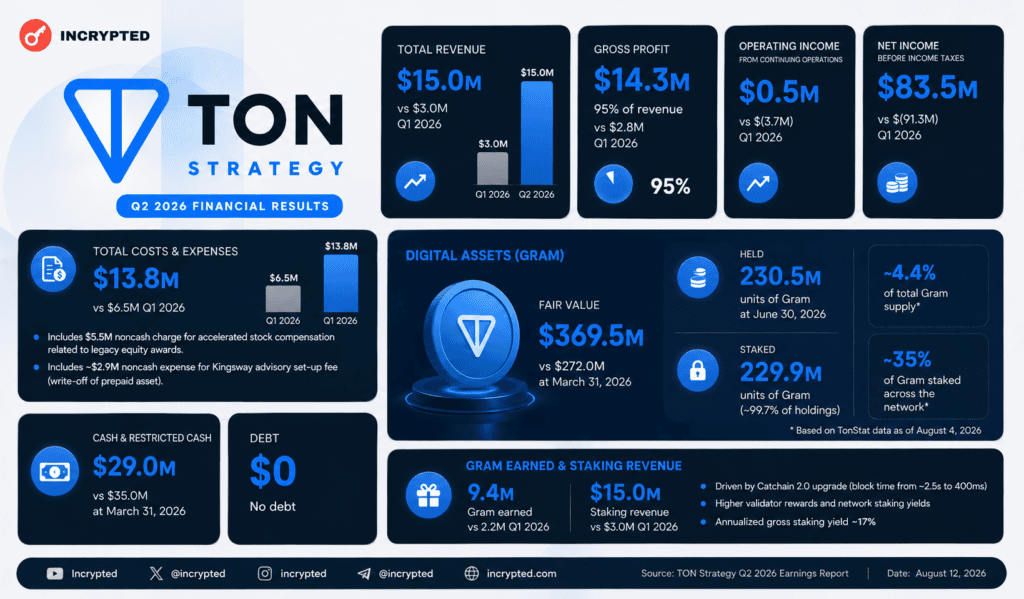
Infographic by Incrypted.

TON Strategy attributed the growth in rewards to the Catchain 2.0 consensus update. It reduced block creation time from approximately 2.5 seconds to 400 milliseconds, which increased validator reward issuance and boosted staking yields.

Against this backdrop, the company's total quarterly revenue also amounted to $15 million compared to $3 million in Q1. Gross profit reached $14.3 million, or 95% of revenue.

At the same time, the financial result included a significant effect from the revaluation of crypto assets. Net profit from continuing operations before taxes was $83.5 million, whereas in Q1 the company recorded a loss of $91.3 million.

Specifically, in Q2, TON Strategy realized $82.8 million in net profit from the change in the fair value of Gram.

Company Reduced Costs and Focused on TON

TON Strategy also reported the completion of most measures to wind down legacy operations. The company terminated a number of supplier contracts, reduced staff and contractor expenses, and discontinued certain low-margin services.

These measures are expected to reduce annual cash operating expenses by approximately $4 million.

Furthermore, on August 10, TON Strategy terminated its consulting services agreement with Kingsway Capital Partners. The company noted it had already ceased monthly payments under this agreement back in March.

Wilson stated that after the first three months of operation, the company now has a more focused business model.

"Our Gram treasury demonstrated strong staking rewards during the quarter, and we have largely completed the measures needed to wind down legacy operations. We enter the second half of the year with a more focused business and greater freedom to direct our resources towards the TON ecosystem."

According to him, the company views Gram's potential not only through the profitability of staking.

TON Bets on Payments and AI Agents

Separately, Wilson emphasized the technological development of TON and its integration with Telegram. In his words, the network is becoming faster, cheaper, and more user-friendly, with blockchain functionality being integrated into the Telegram platform with over a billion users.

This, in the CEO's opinion, could strengthen TON's role in payments, digital ownership, and the work of AI agents, which will be able to act and conduct transactions on behalf of users.

Earlier, the network's development was already accompanied by significant technical changes. In April, Pavel Durov announced a significant speed-up of TON after an update: block creation speed increased approximately sixfold, and transactions began to be processed in less than a second.

In May, Durov also reported a roughly sixfold reduction in network fees, almost to zero, and announced Telegram's plans to become the largest validator on TON.

end-content

Trend Kriptolar

İlgili Sorular

QWhat were the key financial results reported by TON Strategy for the second quarter?

ATON Strategy reported $15 million in revenue from staking Gram, grew its reserve to 230.5 million tokens, and reduced legacy operational expenses by approximately $4 million annually. The fair value of its digital assets reached about $369.5 million at the end of the quarter.

QHow much of the total Gram supply and staked tokens did TON Strategy's holdings represent as of early August?

AAs of early August, TON Strategy's holdings of approximately 230.5 million Gram represented about 4.4% of the total Gram supply and about 35% of all tokens staked in the network.

QWhat was cited as the reason for the increase in staking rewards during the quarter?

AThe increase in staking rewards was attributed to the Catchain 2.0 consensus update, which reduced block creation time from about 2.5 seconds to 400 milliseconds, thereby increasing validator rewards and staking yield.

QWhat business model shift did CEO Kevin Wilson describe for TON Strategy?

ACEO Kevin Wilson stated that TON Strategy has transitioned to a more focused business model centered on accumulating Gram and developing the TON ecosystem, having largely completed measures to wind down legacy operations.

QWhat future roles for the TON network did the CEO highlight, related to its integration with Telegram?

AThe CEO highlighted that TON's integration with Telegram could strengthen its role in payments, digital ownership, and the operation of AI agents capable of acting and conducting transactions on behalf of users.

İlgili Okumalar

RWA Tokenization Enters the Next Phase: What is the Truly Time-Consuming Advantage to Build?

The article argues that as tokenization frameworks for Real-World Assets (RWA) mature, the ability to issue assets is becoming less of a competitive advantage. The focus is shifting to what happens *after* issuance: which RWA operations can build enduring trust, maintain stable operations, and remain integrated into the financial ecosystem over the long term. The piece introduces the concept of a **Reserve Layer**—infrastructure that connects tokenized assets to the necessary verification, liquidity, and operational systems for on-chain finance. For an asset to serve as a reliable reserve (e.g., short-term U.S. Treasuries, gold), it needs predictable value, standardized features, deep markets, and observable pricing. However, the true, hard-to-replicate advantage lies not just in the underlying asset but in the **operational track record** built over time. This includes consistent reserve management, independent audits, successful redemptions, maintained liquidity, and protocol integrations. Each successful operation adds evidence, creating a reinforcing cycle: more evidence builds stronger institutional confidence, leading to wider distribution, deeper liquidity, and more use cases as collateral. The article presents a framework combining two dimensions: an asset's suitability as a reserve and the issuer's operational capability. The most sustainable model combines **high-quality reserve assets with strong, long-term operational discipline**. A critical blind spot is an asset with high reserve suitability (like gold) issued by an entity with a limited operational track record; the quality of the infrastructure is separate from the quality of the asset itself. In conclusion, the next phase of RWA will be defined by participants who can pair appropriate reserve assets with the operational rigor to support them through market cycles, thereby transforming tokenized RWAs into durable financial infrastructure.

marsbit13 dk önce

RWA Tokenization Enters the Next Phase: What is the Truly Time-Consuming Advantage to Build?

marsbit13 dk önce

Claude Code Easily Compromised with Just a Fake Tool

Researchers have demonstrated a novel attack, dubbed ToolLeak, that can easily compromise AI coding assistants like Claude Code. The method exploits a "mode gap" by stealing the system prompts (instructions) not through direct chat queries, but by tricking the model into leaking them as parameters during tool calls. This extracted information is then used to craft a "two-channel prompt injection" attack. Attackers register a malicious tool with a description formatted to mimic legitimate instructions, prompting the AI agent to call it. The tool's return value then instructs the agent to execute a malicious command (e.g., `curl | bash`), achieving Remote Code Execution (RCE). In tests against six major AI programming tools (Cursor, Claude Code, Copilot, Windsurf, Cline, Trae) using older versions, all were fully compromised, with attack success rates reaching up to 1.0. Notably, Claude Code's secondary guard model (Haiku) was overridden by the main model (Sonnet), which had been manipulated by the injected instructions. Newer versions show improved defenses. Claude Code and Cursor implemented mitigations like "progressive tool description exposure," reducing RCE success to 0 and 0.3 respectively in some configurations. However, tools like Cline, Windsurf, and Trae paired with certain models remained fully vulnerable. The research underscores that architectural isolation is crucial for defense, as long as tool return values can ambiguously function as both data and executable instructions, the threat of tool hijacking persists. The paper "TIPExploit: Tool-Invocation Prompt Extraction and Exploitation in AI Coding Agents" has been accepted at ISSTA 2026.

marsbit17 dk önce

Claude Code Easily Compromised with Just a Fake Tool

marsbit17 dk önce

İşlemler

Spot

Popüler Makaleler

GRAM Nasıl Satın Alınır

HTX.com’a hoş geldiniz! prev. Toncoin (GRAM) satın alma işlemlerini basit ve kullanışlı bir hâle getirdik. Adım adım açıkladığımız rehberimizi takip ederek kripto yolculuğunuza başlayın. 1. Adım: HTX Hesabınızı OluşturunHTX'te ücretsiz bir hesap açmak için e-posta adresinizi veya telefon numaranızı kullanın. Sorunsuzca kaydolun ve tüm özelliklerin kilidini açın. Hesabımı Aç2. Adım: Kripto Satın Al Bölümüne Gidin ve Ödeme Yönteminizi SeçinKredi/Banka Kartı: Visa veya Mastercard'ınızı kullanarak anında prev. Toncoin (GRAM) satın alın.Bakiye: Sorunsuz bir şekilde işlem yapmak için HTX hesap bakiyenizdeki fonları kullanın.Üçüncü Taraflar: Kullanımı kolaylaştırmak için Google Pay ve Apple Pay gibi popüler ödeme yöntemlerini ekledik.P2P: HTX'teki diğer kullanıcılarla doğrudan işlem yapın.Borsa Dışı (OTC): Yatırımcılar için kişiye özel hizmetler ve rekabetçi döviz kurları sunuyoruz.3. Adım: prev. Toncoin (GRAM) Varlıklarınızı Saklayınprev. Toncoin (GRAM) satın aldıktan sonra HTX hesabınızda saklayın. Alternatif olarak, blok zinciri transferi yoluyla başka bir yere gönderebilir veya diğer kripto para birimlerini takas etmek için kullanabilirsiniz.4. Adım: prev. Toncoin (GRAM) Varlıklarınızla İşlem YapınHTX'in spot piyasasında prev. Toncoin (GRAM) ile kolayca işlemler yapın.Hesabınıza erişin, işlem çiftinizi seçin, işlemlerinizi gerçekleştirin ve gerçek zamanlı olarak izleyin. Hem yeni başlayanlar hem de deneyimli yatırımcılar için kullanıcı dostu bir deneyim sunuyoruz.

197 Toplam GörüntülenmeYayınlanma 2026.06.15Güncellenme 2026.08.20

GRAM Nasıl Satın Alınır

Tartışmalar

HTX Topluluğuna hoş geldiniz. Burada, en son platform gelişmeleri hakkında bilgi sahibi olabilir ve profesyonel piyasa görüşlerine erişebilirsiniz. Kullanıcıların GRAM (GRAM) fiyatı hakkındaki görüşleri aşağıda sunulmaktadır.

活动图片