Originally from Syncracy Capital Co-founder Ryan Watkins
Compiled by Odaily Planet Daily Qin Xiaofeng (@QinXiaofeng 888 )

Editor's Note: Syncracy Capital Co-founder Ryan Watkins recently published an article titled "The Twilight Zone: The Crypto Economy in 2026 and Beyond". He mentioned that crypto assets had over-discounted expectations in 2021, and valuations have since been rationally adjusting, with quality assets now priced reasonably; the growth of the entire crypto economy is shifting from cyclical drivers to long-term secular drivers, and the industry has already spawned several valuable application scenarios beyond Bitcoin. "There is no force more powerful than an idea whose time has come, and the arrival of the crypto economy has never been more inevitable."
Below is the original content, compiled by Odaily Planet Daily, Enjoy~
——————
The crypto economy is undergoing the most significant transformation I have witnessed in my eight years in the industry.
Institutions are continuously accumulating digital assets, while early cypherpunk pioneers are diversifying wealth and cashing out. Corporations are positioning for S-curve growth, while disillusioned native players are exhausted. Governments are pushing the global financial system towards blockchain rails, while day traders still fret over a few candlesticks on a chart. Emerging markets are celebrating financial democratization, while cynics born in the US lament that it's all just a giant casino.
Lately, there has been much discussion about which historical period the current crypto economy most resembles.
Optimists compare it to the post-dot-com bubble recovery, believing the industry's speculative era has ended, and long-term winners like Google and Amazon will emerge, climbing the S-curve. Pessimists compare it to emerging markets, akin to China in the 2010s, arguing that weak investor protection and a lack of patient, long-only, non-exiting capital could lead to poor asset price performance even as the industry thrives.
Both views hold merit. After all, history is the investor's best guide besides personal experience. However, analogies have their limits. We must also understand the crypto economy within its unique macro-economic and technological context. Markets are not monolithic—they are composed of numerous characters and narratives, interconnected yet distinct.
Here is my best judgment of where we've been and where we're going.
"The Red Queen's Race"
In British author Lewis Carroll's "Through the Looking-Glass," the Red Queen tells Alice: "Now, here, you see, it takes all the running you can do, to keep in the same place. If you want to get somewhere else, you must run at least twice as fast as that!" In 1973, evolutionary biologist L. van Valen used this to propose the "Red Queen Hypothesis," aptly depicting the intense survival competition in nature: no progress means falling behind, stagnation equals death.
In many ways, expectations are all that matter in financial markets. Exceed expectations, prices rise; fall short, prices fall. Over time, expectations swing like a pendulum, and long-term returns are often inversely correlated with them.
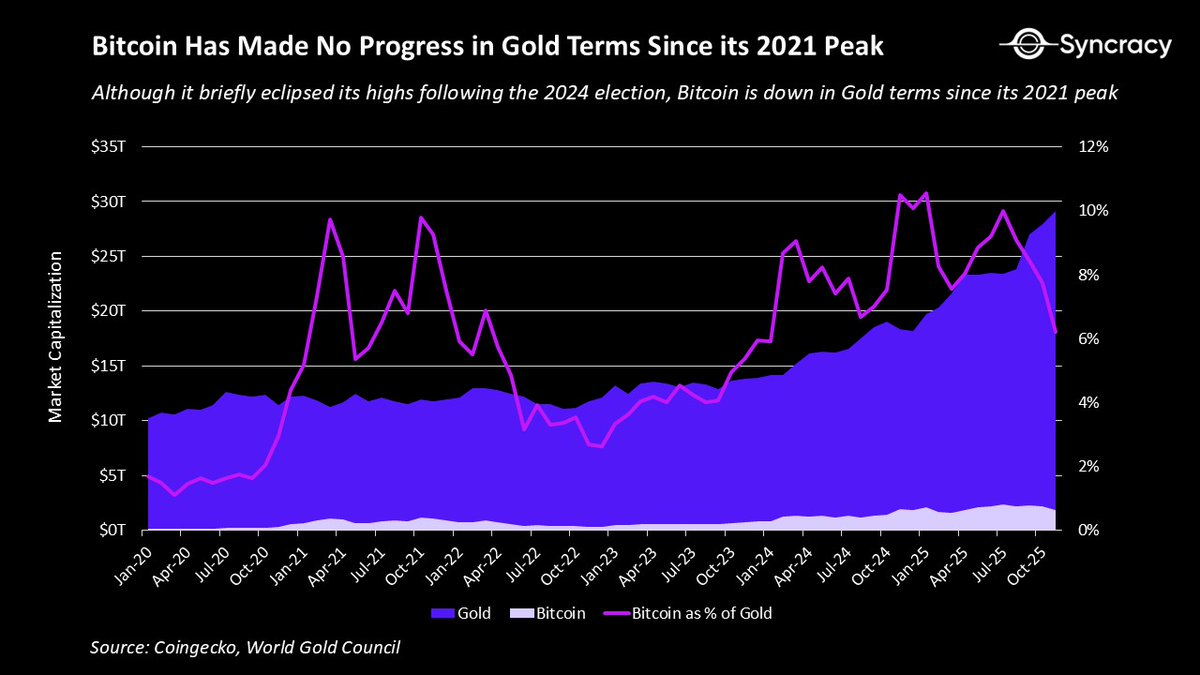
In 2021, the crypto economy discounted expectations far beyond most people's understanding. In some ways, this was obvious, like DeFi blue chips trading at 500x price-to-sales ratios, or eight smart contract platforms once valued over $100 billion. Not to mention the dizzying metaverse and NFT absurdities. But perhaps the most sobering illustration is the Bitcoin-to-gold ratio chart.
Despite all our progress, Bitcoin's price relative to gold has not made new highs since 2021 and has actually declined since then. Who would have thought that under Trump's "crypto capital," after the most successful ETF launch in history, and amid systemic dollar debasement, Bitcoin as digital gold would perform worse than four years ago?
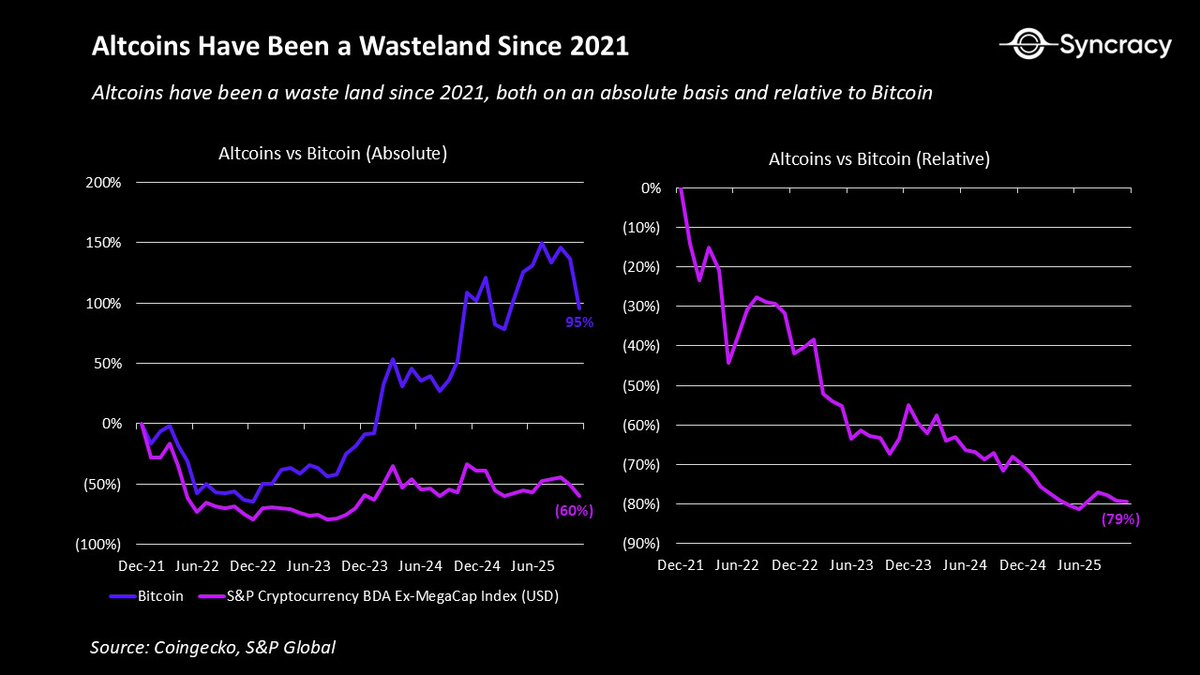
For other varieties, things are much worse. Most of these projects started this cycle with structural issues, compounded by the challenge of managing extreme expectations:
- Revenues for most projects are highly cyclical and predicated on continuously rising asset prices
- Regulatory uncertainty hinders institutional and enterprise participation
- Dual ownership structures cause misalignment between equity insiders and public token investors
- Weak disclosure practices create information asymmetry between project teams and communities
- Lack of common valuation frameworks leads to excessive volatility and no fundamental price floor
The confluence of these issues has led to persistent capital flight for most tokens, with very few sniffing their 2021 highs. The psychological impact is immense, as few things in life are more discouraging than consistently exerting effort without reward.
This disappointment is particularly profound for speculators and opportunists who thought crypto assets were a shortcut to wealth. Over time, this struggle has led to widespread burnout across the industry.
This is, of course, a healthy development. Minimal effort should not continue to yield outsized returns as it did in the past. The pre-2022 era of amassing fortunes through conceptual veneers alone was clearly unsustainable.
Nevertheless, a silver lining is that these issues are now widely recognized, and prices reflect that. Today, beyond Bitcoin, few crypto-native players are willing to seriously consider the long-term fundamental narratives of any other asset. And after four years of struggle, this asset class now has the necessary conditions to once again deliver surprise upside.
The Crypto Economy Awakens
As outlined in the previous section, the crypto economy started this cycle with numerous structural problems. The good news is that everyone now recognizes this, and many of these issues are becoming historical artifacts.
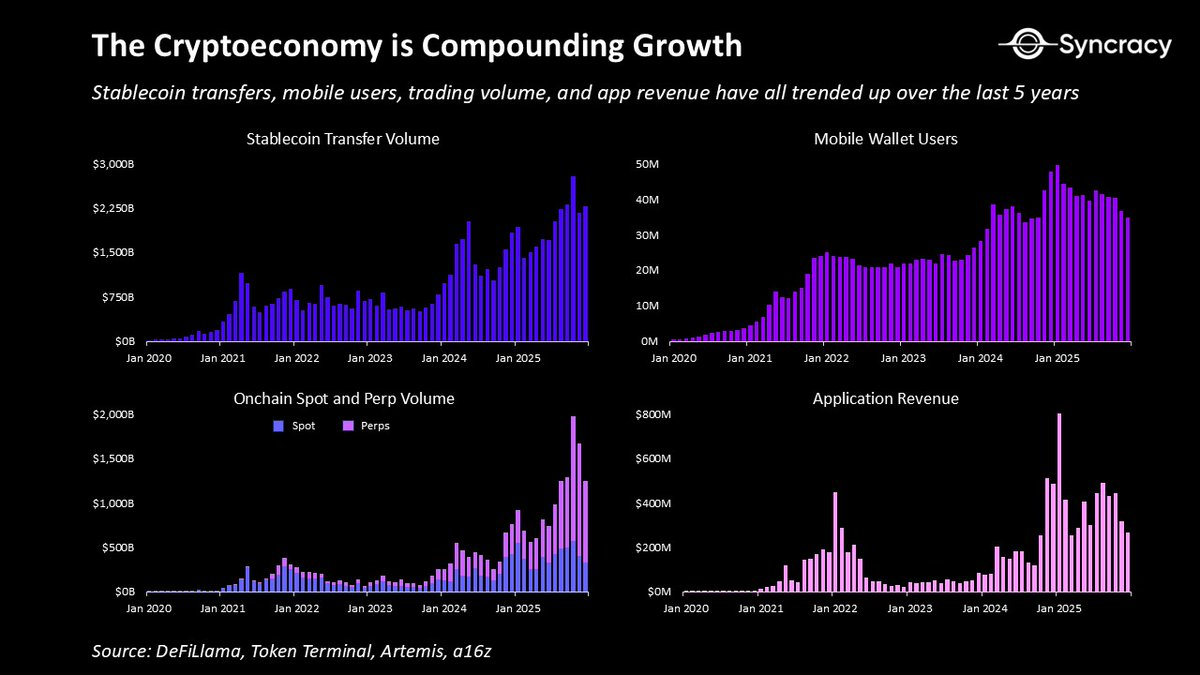
First, beyond digital gold, several application scenarios are showing compounding growth, with many more in transition. Over the past few years, the crypto economy has given rise to:
- Peer-to-peer internet platforms that enable users to execute transactions and enforce contractual relationships without government or corporate intermediaries
- Digital dollars that can be stored and transferred anywhere in the world with internet access, providing cheap and reliable money for billions
- Permissionless exchanges that allow anyone, anywhere, to trade any asset class's top global assets 24/7 in a single, transparent venue
- Novel derivatives like event contracts and perpetual swaps, which provide valuable predictive insights for society and more efficient price discovery mechanisms, respectively
- Global collateral markets enabling users to access credit without permission through transparent, automated infrastructure, significantly reducing counterparty risk
- Democratized asset creation platforms allowing any individual and institution to issue publicly tradable assets at minimal cost
- Open financing platforms enabling anyone in the world to raise capital for their ventures, transcending the constraints of local economies
- Physical infrastructure networks building more scalable and resilient infrastructure through crowdfunded capital and distributed, independent operator management
This is not an exhaustive list of all valuable applications built by the industry to date. The key point is that many of these scenarios are demonstrating real value and are growing regardless of crypto asset price movements.
Simultaneously, as regulatory pressure eases and founders recognize the cost of misaligned interests, the dual equity/token model is being corrected. Many existing projects are consolidating assets and revenues into a single token, while others are clearly delineating: on-chain revenue belongs to token holders, off-chain revenue belongs to equity holders. Furthermore, with the maturation of third-party data providers, disclosure practices are improving, reducing information asymmetry and enabling more reliable analysis.
Concurrently, consensus is forming around a simple, time-tested principle: 99.9% of assets need to generate cash flow, with only a rare few like BTC and ETH serving as value stores being the exception. As more fundamentally driven investors enter the asset class, these frameworks will only strengthen, and rationality will gradually prevail.
In fact, over a sufficiently long horizon, the self-sovereign ownership of on-chain cash flows may be understood as an unlock on par with self-sovereign digital value storage. When in history could you hold a digital bearer asset that autonomously receives payment every single time its program is invoked anywhere in the world?
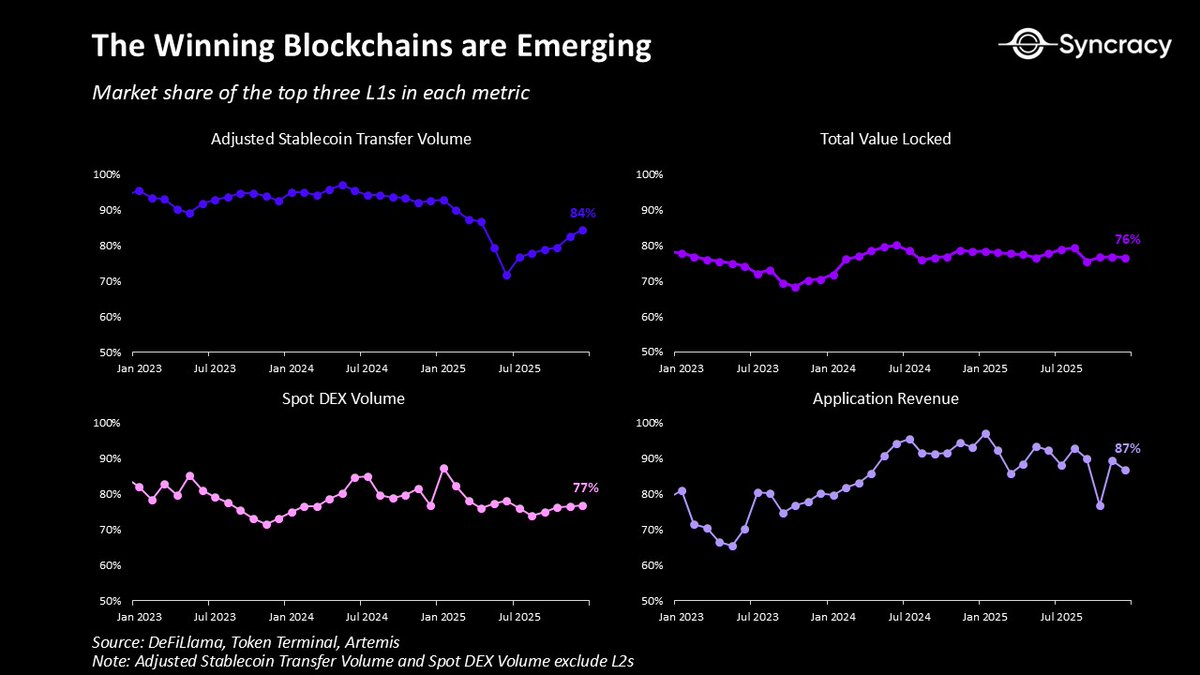
Against this backdrop, winning blockchains are becoming the monetary and financial base layer of the internet. Day by day, the network effects of Ethereum, Solana, and Hyperliquid deepen through their expanding ecosystems of assets, applications, enterprises, and users. Their permissionless design and global distribution enable applications that rank among the world's fastest-growing enterprises, with unparalleled capital efficiency and revenue velocity. Long term, these platforms will likely underpin the total addressable market for the "financial super app" that every leading fintech aspires to capture a piece of.
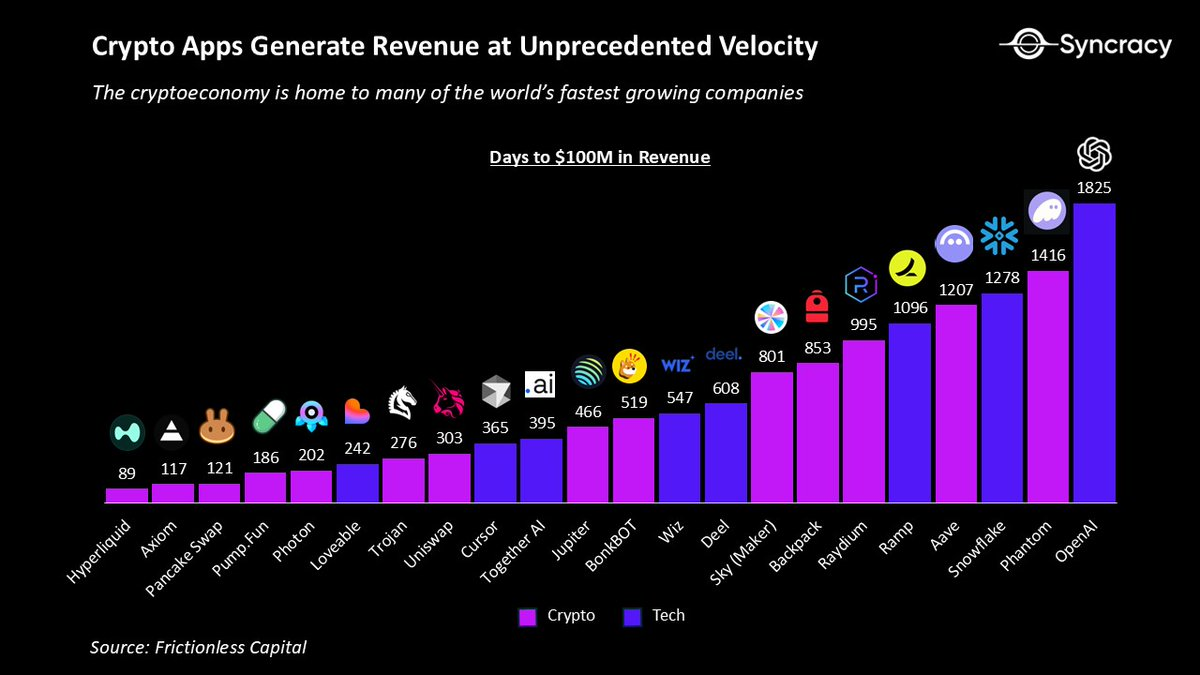
Against this backdrop, it is unsurprising that established giants from Wall Street and Silicon Valley are barreling ahead with blockchain-related initiatives at full speed. There is hardly a week without a new wave of product launches, ranging from tokenization to stablecoins. Notably, unlike previous eras of crypto, these efforts are no longer experiments. They are production-grade products, mostly built on public blockchains rather than isolated, closed private systems.
As the lagging effects of regulatory changes continue to permeate the system over the coming quarters, this activity will only accelerate. With clearer rules, enterprises and institutions can finally shift focus from "Is this legal?" to how blockchain can expand revenue opportunities, reduce costs, and unlock new business models.
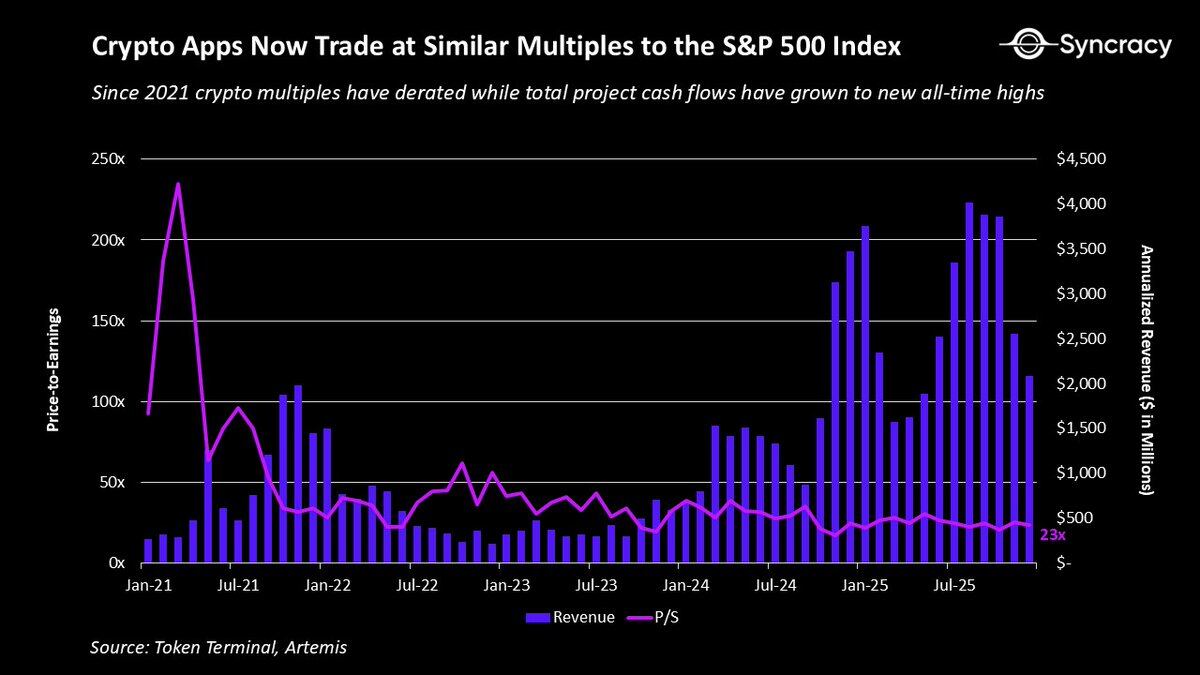
Perhaps one of the most telling signs of the current situation is the scarcity of analysts modeling exponential growth. To my intuition, many peers on the sell-side and buy-side are hesitant to adopt annual growth rates above 20%, fearing they might appear overly optimistic.
With valuations having reset after four years of struggle, it is crucial at this moment to ask oneself: What if this actually goes exponential? What if daring to dream again ultimately pays off?
The Twilight Zone
“To light a candle is to cast a shadow.” — Ursula LeGuin.
On a crisp autumn day in 2018, before another exhausting investment banking workday began, I dropped by an old professor's office to chat about everything blockchain. Sitting down, he recounted to me a conversation he had with a skeptical stock hedge fund manager who proclaimed that crypto assets were entering a nuclear winter and were "a solution still looking for a problem."
After giving me a quick refresher on unsustainable sovereign debt burdens and collapsing institutional trust, he finally told me what he said to that skeptic: "In ten years, the world will be thankful we built this parallel system."
It hasn't been a full decade since, but as crypto assets look more like an idea whose time has come every day, his prophecy seems prescient.
In the same spirit, and the central thesis of this entire piece: The world is still underestimating what is being built here. And of the most practical significance for all of us investors, the multi-year opportunities in leading projects are now underpriced.
This last point is crucial because while the arrival of the crypto world may be inevitable, that token you love might truly go to zero. The flip side of crypto's inevitability is that it attracts fiercer competition, and the pressure to deliver has never been greater. As the corporate and institutional giants I mentioned earlier enter, they are likely to wash out many weaker players. This is not to say they will win outright and hoard the technology. But it does mean that only a select few native players will become the big winners around which the world re-anchors its order.
This is not meant to breed cynicism. In all emerging tech sectors, 90% of startups fail. That there might be more public failures in the coming years should not distract you from the bigger picture.
Perhaps no single technology aligns more with the zeitgeist of our time than crypto. The decline of institutional trust in developed societies, unsustainable government spending in G7 nations, blatant currency debasement by the world's largest fiat issuer, deglobalization and the fracturing of the international order, and a growing desire for a new, fairer system—all are tailwinds. As software, driven by AI as the latest accelerator, continues to eat the world, and as younger generations inherit wealth from the aging boomers, it is the perfect moment for the crypto economy to break out of its own little bubble.
Many analysts frame the present through classic frameworks like the Gartner Hype Cycle and what Carlota Perez calls the "post-frenzy" phase, implying the optimal return period is past, to be followed by a more mundane phase of utility. However, the truth is far more interesting.
The crypto economy is not a monolithic market marching neatly towards maturity, but a collection of products and enterprises each on its own adoption curve. Perhaps more importantly, when a technology enters its growth phase, speculation doesn't disappear; it only ebbs and flows with shifting sentiment and the rhythm of innovation. Anyone telling you the era of speculation is over is likely just disillusioned or doesn't understand history.
Being skeptical is reasonable, but don't become cynical. We are reimagining money, finance, and how our most critical economic institutions are governed. This should be as fascinating and exciting as it is challenging.
From now on, your job is to figure out how best to leverage this emerging reality, not to argue in endless Twitter threads about why it's all doomed.
Because beyond the fog of disillusionment and uncertainty lies a once-in-a-generation opportunity for those willing to bet on the dawn of a new era, not mourn the sunset of the old.