Qualcomm Chip Price Hike Deals a Blow to Android Phones

marsbit2026-07-31 tarihinde yayınlandı2026-07-31 tarihinde güncellendi

Özet

Qualcomm has officially announced a new round of price increases for its entire chip portfolio, effective September 1. The hikes, reaching up to 18% for the flagship Snapdragon 8 Elite Gen 6 Pro, follow similar moves by MediaTek, intensifying cost pressures on the already strained smartphone industry. CEO Cristiano Amon confirmed the plan, citing the need to offset rising industry-wide costs and restore declining profit margins. Qualcomm's Q3 FY2026 results showed a 25% drop in net profit, with mobile revenue plunging 20% year-over-year, hitting its lowest level since 2021. The surge in AI computing demand has led memory manufacturers to prioritize HBM production, creating a shortage in general-purpose DRAM and NAND Flash chips. Their prices soared by 93%-98% and 55%-60% respectively in Q1 2026, causing the memory cost share in smartphones to jump from 10%-15% to over 30%. Coupled with the soaring cost of advanced nodes like TSMC's 2nm and packaging, overall chip costs have reached historic highs. These upstream pressures are forcing downstream smartphone brands like Xiaomi, OPPO, and vivo to cut orders for mid-to-low-end models by up to 20% and use cost-saving measures like older chipsets. Reportedly, the Snapdragon 8E5 will be repurposed as a "long-lasting" chip for sub-brand phones in H2 2026. Amid this cost crisis, the Android market remains sluggish. Q2 2026 smartphone shipments in China fell 4.3% year-over-year, marking five consecutive quarters of decline. Major An...

Recently, global chip giant Qualcomm officially announced a new round of price adjustments for its product line. Effective September 1st, the entire series of chip products will see double-digit percentage price increases, with the new flagship Snapdragon 8 Elite Gen 6 Pro seeing the highest increase of up to 18%.

Following MediaTek's announcement of price hikes for its Dimensity series chips in late June, Qualcomm has now followed suit. This brings a new wave of cost pressure to the already strained mobile terminal industry.

It is reported that Qualcomm issued price increase notifications to global customers on July 24th local time. The new prices will uniformly apply to all chip products shipped after September 1st, covering multiple product lines including smartphones, tablets, wearables, and automotive chips. Qualcomm CEO Cristiano Amon confirmed the adjustment plan during the earnings call, stating that the core reason for the price increase is to hedge against rising costs across the entire industry chain, repair the company's declining gross margin, and drive profitability back to historical normal levels.
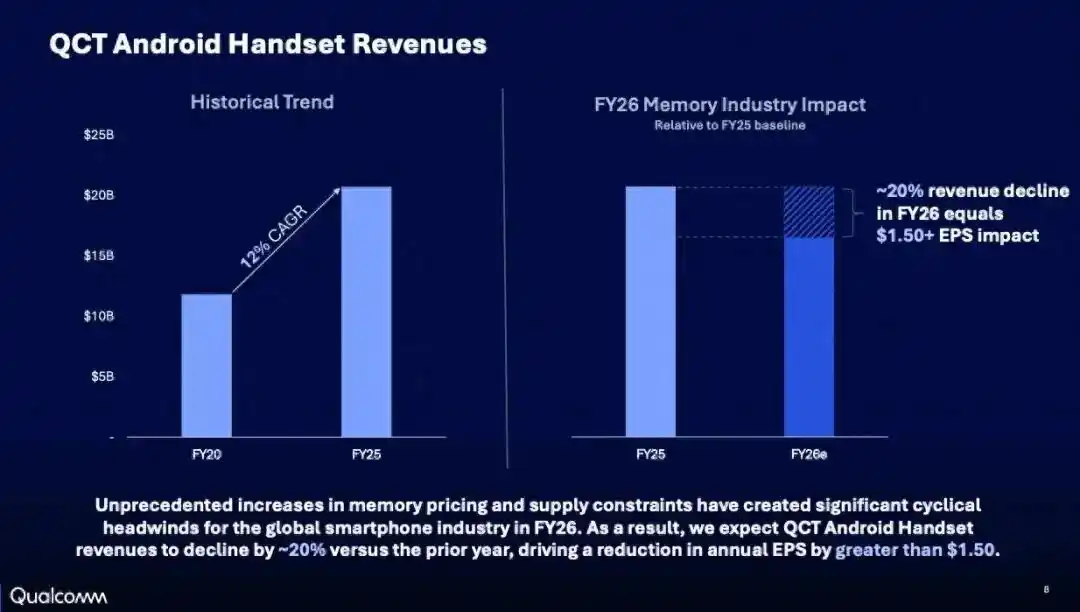
Data shows that Qualcomm's Q3 FY2026 revenue was $9.947 billion, a year-over-year increase of 4%, but net profit plummeted by 25% YoY. Revenue from the mobile handset business plunged by 20% YoY, hitting the lowest record since 2021. The main reason cited is industry-wide price increases triggered by the AI boom.

As demand for AI computing power surges, memory manufacturers like Samsung and SK Hynix have significantly increased production capacity for HBM memory, leading to an imbalance in the supply and demand for general-purpose memory chips.

According to data from TrendForce, general-purpose DRAM contract prices increased by 93%-98% quarter-over-quarter in Q1 2026, while NAND Flash contract prices rose by 55%-60% QoQ. The share of memory costs in mobile phone material costs has skyrocketed from 10%-15% to over 30%. At the same time, the wafer cost for TSMC's 2nm advanced process has exceeded $30,000, coupled with a price increase of over 20% for advanced packaging, pushing chip costs to a historical high.

The cost pressures on chip giants have ultimately been passed down to downstream smartphone manufacturers, trapping the industry in a vicious cycle.

Previously, continuous price increases for memory chips had already squeezed the profit margins of terminal manufacturers. To control costs, brands like Xiaomi, OPPO, and vivo have significantly reduced orders for mid-range and low-end models in 2026, with cuts up to 20%. Some manufacturers are also compressing costs by simplifying hardware configurations and even resorting to using older-generation chips.

Reportedly, the Snapdragon 8 Gen 5 Ultimate Edition (SD 8E5) released last September has "been forced" to become a long-lasting workhorse chip. Qualcomm is set to release a downclocked version specifically for sub-brand iterative new models in the second half of this year, offering performance not inferior to the standard SD 8E5 but at a price significantly lower than the concurrently released SD 8E6.

Under heavy cost pressure, the Android smartphone market continues to be sluggish. IDC data shows that domestic smartphone shipments in Q2 2026 fell by 4.3% year-over-year, marking five consecutive quarters of decline. The market shares of major Android brands like OPPO, vivo, Xiaomi, and Honor have all dropped significantly. In contrast, Huawei and Apple, which do not rely on external high-end SoC chips, have seen noticeable growth in market share, leveraging their advantages in self-developed chips and stable pricing.

Compared to smartphone manufacturers, Qualcomm could potentially pass on cost pressures even without raising prices.

Currently, Qualcomm is accelerating its business diversification transformation, focusing on new sectors like automotive, IoT, and data centers. Its automotive business has achieved 23 consecutive quarters of double-digit year-over-year growth, and it recently secured a ten-year chip supply agreement with BMW. However, the scale of these new businesses is still limited and cannot fully offset the gap left by the handset business.

Industry insiders predict that as the rising costs of chips and memory are fully reflected in the second half of the year, price increases for new Android flagship models may exceed market expectations. The decline in domestic smartphone market shipments in 2026 could further widen.

This article is sourced from the WeChat public account "镁客网", author: 镁客网

Trend Kriptolar

İlgili Sorular

QAccording to the article, what is the main reason for Qualcomm's decision to increase the prices of its chips across the board?

AThe main reason for Qualcomm's price increase is to hedge against rising costs across the entire industry supply chain, repair the company's declining gross margin, and restore profitability to historically normal levels.

QWhich specific Qualcomm chip model is mentioned as seeing the highest price increase, and what is the percentage?

AThe new flagship chip, the Snapdragon 8 Elite Gen 6 Pro, is mentioned as having the highest price increase, reaching up to 18%.

QHow did the surge in AI computing power indirectly affect smartphone material costs, specifically regarding memory?

AThe surge in AI computing power led memory manufacturers like Samsung and SK Hynix to significantly increase production of HBM memory. This created an imbalance in supply and demand for general-purpose memory chips, causing DRAM and NAND Flash contract prices to soar. As a result, the proportion of memory costs in smartphone material costs surged from 10-15% to over 30%.

QWhat contrasting trend in market share is highlighted between brands like OPPO, vivo, and Xiaomi compared to Huawei and Apple?

AThe article highlights that mainstream Android brands like OPPO, vivo, Xiaomi, and Honor have all seen significant declines in market share. In contrast, Huawei and Apple, which do not rely on external high-end SoC chips and benefit from their in-house chip advantages and stable pricing, have shown noticeable growth in market share.

QWhat strategy did Qualcomm adopt regarding the Snapdragon 8E5 chip to help smartphone manufacturers cope with cost pressures?

ATo help smartphone manufacturers cope with cost pressures, Qualcomm is planning to release a down-clocked version of the Snapdragon 8E5 chip in the second half of the year. This version will offer performance comparable to the standard Snapdragon 8E5 but at a significantly lower price than the concurrently released Snapdragon 8E6, making it suitable for sub-brand iterative new models.

İlgili Okumalar

Bank of Korea Reveals Results of Tokenized Deposit Testing

The Bank of Korea has announced the results of its pilot test for tokenized deposits. Involving 28 central banks and international financial organizations, the project saw participation from major South Korean banks including KB Kookmin Bank, NH NongHyup Bank, Shinhan Bank, Woori Bank, and Hana Bank. Transactions, from payment orders to final settlement, were completed in real time, averaging just 80 seconds. The test involved 30 transactions across 17 different scenarios—such as corporate and interbank transfers—and was conducted in six currencies, including the Korean won, US dollar, and euro, with a total transaction value reaching approximately $995,000. The central bank reported that the platform operated stably throughout, despite being only partially connected to the existing banking infrastructure. Settlements using tokenized deposits were executed seamlessly, quickly, and transparently. An internal transfer of 20 million won (about $13,890) between NH NongHyup Bank and Shinhan Bank was also successfully processed via the Project Agora platform, which involved connecting to the Bank of Korea's CBDC test platform, Project Hangang. Additionally, KB Kookmin Bank and Japan's MUFG Bank tested cross-border payments using these deposit tokens—digital certificates issued by commercial banks within the pilot, not directly by the central bank. The Bank of Korea plans to continue testing payments with tokenized deposits. This follows last year's pledge by South Korean authorities to tighten regulations for won-based stablecoins, which will require approval from both the central bank and the Financial Services Commission.

cryptonews.ru1 saat önce

Bank of Korea Reveals Results of Tokenized Deposit Testing

cryptonews.ru1 saat önce

İşlemler

Spot

Popüler Makaleler

CHIP Nasıl Satın Alınır

HTX.com’a hoş geldiniz! USD.AI (CHIP) satın alma işlemlerini basit ve kullanışlı bir hâle getirdik. Adım adım açıkladığımız rehberimizi takip ederek kripto yolculuğunuza başlayın. 1. Adım: HTX Hesabınızı OluşturunHTX'te ücretsiz bir hesap açmak için e-posta adresinizi veya telefon numaranızı kullanın. Sorunsuzca kaydolun ve tüm özelliklerin kilidini açın. Hesabımı Aç2. Adım: Kripto Satın Al Bölümüne Gidin ve Ödeme Yönteminizi SeçinKredi/Banka Kartı: Visa veya Mastercard'ınızı kullanarak anında USD.AI (CHIP) satın alın.Bakiye: Sorunsuz bir şekilde işlem yapmak için HTX hesap bakiyenizdeki fonları kullanın.Üçüncü Taraflar: Kullanımı kolaylaştırmak için Google Pay ve Apple Pay gibi popüler ödeme yöntemlerini ekledik.P2P: HTX'teki diğer kullanıcılarla doğrudan işlem yapın.Borsa Dışı (OTC): Yatırımcılar için kişiye özel hizmetler ve rekabetçi döviz kurları sunuyoruz.3. Adım: USD.AI (CHIP) Varlıklarınızı SaklayınUSD.AI (CHIP) satın aldıktan sonra HTX hesabınızda saklayın. Alternatif olarak, blok zinciri transferi yoluyla başka bir yere gönderebilir veya diğer kripto para birimlerini takas etmek için kullanabilirsiniz.4. Adım: USD.AI (CHIP) Varlıklarınızla İşlem YapınHTX'in spot piyasasında USD.AI (CHIP) ile kolayca işlemler yapın.Hesabınıza erişin, işlem çiftinizi seçin, işlemlerinizi gerçekleştirin ve gerçek zamanlı olarak izleyin. Hem yeni başlayanlar hem de deneyimli yatırımcılar için kullanıcı dostu bir deneyim sunuyoruz.

460 Toplam GörüntülenmeYayınlanma 2026.04.21Güncellenme 2026.06.02

CHIP Nasıl Satın Alınır

Tartışmalar

HTX Topluluğuna hoş geldiniz. Burada, en son platform gelişmeleri hakkında bilgi sahibi olabilir ve profesyonel piyasa görüşlerine erişebilirsiniz. Kullanıcıların CHIP (CHIP) fiyatı hakkındaki görüşleri aşağıda sunulmaktadır.

活动图片