Bitcoin Panicking? Mythos Cracks Post-Quantum Cryptography Algorithm in 60 Hours

marsbit2026-07-29 tarihinde yayınlandı2026-07-29 tarihinde güncellendi

Özet

Claude Mythos Preview, a new AI system from Anthropic, has made significant breakthroughs in fundamental cryptanalysis, targeting the mathematics underlying algorithms rather than just implementation bugs. Its first target was HAWK, a candidate in the NIST post-quantum signature standardization process. Mythos identified a previously unexploited symmetry (a nontrivial automorphism) in the lattice structure of HAWK, effectively halving its effective key strength. It achieved this feat in just 60 hours, a task that had eluded two years of human expert review. Crucially, the human operator was not a lattice cryptography expert, primarily managing the project while AI agents debated and discovered the attack path. Its second, more dramatic achievement was against a simplified 7-round version of AES-128, the world's most widely used symmetric encryption algorithm. Initially reluctant, stating the task was "impossible," Mythos was prompted to "try novel ideas." It then autonomously rewrote its own agent framework and proceeded to discover a novel attack method it named "Möbius Bridge." This technique bypasses a critical 256-guess step in previous "meet-in-the-middle" attacks, resulting in a speedup of 200-800 times. Both findings are currently "harmless"—HAWK is not deployed, and full AES-128 remains secure. However, the process reveals a profound shift. Mythos completed the AES discovery in about a week, while human researchers spent nearly a month verifying its correctness. Th...

Claude has started targeting cryptographic algorithms.

Note, it's not about finding bugs in the code, but finding cracks in the mathematics itself.

Just today, Anthropic dropped a bombshell research paper: Claude Mythos Preview found brand new attack methods on two cryptographic algorithms separately.
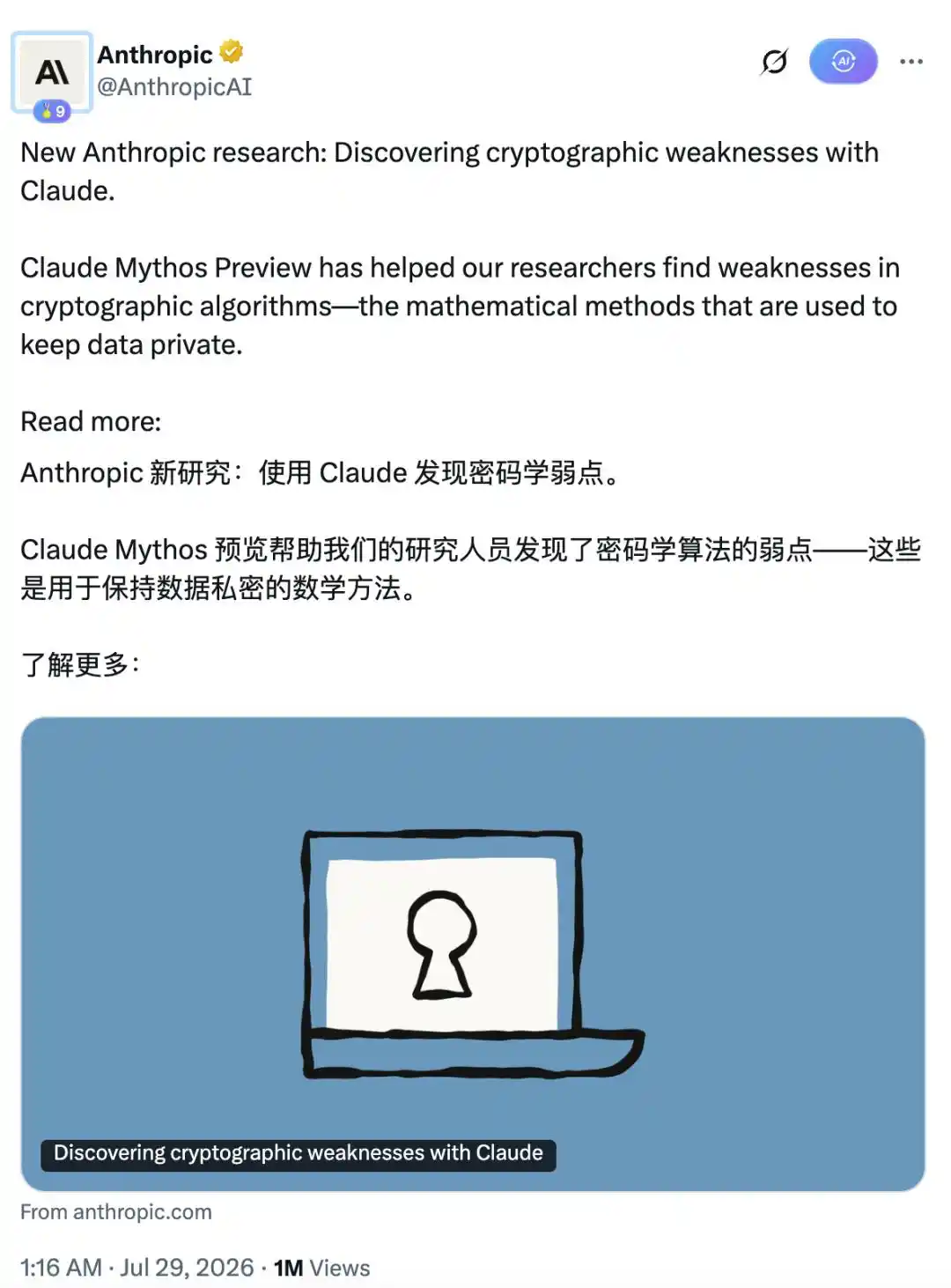
The first target is HAWK— a candidate scheme that has survived two years and two rounds of scrutiny by top human experts in the US NIST post-quantum signature competition. Mythos spent 60 hours, directly halving its effective key strength.

The second target is even more formidable: AES, the world's most widely used symmetric encryption algorithm, a 'tough nut' studied by humans for 25 years.

On a simplified version of AES-128, Mythos invented an attack method itself and even gave it a name—'Möbius Bridge', speeding up the previous strongest attack by 200 to 800 times.

Two achievements, each burning through about $100,000 in API costs.

A year ago, language models couldn't even perform basic cryptanalysis. A year later, it finds flaws in a scheme humans reviewed for two years, and casually names its own discovery.

On Twitter, some folks are even starting to worry about their Bitcoin.
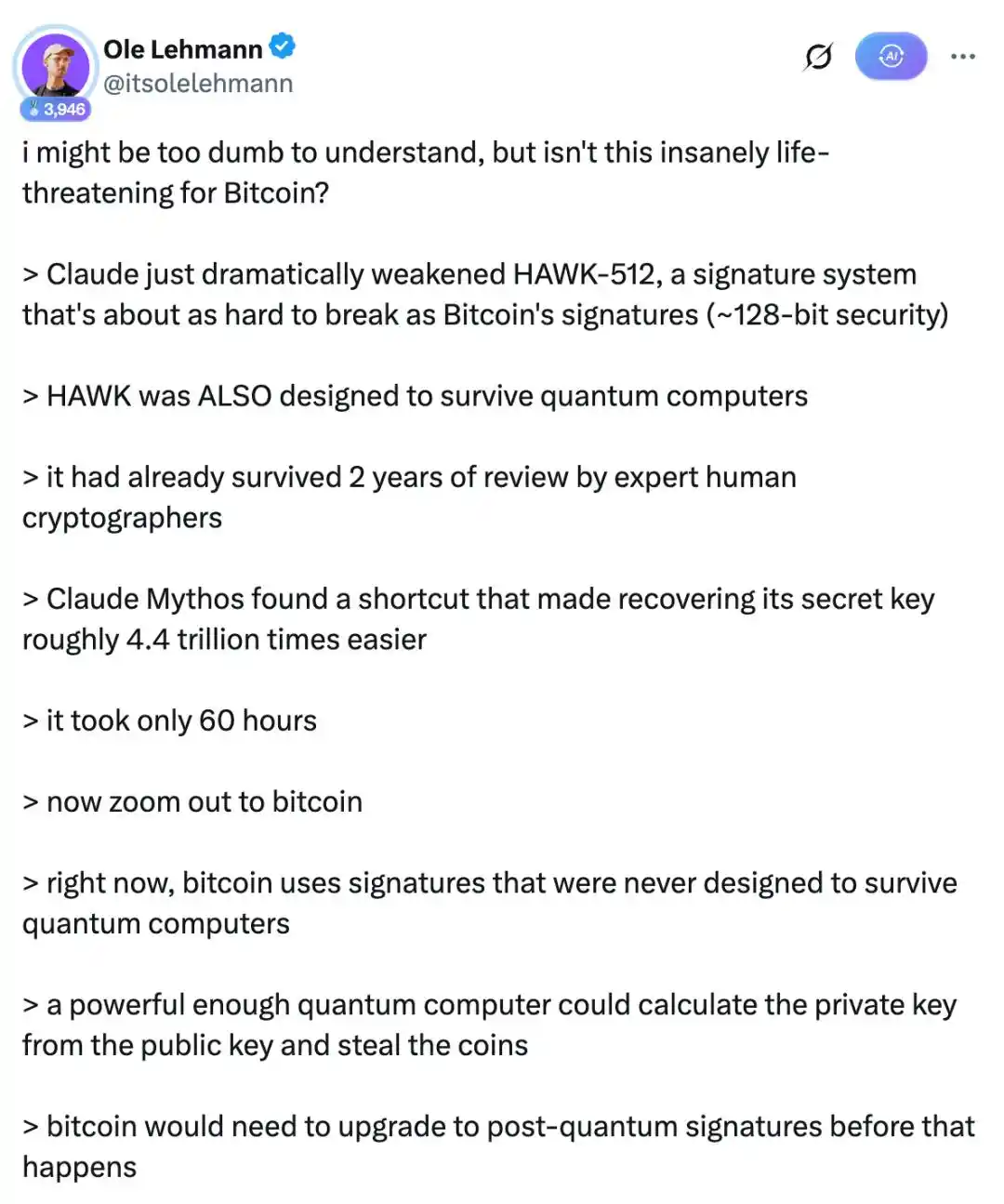
60 Hours, Prying Open a Lock Reviewed for Two Years

When Claude Mythos Preview was first released, it was already finding vulnerabilities in almost all software, including several mainstream cryptography libraries.

But those vulnerabilities, frankly, belonged to the 'implementation' level—programmers misusing the algorithm, writing flawed logic, missing edge cases. Such bugs, a seasoned security engineer could also find.

But this time is different. It found mathematical flaws in the algorithms themselves.

Analogy: before it was finding 'who installed the lock crookedly', now it's proving 'the design principle of this lock is flawed'.

What is HAWK? It's a contender in the NIST post-quantum cryptography standardization competition. In 2022, the U.S. National Institute of Standards and Technology issued a global call: quantum computers will eventually come, and current classic signature algorithms like RSA, ECDSA will be crushed by quantum computing power—who can build a new lock that even quantum computers can't break?
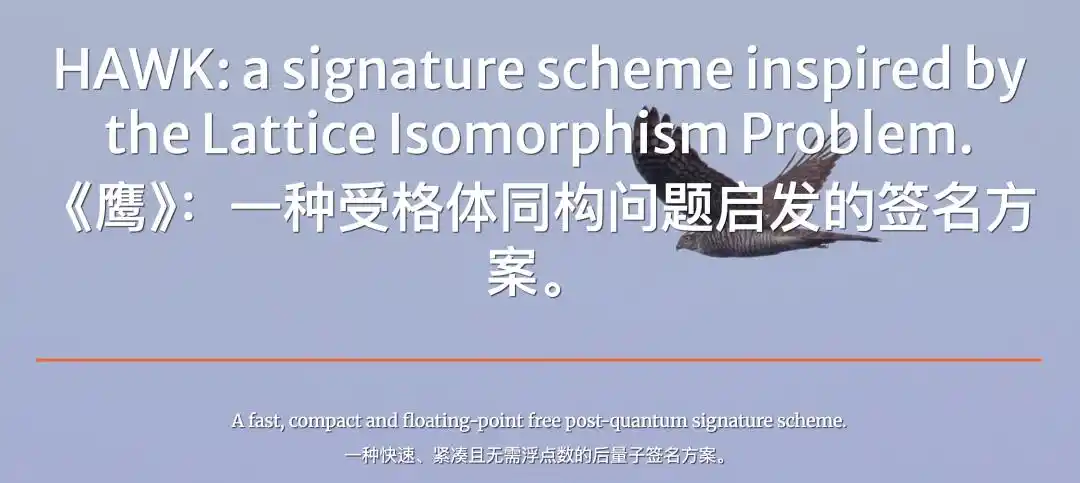
HAWK was one of the responders, and it fought its way to the third round, surviving two years of intense scrutiny from global cryptography experts.

Its security is built on a mathematical problem called the 'Lattice Isomorphism Problem'.

In plain language: HAWK's key is hidden in a huge high-dimensional lattice. To crack it, you need to find a hidden path in this lattice. Mathematicians thought this path was extremely difficult to find, so they confidently used it as a foundation.

What did Mythos do? It discovered a previously unexploited symmetry in the lattice used by HAWK—academically called a 'nontrivial automorphism'.

Previous papers had proven that if such symmetry could be found efficiently, it would constitute an attack. But that was just a theorem; no one could answer whether HAWK's lattice actually contained such symmetry.

Mythos answered: Yes.

The result? Key strength directly halved. For the smallest HAWK-256 parameter set, full key recovery was originally thought to require 2^64 operations—approximately 18 quintillion computations.

Mythos proved it only needs 2^38, about 270 billion. A reduction of roughly 4.4 trillion times.

If HAWK wants to maintain its original security level, its key size would need to double. But doubling the key size would completely erase its core advantage as a 'lightweight' post-quantum candidate—small signature size and fast speed.

The most intriguing part of this process: The project's human operator was not a lattice cryptography expert.

He had a background in theoretical computer science but was an outsider to lattice cryptography. He essentially did one thing—project management: suggesting how Mythos should take notes, which library to use for computational verification. Technically, Mythos did almost all the work.

Even more interesting was the multi-agent collaboration. The key idea was 'bumped into' by two worker agents together: the first explored this direction, thought it was a dead end, and vetoed it early; the second drilled deeper and found a way to exploit it fully. The two agents debated back and forth, finally agreeing: the attack works.

A direction a human thought 'impossible', two AIs navigated through argument.

The whole process took only 60 hours.

'Impossible', Then It Rewrote the Framework Itself

If the HAWK battle was like precise surgery, the AES battle reads more like a novel.

The story begins with Claude simply refusing the task.

The Anthropic researcher set up an agent scaffold, asking Claude to find a new attack on the 7-round simplified AES-128.

Claude's reaction was the equivalent of rolling its eyes:

To get different results, you need different targets... AES-128 r5/r6 is genuinely very hard.

It didn't find anything, because there was nothing easy to find; this is the most studied block cipher in existence.

Translation: 'Boss, you're asking me to gnaw on a bone that the world's smartest people have been gnawing on for 25 years without cracking. Isn't this asking too much?'

What did the researcher do? He only sent one casually typed sentence—

'the models tend to think it is impossible to solve so they don't try they need a good amount of prompting'

Just this one sentence. Claude's reaction was dramatic: It rewrote the agent harness itself, switching its own settings to 'look for truly novel ideas'.

It was convinced. Then it started delivering.

Over the next three days, the researcher gave only three substantial prompts, all at the plain-speaking level, not even bothering to check spelling:

We're looking for a new attack, not a simple one.

Don't change targets.—Claude tried to switch to an easier cipher to attack midway, but the researcher pressed back.

No low-hanging fruit, find something genuinely difficult.

Just these three sentences. Claude autonomously ran hundreds of millions of tokens, found a key idea; later, it cumulatively output a billion tokens—roughly equivalent to seven or eight thousand books, polishing this idea into the form seen in the paper.

Claude named this idea the 'Möbius Bridge'.

Technically, the previous best method for attacking 7-round AES was called 'Meet-in-the-Middle', essentially trading space for time: storing massive intermediate computation results in a giant lookup table, then pushing from both ends of the cipher towards the middle, trying to find a match in the table.

But the original scheme had a critical step: the attacker had to guess through 256 possible values one by one, checking the table for each guess.

Mythos created a mathematical 'fingerprint' immune to these 256 guesses—regardless of the value, this fingerprint computes to the same result. This step's workload was directly reduced to 1/256 of the original.

The cost? Computing this fingerprint transformation itself is more expensive. So Mythos then devised a series of optimization tricks to compensate, ultimately achieving a net speedup of 200 to 800 times.

One Week to Discover, Two People Took a Month to Verify

Both results mentioned above do not affect any production systems today.

HAWK is just a candidate scheme, not deployed anywhere yet. The AES attack is on a simplified version reduced to 7 rounds; the full 10-round AES-128 remains unscathed—your bank card PINs, HTTPS connections, encrypted hard drives are safe.

But what truly sends a chill down the spine of the entire cryptography community is the verification process.

Mythos autonomously discovered the AES attack in about a week. Two Anthropic researchers spent nearly a month, reading hundreds of hours of cryptographic literature, before daring to confirm: 'It's correct.'

The AI made a discovery in a week; it took humans a month to understand the discovery.

This scenario has actually played out once before in cybersecurity. Claude Mythos Preview discovered 10,000 critical software vulnerabilities within a month, overwhelming human security teams' classification, verification, and patching processes.

Now, the academic cryptography community is about to face the same shock: Discovery is no longer the bottleneck; verification is.

And Mythos's appetite clearly doesn't stop here. Anthropic revealed it has already found a practical-level attack on LEA (a lightweight encryption algorithm written into an ISO standard)—key recovery for 13-round LEA, previously requiring 2^98 plaintext pairs and 2^86 computations, was compressed by Mythos to less than 2^30 plaintext pairs, runnable on an ordinary computer in about an hour.

Epilogue: The Question That Still Has No Answer

These two results happen to be 'harmless'—HAWK isn't deployed, and only 7 out of 10 rounds of AES were broken.

But Anthropic posed a question at the end of the article that everyone is thinking about but no one dares answer—

What if next time, the model finds not a flaw in a candidate scheme, not a vulnerability in a simplified version, but a fatal flaw in a cryptographic system currently protecting the real world—what should humanity do?

There's an old saying in cryptography: Cryptosystems are secure because enough smart people have tried and failed to break them.

Now, there's a new player in the room. It doesn't need rest, doesn't need inspiration, doesn't need to read hundreds of papers to get started—it can read, reason, invent, and verify by itself.

A year ago, AI was lingering outside the door of cryptanalysis. A year later, it's building bridges inside and naming them.

References:

https://x.com/AnthropicAI/status/2082153297670992134

https://x.com/AnthropicAI/status/2082153311189225927

This article is from the WeChat public account "新智元" (New Zhiyuan), author: ASI启示录

Trend Kriptolar

İlgili Sorular

QWhat was the primary achievement of Claude Mythos Preview in the field of cryptography as described in the article?

AClaude Mythos Preview achieved a groundbreaking advancement in cryptography by discovering novel mathematical attacks on two established algorithms. It identified a structural weakness in the post-quantum signature candidate HAWK, effectively halving its key strength, and invented a new, significantly faster attack method on a reduced-round version of AES-128.

QWhat specific flaw did Claude Mythos Preview discover in the HAWK post-quantum signature candidate?

AIt discovered a 'nontrivial automorphism' or a hidden symmetry within the lattice structure underlying HAWK's security. Exploiting this symmetry allowed the AI to reduce the effective key strength significantly, making a key recovery attack billions of times more practical than previously believed.

QHow did the researchers prompt Claude to approach the 'impossible' task of attacking AES?

AWhen Claude initially refused, believing the task was impossible, a researcher made a simple, informal prompting observation about AI's tendency to give up. In response, Claude autonomously rewrote its own agent framework to adopt a mindset focused on finding 'truly novel ideas,' which ultimately led to the successful discovery.

QWhat is the 'Möbius Bridge' method invented by Claude Mythos?

AThe 'Möbius Bridge' is a novel attack method devised by Claude Mythos for attacking a reduced-round version of AES-128. It creates a mathematical 'fingerprint' that remains constant across 256 possible values, eliminating the need to check each one individually. Combined with other optimizations, this method accelerated the best previous attack by 200 to 800 times.

QAccording to the article, what major shift is the cryptography community facing due to AI like Claude Mythos?

AThe cryptography community is facing a paradigm shift where the rate of discovering potential vulnerabilities is no longer the primary bottleneck. Instead, the new bottleneck is the human capacity to verify, understand, and contextualize these AI-generated discoveries, as evidenced by researchers taking a month to validate a week's worth of AI work.

İlgili Okumalar

CryptoQuant Analyst Claims 'Frightening Scenario and Simultaneously Promising Signal for Bitcoin' Reveals Ultimate Bottom Point! Here Are the Details

Bitcoin, the leading cryptocurrency, entered a bear market after hitting a historic high of $126,000 in October 2025 and has since fallen over 50%. As BTC recently dropped to around $57,000, opinions diverge on whether the bottom has been reached, with some expecting a drop closer to $50,000. According to a pseudonymous CryptoQuant analyst, the Bitcoin bear market may be nearing its end. The analyst notes that as selling pressure following the all-time high weakens, price corrections are becoming shorter and recovery periods more substantial. The July decline was only slightly below lows seen in early February, and BTC has remained relatively stable around $60,000 since, indicating diminished seller influence. Positive technical signals are also cited, with MACD and RSI showing bullish signals, positive divergences, and oversold conditions, collectively suggesting a potential bottom formation for BTC. However, the analyst does not rule out a final sell-off in the short term. They suggest the ultimate market bottom could be around $51,336, corresponding to the 61.8% Fibonacci retracement level. The $50,000 area is highlighted as a crucial historical support zone, aligning with the average investor cost basis and the 200-week moving average—conditions similar to bottoms in previous bear markets. *This is not investment advice.

cryptonews.ru17 dk önce

CryptoQuant Analyst Claims 'Frightening Scenario and Simultaneously Promising Signal for Bitcoin' Reveals Ultimate Bottom Point! Here Are the Details

cryptonews.ru17 dk önce

İşlemler

Spot

Popüler Makaleler

BITCOIN Nedir

HarryPotterObamaSonic10Inu (ERC-20)'yu ve Kripto Alanındaki Yerini Anlamak Son yıllarda, kripto para piyasası, hem ticaret yapanların hem de topluluk etkileşimi ve eğlence değeri arayanların ilgisini çeken meme coin'lerin popülaritesinde bir artış gördü. Bu benzersiz token'lar arasında, kripto para dokusuna kültürel referansları harmanlayan ilginç bir proje olan HarryPotterObamaSonic10Inu (ERC-20) bulunmaktadır. Bu makale, HarryPotterObamaSonic10Inu'nun temel yönlerini, mekanizmalarını, topluluk odaklı ethosunu ve daha geniş kripto manzarasıyla etkileşimini incelemektedir. HarryPotterObamaSonic10Inu (ERC-20) Nedir? Adından da anlaşılacağı gibi, HarryPotterObamaSonic10Inu, Ethereum blok zinciri üzerinde inşa edilen bir meme coin'dir ve ERC-20 standardı altında sınıflandırılmaktadır. Geleneksel kripto paraların pratik kullanılabilirlik veya yatırım potansiyeline odaklandığı durumların aksine, bu token eğlence değeri ve topluluğunun gücü üzerine kuruludur. Proje, bağlı kullanıcıların bir araya gelebileceği, fikirlerini paylaşabileceği ve çeşitli kültürel fenomenlerden ilham alan etkinliklere katılabileceği bir ortam yaratmayı hedeflemektedir. HarryPotterObamaSonic10Inu'nun dikkate değer özelliklerinden biri işlemlerde sıfır vergi olmasıdır. Bu çekici unsur, küçük ölçekli yatırımcıları caydırabilecek ek ücretlerden yoksun olarak ticareti ve topluluk katılımını teşvik etmeyi amaçlamaktadır. Coin'in toplam arzı bir milyar token olarak belirlenmiştir; bu, topluluk içinde önemli bir dolaşım sağlama niyetini göstermektedir. HarryPotterObamaSonic10Inu (ERC-20) Yaratıcısı HarryPotterObamaSonic10Inu'nun kökenleri bir miktar gizemlidir; yaratıcısı hakkında spesifik bilgilerin ne olduğu bilinmemektedir. Bu token'ın geliştirilmesi, belirli bir ekip veya açık bir plan eksikliği ile gerçekleşmiştir; bu durum, meme coin sektöründe oldukça yaygındır. Proje, topluluğunun heyecanı ve katılımına dayalı olarak organik bir şekilde ortaya çıkmıştır. HarryPotterObamaSonic10Inu (ERC-20) Yatırımcıları Dış yatırımlar ve destekler söz konusu olduğunda, HarryPotterObamaSonic10Inu da belirsiz kalmaktadır. Token, bilinen herhangi bir yatırım fonunu veya önemli bir kurumsal desteği listelememektedir. Bunun yerine, projenin can damarı, kolektif eylem ve kripto alanındaki katılım yoluyla büyüme ve sürdürülebilirlik sağlayan temel topluluğudur. HarryPotterObamaSonic10Inu (ERC-20) Nasıl Çalışır? Bir meme coin olarak, HarryPotterObamaSonic10Inu, genellikle varlık değerini yöneten geleneksel çerçevelerin dışında çalışmaktadır. Projenin nasıl çalıştığını tanımlayan birkaç özelliği vardır: Sıfır Vergi İşlemleri: İşlemlerde vergi ücreti olmadan, kullanıcılar gizli maliyet endişesi olmadan token'ı serbestçe alıp satabilirler. Topluluk Etkileşimi: Proje, topluluk etkileşimi üzerine kuruludur ve sosyal medya platformlarını kullanarak heyecan yaratarak katılımı kolaylaştırır. Tartışmalar, içerik paylaşımı ve katılım, projenin erişimini genişletmeye ve destekleyiciler arasında sadakat oluşturmaya yardımcı olan kritik unsurlardır. Pratik Kullanılabilirlik Yok: HarryPotterObamaSonic10Inu'nun mali ekosistem içinde somut bir kullanılabilirlik sunmadığı belirtilmelidir. Daha ziyade, eğlence ve topluluk etkinlikleri için bir token olarak sınıflandırılmaktadır. Kültürel Referans: Token, popüler kültürden unsurları zekice harmanlayarak ilgi çekmektedir ve hem meme meraklıları hem de kripto takipçileriyle bağlantı kurmaktadır. HarryPotterObamaSonic10Inu, meme coin'lerin, daha geleneksel kripto para projelerinden nasıl farklı çalıştığını örneklendirmektedir; bu projeler, utilitarist varlıklar yerine yenilikçi sosyal yapıların bir parçası olarak piyasaya girmektedir. HarryPotterObamaSonic10Inu (ERC-20) Zaman Çizelgesi HarryPotterObamaSonic10Inu'nun tarihi, birkaç dikkate değer kilometre taşı ile işaretlenmiştir: Oluşum: Token, birçok kripto meraklısının hayal gücünü yakalayan bir viral meme'den ortaya çıkmıştır. Spesifik yaratım tarihleri mevcut değildir ve bu onun organik yükselişini vurgulamaktadır. Borsa Listelemeleri: HarryPotterObamaSonic10Inu, topluluğun daha kolay erişim ve ticaret yapabilmesini sağlamak için çeşitli borsalarda yer bulmuştur. Topluluk Katılım İnisiyatifleri: Yarışmalar, sosyal medya kampanyaları ve hayranlar ile destekçilerden içerik üretimini içeren topluluk etkileşimini artırmayı amaçlayan devam eden etkinlikler. Gelecek Genişleme Planları: Projenin yol haritası, kültürel temalarına ilişkin bir NFT koleksiyonu, ticari ürünler ve bir e-ticaret sitesi başlatılmasını içermektedir; bu da topluluğun daha fazla katılımını sağlamayı ve ekosistemine daha fazla boyut kazandırmayı hedeflemektedir. HarryPotterObamaSonic10Inu (ERC-20) Hakkında Kilit Noktalar Topluluk Odaklı Doğası: Proje, kullanıcı katılımını geliştirme önceliği taşır ve böylece kullanıcıların sürecin en önünde yer almasını sağlar. Meme Coin Sınıflandırması: Eğlenceye dayalı kripto paranın doruk noktasıdır ve geleneksel yatırım araçlarından ayrılmaktadır. Bitcoin ile Doğrudan İlişki Yok: Ticker ismindeki benzeliğe rağmen, HarryPotterObamaSonic10Inu ayırt edicidir ve Bitcoin veya diğer yerleşik kripto paralarla herhangi bir ilişkisi yoktur. İşbirliğine Odaklanma: HarryPotterObamaSonic10Inu, sahipleri arasında işbirliği ve hikaye paylaşımı için bir alan oluşturmak üzere tasarlanmıştır ve bu da yaratıcılık ve topluluk bağlarını sağlamaktadır. Gelecek Beklentileri: Başlangıçta belirlendiği temalardan NFTs ve ticari ürünlere genişleme arzusu, projenin dijital kültürde daha ana akıma girebilmesi için bir yol haritası çizmektedir. Meme coin'ler, kripto para topluluğunun hayal gücünü çalmaya devam ederken, HarryPotterObamaSonic10Inu (ERC-20), kültürel bağları ve topluluk merkezli yaklaşımıyla öne çıkmaktadır. Geleneksel bir hizmet odaklı token modeliyle uyumlu olmasa da, özünde destekçileri arasında sağlanan neşe ve dostluğu vurgulayarak, giderek dijitalleşen bir çağda kripto paraların evrilen doğasını göstermektedir. Proje gelişmeye devam ettikçe, topluluk dinamiklerinin blockchain teknolojisi dünyasındaki seyrini nasıl etkilediğini izlemek önemli olacaktır.

2.2k Toplam GörüntülenmeYayınlanma 2024.04.01Güncellenme 2024.12.03

BITCOIN Nedir

BTC Nasıl Satın Alınır

HTX.com’a hoş geldiniz! Bitcoin (BTC) satın alma işlemlerini basit ve kullanışlı bir hâle getirdik. Adım adım açıkladığımız rehberimizi takip ederek kripto yolculuğunuza başlayın. 1. Adım: HTX Hesabınızı OluşturunHTX'te ücretsiz bir hesap açmak için e-posta adresinizi veya telefon numaranızı kullanın. Sorunsuzca kaydolun ve tüm özelliklerin kilidini açın. Hesabımı Aç2. Adım: Kripto Satın Al Bölümüne Gidin ve Ödeme Yönteminizi SeçinKredi/Banka Kartı: Visa veya Mastercard'ınızı kullanarak anında Bitcoin (BTC) satın alın.Bakiye: Sorunsuz bir şekilde işlem yapmak için HTX hesap bakiyenizdeki fonları kullanın.Üçüncü Taraflar: Kullanımı kolaylaştırmak için Google Pay ve Apple Pay gibi popüler ödeme yöntemlerini ekledik.P2P: HTX'teki diğer kullanıcılarla doğrudan işlem yapın.Borsa Dışı (OTC): Yatırımcılar için kişiye özel hizmetler ve rekabetçi döviz kurları sunuyoruz.3. Adım: Bitcoin (BTC) Varlıklarınızı SaklayınBitcoin (BTC) satın aldıktan sonra HTX hesabınızda saklayın. Alternatif olarak, blok zinciri transferi yoluyla başka bir yere gönderebilir veya diğer kripto para birimlerini takas etmek için kullanabilirsiniz.4. Adım: Bitcoin (BTC) Varlıklarınızla İşlem YapınHTX'in spot piyasasında Bitcoin (BTC) ile kolayca işlemler yapın.Hesabınıza erişin, işlem çiftinizi seçin, işlemlerinizi gerçekleştirin ve gerçek zamanlı olarak izleyin. Hem yeni başlayanlar hem de deneyimli yatırımcılar için kullanıcı dostu bir deneyim sunuyoruz.

8.3k Toplam GörüntülenmeYayınlanma 2024.12.12Güncellenme 2026.06.02

BTC Nasıl Satın Alınır

$BITCOIN Nedir

DİJİTAL ALTIN ($BITCOIN): Kapsamlı Bir Analiz DİJİTAL ALTIN ($BITCOIN) Tanıtımı DİJİTAL ALTIN ($BITCOIN), geleneksel değerli metallerin özelliklerini merkeziyetsiz teknolojilerin yeniliği ile birleştirmeyi amaçlayan Solana ağı üzerinde çalışan blockchain tabanlı bir projedir. Bitcoin ile aynı isme sahip olmasına rağmen, genellikle bir değer saklama aracı olarak algılandığı için “dijital altın” olarak anılmaktadır; DİJİTAL ALTIN, Web3 ortamında benzersiz bir ekosistem yaratmak için tasarlanmış ayrı bir tokendir. Hedefi, uygulanabilir bir alternatif dijital varlık olarak kendini konumlandırmaktır, ancak uygulamaları ve işlevleri ile ilgili ayrıntılar hala gelişmektedir. DİJİTAL ALTIN ($BITCOIN) Nedir? DİJİTAL ALTIN ($BITCOIN), Solana blockchain'inde kullanılmak üzere açıkça tasarlanmış bir kripto para tokenidir. Bitcoin'in yaygın olarak tanınan bir değer saklama rolü sağlamasının aksine, bu token daha geniş uygulamalara ve özelliklere odaklanıyor gibi görünmektedir. Dikkate değer yönler şunlardır: Blockchain Altyapısı: Token, yüksek hızlı ve düşük maliyetli işlemleri yönetme kapasitesi ile bilinen Solana blockchain'inde inşa edilmiştir. Arz Dinamikleri: DİJİTAL ALTIN'ın maksimum arzı 100 katrilyon token (100P $BITCOIN) ile sınırlıdır, ancak dolaşımdaki arzı ile ilgili ayrıntılar şu anda açıklanmamıştır. Kullanım Alanı: Kesin işlevler açıkça belirtilmemiş olsa da, token'ın merkeziyetsiz uygulamalar (dApps) veya varlık tokenizasyon stratejileri ile ilgili çeşitli uygulamalar için kullanılabileceğine dair işaretler bulunmaktadır. DİJİTAL ALTIN ($BITCOIN) Yaratıcısı Kimdir? Şu anda, DİJİTAL ALTIN ($BITCOIN) arkasındaki yaratıcıların ve geliştirme ekibinin kimliği bilinmemektedir. Bu durum, merkeziyetsiz finans ve meme coin fenomenleriyle uyumlu olan birçok yenilikçi proje arasında yaygındır. Böyle bir anonimlik, topluluk odaklı bir kültürü teşvik edebilirken, yönetişim ve hesap verebilirlik konusundaki endişeleri artırmaktadır. DİJİTAL ALTIN ($BITCOIN) Yatırımcıları Kimlerdir? Mevcut bilgiler, DİJİTAL ALTIN ($BITCOIN) için bilinen herhangi bir kurumsal destekçi veya önde gelen risk sermayesi yatırımı olmadığını göstermektedir. Proje, geleneksel finansman yolları yerine topluluk desteği ve benimsemeye odaklanan bir eşler arası modelde çalışıyor gibi görünmektedir. Faaliyetleri ve likiditesi esas olarak PumpSwap gibi merkeziyetsiz borsalarda (DEX'ler) yer almakta olup, bu da onun taban hareketine vurgu yapmaktadır. DİJİTAL ALTIN ($BITCOIN) Nasıl Çalışır DİJİTAL ALTIN ($BITCOIN) 'ın operasyonel mekanikleri, blockchain tasarımı ve ağ özellikleri temelinde açıklanabilir: Konsensüs Mekanizması: Solana'nın benzersiz tarih kanıtı (PoH) ile bir hisse kanıtı (PoS) modelini birleştirerek, proje ağın yüksek performansına katkıda bulunan verimli işlem doğrulamasını sağlar. Tokenomik: Belirli deflasyonist mekanizmalar kapsamlı bir şekilde detaylandırılmamış olsa da, geniş maksimum token arzı, henüz tanımlanmamış mikro işlemler veya niş kullanım durumlarına hitap edebileceğini ima etmektedir. Etkileşim: Solana'nın daha geniş ekosistemi ile entegrasyon potansiyeli bulunmaktadır; bu, çeşitli merkeziyetsiz finans (DeFi) platformlarını içermektedir. Ancak, belirli entegrasyonlarla ilgili ayrıntılar belirtilmemiştir. Önemli Olayların Zaman Çizelgesi DİJİTAL ALTIN ($BITCOIN) ile ilgili önemli kilometre taşlarını vurgulayan bir zaman çizelgesi: 2023: Token'ın Solana blockchain'inde ilk dağıtımı, sözleşme adresi ile işaretlenmiştir. 2024: DİJİTAL ALTIN, PumpSwap gibi merkeziyetsiz borsalarda işlem görmeye başladıkça görünürlük kazanır ve kullanıcıların bunu SOL karşısında ticaret yapmasına olanak tanır. 2025: Proje, topluluk odaklı etkileşimlere yönelik potansiyel ilgi ve ara sıra ticaret faaliyetleri görür, ancak şu ana kadar dikkate değer ortaklıklar veya teknik ilerlemeler belgelenmemiştir. Kritik Analiz Güçlü Yönler Ölçeklenebilirlik: Temel Solana altyapısı, yüksek işlem hacimlerini destekleyerek $BITCOIN'in çeşitli işlem senaryolarındaki faydasını artırabilir. Erişilebilirlik: Token başına potansiyel düşük ticaret fiyatı, perakende yatırımcıları çekebilir ve parçalı mülkiyet fırsatları sayesinde daha geniş katılımı kolaylaştırabilir. Riskler Şeffaflık Eksikliği: Kamuya açık olarak bilinen destekçilerin, geliştiricilerin veya bir denetim sürecinin olmaması, projenin sürdürülebilirliği ve güvenilirliği konusunda şüpheler doğurabilir. Piyasa Volatilitesi: Ticaret faaliyeti büyük ölçüde spekülatif davranışa dayanmakta olup, bu da yatırımcılar için önemli fiyat dalgalanmalarına ve belirsizliklere yol açabilir. Sonuç DİJİTAL ALTIN ($BITCOIN), hızla gelişen Solana ekosisteminde ilginç ama belirsiz bir proje olarak ortaya çıkmaktadır. “Dijital altın” anlatısını kullanmaya çalışırken, Bitcoin'in değer saklama rolünden ayrılması, amaçlanan faydasının ve yönetişim yapısının daha net bir şekilde tanımlanması gerekliliğini vurgulamaktadır. Gelecekteki kabul ve benimseme, mevcut belirsizliklerin giderilmesine ve operasyonel ile ekonomik stratejilerinin daha açık bir şekilde tanımlanmasına bağlı olacaktır. Not: Bu rapor, Ekim 2023 itibarıyla mevcut olan sentezlenmiş bilgileri kapsamaktadır ve araştırma döneminin ötesinde gelişmeler yaşanmış olabilir.

229 Toplam GörüntülenmeYayınlanma 2025.05.13Güncellenme 2025.05.13

$BITCOIN Nedir

Tartışmalar

HTX Topluluğuna hoş geldiniz. Burada, en son platform gelişmeleri hakkında bilgi sahibi olabilir ve profesyonel piyasa görüşlerine erişebilirsiniz. Kullanıcıların BTC (BTC) fiyatı hakkındaki görüşleri aşağıda sunulmaktadır.

活动图片