Court Suspends Effect of Prediction Market Ban in Minnesota Before Its August 1st Start

cryptonews.ru2026-07-28 tarihinde yayınlandı2026-07-28 tarihinde güncellendi

Özet

A Minnesota court has temporarily blocked the state's ban on prediction markets from taking effect on August 1. The ruling, secured by companies Kalshi and Polymarket, allows these fast-growing platforms to continue operating. The case has significant implications for the crypto sector, as these markets are deeply intertwined with digital assets. Polymarket settles trades using blockchain stablecoins, and crypto-related contracts form a substantial portion of trading on both platforms. The legal fight will test how far states can go in regulating markets that increasingly involve digital assets, while regulators debate whether prediction markets fall under derivatives or gambling laws. The prediction market sector has grown dramatically, with monthly trading volumes reaching tens of billions of dollars in 2026. Crypto is a major trading category, accounting for roughly 20% of Polymarket's volume. The Minnesota case could determine whether these platforms develop under federal derivatives oversight or a patchwork of state gambling laws, shaping their future integration with blockchain-based financial infrastructure. While Kalshi, a CFTC-regulated exchange, currently leads in trading volume, Polymarket is reportedly seeking broader U.S. regulatory approval. The preliminary court order is a temporary reprieve; the broader legal question remains unresolved. The outcome will influence not only prediction markets but also how institutional investors view blockchain-based finance...

Companies Kalshi and Polymarket have obtained a preliminary court injunction that prevents the enforcement of a prediction market ban in Minnesota, allowing the two fastest-growing trading services to continue operating amid record sector growth.

This ruling will have broader implications for cryptocurrencies. Polymarket settles margin transactions on-chain using stablecoins. Furthermore, cryptocurrency-related trades constitute a significant portion of the trading operations for both mentioned companies.

Thus, a statewide ban would affect not just two companies but also determine how far states can go in regulating markets that are increasingly intertwined with digital assets, while regulators are still trying to determine whether prediction markets fall under derivatives legislation or gambling laws.

Why the State Court Decision Affects Cryptocurrencies

Prediction markets allow people to trade via contracts linked to future events. The contract value reflects the probability of the prediction coming true, as noted in a Pew Research Center study.

Cryptocurrencies have become one of the largest trading categories in the industry. According to Pew estimates, digital asset-related contracts account for roughly 20% of Polymarket's trading volume and about 7% of Kalshi's, second only to sports and politics.

This clearly shows that the Minnesota lawsuit is important not only for these two companies. Polymarket's development of a high-performance centralized limit order book (CLOB v2) and the launch of a new USDC-backed token called pUSD demonstrate a trend of leading prediction markets evolving into more sophisticated infrastructure for crypto-oriented trading.

As these platforms become faster, more liquid, and better integrated with blockchain-based settlement systems, court rulings in Minnesota are gaining greater significance for the entire digital asset ecosystem. By blocking the enforcement of the Minnesota ruling, the court allows a significant portion of crypto trading in the state to continue.

A Sector That Has Outgrown Its Niche

The industry's rapid growth explains why this case has attracted more attention. Artemis data shows that prediction market trading volume fluctuated between $25 and $30 billion monthly in the first five months of 2026, then reached a historic record of $52.8 billion in June.

In July, trading volume from the month's start reached $50.9 billion, indicating high trading activity even after the FIFA World Cup, which was one of the year's largest trading events.

Unlike previous years, which focused on political events and trends, this year's development of prediction markets has been driven by sports events, macroeconomic expectations, central bank activity, and developments in cryptocurrency markets.

According to Galaxy Research data, the all-time cumulative volume of prediction markets has exceeded $150 billion. Analysts at Bernstein, cited by Galaxy, believe that with improved regulation, prediction market volume could reach $1 trillion by 2030.

However, whether this happens depends on a crucial question currently being examined in Minnesota and several other states: market access.

Kalshi Pulls Ahead While Polymarket Considers Bringing Production Back to the US

Competition has also shifted in favor of Kalshi. According to Token Terminal data, over the last five years, the regulated exchange has captured 61.1% of the cumulative notional volume, reaching $159.5 billion against Polymarket's $101.7 billion. In the last 30 days, Kalshi generated $39.5 billion in notional volume compared to Polymarket's $8.7 billion, highlighting the recent surge in the exchange's popularity.

The key difference lies in regulation. Kalshi is a regulated contract market overseen by the Commodity Futures Trading Commission (CFTC), whereas Polymarket's international platform is not under CFTC supervision.

According to Galaxy estimates, Polymarket's U.S. operations generated about $1.3 billion in April, while the international platform generated about $9 billion. Additionally, Polymarket is reportedly seeking broader regulatory approval in the U.S. for its flagship platform.

Thus, the dispute that began in Minnesota has implications beyond the state. If judges persist in favoring federal regulation of prediction exchanges over state-level gambling regulation, prediction markets could become a key area where cryptocurrencies gain widespread acceptance by leveraging existing market regulation rules rather than bespoke crypto laws. However, if states ultimately prevail, the market may face numerous hurdles operating under conflicting rules.

What Traders Should Watch Next

The court's decision is preliminary, and the broader question of whether states are allowed to restrict federally regulated prediction markets remains open. Traders will be interested to see what Minnesota's next move will be, whether other states adopt similar restrictions, and how Polymarket manages to expand its regulatory footprint in the U.S.

The outcome of the case could impact more than just prediction markets. As stablecoins and digital asset contracts become increasingly integrated into these platforms, this case could affect how institutional investors view blockchain-based financial infrastructure. The dispute in Minnesota may ultimately help define what will define the next phase of development for this rapidly expanding market: federal derivatives oversight or state gambling laws.


Trend Kriptolar

İlgili Sorular

QWhat was the immediate impact of the Minnesota court's ruling regarding the ban on prediction markets?

AThe court issued a temporary injunction that prevents the state of Minnesota from enforcing its ban on prediction markets, allowing the companies Kalshi and Polymarket to continue operating in the state beyond the intended enforcement date of August 1st.

QWhy does the legal case in Minnesota have significant implications for the cryptocurrency sector?

AThe case is significant because Polymarket uses blockchain and stablecoins for margin settlements, and cryptocurrency-related contracts make up a substantial portion of trading volume on these platforms. The ruling will influence how far states can go in regulating markets that are increasingly intertwined with digital assets and whether these markets are treated as financial derivatives or gambling under the law.

QAccording to the article, what was the estimated trading volume for prediction markets in June 2026?

AAccording to data from Artemis cited in the article, trading volume on prediction markets reached a historical high of $52.8 billion in June 2026.

QWhat is a key regulatory difference between the companies Kalshi and Polymarket mentioned in the article?

AA key regulatory difference is that Kalshi is a regulated marketplace, supervised by the U.S. Commodity Futures Trading Commission (CFTC), whereas Polymarket's international platform currently operates without CFTC oversight.

QWhat are the two potential regulatory outcomes highlighted by the article for the future of prediction markets?

AThe article highlights two potential regulatory paths: federal oversight under derivatives regulations, which could provide a clear framework and wider legitimacy, or state-level regulation under gambling laws, which could create a fragmented market with conflicting rules and obstacles.

İlgili Okumalar

2026 Mid-Year Report On-Chain RWA: Tokenized Stock Market Cap Doubles in a Year, But 90% of Rights Are Hollow Shells

The 2026 Mid-Year Report on On-Chain RWA highlights a significant growth in tokenized stock market capitalization, which nearly doubled from $951 million in March to $1.89 billion by July. However, the report reveals a fundamental contradiction in this "layer 2.5" ecosystem: products with the strongest legal foundation (like regulated U.S. infrastructure) lack liquidity and distribution, while freely tradable offshored wrapper products often lack substantive ownership rights. The increase is driven largely by a few products (SECZ, FGRS, STRCx) and platforms (Ondo, xStocks, Securitize collectively hold over 85% share). While distributed value across networks like Ethereum, Solana, and BNB Chain has grown, the market remains fragmented. Products referencing the same underlying asset (e.g., Apple stock) are distinct legal liabilities with different intermediaries and jurisdictional rules, offering varying degrees of legal claim. The report cautions that headline numbers are misleading, as they reflect changes in distributed token value—driven by issuance, conversions, and price movements—not pure investor inflows. True "canonical shares" with legal ownership, wide wallet distribution, institutional liquidity, and independent on-chain price discovery do not yet exist at scale. Tokenized treasuries show stronger product-market fit, and ETFs may be easier to scale than single stocks. The core takeaway is a trade-off: legal certainty versus liquidity and composability.

marsbit13 dk önce

2026 Mid-Year Report On-Chain RWA: Tokenized Stock Market Cap Doubles in a Year, But 90% of Rights Are Hollow Shells

marsbit13 dk önce

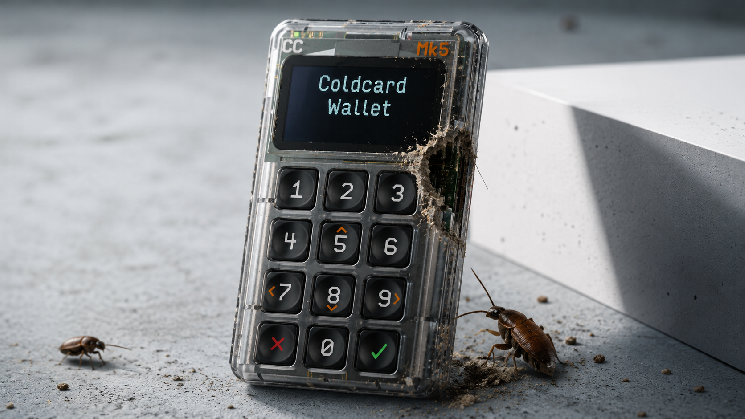
Coldcard Hardware Wallet Hacked: 594 Bitcoin Withdrawn in 25 Minutes

The Coldcard hardware wallet has been compromised, with hackers stealing approximately 594.5 Bitcoin (~$40 million) from 500 addresses in just 25 minutes. The root cause was a critical software bug, undetected for five years, which disabled the device's secure chip for generating true random numbers. This led to the creation of private keys based on predictable data like the processor's serial number, drastically reducing cryptographic security. The attackers exploited this offline by brute-forcing possible seed phrases, finding active addresses on the public ledger, and signing transactions. Initially, Coinkite (Coldcard's maker) claimed only older models were at risk but later admitted all devices running the compromised firmware were vulnerable. CEO Rodolphe Novak (NVK) apologized but ruled out financial compensation for affected users. To secure funds, owners must urgently update their firmware to specific safe versions, generate a completely new seed phrase on the updated device, and transfer all assets to new addresses created with that new seed. While a BIP-39 passphrase can help, it does not replace this migration process. Other Coinkite products like TAPSIGNER were not affected. This incident underscores that even specialized hardware requires rigorous, independent code audits, especially for cryptographic functions. It parallels past failures, like a 2006 OpenSSL bug in Debian, and raises questions about whether automated code analysis can ever fully replace human scrutiny in critical security areas.

cryptonews.ru2 saat önce

Coldcard Hardware Wallet Hacked: 594 Bitcoin Withdrawn in 25 Minutes

cryptonews.ru2 saat önce

İşlemler

Spot

Popüler Makaleler

BAN Nasıl Satın Alınır

HTX.com’a hoş geldiniz! Comedian (BAN) satın alma işlemlerini basit ve kullanışlı bir hâle getirdik. Adım adım açıkladığımız rehberimizi takip ederek kripto yolculuğunuza başlayın. 1. Adım: HTX Hesabınızı OluşturunHTX'te ücretsiz bir hesap açmak için e-posta adresinizi veya telefon numaranızı kullanın. Sorunsuzca kaydolun ve tüm özelliklerin kilidini açın. Hesabımı Aç2. Adım: Kripto Satın Al Bölümüne Gidin ve Ödeme Yönteminizi SeçinKredi/Banka Kartı: Visa veya Mastercard'ınızı kullanarak anında Comedian (BAN) satın alın.Bakiye: Sorunsuz bir şekilde işlem yapmak için HTX hesap bakiyenizdeki fonları kullanın.Üçüncü Taraflar: Kullanımı kolaylaştırmak için Google Pay ve Apple Pay gibi popüler ödeme yöntemlerini ekledik.P2P: HTX'teki diğer kullanıcılarla doğrudan işlem yapın.Borsa Dışı (OTC): Yatırımcılar için kişiye özel hizmetler ve rekabetçi döviz kurları sunuyoruz.3. Adım: Comedian (BAN) Varlıklarınızı SaklayınComedian (BAN) satın aldıktan sonra HTX hesabınızda saklayın. Alternatif olarak, blok zinciri transferi yoluyla başka bir yere gönderebilir veya diğer kripto para birimlerini takas etmek için kullanabilirsiniz.4. Adım: Comedian (BAN) Varlıklarınızla İşlem YapınHTX'in spot piyasasında Comedian (BAN) ile kolayca işlemler yapın.Hesabınıza erişin, işlem çiftinizi seçin, işlemlerinizi gerçekleştirin ve gerçek zamanlı olarak izleyin. Hem yeni başlayanlar hem de deneyimli yatırımcılar için kullanıcı dostu bir deneyim sunuyoruz.

534 Toplam GörüntülenmeYayınlanma 2024.12.11Güncellenme 2026.06.02

BAN Nasıl Satın Alınır

Tartışmalar

HTX Topluluğuna hoş geldiniz. Burada, en son platform gelişmeleri hakkında bilgi sahibi olabilir ve profesyonel piyasa görüşlerine erişebilirsiniz. Kullanıcıların BAN (BAN) fiyatı hakkındaki görüşleri aşağıda sunulmaktadır.

活动图片