Written by: Paul Veradittakit
Compiled by: AididiaoJP, Foresight News
Abstract
Founder-market fit is the most enduring signal in venture capital. Markets, regulations, and products are constantly changing, but the fit between a specific founder and a specific market is the only thing that remains constant.
We have never seen so many founders well-suited to the blockchain space. The truly interesting questions have now converged onto two tracks: AI and FinTech, and the most serious operators are flooding in from Citadel, Stripe, Block, Nvidia, and Goldman Sachs—because that genuinely difficult problem—institutional-grade financial infrastructure—has finally become an interesting problem.
We look for four qualities: deep domain expertise, high agency, an unfair network, and obsession. Every category-defining project we've backed during the bear market, from Offchain Labs to Ondo, possesses all four.
Every founder starts by asking the wrong question. They first ask, "Is this the right market?" The question that truly predicts who will win is: Are you inherently suited to win in the market you've chosen?
Markets change, products change, regulations change. Founder-market fit is the only thing that compounds through it all and the only thing that continues to compound when prices are no longer rising.
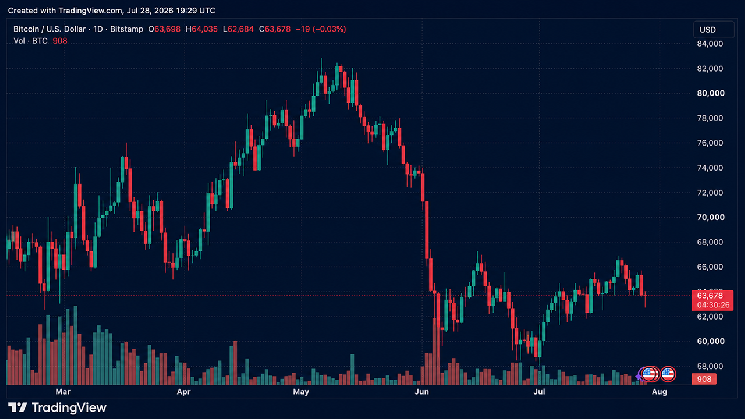
This is easy to say in a bull market, but it must be faced head-on in the current market. Let's first lay out the real context: Bitcoin has fallen about half from its October 2024 high of $126k, market sentiment is fear, and capital and attention have largely shifted to AI—last year, AI absorbed about $211 billion, nearly half of all venture capital, while blockchain attracted only about $20 billion. Artemis data shows that blockchain code commits have dropped about 75% since early 2025, and a group of the industry's most prominent operators have announced pivots to AI. These are the facts, but what they truly mean requires looking deeper.
The developers who left are mostly those who entered during the last bull market; the people writing most of the code now are more experienced contributors. Artemis interprets this as consolidation, not collapse. Talent hasn't disappeared—GitHub added about 36 million developers last year, with overall platform commits growing about 25%, almost all flowing to AI.
The crypto winter is a moment of clarity. It shows you which builders are anchored to a mission and which are only anchored to upside.
So the question has never been whether the market will return, but who will still be standing and who will have become stronger when it does. The answer each cycle boils down to the fit between specific founders and specific markets. This is founder-market fit, the most enduring signal.
We Have Never Seen So Many Founders Suited to the Crypto Market
This is where you should really change your view of the "talent exodus." In past cycles, talent was diluted across hundreds of speculative narratives, with most people just chasing price. Now, the truly interesting questions have converged into two verticals: AI and FinTech, and the founders choosing to solve these problems with blockchain are the most qualified I've seen across four cycles.
The market has matured enough for serious operators to treat it as a career, and the data is global. Specifically:
In 2025, the on-chain settlement value of stablecoins surpassed the combined total of Visa and Mastercard, at approximately $33 trillion, with about 60% of that now being business-to-business activity. This includes real economic activities like corporate treasury, cross-border settlement, and supplier payments, not just speculation.
Nearly 90% of surveyed financial institutions are using or piloting stablecoins; the scale of US Treasury bonds held by stablecoin issuers already exceeds that of Germany or Saudi Arabia; Goldman Sachs, JPMorgan, and BNY Mellon have all launched tokenization products.
Tokenized real-world assets on public chains have surpassed $30 billion, growing over 400% since early 2025. Tracks are being laid globally in sync: The GENIUS Act provides a federal framework for US stablecoins, Europe's MiCA creates a license usable across the entire EU, and Hong Kong, Singapore, and the UAE have all adopted proactive political and regulatory stances.
BCG predicts tokenized asset scale will reach $16 trillion by 2030. When the serious version of a problem arrives, serious founders follow.
The clearest evidence is who is showing up. The truly difficult problem in blockchain now is institutional-grade financial infrastructure, which is exactly the problem the best operators in traditional finance have spent their careers solving. Nathan Allman left Goldman Sachs' digital asset team to found Ondo, now managing a product matrix worth about $2.6 billion, bringing Treasuries and other assets on-chain. Ed Felten went from Princeton professor and White House roles to co-founding Offchain Labs and building Arbitrum. Even within our own firm, my partner Franklin Bi came from JPMorgan's Onyx blockchain team. The founders walking into our meeting rooms now are leaving Goldman Sachs, Citadel, Stripe, and Block—they're not here to chase narratives, but because that genuinely difficult problem has finally become an interesting one.
The Four Dimensions We Underwrite
When meeting founders in this market, I look for four things.
Deep Domain Expertise. You have lived in the market, not just read the map. In a bear market, buyers only schedule truly important meetings, and technical depth consistently trumps a slick pitch. Ed Felten spent a lifetime on the hardest problems in systems and security before co-founding Offchain Labs and building Arbitrum. We led the seed round precisely because this depth allowed the team to see the scaling problem clearly while the market was still arguing.
High Agency. Clearly articulating your thesis on where the market is going to mature, skeptical people until they want to build on top of you. Paul Frambot founded Morpho in Paris in his twenties based on a contrarian thesis: DeFi will win as infrastructure, not just another app—a layer brands and institutions embed, rather than building themselves. That's why Coinbase's crypto-backed loans run on Morpho, Robinhood's on-chain yield product is built on it, and Apollo's credit uses the same rails. He didn't win anyone over with marketing; he just saw the shape of the market earlier.
An Unfair Network. The right relationships let you move faster than anyone else; one warm introduction beats any cold start. Jeremy Allaire launched USDC in September 2018, at the bottom of the last bear market, with Coinbase bound as a partner from day one, becoming its distribution engine. The market took nearly two years to turn, but Circle kept building, making USDC one of the two major dollar stablecoins that the on-chain economy now relies on for settlement. What an unfair network buys is the space to keep delivering through the winter until the market catches up and the rails are already yours. We have been investors in Circle all along.
Obsession. People leave when things get tough; obsessive people stay across cycles, persisting long before it pays off—the kind of belief that kept Hal Finney, Nick Szabo, and Adam Back working on digital cash for decades without a market or money. The grounded version is Alchemy. Nikil Viswanathan and Joe Lau shut down a viral consumer app to build a blockchain data product, realized the underlying infrastructure was the real prize, and have shaped Alchemy into the industry's default developer platform every cycle since 2017. We backed them because they will never stop. This is the trait not visible on a resume, yet it's the most important.
To the Founders Already on the Field
Conviction is the fuel for winter
In a bull market, price is the product, and momentum does the work for the founder. Capital is cheaper, hiring is easier, and every launch gets attention—whether it deserves it or not. In a bear market, the product is truly the product, those chasing price get washed out, and those left are the truly resilient builders. The bear market strips away all comfortable momentum; the only thing that can still push a founder forward is conviction.
True founder-market fit is, at its core, conviction, and conviction is an observable output. A founder who understands their market that deeply will keep building when the token is down 50% and headlines have all shifted to AI, because they can see the end state the market cannot yet price. This is also the least crowded time. When capital and attention leave, so does the noise: fewer teams chasing the same idea, less competition for engineers, and no one bidding up the price of the market you actually want to own. What winter gives you is something a bull market never will—time to build quietly while no one is watching.
And the capital is actually there, which surprises many. Most blockchain funds raised in the bull market, so the capital committed near the top gets deployed all the way through the winter. The playbook from here is straightforward: use that conviction to hire and retain, pivot towards true product-market fit in your domain, and raise the next round as the market accelerates into the next cycle. The only thing worth adjusting is runway—try to raise close to three years, not the usual 18-24 months, because winters last longer than anyone expects, and those who plan ahead are the ones still standing when the turn comes. This works in our favor too. Valuations down, ownership up—it's the best time to enter.
If you're still inside Goldman Sachs, Citadel, or Stripe
This section is written specifically for you. The truly difficult problem in digital assets is no longer clever consumer apps. It's institutional-grade financial infrastructure: settlement, credit, custody, compliance—the unglamorous underlying machinery you already work on every day. For years, this skillset was mismatched with digital assets. Now, it is the entire game.
This is a notable shift. You don't need to have been here for years, and you don't need to time the bottom. You need to understand a market that traditional finance understands better than crypto natives, and start while the space is quiet enough to build. Winter is not a risk; it's a proving ground; the tourists are gone, the noise is gone, making it more convenient. Founder-market fit is what compounds when prices are no longer rising, and the fit between an operator like you and this specific problem might be the strongest in the market right now.
To the founders already on the field: Stay grounded and keep building. Founder-market fit is what compounds when prices are no longer rising, and this season is the test of it. Fit, let it stand.
The founders who will define the next cycle aren't waiting for it to arrive. They are being launched in the quiet, by people who understand their market too well to be scared off by token prices. Every truly important category in blockchain has been built this way—built by the people inherently suited to build it, in a winter that sent everyone else home.
So the real question has never been whether the market will return. It's whether, when it does, you will still be standing in the market you are inherently suited to win. If that's you, we hope to meet you before the rest of the market remembers you exist.