Claude Doesn't Submit Code Directly After Writing It: Runs 4 Skills for Self-Check, Fixes Issues, Then Comes Back to You

marsbit2026-07-27 tarihinde yayınlandı2026-07-27 tarihinde güncellendi

Özet

Claude No Longer Submits Code Directly: 4 Self-Check Skills to Run Before Coming Back to You AI already writes code, but the burden of reviewing it still falls on you. To address this, Anthropic has built a "verification loop" into Claude Code. After writing code, Claude now runs four self-check skills before delivering the work: * `/code-review`: Finds potential bugs and provides review feedback. * `/simplify`: Cleans up the diff, removing redundant or over-complex implementations to reduce future maintenance costs. * `/verify`: Performs end-to-end validation, actually running the application to confirm the feature works, not just appears to. * `/design`: Used only for UI changes; cross-references the implementation against the project's DESIGN.md file. This loop extends the AI agent's workflow from "gather context → execute" to "gather context → execute → auto-verify → fix → re-verify." It tackles the new bottleneck in AI-assisted development: the speed of verifying code now outpaces human review. These skills are built on Claude Code's existing verification foundation (like running apps and using linters). Teams can create their own custom verification skills by documenting their repetitive manual checks in plain language as Markdown files. Verification can be triggered at four levels: manually (Standalone), embedded in a task, chained with other skills, or automatically on every PR (On every PR). The shift signifies that competition in AI programming is movin...

AI has taken over the task of writing code. But the job of acceptance still falls on you.

Whether a piece of code is written correctly or not is not AI's responsibility; ultimately, you still have to go through it line by line. This hurdle has stumped many people.

Recently, Anthropic has also integrated AI acceptance into the loop.

They made Claude, after writing code, not immediately hand it over. Instead, it runs four checks itself first:

/code-review to root out bugs, /simplify to clean up redundant implementations, /verify to perform end-to-end verification, and if the UI was touched this time, use /design to cross-check against the visual specifications in DESIGN.md.

Only after running through all four does it count as delivered.

On July 22nd, the Claude Code team publicly shared this internal "verification loop."
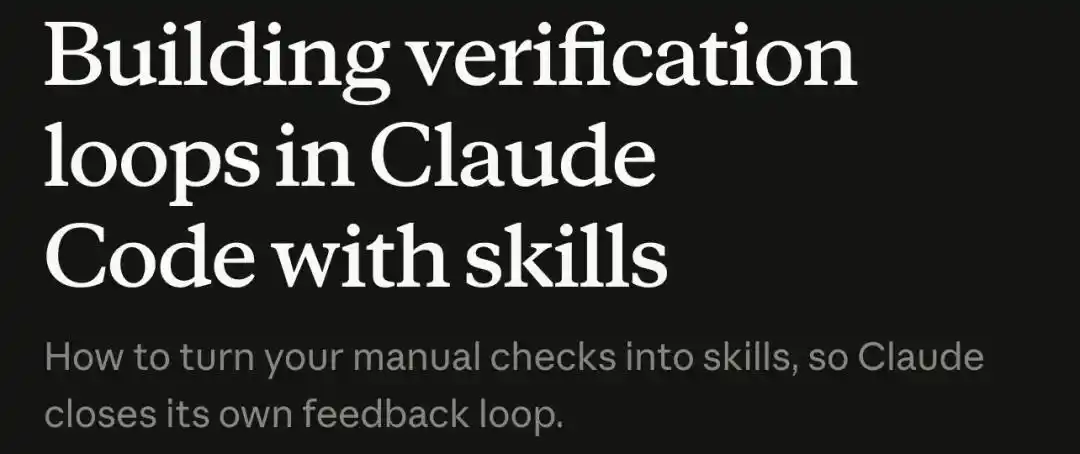
In other words, after Claude writes code, it first finds and fixes errors on its own before coming back to you.

This signifies AI evolving from "being able to write code" to "being able to check the code it wrote."

Agent Work Loop Gains an Extra Verification Step

Anthropic gave this system a name: the verification loop.

The official definition is simple: it's an iterative process where Claude checks and attempts to fix its own work.

What it changes is the agent's work cycle.

Previously, it was "gather context → execute action → manual check." The final step rested on humans: the AI hands over the work, and you have to review it line by line.

Now this line is extended to "gather context → execute action → automatic verification → fix → verify again." Checking and fixing are placed back inside the loop.
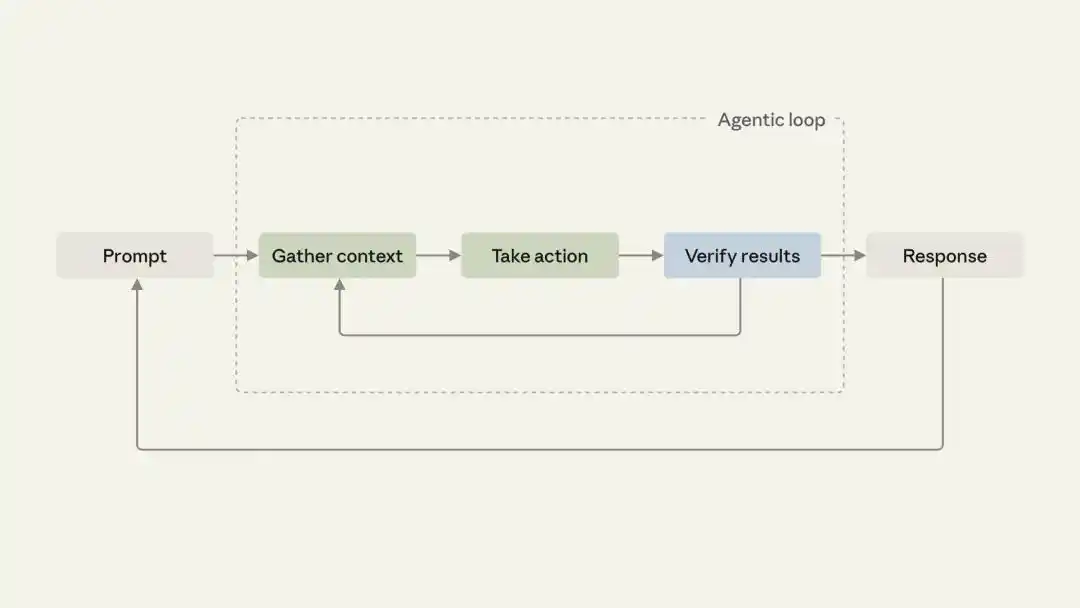
Anthropic's official agent cycle diagram: after a prompt comes in, Claude gathers context, executes actions, verifies results. If verification fails, it loops back; only when it passes does it return.

Some checks Claude already knows how to do. Deterministic signals in the codebase, like type checker, linter, running tests, runtime errors—it can read these and will fix them as it goes.

The real trouble lies with another category: whether the UI changes are correct, whether the user flow is smooth, whether this change has buried unseen pitfalls...

In the past, these could only be caught by humans watching, performing the same checks dozens or hundreds of times.

Anthropic's solution is to write down each of those manual checks you perform every time, package them into Skills, and have Claude execute them automatically for each task.

For decades, all software engineering processes—writing requirements, planning, layer upon layer of reviews, endless meetings—were essentially because: writing code was too slow, and engineers' time was too valuable.

But when AI makes the act of writing code faster and cheaper, this premise disappears.

The Claude Code team's own assessment is: the bottleneck hasn't vanished; it has merely shifted: from "writing code" to verification, code review, security, and other such stages.

Code is generated too quickly. The new problem becomes: are these codes correct, who will maintain them, can people keep up with the pace of reviewing code.

Faced with this new bottleneck, the Claude Code team first experimented on themselves.

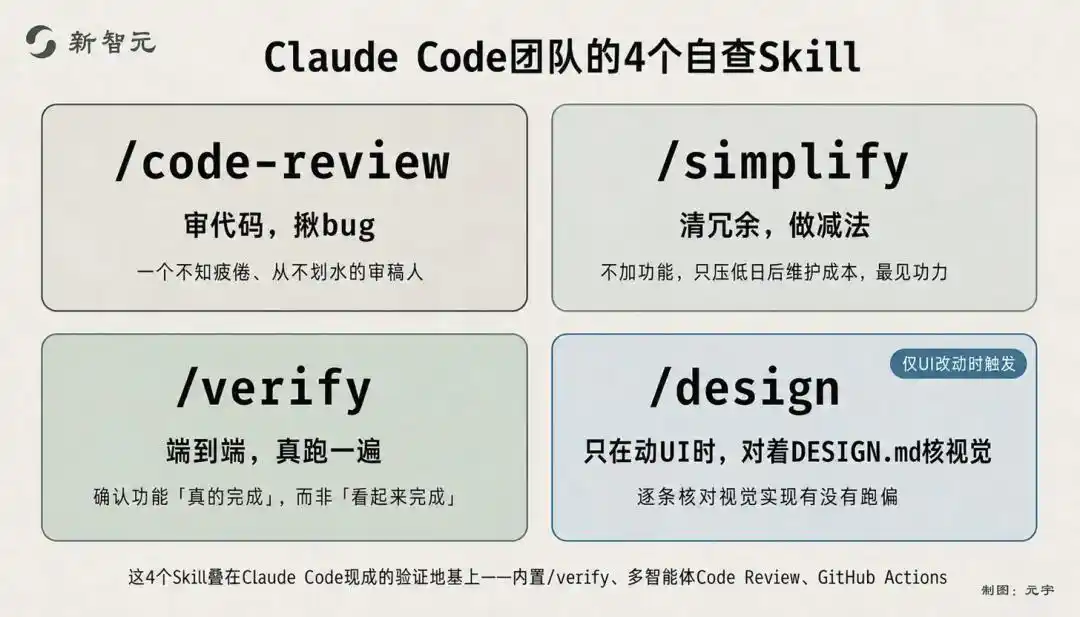
The 4 Self-Check Skills the Claude Code Team Uses Daily

Internally, the Claude Code team uses these four self-check Skills every day.

/code-review, specialized in reviewing code changes, rooting out potential bugs, and providing review comments along the way.

This is like having a tireless reviewer on standby.

/simplify, cleans up the diff for this change, removing convoluted, complex implementations to make the structure simpler.

It doesn't add features for you; instead, it removes redundancy, simplifies implementation, pushing down future maintenance costs.

This point is crucial and requires real skill. Most people write code by adding more; tools that proactively simplify are particularly valuable.

/verify, performs end-to-end verification, actually running things to confirm the feature is truly complete, not just "looks complete."

/design, only comes into play when the UI is touched. It cross-checks against the DESIGN.md in the repository, verifying point by point if your visual implementation has deviated.

These 4 Skills didn't appear out of thin air.

Underlying them, Claude Code has already laid a foundation of existing verification support:

The built-in /verify can run the application to observe changes; you specify the build and test commands in CLAUDE.md, and it follows them. There's also Code Review specifically for multi-agent reviews on PRs, and GitHub Actions that automatically trigger on every commit.

The team's 4 Skills are like adding their own layer of process on top of this general foundation.
How to Write Your Own Verification Skill?

Anthropic's method is also simple:

Write down that manual step you always perform in plain language, as if you were explaining precautions to a new colleague on their first day.

If you're even stuck on how to describe this check step, you can first ask Claude to provide a version of general best practices and then modify it.

Your version will likely differ from the generic approach at a few key points, and those differences are precisely the things most worth documenting.

Checks don't necessarily have to be vague judgments like "feels right or not."

For example: any change that deletes a database field without an accompanying data migration step should be rejected. This is a "local rule" that a generic linter will never catch but is specific to your project.

Any rule you've only been able to enforce by manually watching like a hawk is worth writing into a loop.

What to do after writing it?

Throw it to skill-creator to have it interview you back, or simply drop a Markdown file into .claude/skills/.

The simplest verification Skill is a few lines of instructions plus a body paragraph. Then test it once on a new task to confirm this check step actually runs. If not, fix it.

For Skills you can't modify, like built-in ones or those hosted by plugins, there's a workaround: write a wrapper Skill that first calls the original, then calls your verification. A detour, but it still embeds the check.

Verification Isn't One-Size-Fits-All; It Has 4 Levels

After packaging checks into Skills, the next question is: when should this thing trigger?

Anthropic provides 4 levels of automation, from loose to tight.

Standalone: You remember to manually invoke it.

Embedded: Embedded into a specific task flow, running alongside it.

Chained: Several verification Skills strung into a chain, automatically running one after another.

On every PR: The strictest level, automatically running on every code commit.

The official term for the middle layer transition is "from habit to contract."

What was "I always remember to run /verify after /simplify" as a personal habit becomes "automatically call /verify after /simplify runs" as a fixed contract once chained.

The entire chain completes the development loop on its own, only coming back to you when your approval is needed.

The longer the chain, the higher the reliability, but the official team specifically cautioned: chained verification will genuinely burn through tokens.

So don't immediately set all checks as PR gates that block every commit. The right approach is to first see if it's stable, then gradually add more.

Behind the 4 Skills: AI Programming is Changing Tracks

Behind the 4 Skills, the competition in AI programming is shifting from generation to verification.

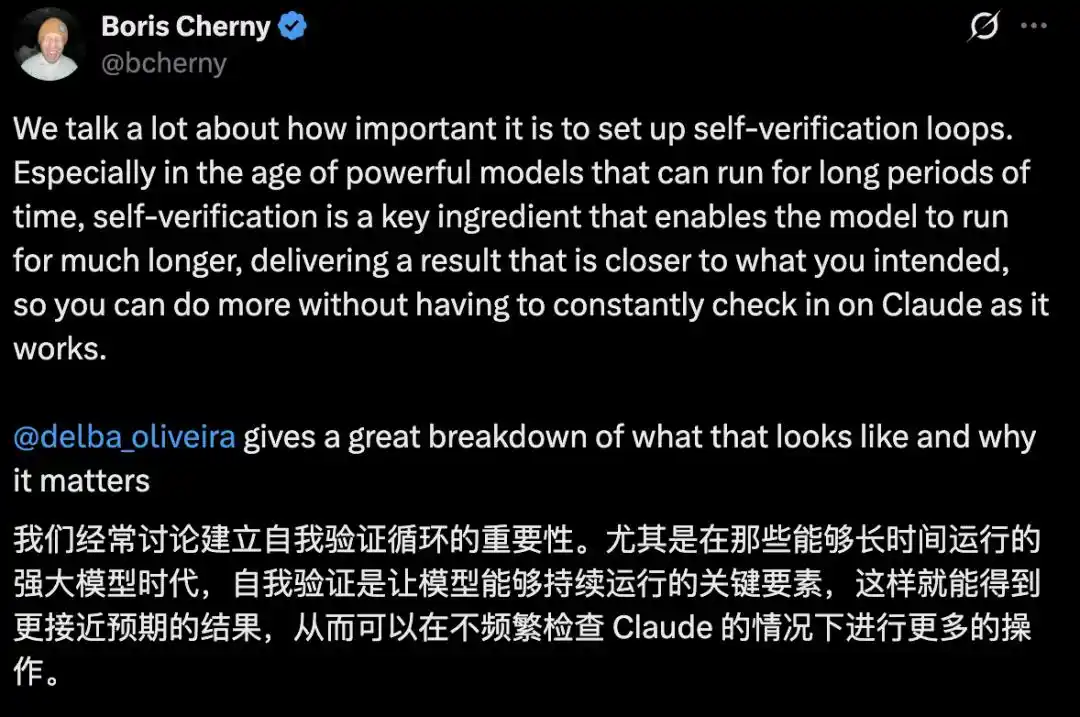
The creator of Claude Code has given the same assessment.

On June 9th of this year, he tweeted: In an era where powerful models can run autonomously for long periods, self-verification is key to letting models run longer and produce results closer to your expectations. You don't have to watch Claude frequently to hand over more work.

Simply put, the more solid the verification, the more confidently an agent can run; the longer it runs, the less hassle for humans.
In the past, we relied on prompts, but they have a ceiling too: they only solve the task at hand; next time you start from scratch.

Let's first correct a common misunderstanding: A Skill is not a piece of Markdown prompt.

It's a capability module containing instructions, file structure, scripts, tool calls, configuration, and an entire workflow. It's about solidifying a team's check steps, design norms, and lessons learned into a package readily available for Claude to reference when needed.

More crucially, Skills are evolving from a feature of Claude Code into an open standard across vendors.

According to industry analysis, GitHub Copilot, Cursor, OpenAI Codex, and Gemini CLI have already adopted the same format.

This means the Skills you solidify for your team won't be locked into one specific tool. They will encapsulate your team's experience, norms, and check processes, turning into reusable capabilities.

This also highlights a stark reality: the same Claude might yield efficiency differences of several times between different teams. This gap isn't due to the model but rather the workflow:

Have you written checks into Skills? Have you set up verification loops? Have you enabled the agent to run its own feedback loop to completion?

Ultimately, an agent's capability is an addition problem: model, plus tools, plus verification mechanisms, plus workflow.

The model aspect is becoming more similar across vendors. What truly creates distance are the latter three items, all of which are in the user's hands.

Of course, what this blog post demonstrates is the process optimization of AI-assisted development, not "AI can already write software independently." It still requires engineers and cannot handle production-grade delivery without humans.

Therefore, it's not about agents coming to take human engineers' jobs, but the direction is already clear.

In the past, we've been teaching AI how to write code. Now we need to start teaching it to verify if what it wrote is correct.

For someone who uses AI to write code every day, the day when "having to manually review everything before leaving work" can finally be entrusted to AI with peace of mind is the day it truly starts carrying the load for you.

References:

https://claude.com/blog/building-verification-loops-in-claude-code-with-skills

https://claude.com/blog/getting-started-with-loops?utm_source=chatgpt.com

This article is from the WeChat public account "New Zhiyuan", author: ASI Revelation

Trend Kriptolar

İlgili Sorular

QWhat is the core innovation described in the article regarding Claude's code generation?

AThe core innovation is the introduction of a 'verification loop' where Claude, after writing code, automatically runs it through four specialized Skill checks (code-review, simplify, verify, design) to find and fix errors before delivering the final code to the user.

QWhat are the four primary verification Skills used by the Claude Code team internally?

AThe four primary Skills are: /code-review (to catch potential bugs and provide review comments), /simplify (to clean up and streamline the implementation), /verify (to perform end-to-end functional verification), and /design (to ensure UI changes align with a project's DESIGN.md file).

QWhat is the key difference between a traditional AI coding workflow and the new 'verification loop' workflow?

AThe traditional workflow is: 'collect context -> execute action -> human review'. The new 'verification loop' workflow extends this to: 'collect context -> execute action -> automatic verification -> repair -> re-verify', embedding the review and repair steps back into an automated loop before returning to the user.

QAccording to the article, what is the main 'bottleneck' that has shifted as AI code generation becomes faster?

AThe main bottleneck has shifted from 'writing code' to the verification, code review, and security aspects. The article states that the new problem is ensuring the rapidly generated code is correct, maintainable, and can be reviewed at the required pace.

QHow does the article describe the nature and importance of 'Skills' compared to simple prompts?

AA Skill is described not as a simple prompt, but as a modular capability package. It contains instructions, file structures, scripts, tool calls, configurations, and workflows. It is a way to encapsulate a team's review steps, design standards, and learned lessons into a reusable asset that Claude can access autonomously.

İlgili Okumalar

UNI Doubles in Two Months Against the Trend: A 5-Year-Overdue Value Realization

Amidst a generally stagnant crypto market in June and July, UNI, the governance token of Uniswap, saw a significant surge, nearly doubling in price from around $2.3 to $4.6. This rally represents a delayed but significant value reassessment, triggered by the practical implementation of its long-debated "fee switch" mechanism. The key turning point was the on-chain execution of the UNIfication proposal in December 2025. It activated a protocol fee on select pools, directed Unichain sequencer revenue (net of costs) to a communal treasury, executed a one-time burn of 100 million UNI, and established a system where all protocol revenue flows into a "TokenJar" contract. This treasury has a single exit: purchasing and permanently burning UNI via a "Firepit" contract. Initially, the market reacted tepidly as the generated revenue and corresponding burn rate were modest. The narrative shifted dramatically in July 2025 with two major developments. First, the launch of Robinhood Chain, tailored for tokenized stocks, rapidly became a primary source of volume and fees for Uniswap, at one point contributing nearly half of its weekly fees. Second, governance votes successfully expanded the fee mechanism to v4 pools and initiated a temperature check for fees on Robinhood Chain. The activation of v4 fees caused the protocol's daily revenue earmarked for UNI burns to nearly triple. The core of UNI's recent price action is the transition from a pure governance token to a cash-flow asset with a permanent, protocol-funded buyer. Its effectiveness is amplified by UNI's mature and widely distributed supply, with no major impending unlocks to dilute the impact of the buybacks. The sustainability of this rally now hinges on whether the transaction volume, particularly on Robinhood Chain, persists after its initial gas subsidies expire, determining if this is a genuine value realization or a subsidy-fueled spike.

marsbit4 dk önce

UNI Doubles in Two Months Against the Trend: A 5-Year-Overdue Value Realization

marsbit4 dk önce

Breaking: Google Earth Urgently Pulls Back Nano Banana 2 Image Generation Feature!

Google Earth's newly launched "Create image" feature, powered by the Nano Banana 2 AI image generation model, was abruptly withdrawn shortly after its release due to being "played" by users. The feature allowed users to generate and overlay AI-created visuals directly onto real-world satellite and 3D maps in Google Earth. The tool enabled creative applications like historical recreations (e.g., visualizing ancient Pompeii), generating informational graphics for landmarks, and envisioning architectural projects or futuristic cityscapes on real terrain. It operated under "geospatial grounding," meaning the AI respected the underlying geography, topography, and perspective of the chosen map view. The model also integrated with Gemini to retrieve relevant factual information. However, upon release, users quickly tested its limits. A prominent example involved reimagining Philadelphia's historic Independence Hall as a post-apocalyptic ruin overrun by "happy" zombies, evil clowns, and giant alien mechs. This highlighted both the feature's playful potential and its risks regarding the generation of inappropriate or misleading content on realistic maps, leading to its swift temporary removal. Google stated it would re-release the feature after implementing "enhanced guardrails." Analysts note this move strategically leverages Google's vast proprietary geospatial data, positioning its AI not just for artistic generation but for spatially accurate world visualization—a unique advantage in the competitive AI image generation landscape.

marsbit1 saat önce

Breaking: Google Earth Urgently Pulls Back Nano Banana 2 Image Generation Feature!

marsbit1 saat önce

Altman Admits: Overestimated AI Snatching Jobs! Huang Renxun: The Unemployment Narrative Is Completely Backwards

Sam Altman has revised his earlier predictions about AI rapidly replacing jobs, admitting he overestimated the speed at which AI would eliminate entry-level white-collar roles. Speaking on the "Invest Like the Best" podcast, he stated that people do not truly want an AI CEO, as accountability and human connection remain critical. He found that individuals prefer interacting with people who can be held responsible for decisions. Similarly, NVIDIA's Jensen Huang argued that the narrative of AI destroying jobs is misguided. He distinguishes between tasks and jobs, noting that while AI can automate specific tasks, entire jobs—encompassing communication, judgment, coordination, and accountability—are not eliminated. He cited examples like radiologists and software engineers, where demand for these roles has increased as AI handles repetitive tasks, allowing for business expansion and the creation of more positions. Data from a University of Maryland and LinkUp study supports this, showing that U.S. job postings for new graduates have actually risen, countering the fear of vanishing entry-level roles. However, a significant shift is occurring: the traditional entry-level tasks that help newcomers gain experience are being automated, making initial career access more challenging. The key insight is that as AI takes over standardized tasks, the enduring value of human work shifts toward areas of responsibility, trust-building, and final decision-making—aspects that AI cannot replicate. The real "moat" for professionals lies in these irreplaceable human elements.

marsbit1 saat önce

Altman Admits: Overestimated AI Snatching Jobs! Huang Renxun: The Unemployment Narrative Is Completely Backwards

marsbit1 saat önce

Weekly Editor's Picks (0725-0731)

Weekly Editor's Picks (0725-0731) provides a curated selection of deep analysis, filtering out market noise. Key themes from this week include: **Macro & Policy:** The Federal Reserve's upcoming meeting is marked by high uncertainty, balancing cooling inflation data against persistent price pressures. Meanwhile, the U.S. crypto regulatory Clarity Act faces critical political hurdles, with its 2026 passage probability seen as low. **Investing & Crypto:** Analysis suggests long-term crypto success depends on conviction through volatile cycles, focusing on assets like Bitcoin and core smart contract platforms. A trend noted is the increasing similarity between global equity markets (especially tech) and crypto, driven by narrative and leverage. Several major crypto protocols show strong revenue growth, but this isn't always translating to token price appreciation due to sell pressure and structural factors. **AI & Semiconductors:** Nvidia's rising credit default swap rates signal market concern over AI infrastructure financing risks. The storage sector experienced volatility as markets began pricing in potential 2027 oversupply. Despite a record profitable quarter, SK Hynix's results were deemed "below expectations," reflecting heightened investor demands for future growth visibility. **Markets & DeFi:** TradeXYZ demonstrated remarkable accuracy in pre-market pricing for a major A股 listing. The token ONDO saw gains, linked to its growing role in the on-chain tokenized stock ecosystem. **Ethereum:** Post-Pectra upgrade, a major structural shift is underway as Lido begins migrating millions of ETH to new validator architectures designed for capital efficiency. **Also Highlighted:** Butian's bullish stock market move; OpenAI's Altman promising major advances; Samsung and SK Hynix securing large AI chip deals; Apple reaching a $5T market cap; and ongoing discussions around exchange security following Poolin's bankruptcy case.

marsbit2 saat önce

Weekly Editor's Picks (0725-0731)

marsbit2 saat önce

İşlemler

Spot

Popüler Makaleler

4 Nasıl Satın Alınır

HTX.com’a hoş geldiniz! 4 (4) satın alma işlemlerini basit ve kullanışlı bir hâle getirdik. Adım adım açıkladığımız rehberimizi takip ederek kripto yolculuğunuza başlayın. 1. Adım: HTX Hesabınızı OluşturunHTX'te ücretsiz bir hesap açmak için e-posta adresinizi veya telefon numaranızı kullanın. Sorunsuzca kaydolun ve tüm özelliklerin kilidini açın. Hesabımı Aç2. Adım: Kripto Satın Al Bölümüne Gidin ve Ödeme Yönteminizi SeçinKredi/Banka Kartı: Visa veya Mastercard'ınızı kullanarak anında 4 (4) satın alın.Bakiye: Sorunsuz bir şekilde işlem yapmak için HTX hesap bakiyenizdeki fonları kullanın.Üçüncü Taraflar: Kullanımı kolaylaştırmak için Google Pay ve Apple Pay gibi popüler ödeme yöntemlerini ekledik.P2P: HTX'teki diğer kullanıcılarla doğrudan işlem yapın.Borsa Dışı (OTC): Yatırımcılar için kişiye özel hizmetler ve rekabetçi döviz kurları sunuyoruz.3. Adım: 4 (4) Varlıklarınızı Saklayın4 (4) satın aldıktan sonra HTX hesabınızda saklayın. Alternatif olarak, blok zinciri transferi yoluyla başka bir yere gönderebilir veya diğer kripto para birimlerini takas etmek için kullanabilirsiniz.4. Adım: 4 (4) Varlıklarınızla İşlem YapınHTX'in spot piyasasında 4 (4) ile kolayca işlemler yapın.Hesabınıza erişin, işlem çiftinizi seçin, işlemlerinizi gerçekleştirin ve gerçek zamanlı olarak izleyin. Hem yeni başlayanlar hem de deneyimli yatırımcılar için kullanıcı dostu bir deneyim sunuyoruz.

486 Toplam GörüntülenmeYayınlanma 2025.10.20Güncellenme 2026.06.02

4 Nasıl Satın Alınır

Tartışmalar

HTX Topluluğuna hoş geldiniz. Burada, en son platform gelişmeleri hakkında bilgi sahibi olabilir ve profesyonel piyasa görüşlerine erişebilirsiniz. Kullanıcıların 4 (4) fiyatı hakkındaki görüşleri aşağıda sunulmaktadır.

活动图片