Unlocking $100 Million in Liquidity? Pump.fun's New Policy Tests the 5-Minute Pump Technique

marsbit2026-07-22 tarihinde yayınlandı2026-07-22 tarihinde güncellendi

Özet

Pump.fun, a popular meme coin launchpad, has introduced a new standard mechanism called BOOST. It aims to address a significant capital efficiency issue: when a newly launched token graduates from its initial bonding curve to a liquidity pool (LP), roughly 20% of its liquidity becomes permanently locked as "dead liquidity," estimated to waste over $100 million annually. Instead of locking these funds permanently, BOOST repurposes them. Upon a token's migration, approximately 20% of the settlement funds (e.g., 17.6 SOL or ~$2516 USDC) are used to buy back the token on the open market over a 5-minute period via a Time-Weighted Average Price (TWAP) mechanism. All purchased tokens are immediately burned. This creates a brief, systematic buy pressure immediately after migration, potentially generating a short-term price surge ("pump") while permanently reducing the token's circulating supply. The goal is to enhance the immediate post-launch trading experience, potentially increasing trader retention and sustainable protocol revenue, which funds ongoing token buybacks. However, concerns exist that this artificial 5-minute boost could lower the barrier for launching low-quality tokens and lead to steeper price crashes once the buy pressure stops, if followed by large sell-offs. The feature automatically applies to tokens migrating after July 21, 2024, but not to previously migrated tokens or those launched via the Mayhem AI Agent lab.

Original author: Ma He, Foresight News

On July 21st, Pump.fun officially announced the launch of the BOOST mode, designating it as the new standard default token launch mechanism. Following the announcement, the price of PUMP continued to fluctuate around $0.002.

According to the official explanation, historical data shows that whenever a token graduates from the bonding curve and migrates to a liquidity pool, approximately 20% of the liquidity becomes "dead liquidity." Even if all holders sell, this portion of funds remains permanently locked in the LP, never to be effectively utilized again. The platform estimates that this mechanism leads to over $100 million in liquidity being permanently lost each year.
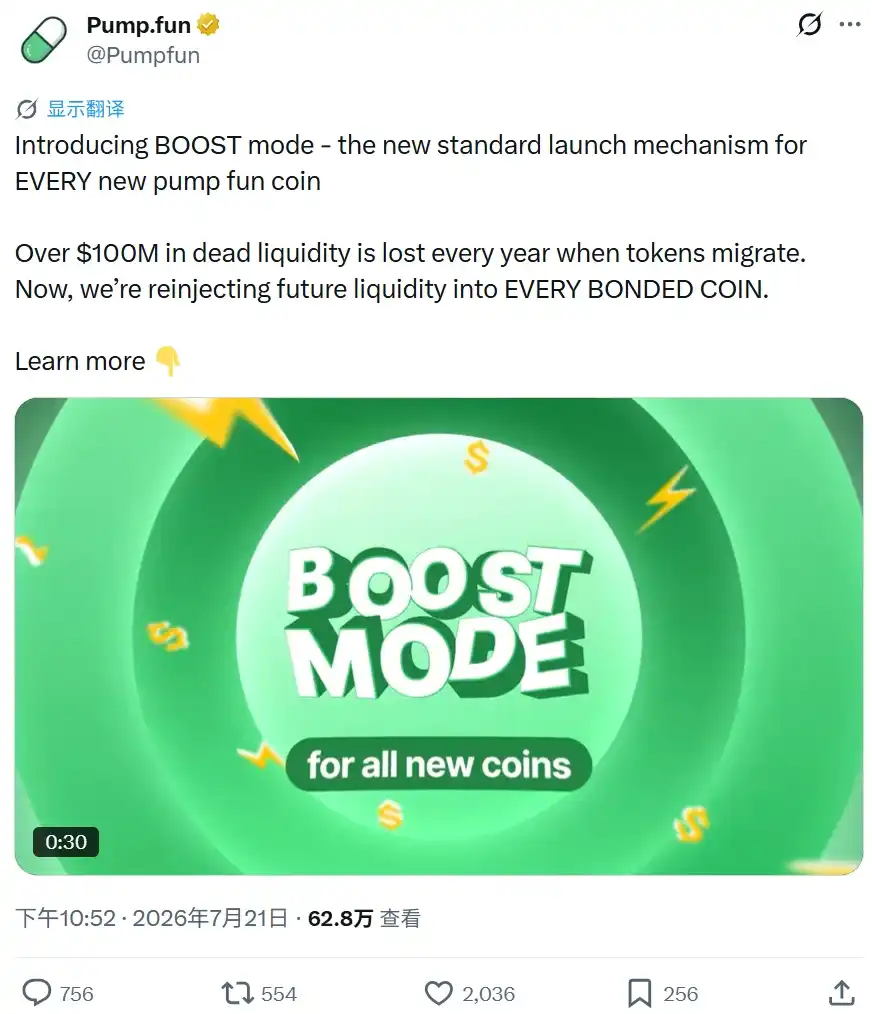
The core action of BOOST mode is straightforward: it takes this portion of funds that would have been wasted and, within the first 5 minutes after token migration, continuously buys the token via TWAP (Time-Weighted Average Price) and immediately burns all purchased tokens. When a token graduates, Pump.fun forcibly withholds roughly 20% of the funds. Calculated based on fixed migration rules, the SOL pair withholds 17.6 SOL, and the USDC pair withholds approximately $2516.

These funds entirely come from the liquidity "sacrificed" during previous migrations, not from new platform subsidies. After the buy order is completed, the corresponding tokens are directly burned, creating short-term buying pressure while permanently reducing the circulating supply.

Using Reserves to Provide 5 Minutes of Buying Pressure for Tokens

Pump.fun's classic process is: users create a token with one click, trade on the bonding curve, and when the token reaches a certain market cap threshold, it automatically migrates to the PumpSwap liquidity pool. Upon migration, the platform locks a portion of the liquidity into the LP at a set ratio to ensure subsequent trading depth.

The issue lies in the high proportion of these locked funds. Even if the token's price later goes to zero and everyone sells, a sum of "dead money" remains in the LP. This money can neither be withdrawn nor reallocated to other active assets, resulting in systemic capital waste. The official estimate is "over $100 million per year."

BOOST mode does not change the trading experience on the bonding curve, nor does it adjust the graduation threshold itself. BOOST mode does not arbitrarily add or release any external liquidity. Its essence is to extract the 20% of settlement funds that were originally destined for the LP and use them to buy and immediately burn tokens on the secondary market via TWAP within 5 minutes.

The official statement clarifies that Pump.fun tokens migrating after 22:23 Beijing Time on July 21st will automatically have the BOOST configuration enabled. Tokens that have already migrated before this time, as well as tokens launched via the Mayhem (AI Agent Lab) mode, do not benefit from this mechanism.

5-Minute Fireworks

As of July 22nd, Pump.fun's current annualized revenue is approximately $342.54 million, with total token buyback value around $411.27 million. However, its token price remains far from its high of $0.008. Relying solely on large-scale buybacks can no longer effectively boost price expectations.
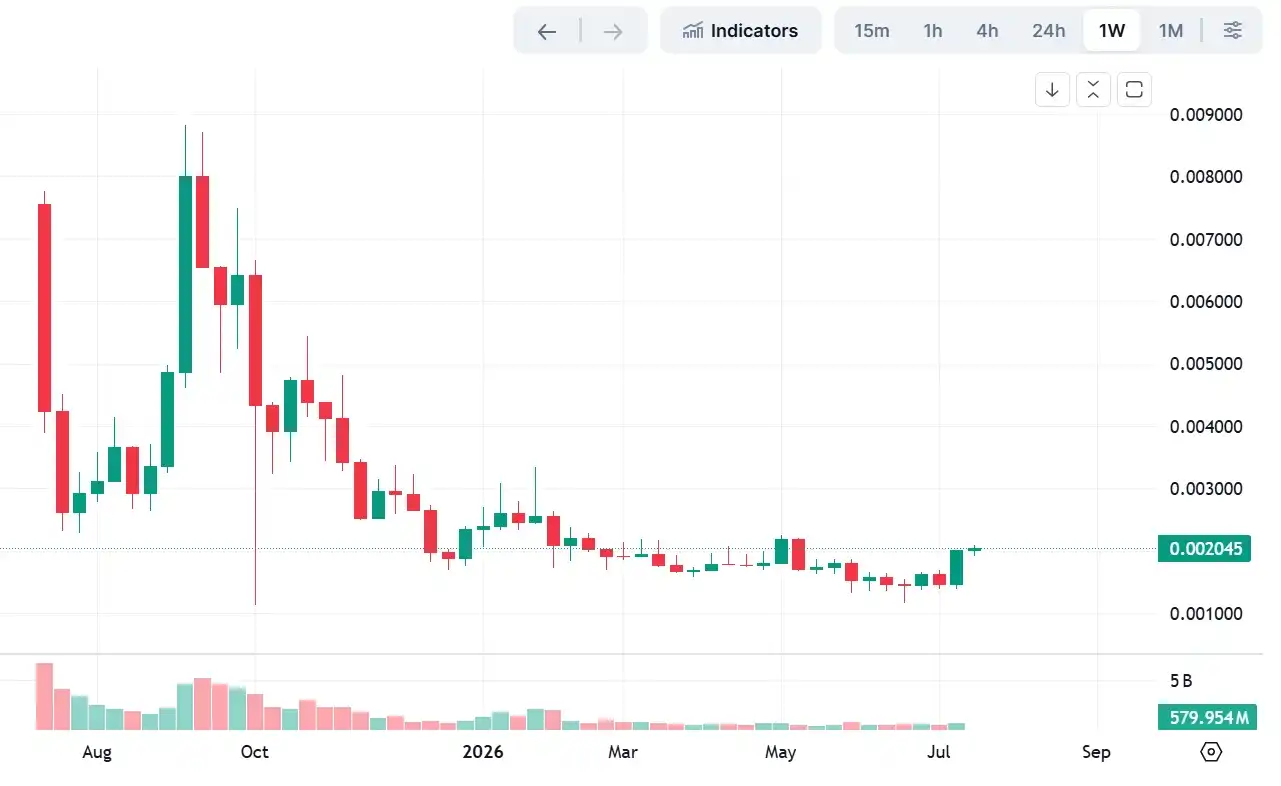
The essence of BOOST is not to add another round of buybacks for PUMP, but to attempt to solve the product issue of the launchpad itself.

The logic behind this might be: if meme tokens, after graduation, could have slightly thicker order books and slightly better short-term performance, trader retention and repurchase willingness would be higher. Most PVP players don't care about whether a Meme coin lives or dies three days later; they care about whether it can "pump" at the moment of graduation. Pump.fun's official team likely sees through this. Rather than defensively locking 20% of funds in the LP pool, it's better to turn that money into "fireworks" for the first 5 minutes.

The platform's real moat is not "large token issuance volume," but rather "a certain proportion of issued tokens can sustain trading volume." Only when the latter is stable can protocol revenue be truly sustainable. Stable or growing revenue provides continuous ammunition for buybacks, rather than making buybacks look like "propping up the price with existing revenue."

Of course, many traders are concerned that the additional buying pressure could lower the actual difficulty of launching a project, potentially making more low-quality tokens appear "successful" and thereby encouraging more aggressive launch behaviors. Others point out that the 5-minute TWAP buying window is still short. Once buying stops after 5 minutes and faces large sell orders, the token price could crash with more exaggerated slippage than before. This essentially trades extremely high post-sell-off risk for the illusion of a pump in the first 5 minutes.


Trend Kriptolar

İlgili Sorular

QWhat is the core mechanism of Pump.fun's new BOOST mode, and what problem is it designed to solve?

AThe core mechanism of the BOOST mode is to take approximately 20% of the liquidity that would normally be permanently locked as 'dead liquidity' when a token graduates from the bonding curve to a liquidity pool. Instead of locking it, this capital is used within the first 5 minutes after migration to buy the token itself via a TWAP (Time-Weighted Average Price) mechanism and then immediately burn all purchased tokens. It is designed to solve the problem of systemic capital waste, where over $100 million annually becomes unusable 'dead' funds locked in LPs even after tokens fail.

QAccording to the article, what is the intended effect of the BOOST mode's 5-minute buy-and-burn operation on new meme tokens?

AThe intended effect is twofold: 1) It creates short-term buying pressure (a 'fireworks' show) in the first 5 minutes after a token's migration, potentially making the token appear to 'pump' at launch. 2) By burning the purchased tokens, it permanently reduces the token's circulating supply. The goal is to improve short-term token performance to boost trader retention and re-engagement on the platform.

QWhat potential risk does the article mention regarding the BOOST mode's 5-minute buy window?

AThe article mentions the risk that once the 5-minute automated buy pressure stops, if the token then faces large sell orders, its price could crash with even more exaggerated slippage than before. This essentially trades the risk of a severe post-pump crash for the short-lived illusion of a price pump in the first 5 minutes.

QWhich tokens are eligible for the new BOOST mechanism, and which are not?

ATokens that graduate (migrate from bonding curve) after 22:23 Beijing Time on July 21st automatically have the BOOST mechanism enabled. Tokens that migrated before this time, as well as tokens launched through the Mayhem (AI Agent Lab) mode, do not receive this mechanism.

QBeyond just boosting PUMP token price, what does the article suggest is Pump.fun's deeper strategic goal with the BOOST update?

AThe deeper strategic goal is to strengthen the platform's core product and sustainable revenue. By making launched meme tokens perform better initially, the platform aims to increase the proportion of tokens that continue to generate trading volume. This sustains and grows protocol revenue, which in turn provides continuous ammunition for PUMP token buybacks, moving away from a model of merely using existing revenue to prop up the price.

İlgili Okumalar

The Verdict in Choi Tae-won's Divorce Case: Revealing the Inheritance Undercurrent Behind SK Hynix's Trillion-Won Empire

SK Group Chairman Chey Tae-won's high-profile divorce case, involving a record 1.38 trillion won settlement, has drawn attention to the succession plans for Korea's second-largest conglomerate, especially its crown jewel, SK hynix. Unlike traditional chaebol scripts centered on the eldest son, Chey's three children from his marriage to former President Roh Tae-woo's daughter, Roh Soh-yeong, are carving distinct, non-traditional paths. Eldest daughter Chey Yun-jung (b. 1989) is seen as the most evident successor. With a scientific and consulting background, she holds executive roles at SK bioscience and SK Inc.'s growth support department, focusing on future strategy and biopharma. Her marriage is to an AI infrastructure entrepreneur, not a traditional business alliance. Second daughter Chey Min-jung (b. 1991) took a unique route, voluntarily serving as a South Korean naval officer, including an anti-piracy deployment. She later worked on policy and strategy for SK hynix in Washington D.C. before co-founding an AI-driven healthcare startup. She married a former U.S. Marine Corps officer, connecting her to U.S. defense and policy circles—networks crucial for a global semiconductor giant. The only son, Chey In-geun (b. 1995), who studied physics like his father, worked briefly at SK E&S before joining McKinsey. Despite fitting the traditional "heir" profile as the eldest son, he remains silent and holds no public position or shares in SK, suggesting the old succession playbook is obsolete. As SK hynix's valuation soars, becoming a geopolitical asset in the AI era, the heirs' legitimacy is no longer automatic. They must prove themselves in fields like AI biotech, global policy, and strategic consulting. Their marriages also reflect new elite networks in tech and defense, not old political alliances. Their inheritance is the complex challenge of navigating a globalized, tech-driven world, not just a corporate throne.

marsbitDün 09:06

The Verdict in Choi Tae-won's Divorce Case: Revealing the Inheritance Undercurrent Behind SK Hynix's Trillion-Won Empire

marsbitDün 09:06

From OpenSea to OpenRouter: Is Alex Atallah Repeating His 'Exit at the Peak' Playbook?

From OpenSea to OpenRouter: Is Alex Atallah Repeating His "Exit at the Peak" Playbook? According to the Wall Street Journal, payments giant Stripe is in talks to acquire the AI model aggregation platform OpenRouter in a potential deal valuing the company near $100 billion. This would mark founder Alex Atallah's second creation of a company reaching a $100 billion valuation, following his co-founding of NFT marketplace OpenSea. OpenRouter, founded just over three years ago, has grown rapidly by acting as a unified gateway for developers to access over 400 AI models. It currently has about 10 million users and processes over 200 trillion tokens monthly. While the platform's annualized revenue is around $50 million, its valuation has skyrocketed from $1.3 billion in March 2026. The potential acquisition by Stripe, a company OpenRouter's founder once likened it to, represents a major expansion into AI infrastructure for the payments leader. This move echoes Atallah's previous timing with OpenSea, where he departed before the NFT market's significant downturn. For OpenRouter, selling now may be strategic. Despite its scale, its business model—charging a 5-5.5% fee on AI inference calls—faces pressure from competition, open-source models, and potential price wars among model providers, limiting its profitability narrative for an IPO. A key asset for potential acquirers like Stripe is OpenRouter's vast repository of real-world AI usage data, which offers unique insights into model performance and developer preferences that are difficult to replicate. Whether this potential deal signifies a new valuation benchmark for AI infrastructure or another market peak signal remains to be seen.

链捕手2 gün önce 08:42

From OpenSea to OpenRouter: Is Alex Atallah Repeating His 'Exit at the Peak' Playbook?

链捕手2 gün önce 08:42

İşlemler

Spot

Popüler Makaleler

PUMP Nasıl Satın Alınır

HTX.com’a hoş geldiniz! Pump.fun (PUMP) satın alma işlemlerini basit ve kullanışlı bir hâle getirdik. Adım adım açıkladığımız rehberimizi takip ederek kripto yolculuğunuza başlayın. 1. Adım: HTX Hesabınızı OluşturunHTX'te ücretsiz bir hesap açmak için e-posta adresinizi veya telefon numaranızı kullanın. Sorunsuzca kaydolun ve tüm özelliklerin kilidini açın. Hesabımı Aç2. Adım: Kripto Satın Al Bölümüne Gidin ve Ödeme Yönteminizi SeçinKredi/Banka Kartı: Visa veya Mastercard'ınızı kullanarak anında Pump.fun (PUMP) satın alın.Bakiye: Sorunsuz bir şekilde işlem yapmak için HTX hesap bakiyenizdeki fonları kullanın.Üçüncü Taraflar: Kullanımı kolaylaştırmak için Google Pay ve Apple Pay gibi popüler ödeme yöntemlerini ekledik.P2P: HTX'teki diğer kullanıcılarla doğrudan işlem yapın.Borsa Dışı (OTC): Yatırımcılar için kişiye özel hizmetler ve rekabetçi döviz kurları sunuyoruz.3. Adım: Pump.fun (PUMP) Varlıklarınızı SaklayınPump.fun (PUMP) satın aldıktan sonra HTX hesabınızda saklayın. Alternatif olarak, blok zinciri transferi yoluyla başka bir yere gönderebilir veya diğer kripto para birimlerini takas etmek için kullanabilirsiniz.4. Adım: Pump.fun (PUMP) Varlıklarınızla İşlem YapınHTX'in spot piyasasında Pump.fun (PUMP) ile kolayca işlemler yapın.Hesabınıza erişin, işlem çiftinizi seçin, işlemlerinizi gerçekleştirin ve gerçek zamanlı olarak izleyin. Hem yeni başlayanlar hem de deneyimli yatırımcılar için kullanıcı dostu bir deneyim sunuyoruz.

395 Toplam GörüntülenmeYayınlanma 2024.12.12Güncellenme 2026.07.09

PUMP Nasıl Satın Alınır

Tartışmalar

HTX Topluluğuna hoş geldiniz. Burada, en son platform gelişmeleri hakkında bilgi sahibi olabilir ve profesyonel piyasa görüşlerine erişebilirsiniz. Kullanıcıların PUMP (PUMP) fiyatı hakkındaki görüşleri aşağıda sunulmaktadır.

活动图片