Crypto market’s weekly winners and losers – DEXE, LIT, BONK, JUP

ambcrypto2026-07-12 tarihinde yayınlandı2026-07-12 tarihinde güncellendi

Özet

This week's crypto market was driven by macro events, with Bitcoin showing resilience above $63,000. The top weekly gainers were primarily protocol-based altcoins. DeXe (DEXE) surged 73%, approaching key resistance, though signs of exhaustion emerged. Arbitrum (ARB) gained 20%, nearing a crucial technical barrier. Lighter (LIT) rose 5%, breaking above a key resistance level. Major speculative assets led the losers. Bonk (BONK) fell 18%, erasing last week's gains and hitting a new low. Audiera (BEAT) dropped 12%, testing a vital support zone. Jupiter (JUP) declined over 10% but maintained its broader uptrend structure. The week highlighted a rotation toward fundamentally stronger projects amid ongoing volatility.

This week, macro events drove the crypto market.

Renewed geopolitical tensions in the Middle East triggered a brief risk-off move, sending Bitcoin [BTC] and altcoins lower before BTC recovered and held above the $63,000 support level, highlighting its resilience.

Against this backdrop, protocol-based altcoins dominated the winners’ list with strong double-digit rallies, while most of the week’s biggest losers came from speculative assets, reflecting a clear rotation toward fundamentally stronger projects.

Weekly winners

How did DeXe [DEXE] reinforce its bullish structure?

DeXe [DEXE] led this week’s gainers with a massive 73% rally, marking its strongest weekly performance on record. The move reflects strong investor demand for decentralized governance protocols despite mixed sentiment across the broader crypto market.

From a technical perspective, DEXE is now approaching the $50 resistance level, putting another breakout within reach. However, the rally is also beginning to flash signs of exhaustion. At press time, the RSI has pushed deep into overbought territory, suggesting buyers may be getting stretched.

At the same time, DEXE has gained 73% in less than four trading days, highlighting an aggressive buying spree that often precedes a period of cooling. With the broader market turning risk-off again as geopolitical tensions weigh on sentiment, short-term profit-taking could increase.
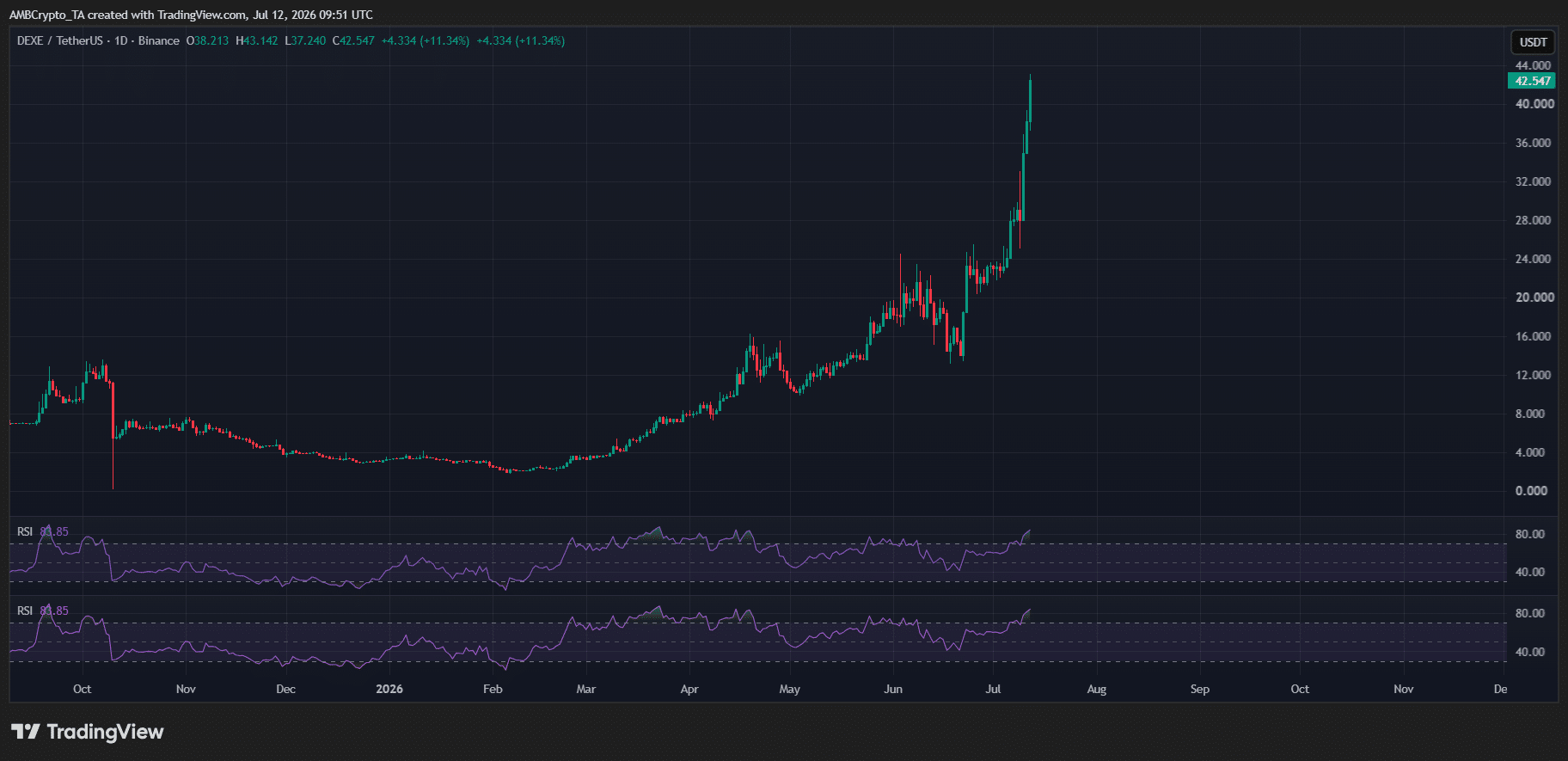
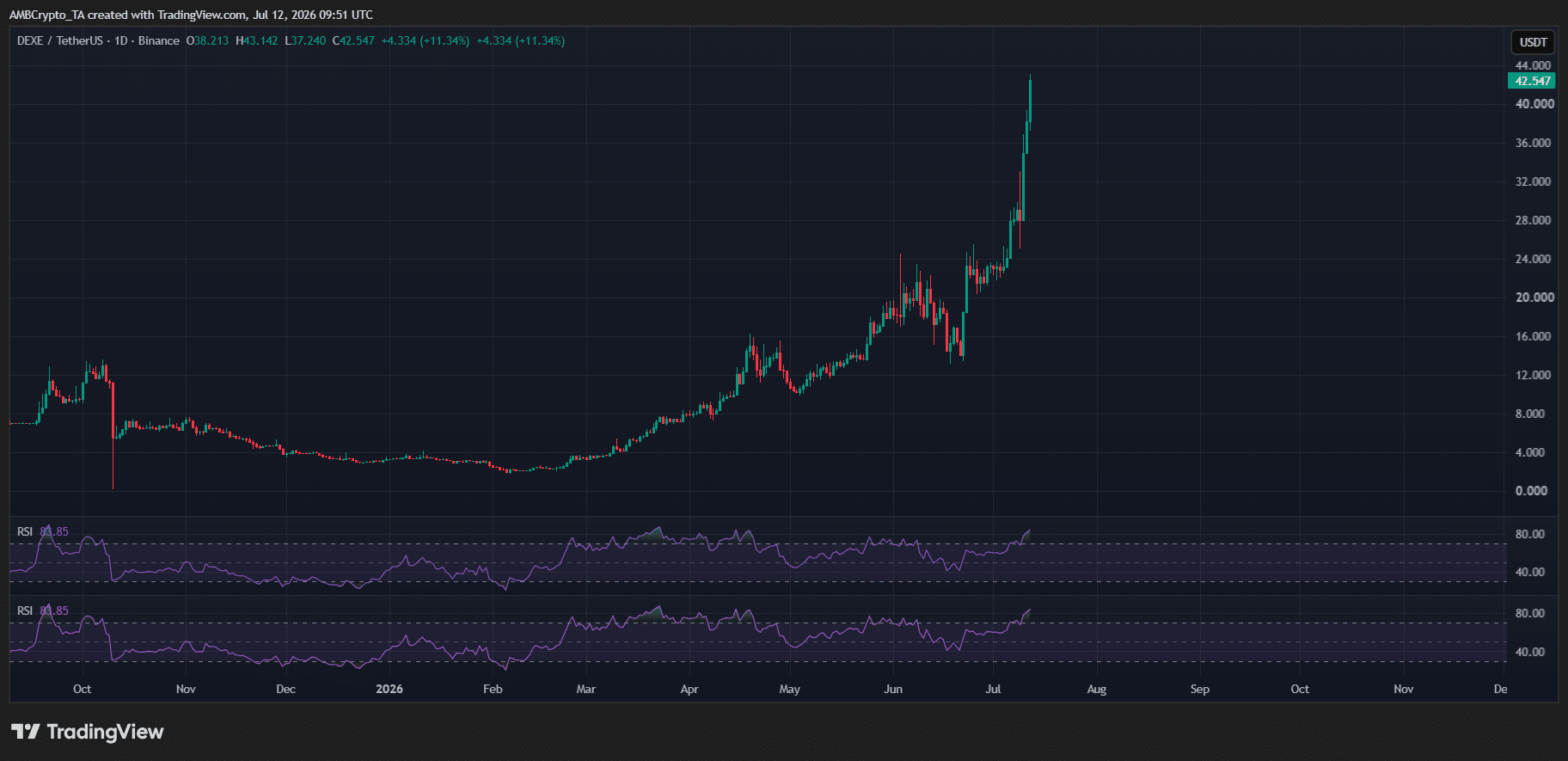
Source: TradingView (DEXE/USDT)

If that happens, $35 is the first key support level to watch. However, if buyers continue to absorb selling pressure, DEXE could still break above $50 and extend its rally.

Overall, DEXE enters the week with strong momentum but elevated risk as technicals become overextended.

Arbitrum [ARB] is approaching a KEY resistance zone

Arbitrum [ARB] was the second-biggest gainer this week, climbing 20% after posting an 8% rally the week before. The back-to-back gains suggest buyers are steadily taking control, with bullish momentum continuing to build. Technically, ARB still doesn’t look overheated.

Despite the strong move, the weekly RSI remains below overbought territory, suggesting there is still room for the rally to extend. The daily chart also continues to print higher highs, showing buyers remain in control. The next key level to watch is the $0.10 resistance zone. ARB hasn’t reclaimed this level since losing it during the late May correction, making it an important technical barrier.

If buying pressure continues at its current pace, a breakout above $0.10 looks increasingly likely. That would open the door for another leg higher, making ARB one of the stronger technical setups to watch this week.

Lighter [LIT] continues to outrun bearish control

Lighter [LIT] secured the third spot among this week’s top gainers with a 5% rally. While the gain was smaller than the week’s biggest winners, it suggests LIT has continued to hold onto its recent strength.

Technically, the more important development is that LIT has broken above the $2.70 resistance level. This comes after the token rallied more than 50% over the past two weeks, showing buyers are still willing to accumulate even after a strong uptrend.

The successful reclaim of resistance also shifts market sentiment in favor of the bulls. If buying pressure continues, the breakout could attract fresh momentum traders, increasing the chances of a move toward $3.

Other notable winners

Outside the majors, altcoin movers also stole the spotlight this week.

TCC [TCC] led the market with a staggering 66,301% gain, followed by Cash Cat [CASHCAT], which surged 3,928%, while Yei Finance [CLO] climbed 76%, rounding out the week’s top performers.

Weekly losers

How did Bonk [BONK] erase its previous week’s gains?

Bonk [BONK] led this week’s losers with an 18% decline, completely wiping out last week’s 18.6% rally. The move is another reminder of the sharp swings that are common across the meme coin sector.

What’s interesting is that the sell-off came despite 110 million BONK being burned this week. That suggests the token burn wasn’t enough to shift sentiment. Technically too, BONK looks weak. The weekly chart has been printing lower lows since the mid-Q3 2025 cycle, showing the broader downtrend remains intact.

Even though the RSI was deep in oversold territory as of writing, buyers have yet to step in with enough conviction to reverse the trend. This week’s decline also pushed BONK to a new all-time low around $0.0000039, reinforcing the bearish structure.
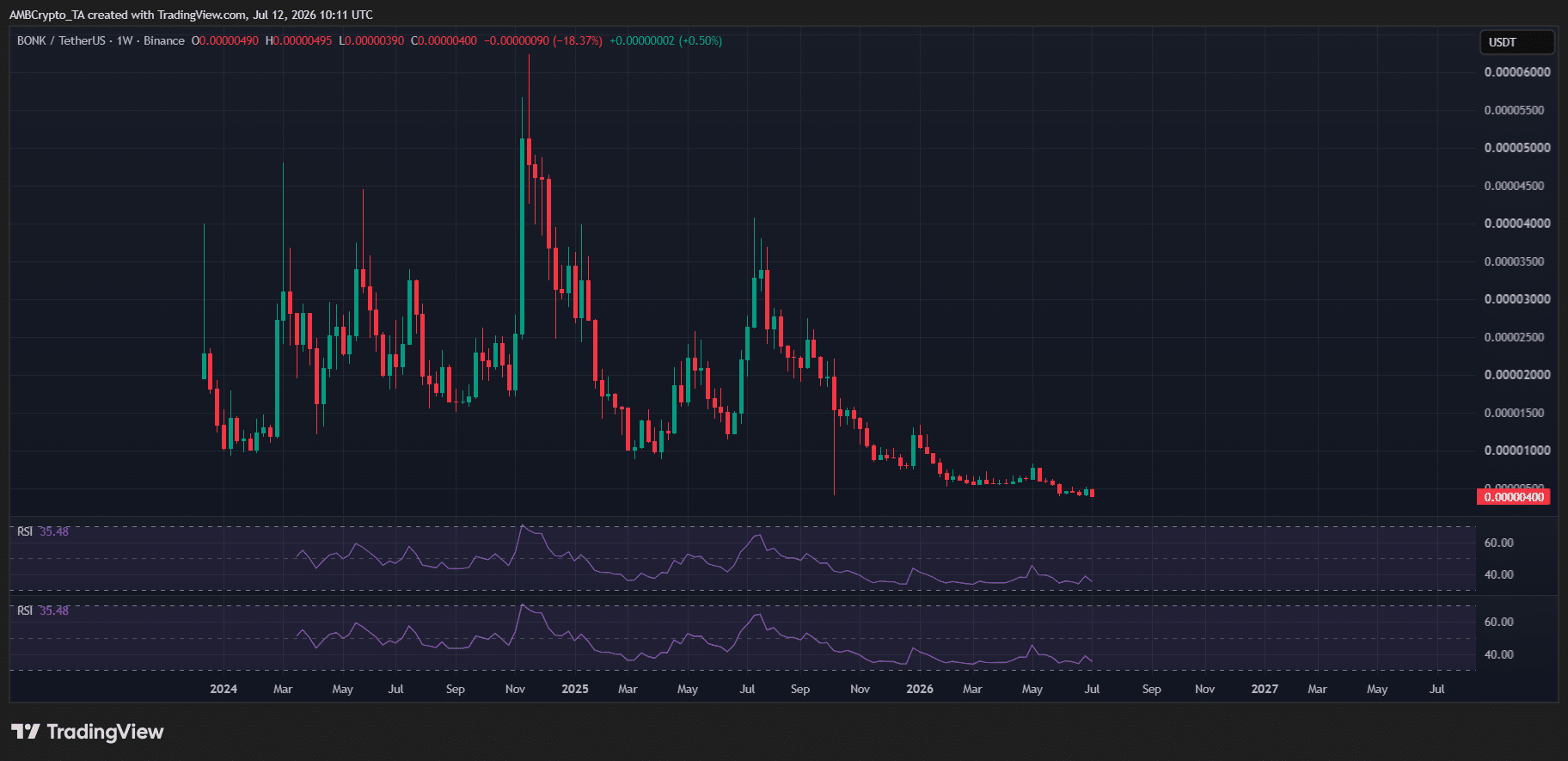
Source: TradingView (BONK/USDT)

Unless market sentiment improves or buyers reclaim key resistance levels, BONK is likely to remain under pressure, making it one of the weaker technical setups heading into next week.

Audiera [BEAT] is testing the strength of a KEY support

Audiera [BEAT] was the second-biggest loser this week, dropping 12% after posting two straight weeks of gains. Despite the pullback, BEAT is still holding above levels it reclaimed during its recent breakout, suggesting bulls haven’t lost control just yet.

Technically, the focus is now on the $2.00–$2.50 support zone. Since mid-May, buyers have consistently stepped in around this area, triggering several weekly rebounds and keeping the broader uptrend intact. That makes this week’s decline look more like a cooldown than a trend reversal.

If bulls defend support once again, BEAT could build enough momentum for another run at the $3.50 resistance. A successful breakout above that level would confirm another higher high and keep BEAT among the stronger bullish setups to watch next week.

Why did Jupiter [JUP] post its weakest weekly rally in over a month?

Jupiter [JUP] was the third-biggest loser this week, falling just over 10%. The pullback came after numerous weeks of gains and pushed the token back below the $0.25 resistance level.

Technically, though, the trend still favors the bulls. JUP continues to hold a pattern of higher highs and higher lows, suggesting the broader uptrend remains intact. The next key level to watch is $0.20, where buyers have consistently stepped in during previous pullbacks.

That puts JUP in a healthy consolidation phase rather than a full trend reversal. If bulls continue to defend support, the current pullback could provide the base for another move higher.

A reclaim of $0.25 would strengthen the bullish structure and increase the chances of another breakout, making JUP one of the key altcoins to watch heading into next week.

Other notable losers

In the broader market, downside volatility hit hard.

LAB [LAB] led the losers with a 96% decline, followed by ETHGas [GWEI], which fell 54%, while BUILDon [B] dropped 47.7% as bearish momentum intensified.

Conclusion

This week was a rollercoaster for crypto. Big pumps, sharp dips, and nonstop action. As always, stay sharp, do your own research, and trade smart.


Final Summary

  • DeXe [DEXE], Arbitrum [ARB], and Lighter [LIT] led the week in gains.
  • Bonk [BONK], Audiera [BEAT], and Jupiter [JUP] saw significant declines.

Trend Kriptolar

İlgili Sorular

QWhat are the main macroeconomic factors mentioned in the article that impacted the crypto market this week?

ARenewed geopolitical tensions in the Middle East triggered a brief risk-off move, which initially sent Bitcoin and altcoins lower before Bitcoin recovered.

QAccording to the article, what was the technical indicator suggesting that DeXe's (DEXE) rally might be due for a cool-down period?

AThe RSI (Relative Strength Index) had pushed deep into overbought territory, suggesting buyers may be getting stretched and that short-term profit-taking could increase.

QWhich token led the week's losers, and what key event failed to shift its negative sentiment?

ABonk (BONK) led the week's losers with an 18% decline. The negative sentiment continued despite 110 million BONK being burned, which wasn't enough to shift market dynamics.

QFor Arbitrum (ARB), what is identified as the next key resistance level to watch for a potential breakout?

AThe next key resistance level for Arbitrum (ARB) is the $0.10 zone. ARB hasn't reclaimed this level since losing it in the late May correction.

QWhat general market trend does the article describe regarding the types of altcoins that dominated the winners' list versus the losers' list?

AProtocol-based altcoins with strong fundamentals dominated the winners' list, while most of the week's biggest losers came from speculative assets (like meme coins), reflecting a clear rotation toward fundamentally stronger projects.

İlgili Okumalar

Is the MicroStrategy Model Failing? Imitator Holding 30,000 Bitcoins Sees Pre-IPO Investors Backing Out

"The 'Bitcoin Treasury' model is facing a critical test. BSTR Holdings, a company founded by Adam Back and holding 30,021 Bitcoin, has called off its planned merger with SPAC Cantor Equity Partners I. The deal, which would have taken it public, fell apart as the attached private investment (PIPE) financing collapsed. This failure highlights a core vulnerability of the 'Bitcoin accumulation company' strategy popularized by MicroStrategy. The model relies on a key metric: mNAV, or the premium of a company's stock market value over the value of its Bitcoin holdings. This premium fuels a cycle where companies issue shares at a premium, use the cash to buy more Bitcoin, and theoretically increase the Bitcoin per share for investors. However, with Bitcoin's price down roughly 49% from its late-2024 peak, this premium has evaporated across the sector. Companies like American Bitcoin and Metaplanet are also under severe pressure. For BSTR, the lack of premium meant investors were unwilling to fund the original deal structure at the proposed terms. The companies are now renegotiating. The next SEC filing detailing any new agreement will be a crucial indicator. It will show if the model can be repriced for a low-premium environment by preserving Bitcoin holdings and investor commitments, or if it requires significantly diluting shareholders and scaling back ambitions. The outcome is a public stress test for the entire 'Bitcoin treasury' investment thesis."

marsbit6 dk önce

Is the MicroStrategy Model Failing? Imitator Holding 30,000 Bitcoins Sees Pre-IPO Investors Backing Out

marsbit6 dk önce

Want Another Bull Market? Bitcoin Needs Trillions in Fresh Capital Inflow

Title: Want Another Bull Run? Bitcoin Needs Trillions in New Capital Bitcoin has fallen 50% from its October 2025 high of $126k, now trading near $63,000. Recent on-chain reports reveal structural differences in this downturn compared to past cycles, extending beyond simple price charts. A key issue is declining capital efficiency. CryptoQuant analysis shows the capital required for price appreciation has surged dramatically. In 2011, $27 billion in net inflows drove a 55,436% gain. From 2018-2021, $36.5 billion fueled a ~2000% rise. This cycle, $69.7 billion in realized cap growth has yielded only a 689% increase. Today, an estimated $101 billion is needed to double the price, versus just $5 million in 2011. The report concludes that triggering a major bull run now likely requires over $1 trillion in new institutional capital, positioning Bitcoin as a core global asset class rather than relying on retail ETF flows. Meanwhile, supply is tightening. K33 Research notes long-term holder supply has hit a record 79% of circulating coins. Dormant bitcoin moving after 2+ years is at its lowest since 2012. Alphractal data confirms this trend, with ~830k BTC recently moving to long-term storage. This scarcity of tradable supply can amplify price moves from any new buying pressure but doesn't guarantee capital inflow. Profitability metrics signal a potential bottom. CryptoQuant's Net Realized Profit/Loss ratio has dropped to -0.35, a 43-month low matching levels seen during the 2022 FTX crash. Historically, such extremes preceded major bull markets in 2015 and 2019. The current price is only 16% above the network's realized price; historically, this has led to average gains of 41% in six months and 81% in one year. Bitcoin is testing key support near $60,000, with analysts noting a potential W-bottom pattern forming. Macro headwinds persist. U.S. spot Bitcoin ETFs saw record monthly outflows of over $4.5 billion in June. Uncertainty around Federal Reserve policy under a potential new chair and mixed economic data add pressure. While European institutional infrastructure is slowly developing (e.g., German banks offering BTC services), this is a demand factor, not an immediate liquidity catalyst. In summary, the market shows signs of bottoming: sell-side pressure is largely exhausted, supply is scarce, and metrics are at historical extremes. However, for a significant bull run akin to past cycles, unprecedented institutional capital—likely exceeding $1 trillion—is required to overcome the new reality of drastically lower capital efficiency. The decisive variable of massive new institutional inflows remains absent.

Foresight News8 dk önce

Want Another Bull Market? Bitcoin Needs Trillions in Fresh Capital Inflow

Foresight News8 dk önce

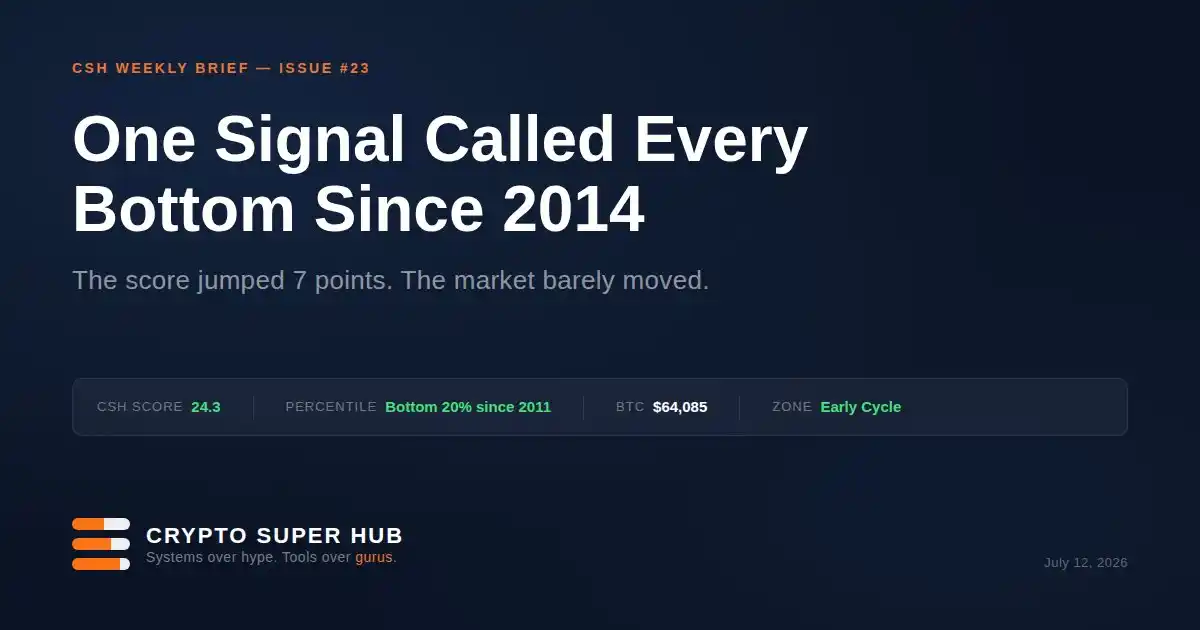
The Signal That Has Appeared Before Every BTC Bottom Since 2014, It Was Close This Time

A valuation model tracking Bitcoin for 12 years has been updated. The new model shows a current score of 24.3, placing BTC in the historical bottom 20% range. However, analysis reveals that since 2014, every Bitcoin bear market bottom has seen this score drop *below 20* for a sustained period before turning around. The current cycle's low so far was 21.5 on July 1st. The author explains the model was rebuilt to address a flaw in its historical baseline, making it a more accurate "map" of current value. Two interpretations are offered: either the historically definitive washout has not yet occurred, or this cycle's bottom will be shallower, as each cycle has been less volatile than the last. The author's action plan involves automated buying triggered at specific score levels. A purchase was made at the cycle's cheapest reading (21.5), with more capital allocated for a potential drop below 20. The strategy emphasizes following a pre-written plan over emotion. Additional market context is provided: Bitcoin reclaimed its 200-week moving average, the BTC/Gold ratio is at a 3-year low showing capital preference for gold, and Bitcoin dominance remains high at 59%, indicating no "altcoin season." The summary concludes by noting the model's inconvenient implication—the market looks less like a bottom now—and poses a question to readers: at what score would they deploy their final capital?

marsbit1 saat önce

The Signal That Has Appeared Before Every BTC Bottom Since 2014, It Was Close This Time

marsbit1 saat önce

Qingyan Jingzhun Raises Hundreds of Millions in Funding, with Investment from National Equipment Manufacturing Giants

Qingyan Precision, a provider of physical AI infrastructure, has secured billions of RMB in Series B financing. The investment round, led by prominent automotive industry funds and notably featuring the state-owned China National Machinery Industry Corp. (Sinomach) fund, underscores a strategic shift in the capital market towards companies with proven industrial application capabilities. The company positions itself as the "engineering foundation for physical AI," specializing in enabling embodied intelligence (like humanoid robots) to operate in complex, real-world industrial environments. Its core offering is the "TsingLoop" multi-modal data engineering pipeline, which captures and standardizes data from physical workspaces (like visual, force, and process parameters) to create reusable data assets. This system supports a "Robot-in-the-Loop" testing framework that validates robotic performance in digital twin simulations and real-world conditions before deployment. Qingyan Precision leverages over eight years of experience and a network of 2000+ industrial sensor nodes across sectors like automotive and mining. This provides a crucial "training ground" for embodied AI models. The founding team combines academic pedigree from Tsinghua University and Stanford with deep industry experience from leading robotics firms. The company's vision is to build "one foundation, one brain, and hundreds of vertical applications," using its data platform and industrial world model to deploy scalable physical intelligence across various industrial tasks.

marsbit1 saat önce

Qingyan Jingzhun Raises Hundreds of Millions in Funding, with Investment from National Equipment Manufacturing Giants

marsbit1 saat önce

İşlemler

Spot

Popüler Makaleler

JUP Nasıl Satın Alınır

HTX.com’a hoş geldiniz! Jupiter (JUP) satın alma işlemlerini basit ve kullanışlı bir hâle getirdik. Adım adım açıkladığımız rehberimizi takip ederek kripto yolculuğunuza başlayın. 1. Adım: HTX Hesabınızı OluşturunHTX'te ücretsiz bir hesap açmak için e-posta adresinizi veya telefon numaranızı kullanın. Sorunsuzca kaydolun ve tüm özelliklerin kilidini açın. Hesabımı Aç2. Adım: Kripto Satın Al Bölümüne Gidin ve Ödeme Yönteminizi SeçinKredi/Banka Kartı: Visa veya Mastercard'ınızı kullanarak anında Jupiter (JUP) satın alın.Bakiye: Sorunsuz bir şekilde işlem yapmak için HTX hesap bakiyenizdeki fonları kullanın.Üçüncü Taraflar: Kullanımı kolaylaştırmak için Google Pay ve Apple Pay gibi popüler ödeme yöntemlerini ekledik.P2P: HTX'teki diğer kullanıcılarla doğrudan işlem yapın.Borsa Dışı (OTC): Yatırımcılar için kişiye özel hizmetler ve rekabetçi döviz kurları sunuyoruz.3. Adım: Jupiter (JUP) Varlıklarınızı SaklayınJupiter (JUP) satın aldıktan sonra HTX hesabınızda saklayın. Alternatif olarak, blok zinciri transferi yoluyla başka bir yere gönderebilir veya diğer kripto para birimlerini takas etmek için kullanabilirsiniz.4. Adım: Jupiter (JUP) Varlıklarınızla İşlem YapınHTX'in spot piyasasında Jupiter (JUP) ile kolayca işlemler yapın.Hesabınıza erişin, işlem çiftinizi seçin, işlemlerinizi gerçekleştirin ve gerçek zamanlı olarak izleyin. Hem yeni başlayanlar hem de deneyimli yatırımcılar için kullanıcı dostu bir deneyim sunuyoruz.

148 Toplam GörüntülenmeYayınlanma 2024.12.12Güncellenme 2026.06.02

JUP Nasıl Satın Alınır

Tartışmalar

HTX Topluluğuna hoş geldiniz. Burada, en son platform gelişmeleri hakkında bilgi sahibi olabilir ve profesyonel piyasa görüşlerine erişebilirsiniz. Kullanıcıların JUP (JUP) fiyatı hakkındaki görüşleri aşağıda sunulmaktadır.

活动图片