La vérification formelle d'Ironwood par Zcash apaisera-t-elle les craintes de contrefaçon et dynamisera-t-elle le ZEC ?

ambcrypto2026-07-08 tarihinde yayınlandı2026-07-08 tarihinde güncellendi

Özet

Zcash lance la vérification formelle de son nouveau pool protégé Ironwood, conçu pour éliminer tout risque indétectable de contrefaçon de jetons ZEC. Cette initiative fait suite à la découverte d'un bug dans le pool Orchard qui aurait pu permettre la création frauduleuse de jetons, une faille dont l'exploitation est impossible à vérifier en raison des protections de vie privée du protocole. Cette faille avait provoqué une vente massive et une chute de plus de 60% du prix du ZEC en juin. Le pool Ironwood intègre un mécanisme interne permettant de vérifier l'offre de ZEC sans compromettre la confidentialité. Sa vérification formelle vise à garantir mathématiquement son bon fonctionnement et à prévenir définitivement ce type de bugs. Des figures du secteur saluent cette avancée comme "colossale", estimant qu'elle pourrait restaurer la confiance et potentiellement stimuler le cours du ZEC. Sur les marchés, l'annonce a déjà entraîné une hausse de 6%. Les analystes envisagent une possible poursuite de la reprise vers 640-680 dollars si le prix conserve le seuil des 500 dollars comme support, mais un rejet à ce niveau pourrait le faire retomber vers 380 dollars. Malgré tout, le pool Orchard reste majoritaire, et l'adoption du nouveau pool Ironwood, actuellement vide, reste à observer.

Zcash a annoncé que le pool blindé Ironwood, récemment lancé, est en cours de « vérification formelle » afin d'éliminer tous les bogues de contrefaçon indétectables.

Le pool Ironwood a été proposé comme une solution après que le pool Orchard, phare du projet, ait rencontré un bogue de contrefaçon qui aurait pu créer de nouveaux jetons ZEC.

Cependant, étant donné la forte conception de confidentialité du protocole Zcash, il n'a pas été possible de vérifier si ce bogue a été exploité ou non.

Début juin, des personnalités notables du secteur, comme Arthur Hayes, ont liquidé leurs avoirs en ZEC et ont critiqué le projet pour son incapacité à prouver que le bogue n'a pas été utilisé pour créer de nouveaux jetons.

Ces FUD (Peur, Incertitude, Doute) ont entamé le sentiment du marché, faisant chuter le prix du ZEC de 640 $ à 251 $, soit une baisse de plus de 60 % en trois jours. Une tentative des principaux soutiens de la vie privée pour calmer la volatilité n'a pas abouti.

La chute du prix du ZEC ne s'est atténuée qu'après que le projet ait proposé un nouveau pool Ironwood auditable. Ce nouveau pool possède un mécanisme interne pour vérifier l'offre de ZEC sans compromettre la confidentialité.

C'est la première fois que ce pool est soumis à une « vérification formelle » pour tester s'il fonctionne comme prévu.

Cela restaurera-t-il la confiance dans Zcash ?

Pour le projet, le bogue découvert le mois dernier sera le dernier avec le nouveau pool blindé et auditable Ironwood.

Le récent bogue de contrefaçon indétectable découvert dans Orchard n'était pas le premier du genre dans Zcash. Grâce à la vérification formelle d'Ironwood, ce sera le dernier.

Réagissant à cette mise à jour, Mertz Mumtaz, un défenseur de la vie privée et fondateur de Helius Labs, a qualifié cette initiative de « colossale ».

C'est colossal. Permettez-moi de traduire : cela rend mathématiquement impossible les bogues de contrefaçon indétectables dans Zcash à l'avenir. C'était le plus grand compromis de l'argent privé auparavant, et Zcash l'a résolu.

Pour lui, le marché mettra un certain temps à assimiler cette mise à jour, mais il s'attend à ce qu'elle finisse par faire monter le ZEC à 10 000 $ par pièce.

Par ailleurs, outre le problème de bogue du mois dernier, le protocole a fait avancer son plan pour des portefeuilles récupérables post-quantiques. Collectivement, la vérification formelle, la confidentialité et l'impulsion post-quantique pourraient contribuer à restaurer la confiance dans le protocole.

Cela dit, le pool Orchard domine toujours l'offre des pools blindés, malgré le rachat de près d'un million de ZEC le mois dernier suite aux FUD liés au bogue.
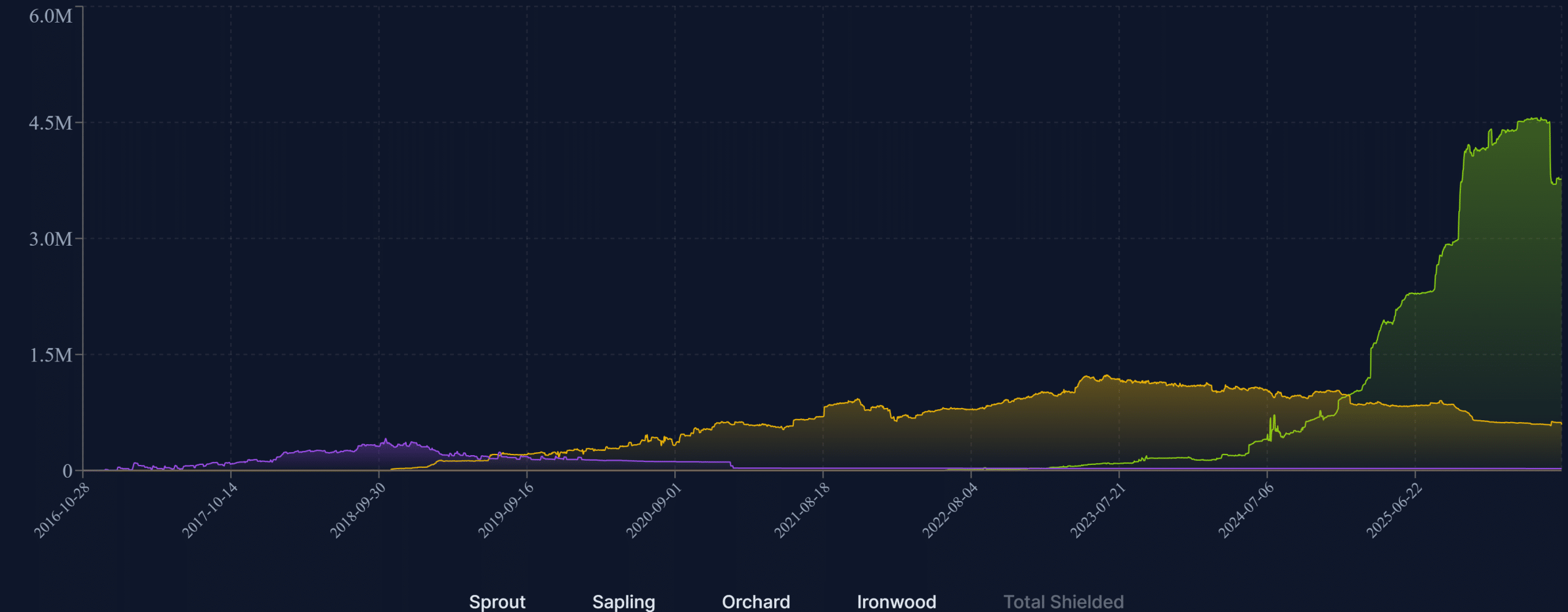
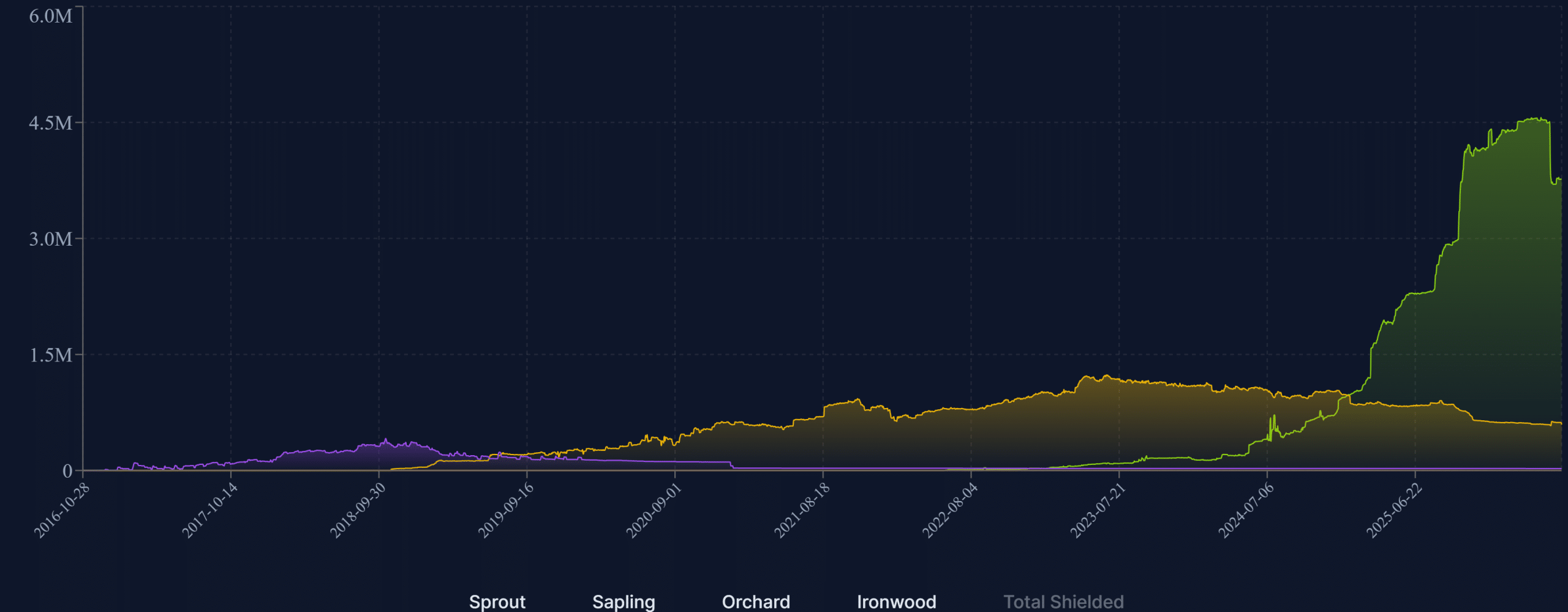
Source : SEC Hub

Au moment de la rédaction, le pool Ironwood avait une offre nulle, et il reste à voir s'il attirera les utilisateurs de ZEC.

Le ZEC retrouvera-t-il son élan ?

Sur les graphiques de prix, le prix du Zcash [ZEC] a bondi de 6 % après la mise à jour et a atteint les 512 $.

Une poursuite de la reprise ne pourrait être confirmée que si le ZEC reprend de manière décisive les 500 $ comme support. Dans ce cas, un potentiel de hausse supplémentaire de 30 % pourrait être envisageable vers 640-680 $. Sinon, un rejet à 500 $ ramènerait le ZEC vers 380 $ (SMA à 200 jours, ligne bleue).
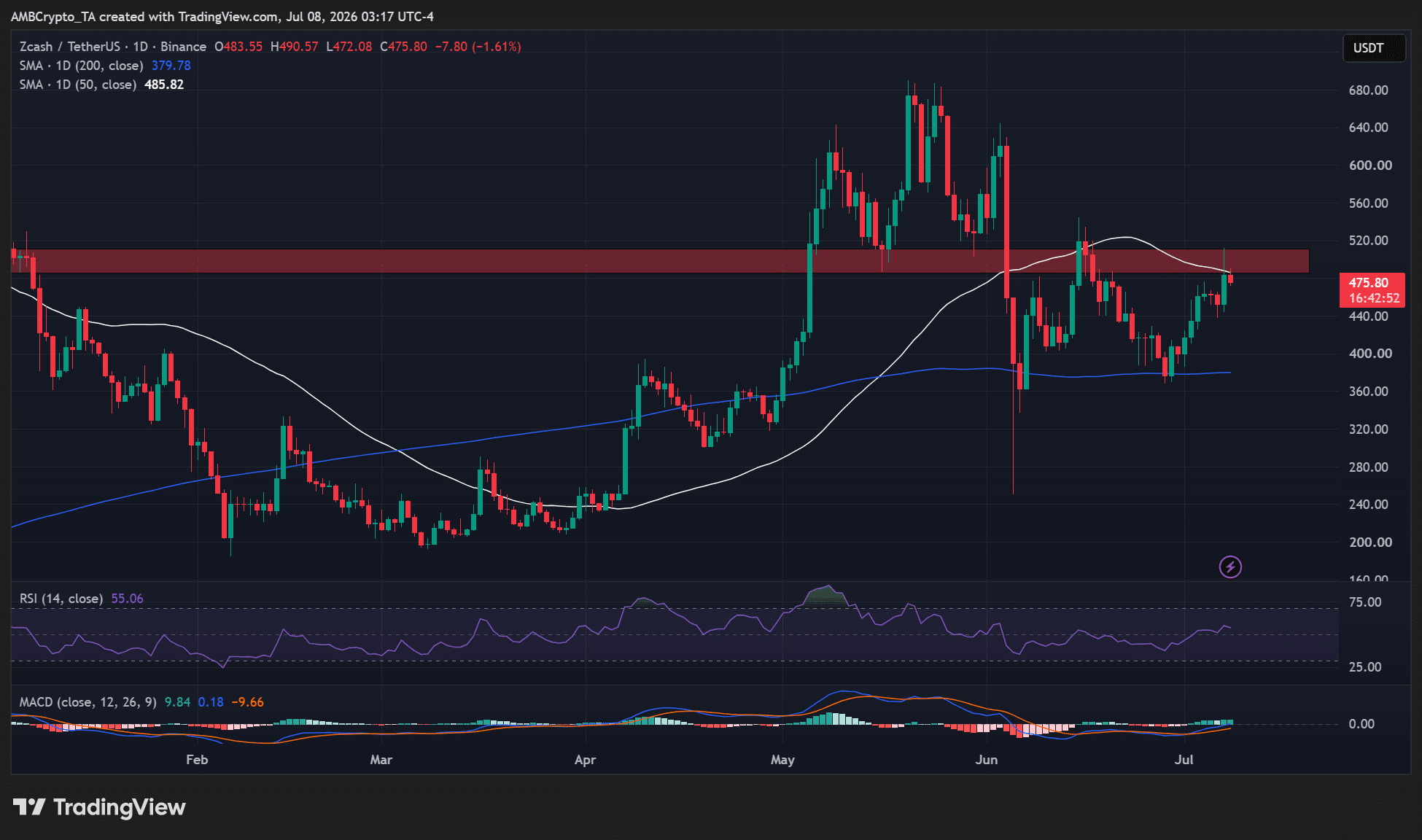
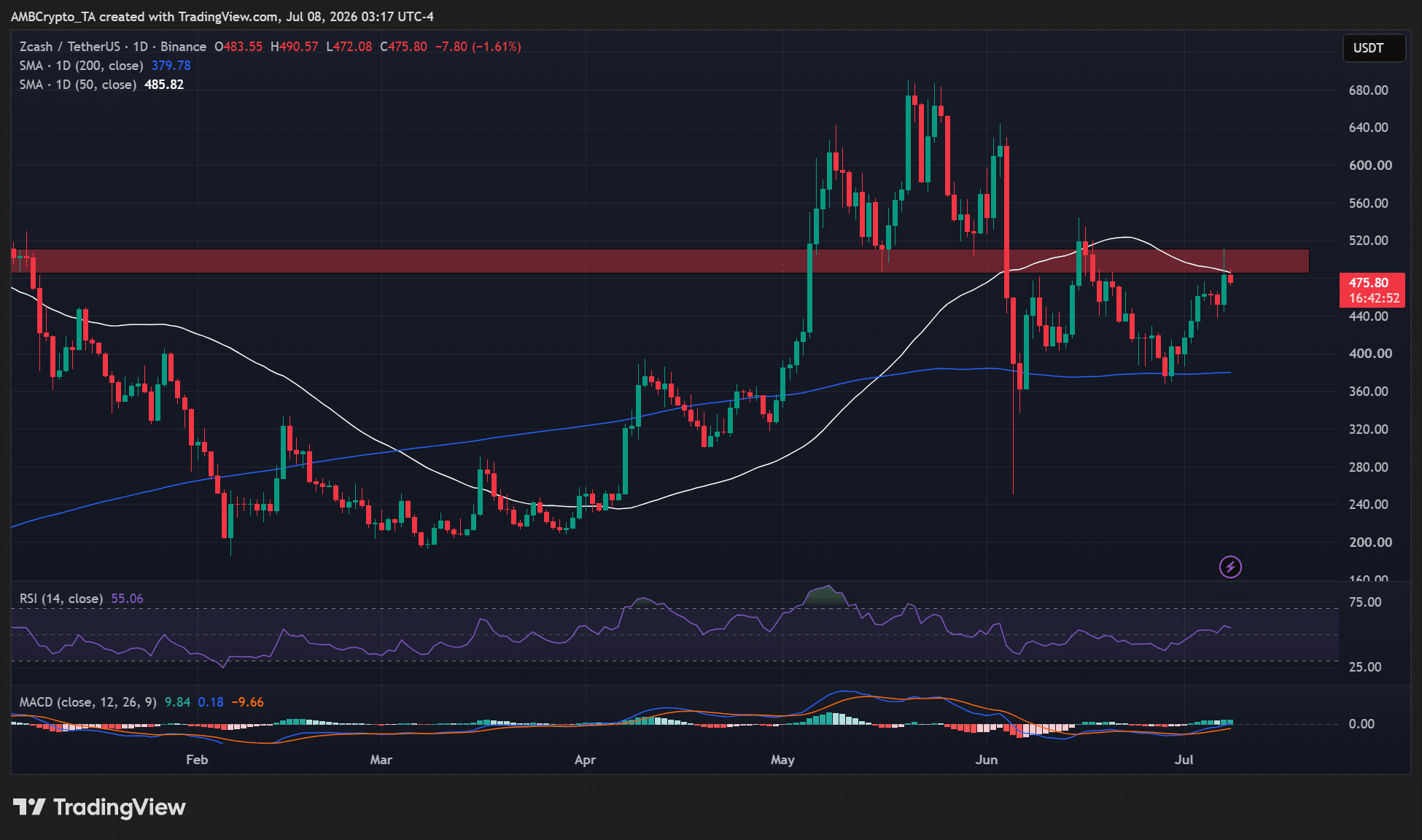
Source : ZEC/USDT, TradingView

Résumé final

  • Zcash a commencé la vérification formelle du pool blindé Ironwood pour éliminer les bogues de contrefaçon indétectables observés dans le pool Orchard
  • Le ZEC pourrait présenter un gain supplémentaire de +30 % si la mise à jour restaure la confiance dans le protocole


Trend Kriptolar

İlgili Okumalar

After Three Consecutive Quarters of Decline, Can the Crypto Market Find a Window for Stabilization in Q3?

The cryptocurrency market has just concluded its worst-performing quarter since 2022, with total capitalization dropping 12.6% to $2.1 trillion. All core metrics indicate capital is leaving the sector, not just rotating within it. Bitcoin fell 14.2% and Ethereum dropped 25.4% in Q2, breaking their previous correlation with US tech stocks. A key driver is the reversal in US spot Bitcoin ETF flows, which saw a net outflow of approximately $4.67 billion in Q2, including a record monthly outflow near $4.5 billion in June. While recent data suggests long-term holders are accumulating again, sustained ETF outflows mean continued selling pressure. Market focus is now singularly on the Federal Reserve. The upcoming July FOMC meeting is seen as the most critical event for Q3. A dovish signal could support Bitcoin reclaiming a $68,000-$84,000 range, while a hawkish stance might establish a new trading band around $50,000-$56,000. Additionally, regulatory uncertainty persists, with the progress of the crucial *CLARITY Act* stalling in the Senate, reducing its perceived 2026 passage probability to 40-45%. Despite the broad downturn, a few sectors showed growth. Prediction markets saw nominal volume surge 48.7% year-over-year to $113.8 billion, and tokenized collectibles transaction volume rose 143% quarterly to $1.4 billion. The Real-World Asset (RWA) tokenization sector also continued steady growth, now representing ~$28.1 billion in on-chain value. The market's foundation for an extreme crash appears limited, with Bitcoin price hovering near its 200-week moving average. However, the trading paradigm has shifted from narrative-driven speculation to decisions based on price action, policy developments, and interest rate expectations, making a broad sentiment-driven rally unlikely in the near term.

marsbit18 saat önce

After Three Consecutive Quarters of Decline, Can the Crypto Market Find a Window for Stabilization in Q3?

marsbit18 saat önce

BIT Trading Moment: BTC Still Suppressed by Weekly 200 EMA, Rejection May Restart Decline; Storage and Semiconductors that Surged Last Night Begin Falling in Evening Trading

**Crypto & Stock Market Wrap: Bitcoin Tests Resistance, Stocks Retreat After AI Surge** Bitcoin consolidates around $66,000, facing key resistance near $68,000—an area seen as a major psychological and technical hurdle where previous rallies have failed. Analysts note the cryptocurrency is caught between its 200-week moving average (~$63,333) and 200-week EMA (~$68,328). A clear break above $68k is needed to signal a stronger bullish trend, while a rejection could lead to a retest of $63k support. Market sentiment remains cautious, with low futures open interest pointing to a low-liquidity rebound rather than a full bull market. Bitcoin spot ETFs saw another $203 million inflow. US stock futures pointed lower after a strong Tuesday session led by a massive rebound in semiconductors and memory stocks. The rally was fueled by renewed optimism about AI-driven hardware demand, with Micron, SanDisk, and SK Hynix surging. However, those gains reversed in pre-market trading. Super Micro Computer (SMCI) soared over 20% after hours on strong guidance and a record backlog. Other standouts included Rocket Lab and nuclear energy plays Oklo and X-Energy. Rising oil prices (Brent above $91) and climbing Treasury yields (10-year near 4.64%), however, are reigniting inflation concerns and acting as a headwind for equities. In Asia, markets were mixed. South Korea's KOSPI pared early gains to close slightly higher as semiconductor stocks like SK Hynix gave back initial surges. Japan's Nikkei edged lower as the yen hit a fresh 38-year low against the dollar, raising fears of potential market intervention. Key events to watch include the Samsung Galaxy launch, AMD's AI event, and a slew of major tech earnings from Alphabet, Tesla, and IBM after the close on Wednesday, followed by the ECB meeting and Intel's earnings on Thursday.

marsbit18 saat önce

BIT Trading Moment: BTC Still Suppressed by Weekly 200 EMA, Rejection May Restart Decline; Storage and Semiconductors that Surged Last Night Begin Falling in Evening Trading

marsbit18 saat önce

Former CFTC Chairman, Circle President Tarbert: Preaching Long-Termism While Cashing Out $30 Million Himself

Former CFTC Chairman and Circle President Heath Tarbert has consistently advocated for a long-term vision in public, urging patience from investors as Circle’s stock price has fallen significantly from its peak. However, it has been revealed that since Circle’s IPO, Tarbert has continuously sold his CRCL shares through pre-arranged trading plans, cashing out approximately $30 million, without making any public market purchases. This contrast between his public messaging and personal actions has drawn criticism. Tarbert joined Circle in July 2023 as Chief Legal Officer, leveraging his regulatory experience to help guide the company through its IPO and expansion. Despite promoting stablecoins as long-term infrastructure, he established a 10b5-1 trading plan just before Circle went public, leading to substantial stock sales over the following year. In March 2026, he initiated another plan to sell more shares. His career trajectory highlights a pattern of moving between high-level regulatory roles and influential positions in the financial sector. After resigning as CFTC Chairman in early 2021, he joined Citadel Securities as Chief Legal Officer just 27 days later, during a period of intense regulatory scrutiny for the firm. He later joined Circle, aiding its efforts to navigate regulatory challenges for its public listing. While Tarbert's expertise in policy and compliance is valuable to companies like Circle, his actions—advocating long-term confidence while personally divesting—raise questions about the alignment between his public statements and his private financial decisions, leaving investors who followed his advice to bear the market risks.

marsbit18 saat önce

Former CFTC Chairman, Circle President Tarbert: Preaching Long-Termism While Cashing Out $30 Million Himself

marsbit18 saat önce

Gate Research Institute: The 'Wall Street-ization' Wave of Crypto Financial Products – Competition or Integration?

The article titled "Gate Research Institute: Are Crypto Financial Products Sparking a 'Wall Street' Wave—Competition or Convergence?" explores the evolving relationship between the crypto ecosystem and traditional finance (TradFi). The piece begins by reflecting on Bitcoin's original 2009 vision of decentralization, disintermediation, and moving away from banks. It then contrasts this with the 2024 landscape, where key crypto assets like Bitcoin are increasingly held through Wall Street products like ETFs issued by giants like BlackRock. The article questions whether this signifies that TradFi is systematically taking over the rights to issue, price, custody, and distribute crypto financial assets. The core argument is that this is not a zero-sum takeover but rather a bidirectional convergence where each side addresses the other's weaknesses. Crypto offers 24/7 global markets, programmable settlement, and open access but lacks compliant channels, institutional-grade custody, deep fiat liquidity, and mainstream distribution. TradFi possesses these but is constrained by legacy systems, limited operating hours, and slow settlement. Two primary convergence paths are highlighted: * **Path A (CEX to TradFi):** Exemplified by Gate, which has progressed from offering tokenized stocks and CFDs to providing direct, real stock trading (US, Hong Kong, South Korea) within its platform, using USDT. * **Path B (TradFi to Crypto):** Exemplified by Robinhood, which has integrated crypto trading, acquired exchanges like Bitstamp, and is moving traditional assets like stocks onto the blockchain via tokenization and its own Layer 2. Both paths are ultimately competing to become the next-generation, unified financial account—a "super account" where users can seamlessly trade cryptocurrencies, stocks, ETFs, RWA (Real World Assets), and tokenized treasury products in one interface. The growth of RWA and tokenized treasuries (e.g., BlackRock's BUIDL) is presented as the asset-layer fusion, providing stable, yield-bearing assets on-chain and acting as a bridge between the two worlds. In conclusion, the "Wall Street-ization" of crypto is framed as a mutual transformation. Decentralized ideals persist in the protocol layer, while at the application layer, a more efficient, global, and accessible unified capital market is emerging from this convergence. The future competition lies not between crypto exchanges and stockbrokers, but between platforms vying to offer the most comprehensive asset coverage, liquidity, and user experience within a single account.

marsbit18 saat önce

Gate Research Institute: The 'Wall Street-ization' Wave of Crypto Financial Products – Competition or Integration?

marsbit18 saat önce

İşlemler

Spot

Popüler Makaleler

ZEC Nasıl Satın Alınır

HTX.com’a hoş geldiniz! Zcash (ZEC) satın alma işlemlerini basit ve kullanışlı bir hâle getirdik. Adım adım açıkladığımız rehberimizi takip ederek kripto yolculuğunuza başlayın. 1. Adım: HTX Hesabınızı OluşturunHTX'te ücretsiz bir hesap açmak için e-posta adresinizi veya telefon numaranızı kullanın. Sorunsuzca kaydolun ve tüm özelliklerin kilidini açın. Hesabımı Aç2. Adım: Kripto Satın Al Bölümüne Gidin ve Ödeme Yönteminizi SeçinKredi/Banka Kartı: Visa veya Mastercard'ınızı kullanarak anında Zcash (ZEC) satın alın.Bakiye: Sorunsuz bir şekilde işlem yapmak için HTX hesap bakiyenizdeki fonları kullanın.Üçüncü Taraflar: Kullanımı kolaylaştırmak için Google Pay ve Apple Pay gibi popüler ödeme yöntemlerini ekledik.P2P: HTX'teki diğer kullanıcılarla doğrudan işlem yapın.Borsa Dışı (OTC): Yatırımcılar için kişiye özel hizmetler ve rekabetçi döviz kurları sunuyoruz.3. Adım: Zcash (ZEC) Varlıklarınızı SaklayınZcash (ZEC) satın aldıktan sonra HTX hesabınızda saklayın. Alternatif olarak, blok zinciri transferi yoluyla başka bir yere gönderebilir veya diğer kripto para birimlerini takas etmek için kullanabilirsiniz.4. Adım: Zcash (ZEC) Varlıklarınızla İşlem YapınHTX'in spot piyasasında Zcash (ZEC) ile kolayca işlemler yapın.Hesabınıza erişin, işlem çiftinizi seçin, işlemlerinizi gerçekleştirin ve gerçek zamanlı olarak izleyin. Hem yeni başlayanlar hem de deneyimli yatırımcılar için kullanıcı dostu bir deneyim sunuyoruz.

628 Toplam GörüntülenmeYayınlanma 2024.12.12Güncellenme 2026.06.02

ZEC Nasıl Satın Alınır

Tartışmalar

HTX Topluluğuna hoş geldiniz. Burada, en son platform gelişmeleri hakkında bilgi sahibi olabilir ve profesyonel piyasa görüşlerine erişebilirsiniz. Kullanıcıların ZEC (ZEC) fiyatı hakkındaki görüşleri aşağıda sunulmaktadır.

活动图片