Chain Gaming Giant YGG Capitulates, Losing $15 Billion in Value Over 5 Years

Foresight News2026-07-07 tarihinde yayınlandı2026-07-07 tarihinde güncellendi

Özet

The leading blockchain gaming guild Yield Guild Games (YGG) is shutting down its publishing arm, YGG Play, announced on July 6th by its official account and co-founder Gabby Dizon. The platform and its supported games will be phased out by July 31st. While YGG Play successfully validated a market for casual, crypto-native mobile games—generating over $9M in total revenue, including $876,000 in Q1 2026—Dizon stated the closure was a market-driven decision. He cited insufficient liquidity and declining user confidence in the macroeconomic environment, making the business commercially unsustainable. Founded in 2020, YGG rose to prominence during the Play-to-Earn (P2E) boom, particularly with Axie Infinity, organizing players and managing assets. Its token price soared above $10 during the 2021 bull market. However, the 2022 crypto downturn exposed the fragility of P2E economic models. YGG attempted to pivot in 2025 with the YGG Play publishing initiative, focusing on short-session casual games. The shutdown reflects broader struggles in the Web3 gaming sector. An April 2026 report highlighted a "structural mismatch" between speculative financial designs and genuine player entertainment needs, leading to an estimated $15 billion in destroyed capital. The report noted that 93% of roughly 3,200 tracked blockchain game projects are now "functionally dead," with token prices down an average of 95% from 2022 peaks. YGG itself is now pivoting its strategy entirely towards the AI Data...


By Ma He, Foresight News


On July 6th, both the official account of Yield Guild Games (YGG) and its co-founder Gabby Dizon simultaneously announced the decision to shut down its game publishing division, YGG Play. The team will gradually phase out the platform and certain games by July 31st according to plan, with 35 employees receiving an additional 8 weeks of salary compensation. Some games, like GIGACHADBAT, will be transferred to the developer Delabs for continued operation. Others, such as LOL Land and Waifu Sweeper, will be officially retired. Games published by YGG Play have generated cumulative revenue exceeding $9 million, with a single quarter in Q1 2026 contributing $876,000.
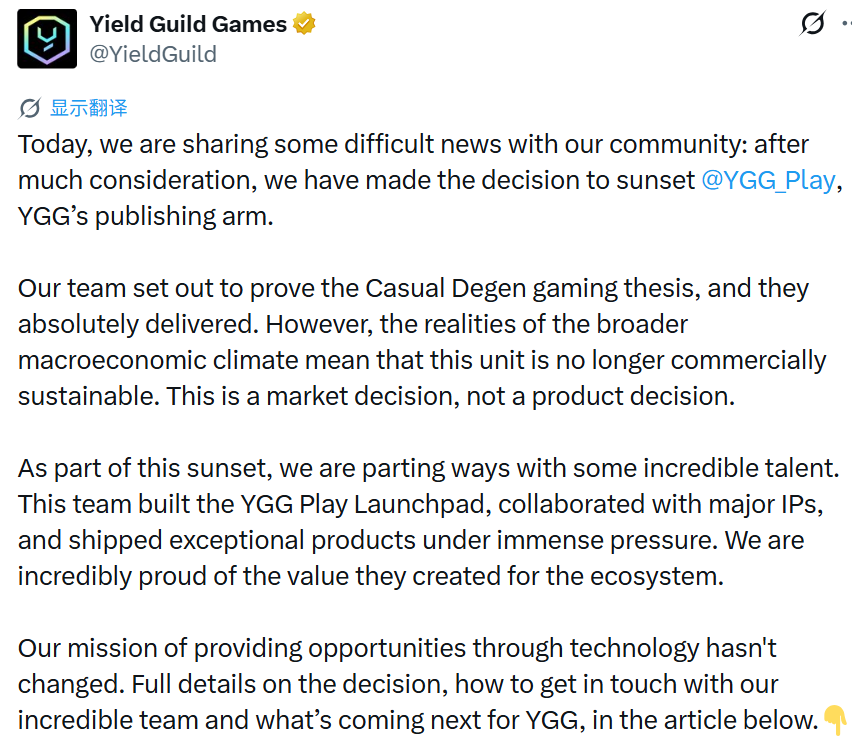


In the statement, Gabby Dizon stated: This is a market decision, not a product decision. Although the team successfully validated the casual gaming segment—short sessions, high engagement, and rapid feedback loops for crypto-native users—the lack of liquidity and declining user confidence in the macroeconomic environment have rendered this business commercially unsustainable.


Alongside shutting down YGG Play, YGG also announced a full pivot to the AI Data Economy, aiming to capture the multibillion-dollar market for AI training datasets, initially focusing on building B2B pipelines around gaming datasets.


The Chain Game Publishing Platform YGG Play


Launched by YGG in 2025, YGG Play was its Web3 game publishing arm, dedicated to serving the casual player community in the crypto space. It targeted short, quick, mobile-friendly games with a touch of social interaction and rewards, helping independent studios quickly go on-chain for distribution and acquire and operate users through YGG's community network. These games accumulated significant revenue during 2025-2026, proving that specific vertical segments could still generate genuine revenue even at the tail end of a bear market.


However, revenue peaked around October 2025. The large-scale liquidation event in October's crypto market further dampened the payment willingness and retention of target users. The closure of YGG Play marks a strategic contraction for YGG, moving away from the dual-engine drive of "guild operations + publishing."


To understand the weight of this closure, one must trace YGG's complete trajectory.


In 2020, veteran Philippine gaming industry figures Gabby Dizon, Beryl Li, and anonymous partner Owl of Moistness co-founded YGG. This was during the peak of the COVID-19 pandemic when many service industry workers in the Philippines were unemployed. Axie Infinity, the hottest Play-to-Earn (P2E) game at the time, was enabling players to borrow Axie NFTs for free to battle and share earnings through its "scholarship" model.


YGG seized this window, starting as a small guild, raising funds to purchase Axie assets, organizing and training players, and rapidly becoming one of the largest and most scalable guilds within the Axie ecosystem.
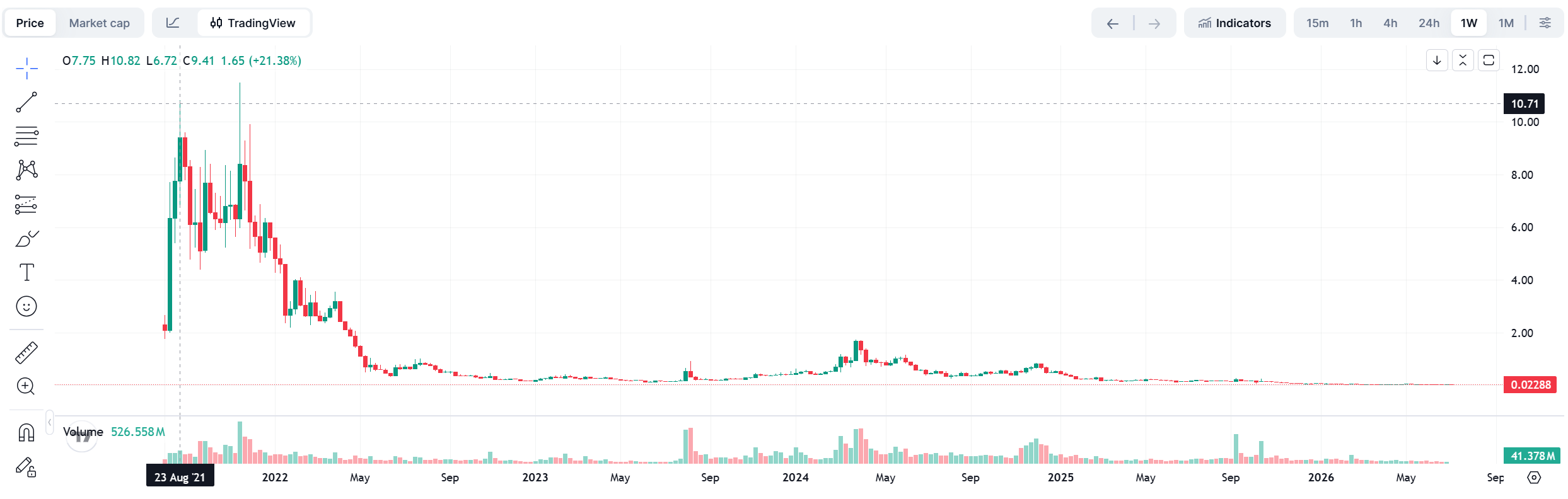


2021 was YGG's peak year. Driven by both the bull market and the P2E narrative, its token price soared, exceeding $10 at its highest. YGG expanded from a single Axie guild into a global network covering dozens of regional sub-guilds and partnered with over 80 blockchain games and infrastructure projects. It moved beyond mere asset lending, helping players maximize earnings through quests, events, and community operations. In places like the Philippines, the real economic phenomenon of "playing games as work" emerged, and YGG became a benchmark for the P2E model.


At its peak, YGG's model was widely replicated: guilds became crucial intermediaries connecting players, assets, and games, with DAO governance and token incentives allowing participants to share in growth benefits. YGG evolved from a simple "asset manager" into an investment, content, and community platform.


When the crypto bear market arrived in 2022, the fragility of Axie Infinity's economic model was laid bare—new user inflow slowed, token prices crashed, and player churn was severe. Many guilds and P2E projects vanished outright, and the entire industry entered a deep trough. YGG did not collapse but began a long adaptation. In 2025, YGG bet on a new direction: launching YGG Play and formally entering the game publishing arena, as heavy P2E was no longer viable, while crypto users naturally gravitated towards high-frequency, instant-feedback casual experiences.


This shutdown comes barely a year after that last pivot.


A Microcosm of the Chain Gaming Industry


The closure of YGG Play can be seen as a concentrated reflection of the chain gaming industry's development trajectory over the past five years.


In April this year, the crypto quantitative trading and market-making firm Caladan reviewed the five-year journey of the Web3 gaming sector from frenzied explosion to comprehensive collapse. Its core conclusion was that the decline of Web3 games is not a normal cyclical downturn but stems from a fundamental "structural misalignment" between the underlying speculative financial design and the genuine entertainment needs of players, leading to a staggering $15 billion in capital being obliterated.


Examples abound: Pixelmon, which raised $70 million but failed to launch public beta in 4 years; Ember Sword, which burned through $18 million and was liquidated; and Hamster Kombat, which lost 96% of its users within 6 months.


As of April 2026, in the roughly 3,200 chain gaming projects tracked by the report, 93% have been categorized as "practically dead" or have completely lost activity. The average decline in the crypto token prices for the entire gaming sector compared to the 2022 all-time highs reached 95%.


The prosperity of chain gaming was entirely built upon the Ponzi-like dividend logic of "Play-to-Earn." This model is inherently an unsustainable speculative financial closed loop: the earnings of early players and token prices entirely depend on a constant influx of new players buying tokens or NFTs to sustain the system. Once new user growth slows and external capital inflow decreases, the token's severe inflation rapidly breaches economic equilibrium, triggering a "death spiral" of token crashes, shrinking earnings, and a mass exodus of users.


YGG Play was not a failure in terms of product delivery or revenue figures but was defeated by "market timing."


The story of chain gaming may be nearing its end.

Trend Kriptolar

İlgili Sorular

QWhy did YGG decide to shut down its YGG Play division?

AYGG decided to shut down its YGG Play division due to market conditions, specifically insufficient market liquidity and declining user confidence in the macroeconomic environment, which made the business commercially unsustainable, despite having validated the casual gaming niche.

QWhat was the original core business model of Yield Guild Games (YGG) at its peak?

AAt its peak during the 2021 bull market, YGG's core model was operating as a major guild within the Play-to-Earn (P2E) ecosystem, most notably for Axie Infinity. It provided asset lending (scholarships), player training, and community management to help players maximize earnings, evolving into a global network and a platform for investment, content, and community.

QWhat new strategic direction has YGG announced alongside the closure of YGG Play?

AAlongside the closure of YGG Play, YGG announced a full-scale pivot into the AI Data Economy, aiming to capture a share of the multi-billion dollar AI training dataset market, with an initial focus on building B2B pipelines around gaming datasets.

QAccording to the article, what is the fundamental structural flaw of most Web3/blockchain games as identified by Caladan's report?

AAccording to Caladan's report cited in the article, the fundamental structural flaw of most Web3 games is a 'structural misalignment' between their underlying speculative financial design and genuine player entertainment needs. Their models rely on an unsustainable Ponzi-like financial loop where early player returns depend on constant new user inflow to buy tokens/NFTs, leading to a 'death spiral' when growth slows.

QWhat statistics does the article provide to illustrate the scale of failure in the blockchain gaming sector over the past five years?

AThe article provides several statistics illustrating the sector's failure: a collective loss of $150 billion in capital, 93% of tracked projects (~3200) being 'effectively dead' or inactive by April 2026, and an average token price decline of 95% from the 2022 highs for the gaming sector. It also cites specific failed projects like Pixelmon and Ember Sword.

İlgili Okumalar

Tiger Research: Three Strategies for Financial Institutions to Keep Up with the Tokenization Wave

Tiger Research's in-depth report analyzes the strategic choices for financial institutions entering the rapidly growing Real-World Asset (RWA) tokenization market. With the market projected to be worth $25-36 billion and a lack of complete regulatory frameworks in many jurisdictions, institutions face three options: waiting for domestic legislation, using regulatory sandboxes for limited experiments, or moving first into established overseas markets to gain a competitive edge. Tokenization is not magic; it requires meticulous preparation. Before entry, institutions must strategically plan across six core areas: choosing a jurisdiction, obtaining necessary licenses, defining the asset type, targeting the appropriate investor base, selecting settlement currencies, and designing operational requirements like custody and governance. The report outlines two main operational paths. The first is a direct jurisdictional path, establishing a legal presence in mature markets like Hong Kong, Singapore, or the U.S., often leveraging local licensed platforms to accelerate market entry. The second is a chain-native path, using platforms like Ondo or Plume that are built with regulatory compliance embedded, allowing for faster, more flexible market access without being tied to a specific jurisdiction. Ultimately, the report advises against waiting for perfect regulation. The preparation process can take 6-12 months and requires thorough legal review. Using the example of a mid-sized securities firm, it details steps from evaluating existing entities to final execution. The core message is that accumulating real-world operational experience is paramount, as the market is moving ahead and will not wait for latecomers.

Foresight News1 saat önce

Tiger Research: Three Strategies for Financial Institutions to Keep Up with the Tokenization Wave

Foresight News1 saat önce

Unitree's IPO Frenzy: The Real Mystery is How It Will Spend the 42 Billion Raised

Unitree, a Chinese robotics company, is set for a public listing after its IPO registration was approved by regulators. The company, which started with quadruped robots and has expanded into humanoids, plans to raise approximately 4.2 billion yuan through its offering. The article traces Unitree's rapid growth from its founding in 2016 to its current status. It highlights key milestones like the 2021 CCTV Spring Festival Gala performance, the 2023 launch of its affordable Go2 robot dog and the H1 humanoid robot, and a series of subsequent product launches. By 2025, the company reported revenue of 1.71 billion yuan, profitability, and sales exceeding 5,500 humanoid robots. As the first publicly-listed humanoid robot company on China's STAR Market, Unitree's main challenges are sustaining growth and deploying its newly raised capital effectively. The humanoid robot sector in China is crowded, with over 140 companies. Competitors include UBTech (focusing on industrial and consumer markets), Fourier, and international players like Tesla Optimus and 1X NEO. The article outlines three critical challenges for Unitree: establishing a strong second product line beyond its quadruped robots, maintaining its price advantage while ensuring quality, and successfully advancing its embodied AI capabilities through partnerships like the one with NVIDIA for the H2 Plus platform. Unitree's likely strategy involves a "developer tools + industry benchmarks" approach: using low-cost models like the R1 and G1 to build developer adoption and volume, leveraging high-end platforms for AI training, and securing pilot projects in sectors like logistics and manufacturing to build case studies. The company's future success hinges on converting its current momentum in shipments and pilot programs into sustainable, large-scale commercial contracts as the broader market evolves.

marsbit2 saat önce

Unitree's IPO Frenzy: The Real Mystery is How It Will Spend the 42 Billion Raised

marsbit2 saat önce

İşlemler

Spot

Popüler Makaleler

YGG Nasıl Satın Alınır

HTX.com’a hoş geldiniz! Yield Guild Games (YGG) satın alma işlemlerini basit ve kullanışlı bir hâle getirdik. Adım adım açıkladığımız rehberimizi takip ederek kripto yolculuğunuza başlayın. 1. Adım: HTX Hesabınızı OluşturunHTX'te ücretsiz bir hesap açmak için e-posta adresinizi veya telefon numaranızı kullanın. Sorunsuzca kaydolun ve tüm özelliklerin kilidini açın. Hesabımı Aç2. Adım: Kripto Satın Al Bölümüne Gidin ve Ödeme Yönteminizi SeçinKredi/Banka Kartı: Visa veya Mastercard'ınızı kullanarak anında Yield Guild Games (YGG) satın alın.Bakiye: Sorunsuz bir şekilde işlem yapmak için HTX hesap bakiyenizdeki fonları kullanın.Üçüncü Taraflar: Kullanımı kolaylaştırmak için Google Pay ve Apple Pay gibi popüler ödeme yöntemlerini ekledik.P2P: HTX'teki diğer kullanıcılarla doğrudan işlem yapın.Borsa Dışı (OTC): Yatırımcılar için kişiye özel hizmetler ve rekabetçi döviz kurları sunuyoruz.3. Adım: Yield Guild Games (YGG) Varlıklarınızı SaklayınYield Guild Games (YGG) satın aldıktan sonra HTX hesabınızda saklayın. Alternatif olarak, blok zinciri transferi yoluyla başka bir yere gönderebilir veya diğer kripto para birimlerini takas etmek için kullanabilirsiniz.4. Adım: Yield Guild Games (YGG) Varlıklarınızla İşlem YapınHTX'in spot piyasasında Yield Guild Games (YGG) ile kolayca işlemler yapın.Hesabınıza erişin, işlem çiftinizi seçin, işlemlerinizi gerçekleştirin ve gerçek zamanlı olarak izleyin. Hem yeni başlayanlar hem de deneyimli yatırımcılar için kullanıcı dostu bir deneyim sunuyoruz.

142 Toplam GörüntülenmeYayınlanma 2024.12.11Güncellenme 2026.06.02

YGG Nasıl Satın Alınır

Tartışmalar

HTX Topluluğuna hoş geldiniz. Burada, en son platform gelişmeleri hakkında bilgi sahibi olabilir ve profesyonel piyasa görüşlerine erişebilirsiniz. Kullanıcıların YGG (YGG) fiyatı hakkındaki görüşleri aşağıda sunulmaktadır.

活动图片