Completely Free, Open-Source Alternative to Claude Science, Use DeepSeek/GLM as You Like

marsbit2026-07-07 tarihinde yayınlandı2026-07-07 tarihinde güncellendi

Özet

Free, Open-Source Alternative to Claude Science: OpenScience Lets Researchers Use Any AI Model Like DeepSeek or GLM Shortly after Anthropic launched Claude Science, a specialized AI workbench for scientific research, the open-source community responded with its own solution: OpenScience. Developed by YC-backed Synthetic Sciences, this platform offers a full AI research workflow covering literature review, hypothesis generation, code experimentation, and paper writing. Unlike Claude Science, which is restricted to macOS/Linux, paid users, and only Claude models, OpenScience is model-agnostic and free. Researchers can use any AI model—DeepSeek, GLM, Claude, GPT, or local models via Ollama—simply by providing their own API keys, keeping data private. OpenScience features over 250 editable research skill packs, more than four times Claude Science's initial offering, and supports one-command installation. It emphasizes openness, arguing that scientific AI tools should not be controlled by a single company. The project includes a clear disclaimer of no affiliation with Anthropic, reflecting caution in the open-source community.

Researchers are ecstatic!!

Less than a week after Anthropic's Claude Science launched, the open-source community has presented its own answer.

An AI research team incubated by YC, has delivered 'the open-source alternative to Claude Science' — OpenScience.

It's also a full-process AI research workbench covering literature search, hypothesis generation, code experiments to paper writing, but it is not tied to any single model provider.

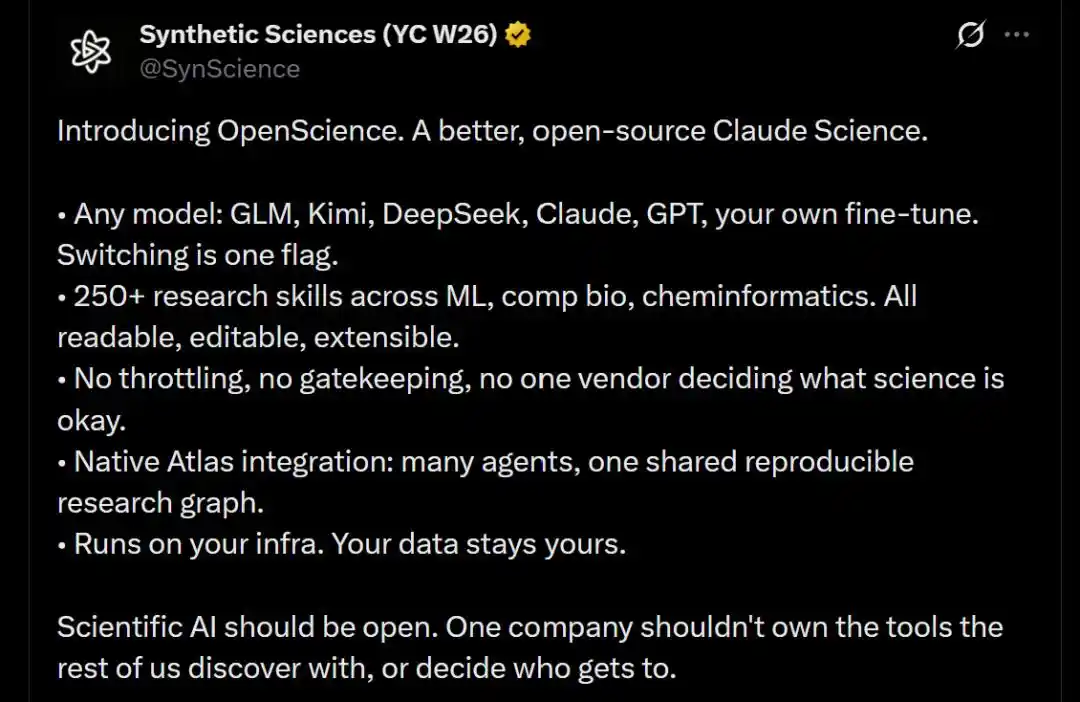
DeepSeek, GLM, Claude, GPT... regardless of domestic or international, use whichever one you want.

Moreover, the project adopts the developer-friendly Apache 2.0 license and can be installed with just one command.

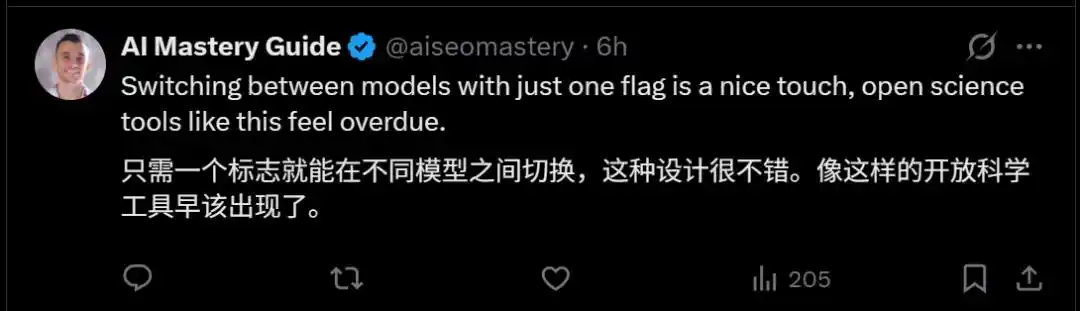
Once the news broke, the project directly trended on X. People bluntly stated:

This is what scientific AI should look like. (Anthropic: Just say my name.)

Claude Science is powerful, but it's unusable...

About 5 days ago, Anthropic officially launched Claude Science at a closed-door event by MIT Technology Review.

This is an AI workbench specifically for scientists, providing various tools and software packages most commonly used by researchers.
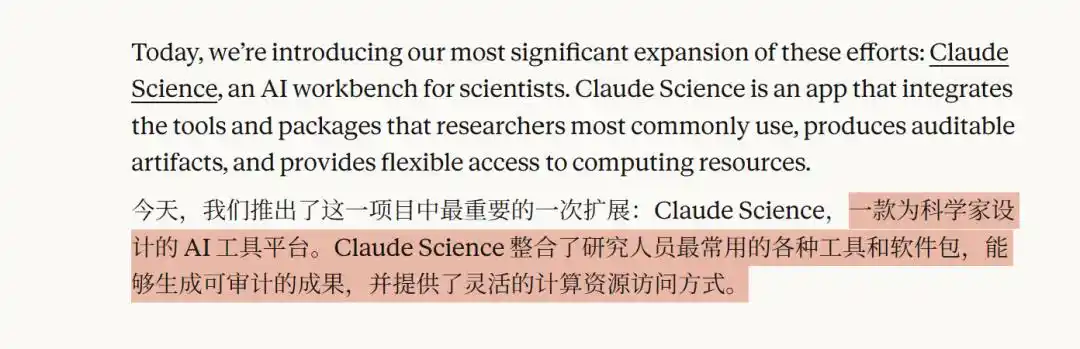
For example, previously, a researcher completing a study had to search literature on PubMed, write code in Jupyter, run statistics in R, connect to a cluster via SSH to submit tasks, and then use various tools to create charts and write papers.

Switching between a dozen windows, the mere 'transitions' between tools consumed a huge amount of energy.

What Claude Science aims to do is bundle all of this into the same workbench.

Specifically, it achieves several key integrations:

At the database and toolchain level, it comes with built-in connectors to over 60 scientific databases and pre-configured skill packages, covering common research fields like genomics, single-cell analysis, proteomics, structural biology, chemoinformatics, etc.

You ask in natural language, and specialized Agents automatically perform cross-database queries — no need to manually search databases like UniProt, PDB, Ensembl, ChEMBL, GEO one by one.

It also integrates with NVIDIA's BioNeMo Agent Toolkit, allowing direct connection to life science models like Evo 2, Boltz-2, OpenFold3.
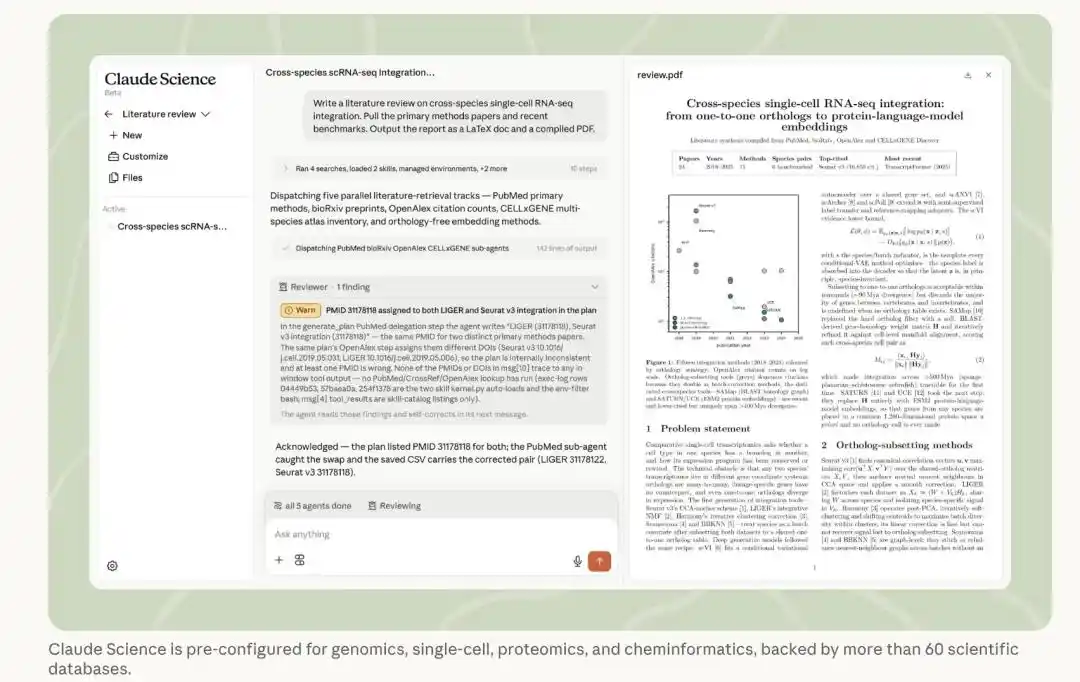
At the execution level, it introduces a multi-agent architecture.

The main Agent handles overall planning, sub-agents process different tasks in parallel, and there is a Reviewer Agent specifically responsible for fact-checking, such as verifying citations, validating calculation results, and flagging potential errors.

The generated output is not just text. It can natively render content like 3D protein structures, genome browser tracks, chemical structure formulas.

Moreover, each chart retains the generation code, runtime environment, natural language description, and complete conversation history.

In some scenarios, scientists can even modify charts with a single sentence, and the system automatically rewrites the underlying code.

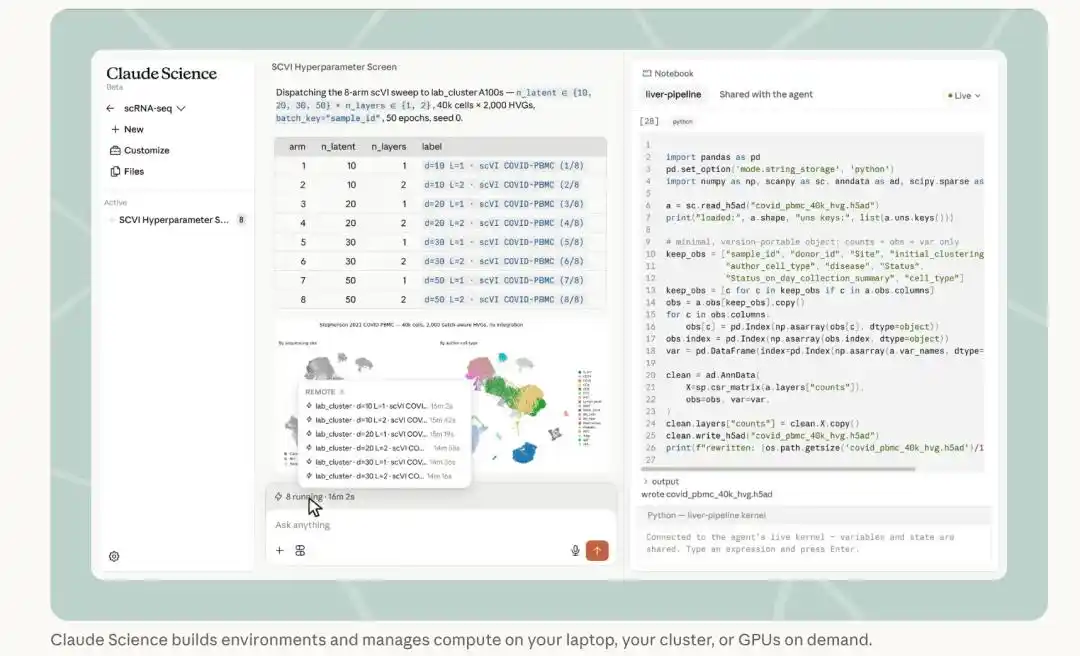
At the computing power level, Claude Science can directly interface with your lab's existing infrastructure.

Be it notebooks, Linux servers, or HPC cluster login nodes, it can connect via SSH or use a Modal account to call cloud GPUs on demand, scaling from a single GPU to hundreds.

Large-scale datasets only need to be loaded once; sensitive data never leaves your own system. Only the context needed for each step of analysis is sent to Claude.
Early beta users have already produced some practical cases.

Jerome Lecoq, a neuroscientist at the Allen Institute, used it to build a multi-agent 'computational review template' containing about 20 custom skills, letting sub-agents read thousands of papers, extract core viewpoints and quantitative data, and then generate review chapters one by one.

To put it simply, writing a review used to take two years; now he has about 10 drafts in hand —

Many exceed 100 pages, and all citations have been verified by the Reviewer Agent.

Stephen Francis from the UCSF Brain Tumor Center used it for molecular epidemiological studies of glioma, running germline variant analysis.

He said Claude Science compressed the previously required time to one-tenth, and his team independently validated the results, confirming the analysis was both fast and reliable.

Combined with the evaluation of AI research capabilities by Harvard physicist Matthew Schwartz this past March, Claude's current level is roughly equivalent to a second-year graduate student.

He published a guest post titled "Vibe Physics: The AI Grad Student" on the Anthropic official blog, documenting his entire process of using Claude Opus 4.5 to complete a theoretical physics paper.

His conclusion at the time was:

Current AI research capability is roughly equivalent to a second-year grad student — can work, doesn't complain about being tired, but needs a supervisor to monitor every step.

This assessment was later incorporated by Anthropic into the Claude Science technical documentation as a calibration point for the product's positioning.

However, Claude Science currently has several hard limitations:

Only supports macOS and Linux

Only available to Pro/Max/Team/Enterprise paying users

Only Claude's own models can be used on the platform

These thresholds stacked together, especially for domestic research teams in China, make Claude Science something "visible but out of reach."

Good News: An Open-Source Alternative is Here

Targeting the above limitations, the open-source project OpenScience emerged.

The team behind it is called Synthetic Sciences, founded in San Francisco in 2025, and just graduated from the YC Winter 2026 batch this year.

The founding team's ambition is not small: to build a platform that lets scientists directly delegate complex research tasks to "AI co-scientists," enabling AI to autonomously run the entire chain from literature review to hypothesis generation to experiment execution to paper writing.

They have an internal core belief:

Scientific foundation models need to possess genuine 'research taste,' and this taste cannot be achieved by simply scaling parameters. It must be a two-pronged approach: product and model. Use the product to collect high-quality scientific process data, then use this data to train models with taste.

OpenScience is the first product landing on this path.
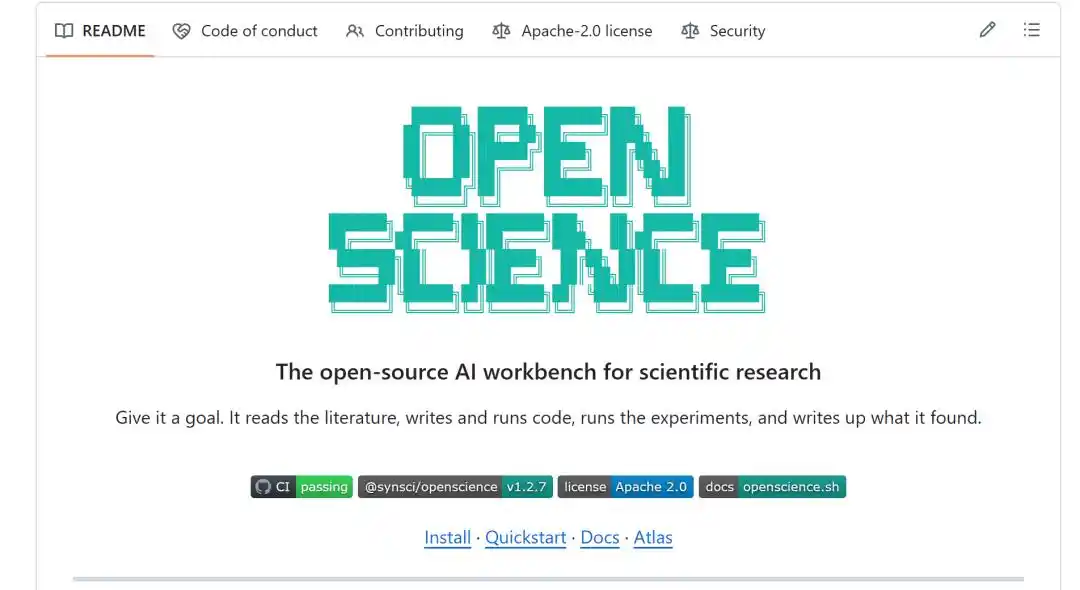
Although OpenScience's mission is the same as Claude Science's, they have a fundamental difference:

Model-agnostic.

In Synthetic Sciences' own words:

Scientific AI should be open. The tools humans use for exploration and discovery should not be monopolized by one company, nor should that company decide who is qualified to use them.

Therefore, on this platform, Anthropic, OpenAI, Google, DeepSeek, GLM... as long as you have an API Key, you can connect directly.

You can even run local models, deploy via Ollama, without a single byte of your data leaving your machine.

Your Key stays locally, requests go directly to the model provider, not passing through any intermediate server.

Moreover, OpenScience supports switching models per request.

Within the same workbench, you can use Claude for this step, then switch to DeepSeek for the next, without changing any configuration.
Feature-wise, OpenScience is even more aggressive than Claude Science —

Built-in with over 250 research skill packages, more than 4 times that of Claude Science, covering ML, computational biology, chemoinformatics, etc., and all are readable, editable, and extensible.
Installation is also simple, just one command in the terminal:

Open and use immediately, the workbench automatically pops up in the browser. On first run, select a model source, fill in the API Key, and you can start working.

You can also install it globally:

If configuring Keys is troublesome, the team also provides a hosted platform called Atlas —

Top up a wallet to directly call various cutting-edge models without configuring Keys one by one, plus persistent research graphs and cloud computing power.

But Atlas is not mandatory. You can use OpenScience fully for free with your own Keys, no barrier.

One More Thing

Interestingly, if you scroll to the very bottom of OpenScience's GitHub page, you'll see a statement added specifically:

OpenScience is an independent project. It is not affiliated with, endorsed by, or sponsored by Anthropic. “Claude” is a trademark of Anthropic, PBC, used here only to describe compatibility.
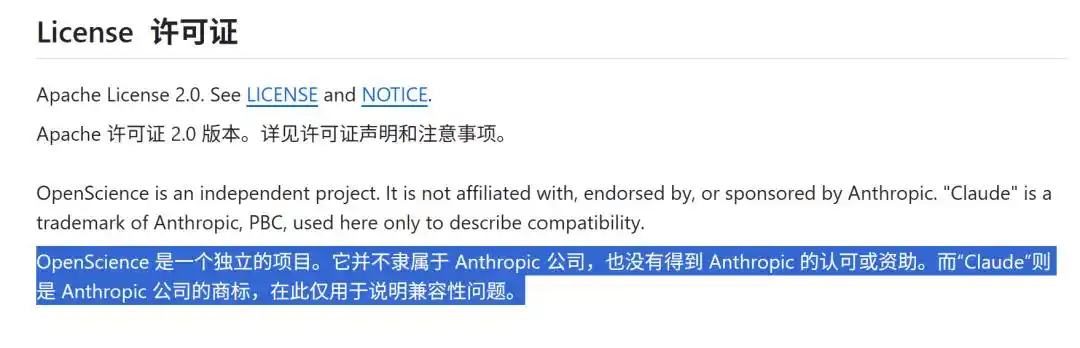
Translation: We are an independent project, with no relation to Anthropic whatsoever. Mentioning "Claude" is purely about describing compatibility, don't read too much into it.

It seems the impression left by the "lobster" incident on the entire open-source community is still too profound.

With OpenClaw changing names several times before, OpenScience this time directly welded the disclaimer onto the first version of the README.

Nothing else — survive first, then talk about being an alternative (doge).

Open-source address:

https://x.com/i/trending/2073904804829741364?s=20

Reference links:

[1]https://x.com/SynScience/status/2073829478393086311?s=20

[2]https://x.com/i/trending/2073904804829741364?s=20

[3]https://www.openscience.sh/

[4]https://www.anthropic.com/news/claude-science-ai-workbench

This article is from WeChat official account "QbitAI", author: Yi Shui

Trend Kriptolar

İlgili Sorular

QWhat is OpenScience and how does it compare to Claude Science?

AOpenScience is an open-source AI scientific research workbench that serves as a free alternative to Anthropic's Claude Science. Unlike Claude Science, which is proprietary and limited to Claude models for paid users, OpenScience is model-agnostic, allowing users to freely choose and switch between various AI models like DeepSeek, GLM, Claude, or GPT via API keys or local deployments. It is released under the Apache 2.0 license and offers more than 250 research skill packages, significantly more than Claude Science's 60+.

QWhat are the key limitations of Claude Science mentioned in the article?

AClaude Science has several key limitations: 1) It only supports macOS and Linux operating systems. 2) It is exclusively available to Pro, Max, Team, and Enterprise paying users. 3) Users are restricted to using only Anthropic's proprietary Claude models on the platform. These restrictions, especially the payment requirement and model lock-in, make it inaccessible to many researchers, particularly in certain regions.

QHow does OpenScience address data privacy and local deployment?

AOpenScience prioritizes data privacy and flexibility by supporting local model deployment. Users can run models locally using tools like Ollama, ensuring that sensitive research data never leaves their own machines. API keys are also stored locally, and requests are sent directly to the model provider without passing through any intermediate servers, giving researchers full control over their data and computational environment.

QWhat was the early user feedback on Claude Science's capabilities?

AEarly internal testers reported positive results. A neuroscientist at the Allen Institute used Claude Science to create a multi-agent computational review template, enabling the generation of lengthy, citation-verified review papers in a fraction of the traditional time (e.g., producing ~10 papers over 100 pages each that previously would have taken years). A researcher at UCSF's Brain Tumor Center used it for molecular epidemiology studies, reducing the required time for germline variant analysis to one-tenth while maintaining result accuracy verified by his team.

QWhat is the stated long-term vision of the Synthetic Sciences team behind OpenScience?

AThe Synthetic Sciences team aims to build a platform where scientists can delegate complex research tasks to 'AI co-scientists' that autonomously handle the entire research pipeline from literature review to hypothesis generation, experiment execution, and paper writing. They believe that truly capable scientific foundation models require 'research taste,' which cannot be achieved by merely scaling model parameters. Instead, it requires a product-model co-development approach, where the product collects high-quality research process data to train models with genuine scientific intuition.

İlgili Okumalar

Ray Dalio's Latest Macro Analysis Full Text: Buy More Gold, Add Some Bitcoin

In his latest macro analysis, Ray Dalio applies his framework from "How Countries Go Broke: The Big Cycle" to the current global debt environment. He highlights recent events like Japan selling U.S. Treasuries and rising U.S. long-term yields as signs of an unsustainable debt dynamic. Dalio explains that excessive government debt leads to either unacceptably high interest rates, severe economic downturns, or significant currency debasement through central bank money printing. He summarizes the U.S. fiscal situation: with $5.5 trillion in revenue, $7.5 trillion in spending, a $2 trillion deficit, and total debt at six times annual revenue, debt servicing costs are immense. Without correction, U.S. debt could reach $55-$60 trillion in a decade. Dalio proposes a "3% Three-Way" solution: reducing the budget deficit to 3% of GDP through balanced spending cuts, tax increases, and interest rate reductions to avoid a traumatic adjustment. In response to FAQs, he argues that the risk of a U.S. debt crisis is high and could materialize within a few years if the current path continues. He dismisses the notion that the dollar's reserve status makes the U.S. immune, citing historical precedents of reserve currency declines. He is also unconvinced by Japan's high-debt stability, noting poor returns for yen-denominated assets. For investors, Dalio recommends diversifying globally, underweighting bonds, and overweighting assets like gold and a small allocation to Bitcoin (around 10-15% to gold) to hedge against currency debasement and poor debt returns.

marsbit6 dk önce

Ray Dalio's Latest Macro Analysis Full Text: Buy More Gold, Add Some Bitcoin

marsbit6 dk önce

Stripe’s 16-Year Chronicle: From 7 Lines of Code to a $100 Billion Valuation

Stripe's 16-year journey began with a simple promise: "7 lines of code to accept payments." Founded by Patrick and John Collison, the company started by hiding the complexity of bank integrations and merchant accounts behind a clean API, initially targeting developers at startups. This early focus on user experience and technical simplicity fueled rapid adoption. A key early milestone was establishing vital bank partnerships, a challenge overcome by hiring Billy Alvarado, who brought crucial institutional relationship skills. From this foundation, Stripe systematically expanded its product boundaries. It launched Connect for platform payments, Atlas for company formation, Radar for fraud prevention, and Billing for subscriptions. This transformed Stripe from a payment processor into a broader financial infrastructure suite for internet businesses. The COVID-19 pandemic accelerated growth but also led to over-hiring. A 14% layoff in 2022 marked a period of organizational correction. Subsequently, Stripe shifted its growth strategy towards strategic acquisitions to enter new domains quickly. It acquired Bridge (stablecoin infrastructure), Privy (wallet infrastructure), Metronome (usage-based billing), and agreed to buy OpenRouter (AI model routing). These moves signal Stripe's ambition to build a "programmable money system" for the emerging AI and agent-based economy, managing not just currency flows but also the measurement and pricing of computational resources like AI tokens. Internally, Stripe leverages AI agents (like "Minions") to boost engineering productivity. Despite scaling to nearly 8,000 employees and processing $1.9 trillion in payment volume annually, the company remains private. A recent employee tender offer valued it at $159 billion. The core question for Stripe's future is whether it can successfully integrate its expanding product matrix—spanning payments, crypto, and AI infrastructure—into a cohesive platform, positioning itself as the foundational economic layer for autonomous software agents.

marsbit35 dk önce

Stripe’s 16-Year Chronicle: From 7 Lines of Code to a $100 Billion Valuation

marsbit35 dk önce

Treasury Secretary's Move to Suppress Treasury Yields Ignites 'Currency Debasement Trade'! Gold Hits Three-Month High, Bitcoin Surges Over 25% in a Single Week

US Treasury Secretary Besant's efforts to lower long-term Treasury yields by announcing expanded buybacks had only a brief market impact. However, this move fueled a "currency devaluation trade," weakening the US dollar while boosting both gold (to a three-month high) and Bitcoin (up over 25% for the week). Analysts attribute this reaction to deepening market concerns over the massive US fiscal deficit and structural pressures keeping long-term rates elevated, including fierce competition for capital from global government borrowing and massive AI sector financing. Despite the Treasury's actions, fundamental forces like growth, inflation, and capital demand are seen as limiting its ability to sustainably suppress yields. Bitcoin's strong positive correlation with gold has reinforced its narrative as a hedge against devaluation. While equity markets have shown resilience, some strategists warn that Treasury yields nearing 5% increase pressure on the dollar and high-leverage assets. Figures like Ray Dalio have advised reducing bond exposure in favor of gold and some Bitcoin, citing US debt risks. Market opinions are divided on the sustainability of the devaluation trade, with some noting the lack of a near-term catalyst for its next leg higher. The underlying tension between the Treasury's desire for lower borrowing costs and the Federal Reserve's focus on inflation and reducing market intervention remains a key theme. Upcoming events like Nvidia's earnings and the Jackson Hole symposium will test whether AI profits can continue supporting stocks and if the Fed aligns more with Washington's preference for easier financial conditions.

华尔街日报2 saat önce

Treasury Secretary's Move to Suppress Treasury Yields Ignites 'Currency Debasement Trade'! Gold Hits Three-Month High, Bitcoin Surges Over 25% in a Single Week

华尔街日报2 saat önce

Alexander Shokhin: Business Needs an Interest Rate Below 10% and the Dollar at 90-95 Rubles

Alexander Shokhin, head of the Russian Union of Industrialists and Entrepreneurs (RSPP), has advocated for potentially using "non-market" tools to keep the ruble within a target exchange rate corridor. This, he argues on August 21, would help avoid excessive volatility, though he called the topic a separate discussion. Shokhin had previously raised the idea of a currency corridor in late May, noting the ruble's current exchange rate is not fully market-driven due to a limited currency segment and reduced foreign currency demand. He stated that many business community colleagues propose fixing a corridor, even through non-market methods, to ensure predictability. The business community's key targets, as outlined by Shokhin in late December 2025, are a Central Bank key rate of 12%, inflation of 4–5%, and a US dollar exchange rate of 90–95 rubles by the end of 2026. A turning point for investment, he said, would be lowering the rate to 12% with 6% inflation, though truly comfortable business conditions would require a rate below 10%. He stressed the critical importance of currency predictability for corporate investment decisions. From a data analysis perspective, the idea of a ruble corridor is not new. A similar mechanism was used in Russia from 1995 to 1998, where the central bank held the dollar within fixed boundaries through regular interventions. This regime lasted three years before ending abruptly during the 1998 default, illustrating the fragility of rigid targets under external shocks. The macro-economic link is clear: stricter corridors require more reserves to defend against currency pressure. The key unresolved technical aspect is the specific sources and volume of such interventions given the current market's limited liquidity. Whether this discussion remains theoretical or leads to concrete corridor parameters will be seen in the coming months.

cryptonews.ru4 saat önce

Alexander Shokhin: Business Needs an Interest Rate Below 10% and the Dollar at 90-95 Rubles

cryptonews.ru4 saat önce

İşlemler

Spot

Popüler Makaleler

GLM Nasıl Satın Alınır

HTX.com’a hoş geldiniz! Golem (GLM) satın alma işlemlerini basit ve kullanışlı bir hâle getirdik. Adım adım açıkladığımız rehberimizi takip ederek kripto yolculuğunuza başlayın. 1. Adım: HTX Hesabınızı OluşturunHTX'te ücretsiz bir hesap açmak için e-posta adresinizi veya telefon numaranızı kullanın. Sorunsuzca kaydolun ve tüm özelliklerin kilidini açın. Hesabımı Aç2. Adım: Kripto Satın Al Bölümüne Gidin ve Ödeme Yönteminizi SeçinKredi/Banka Kartı: Visa veya Mastercard'ınızı kullanarak anında Golem (GLM) satın alın.Bakiye: Sorunsuz bir şekilde işlem yapmak için HTX hesap bakiyenizdeki fonları kullanın.Üçüncü Taraflar: Kullanımı kolaylaştırmak için Google Pay ve Apple Pay gibi popüler ödeme yöntemlerini ekledik.P2P: HTX'teki diğer kullanıcılarla doğrudan işlem yapın.Borsa Dışı (OTC): Yatırımcılar için kişiye özel hizmetler ve rekabetçi döviz kurları sunuyoruz.3. Adım: Golem (GLM) Varlıklarınızı SaklayınGolem (GLM) satın aldıktan sonra HTX hesabınızda saklayın. Alternatif olarak, blok zinciri transferi yoluyla başka bir yere gönderebilir veya diğer kripto para birimlerini takas etmek için kullanabilirsiniz.4. Adım: Golem (GLM) Varlıklarınızla İşlem YapınHTX'in spot piyasasında Golem (GLM) ile kolayca işlemler yapın.Hesabınıza erişin, işlem çiftinizi seçin, işlemlerinizi gerçekleştirin ve gerçek zamanlı olarak izleyin. Hem yeni başlayanlar hem de deneyimli yatırımcılar için kullanıcı dostu bir deneyim sunuyoruz.

179 Toplam GörüntülenmeYayınlanma 2024.12.10Güncellenme 2026.06.02

GLM Nasıl Satın Alınır

Tartışmalar

HTX Topluluğuna hoş geldiniz. Burada, en son platform gelişmeleri hakkında bilgi sahibi olabilir ve profesyonel piyasa görüşlerine erişebilirsiniz. Kullanıcıların GLM (GLM) fiyatı hakkındaki görüşleri aşağıda sunulmaktadır.

活动图片












