Claude Engineer Finally Unveils Fable 5's Ultimate Strategy, Teaching You How to Bridge the Information Gap with AI Models

marsbit2026-07-06 tarihinde yayınlandı2026-07-06 tarihinde güncellendi

Özet

This article, titled "Claude Engineer Finally Releases Fable 5 'Skill-Burning' Guide, Teaching How to Bridge the Information Gap with Models," details a blog post by Claude Code engineer Thariq Shihipar. The core concept is the "information gap" or "unknowns"—the disconnect between a user's instructions (the "map") and the actual task requirements (the "territory"). The article argues that with powerful models like Claude Fable 5, work quality depends on the user's ability to identify and clarify these unknowns. Shihipar categorizes unknowns into four types: Known Knowns (explicit instructions), Known Unknowns (awareness of gaps), Unknown Knowns (implicit, unstated knowledge), and Unknown Unknowns (unforeseen issues). The blog provides a framework for addressing these gaps throughout the workflow: * **Before Implementation:** Techniques include "Blindspot Scanning" to uncover Unknown Unknowns, brainstorming/prototyping for visual or complex tasks, having Claude ask clarifying questions, using reference code/examples, and creating implementation plans. * **During Implementation:** Maintaining an "implementation notes" file for Claude to document deviations and decisions made due to encountered edge cases. * **After Implementation:** Creating summary documents for review and having Claude generate quizzes to ensure the user fully understands the completed changes. The article concludes that as models become more capable, the key to success is systematically discovering...

The fate of Fable 5 has been as mystifying as its model's name since its release.

From the highly anticipated "AI's Defining Moment" to being forced offline by a U.S. government ban, and then restricting access to non-Americans, it has captivated global attention.

Now, the storm has gradually subsided. Ultimately, models must return to productivity.

To this end, Claude Code engineer Thariq Shihipar published a detailed blog post on social media, outlining techniques for using Fable 5.

This article addresses a long-standing question. With models having evolved to such powerful capabilities, why do I still feel they perform tasks incorrectly when I use them?

Thariq's blog post is an eye-opener. In short: there is an information gap between humans and models, a disparity between the prompts, Skills, and context provided by the user and the actual task execution.

Thus, the entire blog post teaches you how to bridge this information gap. Below, Machine Heart provides the full blog post for our readers.

Blog Title: A Field Guide to Fable: Finding Your Unknowns

Blog Link: https://x.com/trq212/status/2073100352921215386

Working with Claude Fable 5 constantly reminds me of an old adage: the map is not the territory.

The "map" is the representation of the work to be done—my prompts, skills, and context—what I give to Claude. The "territory" is where the work actually needs to happen: the codebase, the real world, and the real constraints within.
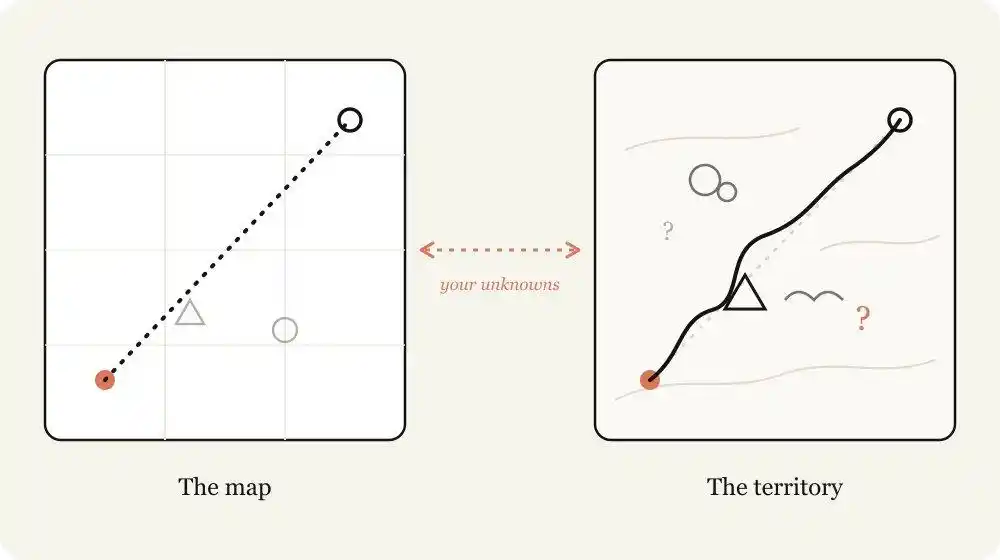
I call the gap between the map and the territory "unknowns." When Claude encounters an unknown, it must make a decision based on its best guess of my intent. The more complex the work, the more unknowns Claude might encounter.

Fable is the first model where I've strongly felt that the bottleneck of work quality depends on my ability to clarify its unknowns.

Importantly, mere upfront planning isn't always enough. You might discover unknowns deep in implementation; you might also find these unknowns point to the fact that you should be solving the problem in a completely different way.

I find that collaborating with Fable is essentially an iterative process of discovering unknowns before, during, and after implementation.

The author provides some examples of discovering "unknowns." Readers are encouraged to review them alongside the full article.
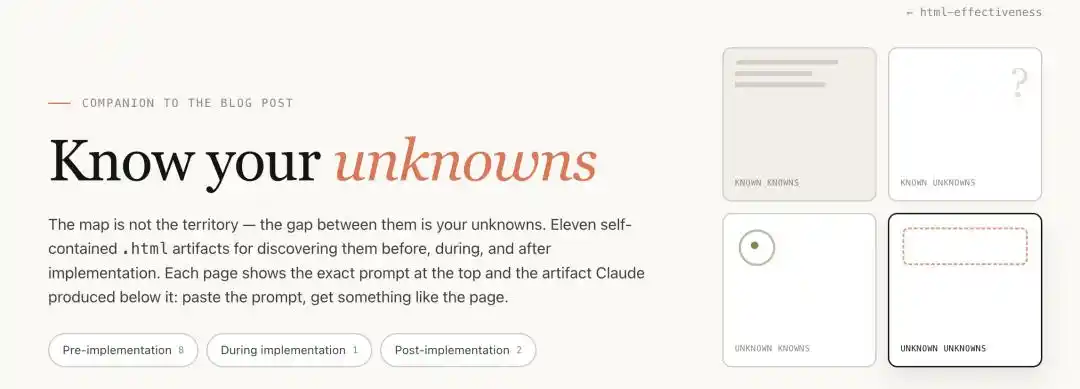
Example Link: https://thariqs.github.io/html-effectiveness/unknowns/

Know Your Unknowns

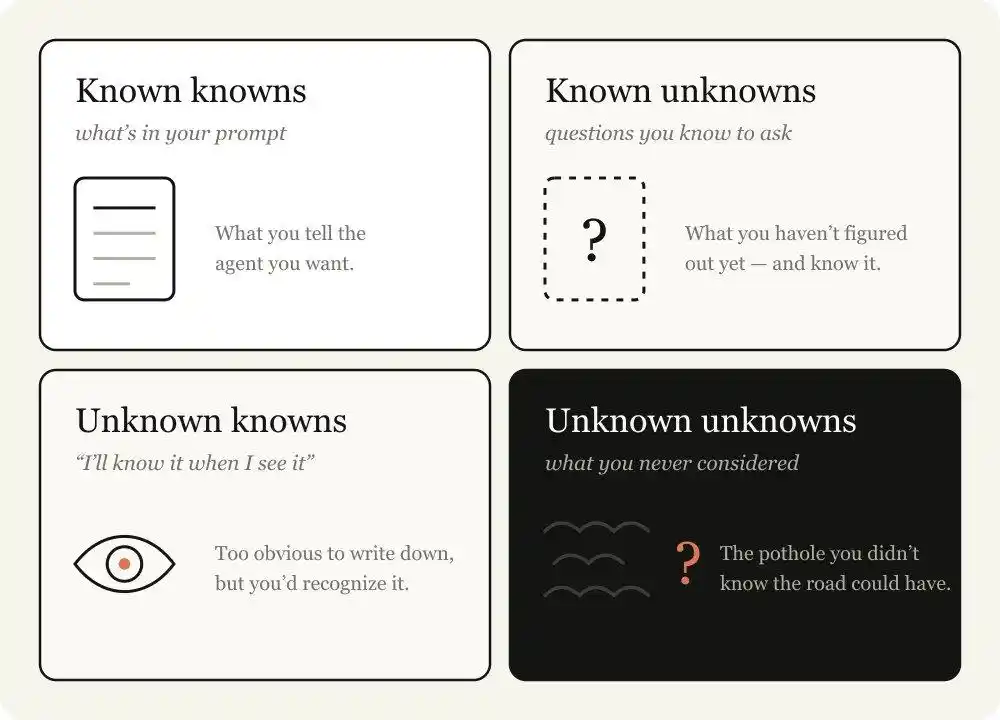
What are unknowns? When I approach Claude with a problem, I typically break it down from four perspectives:

Known knowns: This is basically what I write in the prompt. I tell the agent what I want.

Known unknowns: What things haven't I figured out yet, but I know I haven't figured them out?

Unknown knowns: What things are so obvious to me that I wouldn't even write them down, but I'd recognize them if I saw them?

Unknown unknowns: What things haven't I considered at all? What knowledge do I not yet know I don't know? Do I know how well something can be done?
The most skilled agent-style programmers tend to have relatively fewer unknowns. They know exactly what they want, in great detail. They are highly synchronized with both the codebase and model behavior.

But they also presuppose the existence of unknowns. In many ways, reducing and planning for your unknowns ahead of time is the core skill of agent-style programming. Fortunately, this is a skill that can be honed by collaborating with Claude.

Help Claude Help You
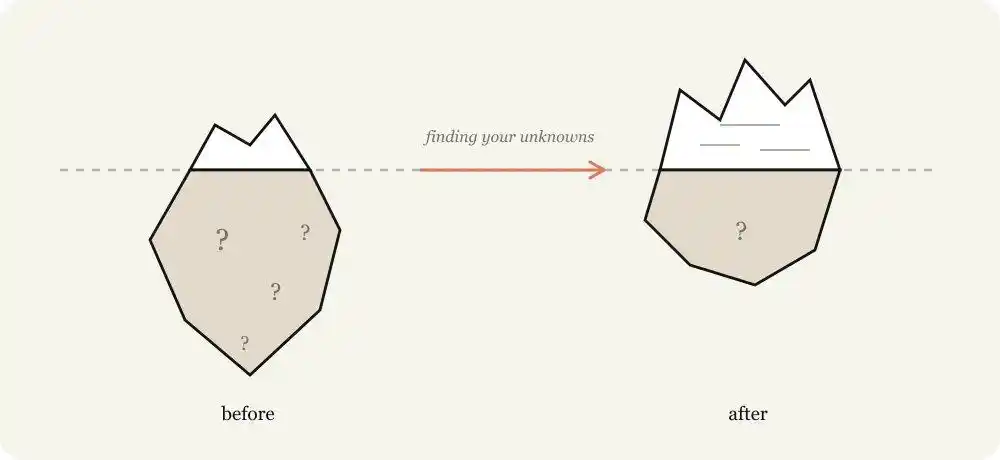
Giving instructions to Claude is a delicate balance. If you're too specific, Claude will follow your instructions strictly, even if pivoting to a different approach might be better. If you're too vague, Claude will often make choices and assumptions based on industry best practices, which may not be right for your task.

Both can fail when you haven't adequately considered your unknowns. You don't know when the road ahead is fraught with obstacles, nor do you know when it's actually smooth, but you still want Claude to make adjustments if necessary.

Claude can help you discover unknowns faster. It can search your codebase and the internet incredibly quickly, and it possesses more general knowledge on most topics than you do. It can also iterate faster from failures.

The most important part of this process is giving Claude enough starting context. For example, tell it what step you're currently thinking about; explain your level of familiarity with the problem and codebase; let it collaborate with you as a thinking partner.

I've previously written about generating HTML with Claude. In almost all those scenarios, the HTML artifact is the best way to visualize and express ideas.

In this article, I'll detail some patterns I use to discover these unknowns. I don't use all these tricks every time, but having them as a toolkit to call upon is incredibly useful.
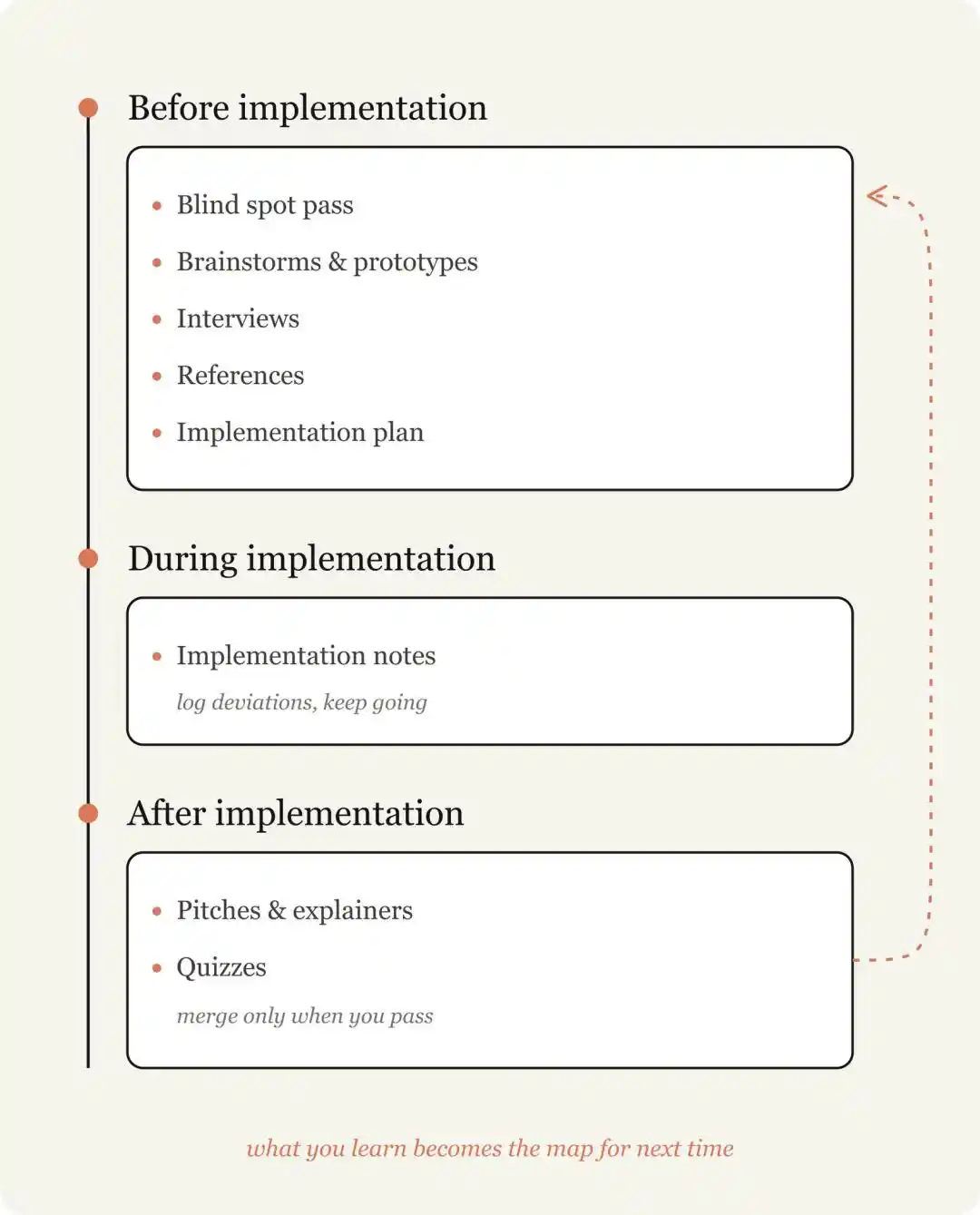
Before Implementation

Blindspot Scan

One of the most useful things when starting work is understanding your blind spots. For example, if you're writing a feature in a new module of the codebase, or having Claude handle a type of work you're unfamiliar with, like iterating on a design, you're likely to have many "unknown unknowns."

You might not know what questions to ask, what constitutes "good," what historical work has been done before, or what pitfalls to avoid.

To do this, you can ask Claude to help find your "unknown unknowns" and explain them. I like to use the terms "blindspot pass" and "unknown unknowns" directly. Usually, it's also important to tell it who you are and what you know.

Example prompts:

"I'm adding a new identity authentication provider, but I know nothing about the auth module in this codebase. Can you do a blindspot pass, help me find relevant unknown unknowns, and assist me in writing better prompts for you?"

"I don't understand color grading, but I need to grade this video. Can you teach me to understand my unknown unknowns about color grading so I can write better prompts?"

Brainstorming & Prototyping

When I'm working in a domain with many "unknown knowns"—things I only know how to define standards for once I see them—I have Claude brainstorm and prototype with me.

Identifying and expressing these "unknown knowns" early in the prototyping stage is valuable because discovering them during implementation often carries a higher relative cost. Small changes in features or specifications can lead to vastly different code implementations, and it's harder to get the agent to backtrack on previous changes.

For example, you might just want to see what adding a button looks like in a certain framework, without actually hooking up the backend routes or maintaining extra frontend state.

Visual design is something I find hard to articulate clearly, but I know what I want when I see it. In such cases, I ask Claude to provide several different design directions for an artifact.

I also start almost every coding session with exploration or brainstorming. This helps me define the project scope with clear intent. Claude often discovers high-value approaches I would have missed, but it can also miss the forest for the trees. Brainstorming prevents me from setting the scope too narrowly or too broadly from the start.

Example prompts:

"I want to make a dashboard for this dataset, but I have no visual taste and don't know what's possible. Help me create an HTML page with 4 vastly different design styles so I can provide feedback based on the results."

"Before wiring anything up, create a standalone HTML file with fake data to simulate the new editor toolbar. I want to give feedback on the layout first before you touch the real app."

"Here's my rough problem: user churn after completing onboarding. Search the codebase and brainstorm 10 places we could intervene, from lowest cost to most ambitious. I'll tell you which directions feel better."

Reverse Interview

After enough brainstorming, I usually still have unknowns.

In such cases, I have Claude interview me around anything unclear or ambiguous. When having Claude interview you, try to provide context about the problem so it can ask more targeted questions. Here are some examples.

Example prompts:

"Please ask me one question at a time, interviewing me around any points of ambiguity. Prioritize questions where my answer would change the architectural design."

Reference Materials

Sometimes, you can't describe in detail what you want. Maybe you lack the language to express it, or it's too complex to describe fully within a reasonable time.

In such cases, the best answer is reference materials. You can provide diagrams, documentation, or images, but the best reference is often source code.

If you have a library that implements a feature in a specific way, or a design component you really like, just point Fable to the corresponding folder and tell it what to look at. Even if the reference code is in another language, that's okay.

This is also how Claude Design works. You don't necessarily have to give it a file, though you can. You can point it to a module on a website you like, and it will read the underlying code, not just a screenshot. This provides richer detail—markup structure, component organization, and how the component is actually built.

Example prompts:

"This Rust crate in vendor/rate-limiter implements exactly the exponential backoff retry behavior I want. Please read it and reimplement the same semantics in our TypeScript API client."

Implementation Plan

When I feel ready to start implementation, I usually have Claude first compile an implementation plan for my review, focusing on parts most likely to change, such as data models, type interfaces, or UX flows. This lets Claude surface areas I might indeed need to adjust ahead of time.

Example prompts:

"Write an implementation plan in HTML, but start by presenting the decision points I'm most likely to change: data model changes, new type interfaces, and any user-facing content. Put mechanical refactoring at the bottom; I trust you can handle that part."

During Implementation

Implementation Notes

When satisfied with the plan, I start a new session and pass the relevant artifacts into the prompt. For example, I might pass a specification file and a prototype, then ask the agent to implement it.

But the truth is, no matter how much you plan, unknown unknowns will always lurk. The agent might discover mid-work that it must take a different approach due to an edge case in the code.

I ask Claude Code to maintain a temporary implementation-notes.md file, or an .html file, to record the decisions it makes, so we can learn from them for the next attempt.

Example prompts:

"Please maintain an implementation-notes.md file. If you encounter an edge case forcing you to deviate from the original plan, choose the conservative option, record the reason under 'Deviations,' and continue."

After Implementation

Pitch & Explanation Documentation
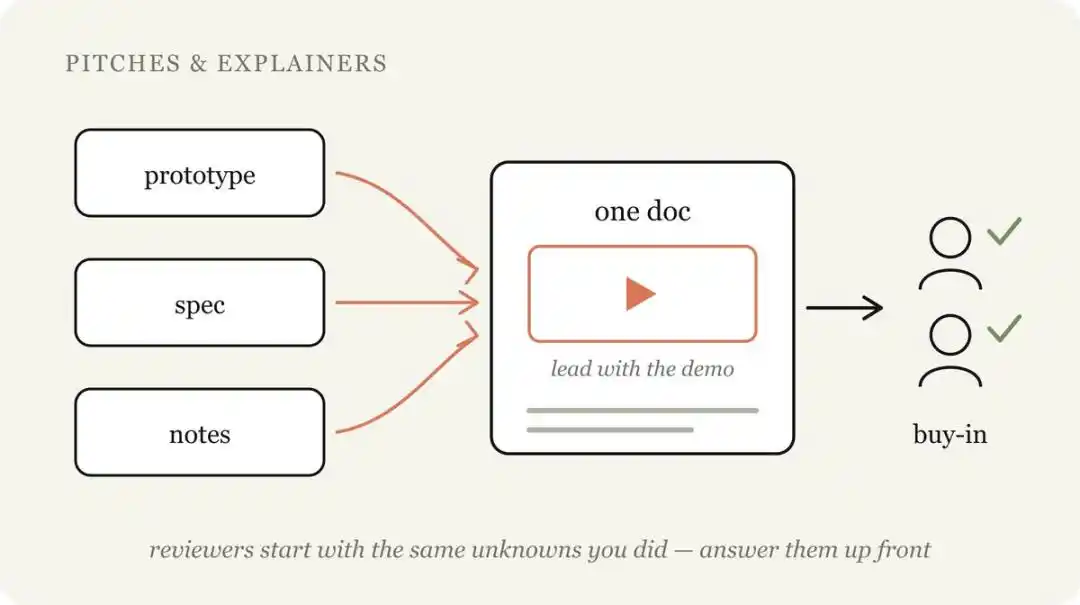
One of the most important things when shipping something is getting others' understanding, support, and approval. Building pitch and explanation artifacts into the final documentation helps:

Accelerate reviewers' understanding when they start with the same unknowns you had.

Accelerate approval from experts when they want to confirm you've considered the unknowns and common failure points they would have foreseen.

Example prompts:

"Package the prototype, spec, and implementation notes into a single document I can directly post on Slack to seek support. Start with a demo GIF."

Quizzes

After a long work session, Claude might have accomplished more than I realize. Just looking at the code diff often gives me only a shallow understanding of what happened, as much behavior depends on existing code paths.

Having Claude test me on the changes after providing substantial context helps me truly understand what occurred. I only merge the code after perfectly passing the quiz.

Example prompts:

"I want to ensure I understand everything that happened in this change. Please give me an HTML report to help me read and understand these changes, including context, intuitive explanations, what was done concretely, etc., and attach a quiz at the bottom that I must pass."

Putting It All Together: The Fable Launch Example

The launch video for Fable was entirely edited by Claude Code. This was a completely new field for me, and I am by no means an expert.

So I started with what I knew. I knew Claude could use code to edit videos and transcribe, but I wasn't sure if its accuracy was sufficient. So I had Claude explain how transcription technologies like Whisper work and whether I could use ffmpeg to accurately cut filler words like "um" or long pauses.

I wanted Claude to create a UI synchronized with my spoken words in time, but I wasn't sure if it could. So I had Claude create a video prototype using Remotion and transcript text to see if the idea was feasible.

Finally, the video itself looked somewhat dark. I knew this was a color grading issue, but I didn't truly understand what color grading was. My first attempt was to have Claude make a few versions for me to choose from, but I realized that when it comes to color grading, I didn't know what "good" was. So, instead of having it generate versions blindly, I had Claude teach me color grading to discover my unknowns.

Matching the Map to the Territory

The more powerful the model, the more you can accomplish with the right approach. When a long-cycle task returns an incorrect result, it likely means you need to spend more time defining your unknowns or creating an implementation plan that allows Claude to navigate these unknowns flexibly.

Every explanation document, brainstorming session, interview, prototype, and reference material is a low-cost way to discover things you didn't know before the cost of fixing them becomes high.

So, when starting your next project, first let Claude help you find your unknowns.

This article is from the WeChat public account "Machine Heart," edited by the Machine Heart Editorial Department.


Trend Kriptolar

İlgili Sorular

QWhat is the core issue that prevents AI models like Claude Fable 5 from performing tasks correctly, according to the article?

AAccording to the article, the core issue is the information gap or 'unknowns' between the user (the map) and the actual task execution environment (the territory). This gap exists in the prompts, skills, and context provided versus what is truly needed in the codebase or real world.

QWhat are the four categories of 'unknowns' mentioned in Thariq Shihipar's framework for breaking down a problem?

AThe four categories are: Known Knowns (what is written in the prompt), Known Unknowns (things the user knows they haven't figured out), Unknown Knowns (things obvious to the user that aren't written down but can be recognized), and Unknown Unknowns (things the user hasn't considered or knowledge they don't know they lack).

QWhat is one specific technique recommended for the 'Before Implementation' phase to help identify blind spots?

AOne recommended technique is a 'Blindspot Scan.' The user can ask Claude to help identify 'Unknown Unknowns' by using prompts like, 'Can you do a blindspot pass for me to identify relevant unknown unknowns to help me write better prompts?'

QHow can providing references, especially source code, help when working with Claude Fable 5?

AProviding references, especially source code, helps when the user cannot fully describe what they want. It gives Claude a concrete example of the desired implementation, style, or component structure, even if the reference code is in a different language, allowing for more accurate and detailed task execution.

QWhat practice does the author recommend for the 'After Implementation' phase to ensure a reviewer's understanding and approval?

AThe author recommends creating 'Pitch and Explanation Documentation.' This involves packaging prototypes, specifications, and implementation notes into a single document (often starting with a demo GIF) to quickly bring reviewers up to speed and address potential concerns they might have.

İlgili Okumalar

ARK Invest Heavily Buys Crypto-Related Stocks: Lower Risk, or Double Pressure?

During Bitcoin's worst monthly performance in four years, ARK Invest, led by Cathie Wood, purchased $77 million worth of stock in crypto-related public companies in June, including Coinbase, Circle, and Bullish. The investment thesis suggests these stocks offer compliant exposure to the crypto sector without directly holding Bitcoin. However, analysis reveals significant drawbacks: these stocks exhibit nearly double the volatility of Bitcoin itself (68%-90% vs. 37.6% over 30 days) and only moderate correlation with Bitcoin prices (0.55-0.58 for several firms). This indicates investors are exposed to both partial crypto price movements and a full suite of company-specific business risks like earnings, competition, and financing. MicroStrategy (MSTR) is the closest to a pure Bitcoin proxy with high correlation and leverage (beta of 1.59). In contrast, Circle's price is heavily influenced by stablecoin competition, while Robinhood's diversified business buffers crypto downturns but also limits upside. Notably, some mining stocks (RIOT, MARA) have risen sharply in 2024 due to AI-related ventures, decoupling from Bitcoin's decline. The case of MicroStrategy highlights additional equity-specific risks like potential shareholder dilution and the breakdown of its premium valuation model (mNAV), which recently forced it to consider selling Bitcoin for liquidity. While some stocks like Coinbase have outperformed Bitcoin year-to-date, the data suggests investing in crypto equities generally amplifies volatility or layers on independent business risks compared to direct Bitcoin ownership.

marsbit41 dk önce

ARK Invest Heavily Buys Crypto-Related Stocks: Lower Risk, or Double Pressure?

marsbit41 dk önce

DeepMind's Classic Masterpiece Crowned Again, ICML 2026 Awards Announced

ICML 2026 has announced its annual awards, with diffusion models and AI safety ethics taking center stage. The Outstanding Paper Award was shared by two diffusion model studies. One challenges a core assumption of diffusion language models (DLMs), arguing that their touted "arbitrary order generation" is a "flexibility trap" that harms performance. The other provides a high-accuracy sampling method, pushing the technical ceiling for diffusion models and log-concave distributions. A position paper winning the Outstanding Award raises a critical ethical concern: AI alignment research is unintentionally building a "censor's toolkit," where safety tools like RLHF can be repurposed for content control. Several papers received Honorable Mentions, spanning key areas: mapping where honesty emerges in RLHF-trained models, motion attribution in video generation, quantifying how much language models memorize, analyzing diffusion model consistency via random matrix theory, and providing a mathematical proof for the "grokking" phenomenon in a simple model. The Test of Time Award was given to DeepMind's 2016 seminal work "Asynchronous Methods for Deep Reinforcement Learning," recognizing the enduring impact of the A3C algorithm. Overall, the awards signal a shift in AI research from rapid expansion to deeper scrutiny—validating diffusion models as a major architectural contender while prompting serious ethical reflection within the safety community.

marsbit57 dk önce

DeepMind's Classic Masterpiece Crowned Again, ICML 2026 Awards Announced

marsbit57 dk önce

İşlemler

Spot

Popüler Makaleler

$S$ Nedir

SPERO'yu Anlamak: Kapsamlı Bir Genel Bakış SPERO'ya Giriş İnovasyonun manzarası gelişmeye devam ederken, web3 teknolojilerinin ve kripto para projelerinin ortaya çıkışı dijital geleceği şekillendirmede önemli bir rol oynamaktadır. Bu dinamik alanda dikkat çeken projelerden biri SPERO, $$s$$ olarak adlandırılmaktadır. Bu makale, SPERO hakkında ayrıntılı bilgi toplamak ve sunmak amacıyla, meraklılar ve yatırımcıların web3 ve kripto alanlarındaki temellerini, hedeflerini ve yeniliklerini anlamalarına yardımcı olmayı amaçlamaktadır. SPERO,$$s$$ Nedir? SPERO,$$s$$, kripto alanında merkeziyetsizlik ve blok zinciri teknolojisi ilkelerini kullanarak etkileşimi, faydayı ve finansal kapsayıcılığı teşvik eden bir ekosistem yaratmayı amaçlayan benzersiz bir projedir. Proje, kullanıcıların yenilikçi finansal çözümler ve hizmetler sunarak eşler arası etkileşimleri yeni yollarla kolaylaştırmayı hedeflemektedir. SPERO,$$s$$'nin temel amacı, bireyleri güçlendirmek ve kripto para alanındaki kullanıcı deneyimini artıran araçlar ve platformlar sağlamaktır. Bu, daha esnek işlem yöntemlerini mümkün kılmayı, topluluk odaklı girişimleri teşvik etmeyi ve merkeziyetsiz uygulamalar (dApp'ler) aracılığıyla finansal fırsatlar yaratmayı içermektedir. SPERO,$$s$$'nin temel vizyonu kapsayıcılık etrafında dönmekte olup, geleneksel finansal sistemlerdeki boşlukları kapatmayı ve blok zinciri teknolojisinin faydalarından yararlanmayı hedeflemektedir. SPERO,$$s$$'nin Yaratıcısı Kimdir? SPERO,$$s$$'nin yaratıcısının kimliği bir miktar belirsizdir, çünkü kurucusu(ları) hakkında ayrıntılı arka plan bilgisi sağlayan sınırlı kamuya açık kaynaklar bulunmaktadır. Bu şeffaflık eksikliği, projenin merkeziyetsizlik taahhüdünden kaynaklanabilir—birçok web3 projesinin paylaştığı bir etik anlayışı, bireysel tanınmanın yerine kolektif katkıları önceliklendirmektedir. Topluluk ve onun kolektif hedefleri etrafında tartışmaları merkezileştirerek, SPERO,$$s$$, belirli bireyleri öne çıkarmadan güçlendirme özünü taşımaktadır. Bu nedenle, SPERO'nun etik anlayışını ve misyonunu anlamak, tek bir yaratıcının kimliğini belirlemekten daha önemlidir. SPERO,$$s$$'nin Yatırımcıları Kimlerdir? SPERO,$$s$$, kripto sektöründe yeniliği teşvik etmeye adanmış girişim sermayedarlarından melek yatırımcılara kadar çeşitli yatırımcılar tarafından desteklenmektedir. Bu yatırımcıların odak noktası genellikle SPERO'nun misyonuyla uyumlu olup, toplumsal teknolojik ilerlemeyi, finansal kapsayıcılığı ve merkeziyetsiz yönetimi vaat eden projeleri önceliklendirmektedir. Bu yatırımcı temelleri, yalnızca yenilikçi ürünler sunan projelere değil, aynı zamanda blok zinciri topluluğuna ve ekosistemlerine olumlu katkılarda bulunan projelere de ilgi duymaktadır. Bu yatırımcıların desteği, SPERO,$$s$$'yi hızla gelişen kripto projeleri alanında dikkate değer bir rakip haline getirmektedir. SPERO,$$s$$ Nasıl Çalışır? SPERO,$$s$$, onu geleneksel kripto para projelerinden ayıran çok yönlü bir çerçeve kullanmaktadır. İşte benzersizliğini ve yeniliğini vurgulayan bazı temel özellikler: Merkeziyetsiz Yönetim: SPERO,$$s$$, kullanıcıların projenin geleceğiyle ilgili karar alma süreçlerine aktif olarak katılmalarını sağlayan merkeziyetsiz yönetim modellerini entegre etmektedir. Bu yaklaşım, topluluk üyeleri arasında sahiplik ve hesap verebilirlik duygusunu teşvik etmektedir. Token Kullanımı: SPERO,$$s$$, ekosistem içinde çeşitli işlevler sunmak üzere tasarlanmış kendi kripto para token'ını kullanmaktadır. Bu token'lar, işlemleri, ödülleri ve platformda sunulan hizmetlerin kolaylaştırılmasını sağlayarak genel etkileşimi ve faydayı artırmaktadır. Katmanlı Mimari: SPERO,$$s$$'nin teknik mimarisi, modülerlik ve ölçeklenebilirliği destekleyerek projenin evrimi sırasında ek özelliklerin ve uygulamaların sorunsuz bir şekilde entegrasyonuna olanak tanımaktadır. Bu uyum sağlama yeteneği, sürekli değişen kripto manzarasında geçerliliği sürdürmek için hayati öneme sahiptir. Topluluk Katılımı: Proje, işbirliği ve geri bildirim teşvik eden mekanizmalar kullanarak topluluk odaklı girişimlere vurgu yapmaktadır. Güçlü bir topluluk oluşturarak, SPERO,$$s$$, kullanıcı ihtiyaçlarını daha iyi karşılayabilir ve piyasa trendlerine uyum sağlayabilir. Kapsayıcılığa Odaklanma: Düşük işlem ücretleri ve kullanıcı dostu arayüzler sunarak, SPERO,$$s$$, daha önce kripto alanında yer almamış bireyler de dahil olmak üzere çeşitli bir kullanıcı tabanını çekmeyi hedeflemektedir. Bu kapsayıcılık taahhüdü, erişilebilirlik yoluyla güçlendirme misyonuyla uyumludur. SPERO,$$s$$ Zaman Çizelgesi Bir projenin tarihini anlamak, gelişim yolculuğu ve kilometre taşları hakkında kritik bilgiler sağlar. Aşağıda, SPERO,$$s$$'nin evriminde önemli olayları haritalayan önerilen bir zaman çizelgesi bulunmaktadır: Kavram Geliştirme ve Fikir Aşaması: SPERO,$$s$$'nin temelini oluşturan ilk fikirler, blok zinciri endüstrisindeki merkeziyetsizlik ve topluluk odaklılık ilkeleriyle yakından uyumlu olarak geliştirildi. Proje Beyaz Kağıdının Yayınlanması: Kavramsal aşamayı takiben, SPERO,$$s$$'nin vizyonunu, hedeflerini ve teknolojik altyapısını ayrıntılı bir şekilde açıklayan kapsamlı bir beyaz kağıt yayımlandı ve topluluk ilgisini ve geri bildirimini toplamak amacıyla sunuldu. Topluluk Oluşturma ve Erken Katılımlar: Projenin hedefleri etrafında tartışmalar yürüterek destek toplamak ve erken benimseyenler ile potansiyel yatırımcılar için bir topluluk oluşturmak amacıyla aktif iletişim çabaları gerçekleştirildi. Token Üretim Etkinliği: SPERO,$$s$$, yerel token'larını erken destekçilere dağıtmak ve ekosistem içinde başlangıç likiditesini sağlamak amacıyla bir token üretim etkinliği (TGE) gerçekleştirdi. İlk dApp'in Yayınlanması: SPERO,$$s$$ ile ilişkili ilk merkeziyetsiz uygulama (dApp) faaliyete geçti ve kullanıcıların platformun temel işlevleriyle etkileşimde bulunmalarını sağladı. Sürekli Gelişim ve Ortaklıklar: Projenin tekliflerine sürekli güncellemeler ve iyileştirmeler yapılmakta olup, blok zinciri alanındaki diğer oyuncularla stratejik ortaklıklar, SPERO,$$s$$'yi rekabetçi ve gelişen bir oyuncu haline getirmiştir. Sonuç SPERO,$$s$$, web3 ve kripto paranın finansal sistemleri devrim niteliğinde dönüştürme ve bireyleri güçlendirme potansiyelinin bir kanıtıdır. Merkeziyetsiz yönetime, topluluk katılımına ve yenilikçi tasarlanmış işlevselliğe olan bağlılığıyla, daha kapsayıcı bir finansal manzaraya doğru bir yol açmaktadır. Hızla gelişen kripto alanındaki herhangi bir yatırımda olduğu gibi, potansiyel yatırımcılar ve kullanıcılar, SPERO,$$s$$ içindeki devam eden gelişmelerle ilgili olarak kapsamlı bir araştırma yapmaları ve düşünceli bir şekilde katılmaları teşvik edilmektedir. Proje, kripto endüstrisinin yenilikçi ruhunu sergileyerek, sayısız olasılığını keşfetmeye davet etmektedir. SPERO,$$s$$'nin yolculuğu hala devam ederken, temel ilkeleri, teknoloji, finans ve birbirimizle etkileşim biçimimizi etkileyebilir.

153 Toplam GörüntülenmeYayınlanma 2024.12.17Güncellenme 2024.12.17

$S$ Nedir

AGENT S Nedir

Agent S: Web3'te Otonom Etkileşimin Geleceği Giriş Web3 ve kripto para dünyasında sürekli gelişen manzarada, yenilikler bireylerin dijital platformlarla etkileşim biçimlerini sürekli olarak yeniden tanımlıyor. Bu tür öncü projelerden biri olan Agent S, açık ajans çerçevesi aracılığıyla insan-bilgisayar etkileşimini devrim niteliğinde değiştirmeyi vaat ediyor. Otonom etkileşimlerin yolunu açarak, Agent S karmaşık görevleri basitleştirmeyi ve yapay zeka (AI) alanında dönüştürücü uygulamalar sunmayı hedefliyor. Bu detaylı inceleme, projenin karmaşıklıklarına, benzersiz özelliklerine ve kripto para alanındaki etkilerine dalacaktır. Agent S Nedir? Agent S, bilgisayar görevlerinin otomasyonunda üç temel zorluğu ele almak üzere özel olarak tasarlanmış çığır açıcı bir açık ajans çerçevesidir: Alan Spesifik Bilgi Edinimi: Çerçeve, çeşitli dış bilgi kaynaklarından ve iç deneyimlerden akıllıca öğrenir. Bu çift yönlü yaklaşım, alan spesifik bilgi açısından zengin bir veri havuzu oluşturmasını sağlar ve görev yürütmedeki performansını artırır. Uzun Görev Ufukları Üzerinde Planlama: Agent S, karmaşık görevlerin verimli bir şekilde parçalanmasını ve yürütülmesini kolaylaştıran deneyim artırımlı hiyerarşik planlama kullanır. Bu özellik, çoklu alt görevleri etkili ve verimli bir şekilde yönetme yeteneğini önemli ölçüde artırır. Dinamik, Homojen Olmayan Arayüzlerle Başlama: Proje, ajanlar ve kullanıcılar arasındaki etkileşimi geliştiren yenilikçi bir çözüm olan Ajan-Bilgisayar Arayüzü'ni (ACI) tanıtmaktadır. Çok Modlu Büyük Dil Modellerini (MLLM'ler) kullanarak, Agent S çeşitli grafik kullanıcı arayüzlerini sorunsuz bir şekilde gezinebilir ve manipüle edebilir. Bu öncü özellikler aracılığıyla, Agent S, makinelerle insan etkileşimini otomatikleştirmede karşılaşılan karmaşıklıkları ele alan sağlam bir çerçeve sunarak, AI ve ötesinde birçok uygulama için zemin hazırlıyor. Agent S'nin Yaratıcısı Kimdir? Agent S'nin kavramı temelde yenilikçi olsa da, yaratıcısı hakkında spesifik bilgiler belirsizliğini koruyor. Yaratıcı şu anda bilinmiyor, bu da projenin yeni aşamasını veya kurucu üyeleri gizli tutma stratejik tercihini vurguluyor. Anonimlikten bağımsız olarak, odak çerçevenin yetenekleri ve potansiyeli üzerinde kalıyor. Agent S'nin Yatırımcıları Kimlerdir? Agent S, kriptografik ekosistemde oldukça yeni olduğundan, yatırımcıları ve finansal destekçileri hakkında ayrıntılı bilgiler açıkça belgelenmemiştir. Projeyi destekleyen yatırım temelleri veya organizasyonları hakkında kamuya açık bilgilerdeki eksiklik, finansman yapısı ve gelişim yol haritası hakkında sorular doğuruyor. Destekleyicilerin anlaşılması, projenin sürdürülebilirliğini ve potansiyel pazar etkisini değerlendirmek için kritik öneme sahiptir. Agent S Nasıl Çalışır? Agent S'nin temelinde, çeşitli ortamlarda etkili bir şekilde çalışmasını sağlayan son teknoloji bir sistem yatmaktadır. İşleyiş modeli birkaç ana özellik etrafında inşa edilmiştir: İnsan Benzeri Bilgisayar Etkileşimi: Çerçeve, bilgisayarlarla etkileşimleri daha sezgisel hale getirmeyi amaçlayan gelişmiş AI planlaması sunar. Görev yürütmedeki insan davranışını taklit ederek, kullanıcı deneyimlerini yükseltmeyi vaat eder. Anlatı Belleği: Yüksek düzeyde deneyimlerden yararlanmak için kullanılan Agent S, görev geçmişlerini takip etmek amacıyla anlatı belleğini kullanarak karar verme süreçlerini geliştirir. Episodik Bellek: Bu özellik, kullanıcılara adım adım rehberlik sağlayarak, çerçevenin görevler gelişirken bağlamsal destek sunmasına olanak tanır. OpenACI Desteği: Yerel olarak çalışabilme yeteneği ile Agent S, kullanıcıların etkileşimleri ve iş akışları üzerinde kontrol sağlamasına olanak tanır ve Web3'ün merkeziyetsiz felsefesiyle uyumlu hale gelir. Dış API'lerle Kolay Entegrasyon: Çeşitli AI platformlarıyla uyumluluğu ve çok yönlülüğü, Agent S'nin mevcut teknolojik ekosistemlere sorunsuz bir şekilde entegre olmasını sağlar ve geliştiriciler ile organizasyonlar için cazip bir seçenek haline getirir. Bu işlevsellikler, Agent S'nin kripto alanındaki benzersiz konumuna katkıda bulunarak, karmaşık, çok aşamalı görevleri minimum insan müdahalesi ile otomatikleştirir. Proje geliştikçe, Web3'teki potansiyel uygulamaları dijital etkileşimlerin nasıl gelişeceğini yeniden tanımlayabilir. Agent S'nin Zaman Çizelgesi Agent S'nin gelişimi ve kilometre taşları, önemli olaylarını vurgulayan bir zaman çizelgesinde özetlenebilir: 27 Eylül 2024: Agent S'nin kavramı, “Bilgisayarları İnsan Gibi Kullanan Açık Bir Ajans Çerçevesi” başlıklı kapsamlı bir araştırma makalesi ile tanıtıldı ve projenin temelini sergiledi. 10 Ekim 2024: Araştırma makalesi arXiv'de kamuya açık olarak yayınlandı ve çerçevenin derinlemesine bir incelemesini ve OSWorld benchmark'ına dayalı performans değerlendirmesini sundu. 12 Ekim 2024: Agent S'nin yetenekleri ve özellikleri hakkında görsel bir içgörü sağlayan bir video sunumu yayımlandı ve potansiyel kullanıcılar ve yatırımcılarla daha fazla etkileşim sağlandı. Bu zaman çizelgesindeki işaretler, sadece Agent S'nin ilerlemesini değil, aynı zamanda şeffaflık ve topluluk katılımına olan bağlılığını da göstermektedir. Agent S Hakkında Ana Noktalar Agent S çerçevesi gelişmeye devam ederken, birkaç ana özellik öne çıkmakta ve yenilikçi doğasını ve potansiyelini vurgulamaktadır: Yenilikçi Çerçeve: İnsan etkileşimine benzer bir bilgisayar kullanımı sağlamak üzere tasarlanan Agent S, görev otomasyonuna yeni bir yaklaşım getiriyor. Otonom Etkileşim: GUI aracılığıyla bilgisayarlarla otonom olarak etkileşim kurabilme yeteneği, daha akıllı ve verimli hesaplama çözümlerine doğru bir sıçrama anlamına geliyor. Karmaşık Görev Otomasyonu: Sağlam metodolojisi ile karmaşık, çok aşamalı görevleri otomatikleştirerek süreçleri daha hızlı ve daha az hata payı ile gerçekleştirebilir. Sürekli İyileştirme: Öğrenme mekanizmaları, Agent S'nin geçmiş deneyimlerden öğrenmesini sağlar ve sürekli olarak performansını ve etkinliğini artırır. Çok Yönlülük: OSWorld ve WindowsAgentArena gibi farklı işletim ortamlarında uyumlu olması, geniş bir uygulama yelpazesine hizmet edebilmesini sağlar. Agent S, Web3 ve kripto alanında kendini konumlandırırken, etkileşim yeteneklerini artırma ve süreçleri otomatikleştirme potansiyeli, AI teknolojilerinde önemli bir ilerlemeyi temsil etmektedir. Yenilikçi çerçevesi aracılığıyla, Agent S dijital etkileşimlerin geleceğini örneklemekte ve çeşitli sektörlerde kullanıcılar için daha sorunsuz ve verimli bir deneyim vaat etmektedir. Sonuç Agent S, AI ve Web3'ün birleşiminde cesur bir sıçramayı temsil ediyor ve teknoloji ile etkileşim biçimimizi yeniden tanımlama kapasitesine sahip. Henüz erken aşamalarında olmasına rağmen, uygulama olanakları geniş ve çekici. Kritik zorlukları ele alan kapsamlı çerçevesi ile Agent S, otonom etkileşimleri dijital deneyimin ön plana çıkmasına taşımayı hedefliyor. Kripto para ve merkeziyetsizlik alanlarına daha derinlemesine girdikçe, Agent S gibi projelerin teknoloji ve insan-bilgisayar işbirliğinin geleceğini şekillendirmede önemli bir rol oynayacağı kesin.

646 Toplam GörüntülenmeYayınlanma 2025.01.14Güncellenme 2025.01.14

AGENT S Nedir

S Nasıl Satın Alınır

HTX.com’a hoş geldiniz! Sonic (S) satın alma işlemlerini basit ve kullanışlı bir hâle getirdik. Adım adım açıkladığımız rehberimizi takip ederek kripto yolculuğunuza başlayın. 1. Adım: HTX Hesabınızı OluşturunHTX'te ücretsiz bir hesap açmak için e-posta adresinizi veya telefon numaranızı kullanın. Sorunsuzca kaydolun ve tüm özelliklerin kilidini açın. Hesabımı Aç2. Adım: Kripto Satın Al Bölümüne Gidin ve Ödeme Yönteminizi SeçinKredi/Banka Kartı: Visa veya Mastercard'ınızı kullanarak anında Sonic (S) satın alın.Bakiye: Sorunsuz bir şekilde işlem yapmak için HTX hesap bakiyenizdeki fonları kullanın.Üçüncü Taraflar: Kullanımı kolaylaştırmak için Google Pay ve Apple Pay gibi popüler ödeme yöntemlerini ekledik.P2P: HTX'teki diğer kullanıcılarla doğrudan işlem yapın.Borsa Dışı (OTC): Yatırımcılar için kişiye özel hizmetler ve rekabetçi döviz kurları sunuyoruz.3. Adım: Sonic (S) Varlıklarınızı SaklayınSonic (S) satın aldıktan sonra HTX hesabınızda saklayın. Alternatif olarak, blok zinciri transferi yoluyla başka bir yere gönderebilir veya diğer kripto para birimlerini takas etmek için kullanabilirsiniz.4. Adım: Sonic (S) Varlıklarınızla İşlem YapınHTX'in spot piyasasında Sonic (S) ile kolayca işlemler yapın.Hesabınıza erişin, işlem çiftinizi seçin, işlemlerinizi gerçekleştirin ve gerçek zamanlı olarak izleyin. Hem yeni başlayanlar hem de deneyimli yatırımcılar için kullanıcı dostu bir deneyim sunuyoruz.

1.7k Toplam GörüntülenmeYayınlanma 2025.01.15Güncellenme 2026.06.02

S Nasıl Satın Alınır

Tartışmalar

HTX Topluluğuna hoş geldiniz. Burada, en son platform gelişmeleri hakkında bilgi sahibi olabilir ve profesyonel piyasa görüşlerine erişebilirsiniz. Kullanıcıların S (S) fiyatı hakkındaki görüşleri aşağıda sunulmaktadır.

活动图片