$8 Billion Valuation, 2x Growth in 8 Months! What Makes Crypto-Friendly Bank Erebor Bank So Special?

链捕手2026-07-04 tarihinde yayınlandı2026-07-04 tarihinde güncellendi

Özet

Erebor Bank, a crypto-friendly U.S. bank founded by Palmer Luckey, is reportedly in talks for a new funding round targeting a valuation of at least $8 billion, double its $4.35 billion valuation from December. Despite being operational for only a few months, its rapid growth—deposits surged from $1.1 billion in March to approximately $4.05 billion within a quarter, adding nearly 400 clients—has attracted investor interest. The bank aims to fill the void left by Silicon Valley Bank's collapse, targeting startups and businesses with non-traditional assets like defense contracts and digital tokens. Its strategy involves holding its own banking license to offer services like stablecoin deposits, payments, and 24/7 on-chain settlement. While digital assets are a core long-term focus, recent growth has been driven more by financing for U.S. manufacturing and defense sectors. Erebor's leadership combines Luckey's tech/defense background with a seasoned financial team. It received a national bank charter from the OCC in early 2026, benefiting from a favorable regulatory climate for digital assets. However, the bank faces significant risks, including reliance on a concentrated client base, exposure to crypto market volatility, potential regulatory shifts, and the unproven demand for its integrated banking model. Investors are betting on its future potential to monetize deposits through lending and crypto services, despite current losses typical for a new bank.

Author: Chloe, ChainCatcher

According to a Bloomberg report, digital bank Erebor, initiated by Anduril founder Palmer Luckey and backed by billionaire investor Peter Thiel, is in talks with investors for a new round of financing, targeting a valuation of at least $8 billion, roughly double its December 2025 round ($350 million raised, $4.35 billion valuation). The financing is still in early stages, with the valuation not yet finalized. An Erebor spokesperson declined to comment on the negotiations.

A bank that has only been operating for a few months, doubling its valuation, stands as one of the highest valuation increases among newly licensed U.S. banks in recent years. What likely makes investors willing to reprice it is the expansion speed revealed in its financial reports.

What Potential Do Investors See in the Financials?

According to sources familiar with the matter, Erebor's deposit base surged from $1.1 billion disclosed to regulators at the end of March to approximately $4.05 billion within three months, nearly quadrupling in a single quarter. It also added nearly 400 new clients, with the bank expecting to become profitable by the end of 2026.
This growth rate has also sparked external skepticism—whether Erebor's ties to Silicon Valley tech circles and government/defense circles are too close, raising suspicions of a "friends and family" game.

Luckey responded directly, emphasizing that none of the quarterly growth came from his own companies, and new clients independently chose Erebor. He added that a significant portion of the recent expansion focused on companies rebuilding U.S. manufacturing capacity, and the bank has correspondingly expanded equipment financing, venture debt, and credit businesses supporting industrial and defense enterprises.

Looking back at the Q1 financials, Erebor's total assets were $1.703 billion, deposits $1.098 billion, and bank equity $600.6 million. There were no loans, leases, or borrowings other than deposits (items like federal funds purchased, repurchase agreements, other borrowed money, subordinated debt were all zero). The asset structure was extremely liquid: approximately $1.411 billion in cash and due from banks, and about $275 million in available-for-sale debt and equity securities (of which bonds $116 million, equity securities $159 million).

Additionally, quarterly net interest income was only $3.36 million, non-interest expenses were $10.56 million, resulting in a net loss of $6.01 million. However, for a newly launched bank still amortizing technology, compliance, and operational costs, such losses are considered necessary expenditures.

In other words, investors are willing to pay an $8 billion valuation not for Erebor's current monetization potential, but for its growth speed—deposits surging from $1.1 billion to $4.05 billion—and the expectation that it will eventually lend out these deposits and develop stablecoin business.

Founder Unfamiliar with Wall Street, Yet Comes with Considerable Pedigree

To understand Erebor, one must first understand the recurring product-building pattern behind it.

Founder Palmer Luckey's trajectory spans Oculus VR and Anduril, consistently focusing on capital-intensive industries at the intersection of hardware, regulatory moats, and government-adjacent ecosystems. In 2012, he entered the not-yet-formed VR market, solving long-standing industry issues like latency and spatial tracking, selling Oculus to Facebook for $2 billion in 2014. His second venture, Anduril, applied the same playbook to the defense industry: using private venture capital to build defense systems first, then selling them to the government as "products" rather than through traditional "cost-plus" contracts, thereby building deep relationships with the Department of Defense and intelligence agencies. Luckey explicitly stated that Erebor would "work with the intelligence community from day one" to prevent fraud, adopting a proactive compliance posture.

However, Luckey himself is an outsider to banking. Erebor's brand partly relies on his and Thiel's reputations, but prestige ultimately cannot replace regulatory and operational track records. Once entering Wall Street, the bank will ultimately be judged by the standards of a regulated institution.

Therefore, the real operators are a team with deep financial backgrounds: President Michael Hagedorn from Wells Fargo's regional banking; CEO Owen Rapaport with crypto compliance experience through Aer Compliance; Chief Strategy Officer Jacob Hirshman, who worked on Circle's stablecoin business and practiced at Sullivan & Cromwell; Growth VP Noah Pompan with a background at MoonPay. The investor lineup includes Joe Lonsdale's 8VC, Thiel's Founders Fund, Lux Capital, and a fund associated with a16z.
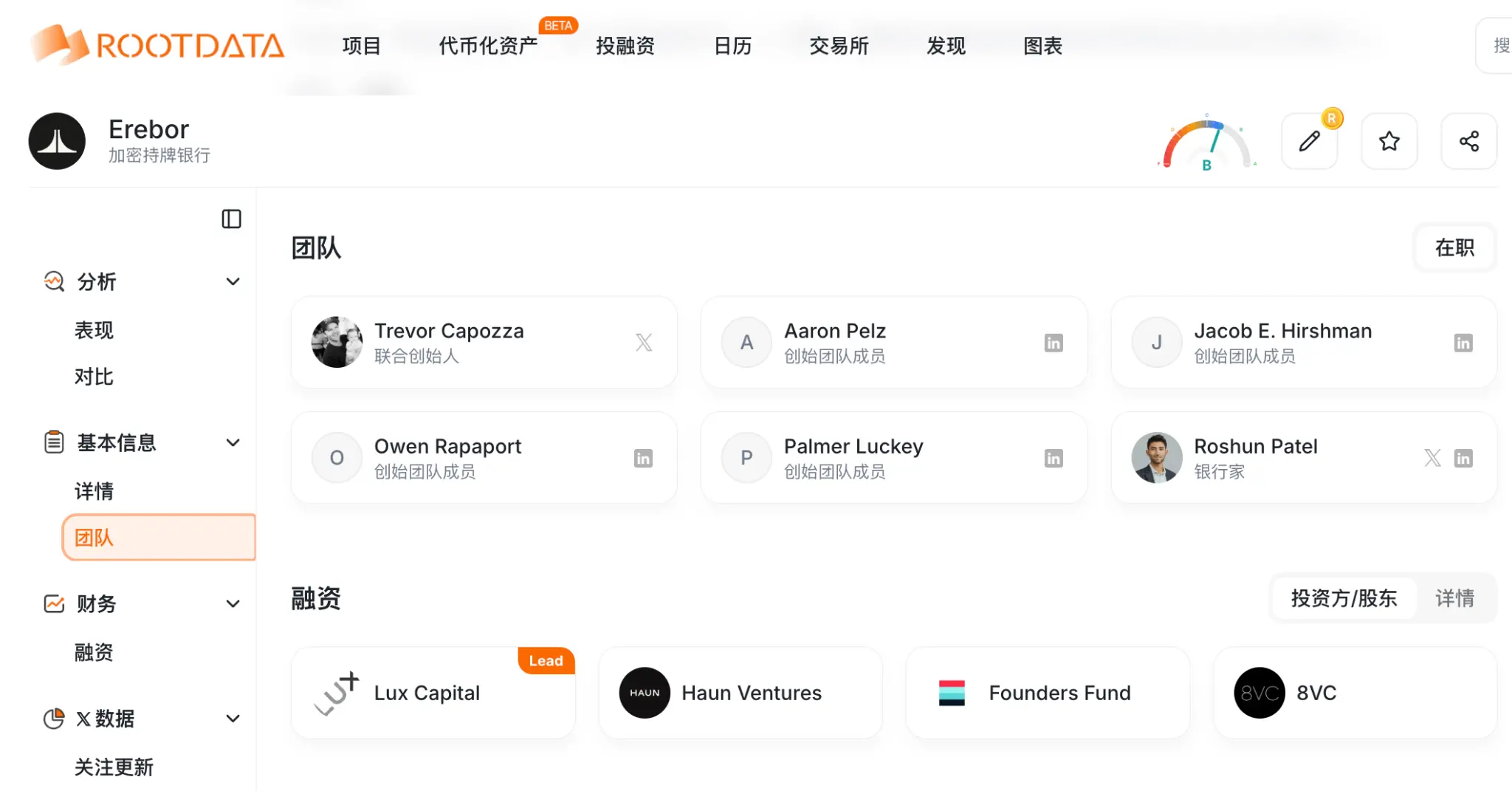
Image Source:RootData

Furthermore, a key strategic choice for Erebor is: insisting on obtaining its own license and being responsible for its financials, unlike Mercury or Brex which rely on partner banks. Luckey's argument is that relying on third-party infrastructure exposes one to risks of "de-platforming," policy pressure, and product limitations; only by holding the license and ledger can it fulfill promises of on-chain settlement, stablecoin minting, and redemption.

Looking back at Erebor's origin, it is almost entirely tied to the collapse of Silicon Valley Bank (SVB) in 2023. That failure left a large number of startups and venture capitalists suddenly without banking partners and deposit protection. Luckey and investors believed this left a "structural vacuum"—the disappearance of banks specializing in serving startups, while traditional banks were too conservative or slow for startups holding non-standard assets (defense contracts, AI hardware, digital tokens).

Erebor claims to address roughly four pain points: First, providing credit for physical assets—traditional banks are good at lending against real estate or receivables but not at valuing "GPUs" or "aerospace research." Second, bridging the on-chain/off-chain divide, bringing fiat banking and stablecoin settlement onto the same regulated balance sheet. Third, meeting 24/7 settlement needs, replacing SWIFT and ACH still operating on decades-old schedules. Fourth, providing USD access for high-growth international companies, combating the "de-banking" friction they often face.

Of course, how much of this operational potential is real versus marketing remains debatable. Venture-backed companies now have alternatives like non-bank lenders and DeFi lending, and some incumbent banks had already started targeting tech niches before SVB's collapse. Erebor's founders clearly believe existing institutions are insufficient, and the fact that it obtained a full banking license suggests regulators might also see some merit in this assessment?

Additionally, digital assets are core to Erebor's long-term strategy. It plans to handle deposits and payments for dollar stablecoins, provide instant fiat/stablecoin conversion, 24/7 settlement rails, and gradually support stablecoin minting and redemption within a regulated framework. Its OCC license even explicitly allows it to hold small amounts of crypto assets on its own books to pay for on-chain transaction fees, with supervisory letters defining such holdings as "incidental" to banking business—a noteworthy precedent in compliance.

On April 2nd, the Sui Foundation announced that Erebor now supports the Sui network, allowing clients to deposit and withdraw stablecoins. This is one of the first public pieces of evidence of it connecting regulated bank infrastructure to on-chain payments.

However, reality also presents gaps. Sources indicate demand for crypto-collateralized loans has been lower than the bank initially expected. This aligns with the earlier financials: the recent growth has actually been driven by companies rebuilding U.S. manufacturing capacity and their equipment financing and venture debt needs. In other words, Erebor currently resembles more of a "defense + advanced manufacturing + crypto" hybrid than a purely native crypto bank.

Perfect Timing—Even Its License Application Timing Was Fortuitous?

Breaking down the licensing: Erebor received preliminary conditional approval from the OCC on October 15, 2025, FDIC deposit insurance approval on December 16, final license in early February 2026, and officially launched on February 8 with approximately $625 million in initial capital (significantly increased from about $275 million during the preliminary approval phase). It is the first newly issued (de novo) national bank charter under the current U.S. administration.
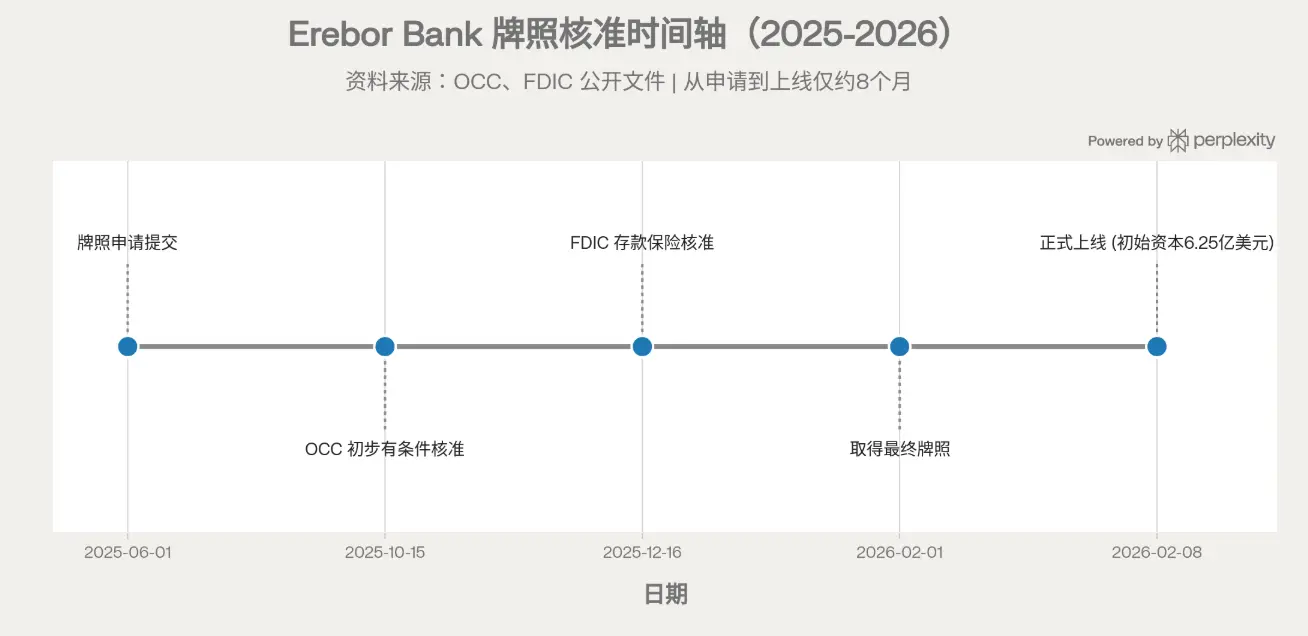
All this occurred against the backdrop of a clear shift in U.S. banking policy: Under the leadership of Acting Comptroller Jonathan Gould, the OCC has adopted an explicitly open regulatory stance toward digital asset banks, with Gould himself hailing this license as an example of a "dynamic and diverse financial system"; coupled with the advancement of federal-level stablecoin framework (GENIUS Act), once-fuzzy legal territories have been clarified considerably.

Notably, regulators did not grant approval without conditions. In exchange for approval, the OCC and FDIC imposed strict requirements: maintaining a Tier 1 leverage ratio of at least 12% for the first three years (roughly double the "well-capitalized" threshold) and a capital maintenance commitment. It could be said that Erebor's feasibility is partly tied to the current political cycle. If future regulatory stances shift, or stablecoin and anti-money laundering rules tighten, its entire narrative built on "token-friendly rules" could face headwinds.

Finally, synthesizing external media judgments, Erebor's model replicates almost every risk that contributed to SVB's downfall.

It serves early-stage, tech-heavy companies with non-traditional collateral. It caters to a small number of large accounts (startups, founders, investment funds) rather than thousands of retail customers; any single client's failure or withdrawal (crypto market volatility, venture capital pullback) could significantly impact liquidity. Regulators have long pointed out that SVB's "monoculture" client structure was a key driver of its run.

Crypto correlation makes the issue more tricky. If a supported stablecoin de-pegs or crypto prices crash, the deposit base and loan collateral could shrink simultaneously. Further down are policy reversal risks (its entire narrative bets on lenient token rules), execution risks of building core systems and on-chain settlement from scratch, and the unverified premise of "whether stablecoins will be widely adopted by clients." Finally, reputational and political risks—Luckey's highly controversial political affiliations plus the novelty of a "crypto bank" itself could amplify market confidence loss if the bank ever faces trouble.

It could be said Erebor is a high-profile experiment happening at the intersection of banking, crypto, and industrial policy.

The market need it advocates emerged from the financing gap left by SVB's collapse and friction in crypto payments. Now, regulators have given paper endorsement, the team combines tech prestige with Wall Street backgrounds. The execution of this new model, the continuity of regulatory stances, and the genuine market demand for its integrated services are precisely the points under rigorous market scrutiny.


Trend Kriptolar

İlgili Sorular

QWhat are the key factors driving Erebor Bank's rapid valuation increase to $8 billion?

AThe rapid valuation increase to $8 billion is primarily driven by the bank's exceptional deposit growth, which surged from $1.1 billion to approximately $4.05 billion in a single quarter. Investors are betting on its future potential to deploy these deposits into profitable lending and stablecoin operations, its strategic positioning to fill the void left by Silicon Valley Bank's collapse, and its unique combination of founder reputation (Palmer Luckey, Peter Thiel) and a seasoned financial and crypto-compliance team.

QHow does Erebor Bank's business model differ from that of traditional banks and other fintech companies like Mercury?

AErebor Bank's business model differs from traditional banks by focusing on niche, capital-intensive clients like defense, advanced manufacturing, and crypto-native businesses, offering services like equipment financing for non-traditional assets (e.g., GPUs) and crypto integration. Unlike fintechs like Mercury or Brex that operate on third-party bank infrastructure, Erebor holds its own national bank charter, giving it direct control over its ledger, compliance, and the ability to offer regulated stablecoin minting/redemption and 24/7 on-chain settlement services.

QWhat are the main risks associated with Erebor Bank's strategy as outlined in the article?

AThe main risks include: 1) Concentrated client risk similar to SVB, relying on a small number of large depositors from volatile sectors (tech startups, crypto). 2) Execution risk in building core banking and on-chain settlement systems from scratch. 3) Regulatory and policy risk, as its model depends on a favorable crypto regulatory environment which could reverse. 4) Market adoption risk for its core crypto/stablecoin services, which currently have lower-than-expected demand. 5) Reputational and political risk tied to its founders' controversial profiles and the novel nature of a 'crypto bank'.

QWhat role does digital asset integration play in Erebor Bank's long-term strategy?

ADigital asset integration is central to Erebor's long-term strategy. It plans to offer deposit and payment services for US dollar stablecoins, provide instant fiat-to-stablecoin conversions, enable 24/7 settlement rails, and support the minting and redemption of stablecoins within a regulated framework. Its OCC charter even allows it to hold small amounts of crypto assets on its balance sheet for operational purposes. The bank has already taken steps like integrating with the Sui network for stablecoin transactions.

QWhy was the timing of Erebor Bank's regulatory approval considered favorable?

AThe timing was favorable due to a significant shift in U.S. banking policy under the current administration. The OCC, led by Acting Comptroller Jonathan Gould, adopted an explicitly open stance toward digital asset banks. This coincided with legislative progress on a federal stablecoin framework (the GENIUS Act), which helped clarify the legal landscape. Erebor's charter is the first *de novo* national bank charter issued under this administration, making it a beneficiary of this specific regulatory and political moment.

İlgili Okumalar

Ethereum Sheds Its Load? What Ethereum Supporters Think About the Lean Ethereum Upgrade and the Future Market

Ethereum is back in focus with the announcement of the "Lean Ethereum" upgrade roadmap, described by Vitalik Buterin as Ethereum's third major update. This proposal aims to fundamentally redesign the consensus, data, and execution layers from first principles, striving to make Ethereum **simpler, more secure (quantum-resistant), more verifiable, and more scalable.** The announcement comes amidst a broader restructuring within the ecosystem, including a 20% staff reduction at the Ethereum Foundation and the emergence of new organizations like EthLabs. This has sparked a debate among Ethereum supporters ("E-bizens"). **Optimists** view Lean Ethereum as a critical refocusing on core protocol fundamentals: * **sassal.eth** calls it the ultimate bullish catalyst, envisioning a future where running a node is so lightweight it could be done on a smartwatch, greatly enhancing decentralization. * **Ryan Sean Adams** sees it as Ethereum moving from "narrative expansion" to "protocol hardening," addressing long-term foundational issues like security and scalability. * Analysts like **BITWU** and **蓝狐 (Blue Fox)** frame it as a third-phase evolution towards a "minimal, durable, and credible base layer" designed for the next decade. * **gigi发财猪** interprets the organizational changes as Ethereum "shedding old baggage and forming new teams" for a lighter, more agile approach. * **Xiyu** notes that the roadmap itself provides a much-needed new narrative for market sentiment recovery. **Cautious voices** acknowledge the vision but emphasize execution and market timing: * **Ignas** warns that while the roadmap addresses key community requests, it overlooks tokenomics, and competitors are gaining ground in areas like RWA. Timely delivery is crucial; delays could be bearish. * **Dankrad Feist**, a former Ethereum Foundation researcher, agrees on direction but criticizes the proposed 3-4 year timeline as too slow for the current market pace, especially with AI-aided development available. **In summary,** optimists believe Lean Ethereum reaffirms Ethereum's long-term value proposition as a decentralized world computer, while the cautious argue that its success hinges on faster delivery and tangible results to maintain market relevance. Despite ongoing criticism, the move signals Ethereum's effort to regroup and reclaim initiative at the protocol level.

marsbit26 dk önce

Ethereum Sheds Its Load? What Ethereum Supporters Think About the Lean Ethereum Upgrade and the Future Market

marsbit26 dk önce

AI Folding: Fable 5 and GPT-5.6 Are Becoming the Privilege of a Few

【AI Accessibility Gap Widens: Elite Tools Like Fable 5 and GPT-5.6 Are Becoming Privileged】 We are witnessing a growing "AI divide." A stark reality is emerging: a tiny fraction of elites, primarily in tech, are using powerful next-generation models like Fable 5 or the upcoming GPT-5.6, while the vast majority of the public only has access to "toys" - free, limited models equivalent to ChatGPT's basic versions (8B to 30B parameters). This creates a massive experiential chasm and cognitive dissonance. Industry outsiders see AI as overhyped and ineffective, unable to grasp its transformative potential, while insiders leverage these advanced models for a decisive competitive edge. The gap isn't just about model quality but product functionality. Free users get a simple chatbot. Paying elites get integrated workflow systems—capable of creating specialized agents, processing complex data, and handling real-world tasks like management, coding, and planning. Demos showcasing AI planning weddings or building apps feel disconnected from everyday needs like managing bills, groceries, or health. The cost barrier is immense, with reports of engineers spending $1000 daily on Fable 5 inference. Elite users employ sophisticated multi-model workflows, combining different AIs for ideation, architecture, execution, and review, completing complex projects in minutes instead of weeks. This divide extends to critical areas like healthcare, where free models are dangerously unreliable for medical queries. However, some argue that for 90% of common business tasks, mid-tier models like GPT-5.5 are sufficient; the perceived limitation often stems from poor integration and lack of context, not model intelligence. Ultimately, unequal access to cutting-edge AI is creating a new form of social stratification, where the most powerful tools are becoming the exclusive privilege of a few.

marsbit1 saat önce

AI Folding: Fable 5 and GPT-5.6 Are Becoming the Privilege of a Few

marsbit1 saat önce

Cathie Wood's June $77M Investment: Are Crypto Stocks a True 'Substitute' for Bitcoin?

In June, Cathie Wood's ARK Invest purchased $77 million worth of publicly traded crypto-related stocks, including Coinbase, Circle, and Bullish, during Bitcoin's worst monthly performance in four years. This aligns with the investment thesis that such stocks offer a compliant way to gain exposure to the crypto cycle without directly holding Bitcoin. However, data analysis reveals significant drawbacks. A group of nine U.S.-listed crypto companies showed 30-day annualized realized volatility between 68% and 90%, nearly double Bitcoin's 37.6%. Over 90 days, Circle's volatility reached 103.6% versus Bitcoin's 37.8%. Drawdowns were also more severe for stocks like Circle (-51.4%) and MicroStrategy (-48.6%) compared to Bitcoin's -36.4% from its January high. Correlation analysis shows most stocks share only a moderate link to Bitcoin. For example, Circle, Robinhood, and Bullish have a 90-day correlation coefficient of just 0.55–0.58 with BTC, meaning only about one-third of their price movement is explained by Bitcoin's action. The rest stems from company-specific risks: earnings, competition, fundraising, and equity dilution. MicroStrategy (MSTR) is the notable exception, acting as a leveraged Bitcoin proxy with a beta of 1.59 and 0.85 correlation. Coinbase offers relatively balanced exposure. Circle exemplifies "crypto-wrapped" corporate risk, with its recent crash tied to stablecoin competition, not Bitcoin. Robinhood's diversified business insulates it from crypto downturns but also limits upside. Bitcoin miners like RIOT and MARA have posted significant gains year-to-date, driven primarily by their pivot to AI compute services, not Bitcoin's price. The article highlights that investing in crypto stocks often means accepting amplified volatility or layering on business-specific risks absent from direct Bitcoin ownership. For instance, MicroStrategy's recent challenges—its market value falling below its Bitcoin holdings (mNAV <1) and facing potential Bitcoin sales for liquidity—demonstrate equity-specific hazards like dilution and financing pressures not faced by a direct Bitcoin holder. ARK's buying spree represents a bet on a basket of different business models with varying crypto exposure, not a simple, lower-risk substitute for holding Bitcoin.

marsbit1 saat önce

Cathie Wood's June $77M Investment: Are Crypto Stocks a True 'Substitute' for Bitcoin?

marsbit1 saat önce

Crypto Welcomes the 'July Rebound'? On-Chain Bottom Signals Align, Reversal Still Requires Breakthrough Above $70k

The cryptocurrency market is showing signs of a potential "July rebound," with Bitcoin leading a recovery above $63,000 and total market cap rising. This bounce is attributed to improved macro expectations (weaker US jobs data easing Fed hike fears), a short squeeze in derivatives, and signs of whale accumulation. Key on-chain metrics signal a potential bottom, including the Sharpe Ratio hitting extreme lows, the AHR999 index nearing historic buy zones, and miner pressure reaching significant levels. However, analysts caution this is likely a corrective rebound rather than a confirmed trend reversal. Persistent challenges include weak spot demand, negative Coinbase Premium indicating institutional caution, and ongoing selling pressure in the altcoin market. Market sentiment remains in "extreme fear" territory, and the AVIV ratio suggests the average active Bitcoin investor is still at a loss. For a true bullish reversal, Bitcoin needs to convincingly break above the key $70,000 level (aligned with the Short-Term Holder Realized Price). The path to a new parabolic bull market is seen as dependent on attracting substantially more capital, as capital efficiency has declined. While prices may be approaching a cyclical bottom zone (with estimates between $37k-$60k), the market requires more sustained positive signals for a definitive uptrend.

marsbit1 saat önce

Crypto Welcomes the 'July Rebound'? On-Chain Bottom Signals Align, Reversal Still Requires Breakthrough Above $70k

marsbit1 saat önce

İşlemler

Spot

Popüler Makaleler

$BANK Nedir

Bank AI: Bankacılıkta Devrimsel Bir Adım Giriş Teknolojideki hızlı ilerlemelerin damgasını vurduğu bir çağda, Bank AI, yapay zeka (AI) ve bankacılık hizmetleri kesişiminde yer almaktadır. Bu yenilikçi proje, finansal manzarayı yeniden tanımlamayı, operasyonel verimliliği, güvenlik önlemlerini ve müşteri deneyimlerini AI'nin gücüyle geliştirmeyi hedefliyor. Bank AI yolculuğuna çıkarken, projenin içeriğine, operasyonel dinamiklerine, tarihsel bağlamına ve önemli kilometre taşlarına dalacağız. Bank AI Nedir? Bank AI, yapay zekanın çeşitli bankacılık operasyonlarına entegrasyonunu hedefleyen dönüştürücü bir girişimi temsil etmektedir. Bu proje, süreçleri otomatikleştirmek, risk yönetimi protokollerini geliştirmek ve kişiselleştirilmiş hizmetler aracılığıyla müşteri etkileşimini artırmak için AI'nin yeteneklerinden yararlanmaktadır. Bank AI'nin temel hedefleri şunlardır: Bankacılık Fonksiyonlarının Otomasyonu: AI teknolojilerini kullanarak, Bank AI rutin görevleri otomatikleştirmeyi, insan kaynakları üzerindeki yükü azaltmayı ve verimliliği artırmayı amaçlamaktadır. Geliştirilmiş Risk Yönetimi: Proje, dolandırıcılık ve diğer tehditlere karşı güvenlik önlemlerini güçlendirerek riski tahmin edip tanımlamak için AI algoritmalarını kullanmaktadır. Bankacılık Hizmetlerinin Kişiselleştirilmesi: Bank AI, müşteri verilerini ve davranışlarını analiz ederek, özel finansal ürünler ve hizmetler sunmaya odaklanmaktadır. Müşteri Deneyimini İyileştirme: Chatbotlar ve sanal asistanlar gibi AI destekli çözümlerin uygulanması, kullanıcıların daha insana yakın etkileşimler yaşamasını sağlamayı hedeflemekte, bankalarla etkileşim biçimlerini devrim niteliğinde değiştirmektedir. Bu hedeflerle, Bank AI, bankacılığı daha verimli, güvenli ve kullanıcı odaklı hale getiren önemli bir oyuncu olarak kendini konumlandırmaktadır. Bank AI'nin Yaratıcısı Kimdir? Bank AI'nin yaratıcısı hakkında detaylar bilinmemektedir. Bu nedenle, mevcut bilgilerde belirli bir kişi veya organizasyon tanımlanmamıştır. Projenin başlangıcı etrafındaki anonimlik soruları gündeme getirse de, bunun iddialı vizyonu ve hedefleri üzerinde bir olumsuz etkisi yoktur. Bank AI'nin Yatırımcıları Kimlerdir? Proje yaratıcılarında olduğu gibi, Bank AI'nin yatırımcıları veya destekleyen organizasyonları hakkında da özel bilgiler açıklanmamıştır. Bu bilgiler olmadan, projenin ilerlemesini destekleyen finansal destek ve kurumsal destek hakkında bir çerçeve çizmek zordur. Yine de, böyle yenilikçi bir alanda gelişimi sürdürmek için sağlam bir yatırım temelinin önemi büyüktür. Bank AI Nasıl Çalışır? Bank AI, geleneksel bankacılık çerçevelerinden ayıran benzersiz faktörlere odaklanarak birden fazla yenilikçi alanda faaliyet göstermektedir. İşte temel operasyonel özellikler: Otomasyon: Makine öğrenimi algoritmalarını uygulayarak, Bank AI bankalar içindeki çeşitli manuel süreçleri otomatikleştirir. Bu, operasyonel maliyetleri azaltır ve insan çalışanların daha stratejik faaliyetlere yönelmelerini sağlar. Gelişmiş Risk Yönetimi: Risk yönetimi uygulamalarına AI entegrasyonu, bankaların dolandırıcılık gibi potansiyel tehditleri doğru bir şekilde tahmin etme araçlarıyla donatılmasını sağlar, böylece müşteri bilgileri ve varlıkları güvence altına alınır. Özelleştirilmiş Finansal Tavsiyeler: Müşteri etkileşimlerinden sürekli olarak öğrenerek, AI sistemleri kullanıcı ihtiyaçlarının daha iyi anlaşılmasını sağlar ve finansal kararlar hakkında özelleştirilmiş tavsiyeler sunar. Geliştirilmiş Müşteri Etkileşimleri: AI destekli chatbotlar ve sanal asistanlar kullanarak, Bank AI daha etkileşimli bir müşteri deneyimi sunar, kullanıcıların sorularını hızlı bir şekilde çözmelerine imkan tanır, bekleme sürelerini azaltır ve memnuniyet seviyelerini artırır. Bu operasyonel özellikler, Bank AI'yi bankacılık sektöründe bir öncü olarak konumlandırmakta ve hizmet sunumu ile operasyonel mükemmeliyet için yeni standartlar belirlemektedir. Bank AI Zaman Çizelgesi Bank AI'nin gidişatını anlamak için tarihsel bağlamına bir göz atmak gerekmektedir. Aşağıda önemli kilometre taşlarını ve gelişmeleri vurgulayan bir zaman çizelgesi bulunmaktadır: 2010'ların Başları: AI entegrasyonunun bankacılık hizmetlerine olan ilgisi arttı, bankacılık kurumları potansiyel faydalarını tanımaya başladılar. 2018: Bankaların temel müşteri hizmetleri ve geliştirilmiş güvenlik yönetimi için risk yönetim sistemlerinde chatbotlar gibi AI araçları kullanmaya başlamasıyla AI teknolojilerinin uygulanmasında belirgin bir artış yaşandı. 2023: AI'nin karmaşıklığı artmaya devam etti ve belge işleme ile gerçek zamanlı yatırım analizi gibi daha karmaşık görevler için üretken AI devreye alındı. Bu yıl, AI teknolojisi sayesinde bankaların sahip olduğu yeteneklerde önemli bir sıçrama yaşandı. 2024-Güncel Durum: Bu yıl itibarıyla, Bank AI yükselişte, devam eden araştırmalar ve geliştirmeler bankacılık operasyonlarındaki yetenekleri daha da artırmaya hazırlanıyor. AI uygulamalarının sürekli araştırılması, heyecan verici gelişmelere işaret etmektedir. Bank AI Hakkında Anahtar Noktalar Bankacılıkta AI Entegrasyonu: Bank AI, bankacılık süreçlerini kolaylaştırmak ve kullanıcı deneyimlerini geliştirmek için yapay zekanın benimsenmesine odaklanmaktadır. Otomasyon ve Risk Yönetimi Vurgusu: Proje, rutin görevlerin yükünü azaltmayı amaçlarken, tahmine dayalı analizlerle güvenlik çerçevelerini geliştirmeye büyük önem vermektedir. Kişiselleştirilmiş Bankacılık Çözümleri: Müşteri verilerinden yararlanarak, Bank AI bireysel kullanıcı ihtiyaçlarına yönelik özelleştirilmiş bankacılık hizmetleri sunar. Gelişime Bağlılık: Bank AI, teknolojinin sürekli evrimi ile uyumlu olmasını sağlamak ve güncel kalmak için sürekli araştırma ve geliştirme çabalarına bağlı kalmaktadır. Sonuç Özetle, Bank AI bankacılık endüstrisinde önemli bir adımı temsil etmekte, yapay zekayı kullanarak operasyonel paradigmaları yeniden şekillendirmekte, güvenliği artırmakta ve müşteri memnuniyetini teşvik etmektedir. Yaratıcı ve yatırımcılar hakkındaki bilgi eksikliklerine rağmen, Bank AI'nin net hedefleri ve işlevsel mekanizmaları, devam eden evrimi için güçlü bir temel sunmaktadır. AI teknolojisi gelişmeye ve bankacılık sektörüyle birleşmeye devam ettikçe, Bank AI finansal hizmetlerin geleceğini önemli ölçüde etkilemeye hazır durumda, bankacılıkla olan anlayışımızı ve etkileşim biçimlerimizi geliştirmektedir.

162 Toplam GörüntülenmeYayınlanma 2024.04.06Güncellenme 2024.12.03

$BANK Nedir

BANK Nasıl Satın Alınır

HTX.com’a hoş geldiniz! Lorenzo Protocol (BANK) satın alma işlemlerini basit ve kullanışlı bir hâle getirdik. Adım adım açıkladığımız rehberimizi takip ederek kripto yolculuğunuza başlayın. 1. Adım: HTX Hesabınızı OluşturunHTX'te ücretsiz bir hesap açmak için e-posta adresinizi veya telefon numaranızı kullanın. Sorunsuzca kaydolun ve tüm özelliklerin kilidini açın. Hesabımı Aç2. Adım: Kripto Satın Al Bölümüne Gidin ve Ödeme Yönteminizi SeçinKredi/Banka Kartı: Visa veya Mastercard'ınızı kullanarak anında Lorenzo Protocol (BANK) satın alın.Bakiye: Sorunsuz bir şekilde işlem yapmak için HTX hesap bakiyenizdeki fonları kullanın.Üçüncü Taraflar: Kullanımı kolaylaştırmak için Google Pay ve Apple Pay gibi popüler ödeme yöntemlerini ekledik.P2P: HTX'teki diğer kullanıcılarla doğrudan işlem yapın.Borsa Dışı (OTC): Yatırımcılar için kişiye özel hizmetler ve rekabetçi döviz kurları sunuyoruz.3. Adım: Lorenzo Protocol (BANK) Varlıklarınızı SaklayınLorenzo Protocol (BANK) satın aldıktan sonra HTX hesabınızda saklayın. Alternatif olarak, blok zinciri transferi yoluyla başka bir yere gönderebilir veya diğer kripto para birimlerini takas etmek için kullanabilirsiniz.4. Adım: Lorenzo Protocol (BANK) Varlıklarınızla İşlem YapınHTX'in spot piyasasında Lorenzo Protocol (BANK) ile kolayca işlemler yapın.Hesabınıza erişin, işlem çiftinizi seçin, işlemlerinizi gerçekleştirin ve gerçek zamanlı olarak izleyin. Hem yeni başlayanlar hem de deneyimli yatırımcılar için kullanıcı dostu bir deneyim sunuyoruz.

748 Toplam GörüntülenmeYayınlanma 2025.05.09Güncellenme 2026.06.02

BANK Nasıl Satın Alınır

Tartışmalar

HTX Topluluğuna hoş geldiniz. Burada, en son platform gelişmeleri hakkında bilgi sahibi olabilir ve profesyonel piyasa görüşlerine erişebilirsiniz. Kullanıcıların BANK (BANK) fiyatı hakkındaki görüşleri aşağıda sunulmaktadır.

活动图片