Q2 Crypto Market Review: Did Bitcoin Rise for 'Nothing'? Did Money Flow to AI and On-Chain?

Foresight News2026-07-01 tarihinde yayınlandı2026-07-01 tarihinde güncellendi

Özet

Q2 2026 Crypto Market Recap: Bitcoin's Gains Erased Amid Shift to AI and On-Chain Activity The second quarter of 2026 saw a significant reversal for the cryptocurrency market. Bitcoin gave back all its April gains, ending Q2 down approximately 11%, while major stock indices posted strong gains. This divergence was driven by a hawkish shift in Fed rate expectations, capital rotation into AI stocks, and weakening liquidity channels into crypto. Key demand pillars deteriorated simultaneously. Spot Bitcoin ETFs recorded net outflows of $4.08 billion for the quarter, with outflows dominating June. Crypto treasury entity Strategy's bitcoin accumulation slowed markedly, and the total stablecoin market cap contracted by ~$4.2 billion. This created a tighter liquidity environment. Exchange data reflected the downturn. Spot trading volumes fell 28% quarter-over-quarter. The market underwent significant deleveraging, with $8.35 billion in long liquidations for BTC and ETH, primarily in late May/early June. Open interest and order book liquidity also declined. Despite the bearish price action, structural developments point to an expanding on-chain ecosystem. These include the rise of tokenized stocks with full legal rights, the growth of RWA (real-world asset) perpetual contracts for trading stocks and commodities 24/7, and the use of crypto markets for price discovery ahead of major events like the SpaceX IPO. On-chain vaults are also emerging as a core layer for institutional capit...


Author: Tanay Ved, Coin Metrics

Compiled by: Luffy, Foresight News


TL;DR:


  • Bitcoin gave back all of its April gains, falling approximately 11% in Q2 against a backdrop of shifting interest rate expectations, ETF outflows, and capital rotation into AI stocks.
  • Three major liquidity channels—ETFs, Treasury companies like Strategy, and stablecoins—all weakened in Q2, with spot Bitcoin ETFs alone seeing net outflows of $4.08 billion.
  • Total long liquidations for BTC and ETH reached $8.35 billion, leading to significant deleveraging in Q2, but the market entered Q3 in a more stable condition.


Market Overview


The crypto market entered Q2 2026 with strong momentum. After a difficult Q1, Bitcoin rebounded alongside equities in April, as geopolitical tensions eased briefly and institutional demand improved, climbing to around $82,000. However, this recovery did not last.


This reversal was driven by three forces: Brent crude prices hitting a high of $126.41 amid volatility from geopolitical negotiations, a hawkish shift in the Federal Reserve's interest rate outlook, and capital rotation into the AI trade.
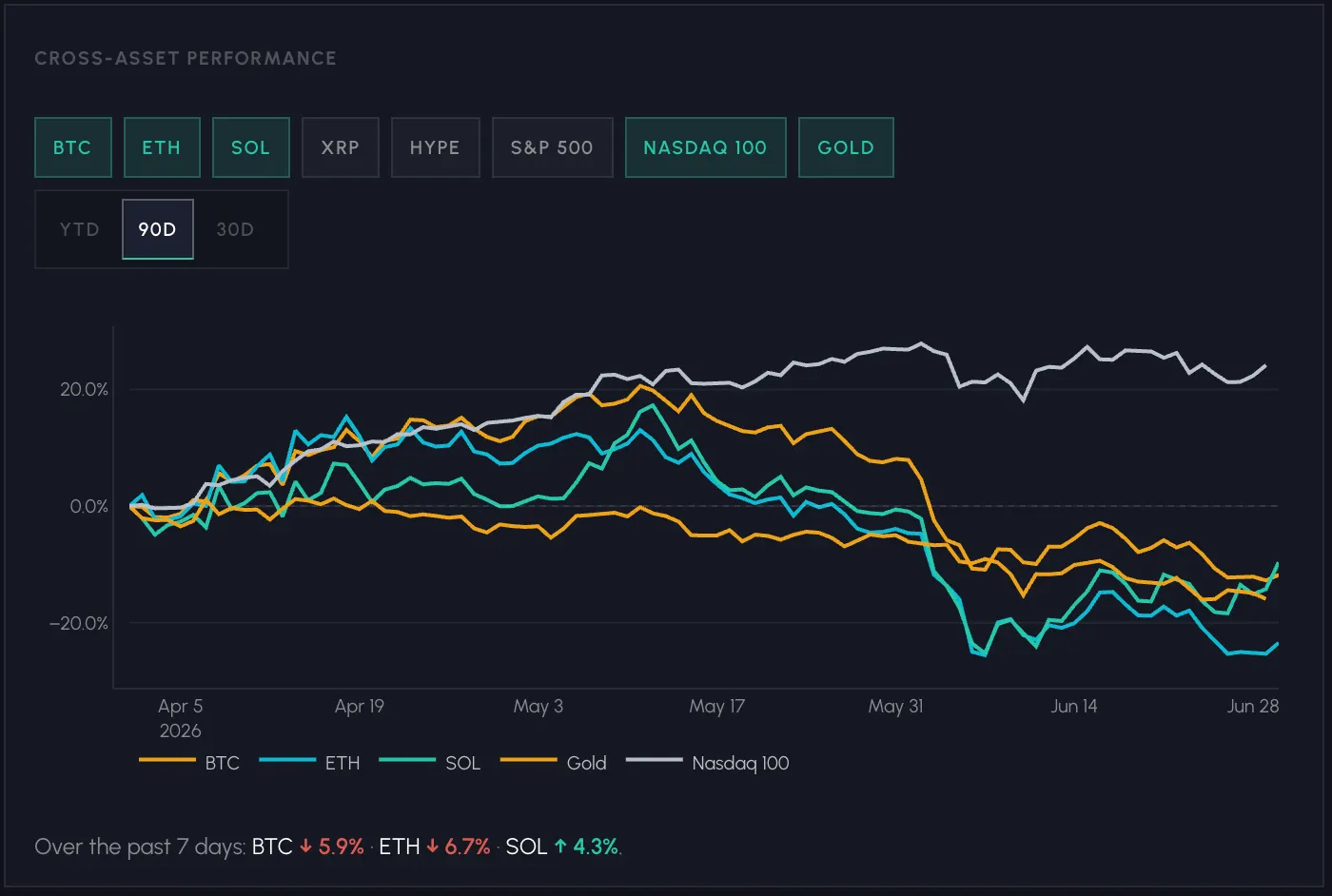


Until mid-May, cryptocurrencies and equities largely moved in sync, with both BTC and ETH rising about 20% from their early-April lows. The divergence came in late May when cryptocurrencies pulled back while equities held firm. Ultimately, the S&P 500 and Nasdaq 100 rose approximately 16% and 28% for the quarter, respectively, while BTC fell about 10%, ETH about 20%, and SOL about 13%.
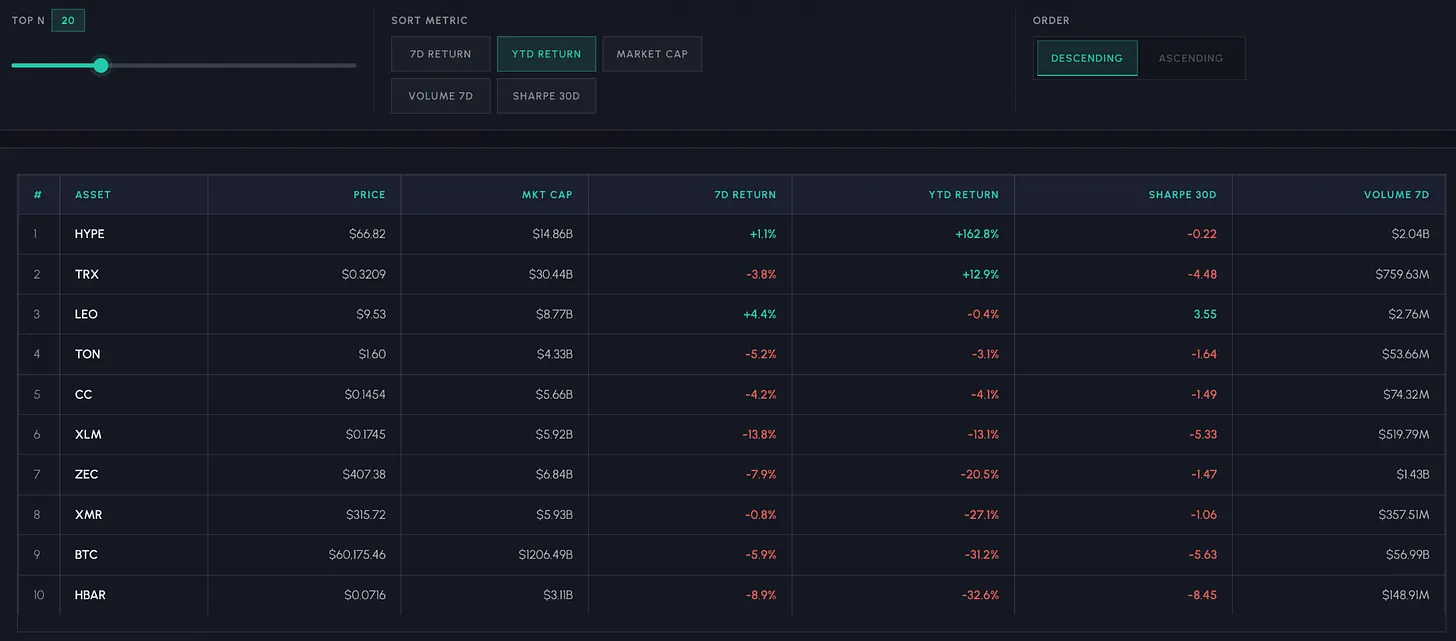


Bitcoin is currently trading around $60,000, down about 52% from its all-time high of $126,000 set in late 2025. Altcoin performance has been similar, with few gainers. Year-to-date, among the top 20 crypto assets by market cap, Hyperliquid (HYPE) remains the sole bright spot (up 142%), driven by strong demand for its on-chain trading of perpetual contracts for stocks and commodities.


Fund Flows


The weakness in Q2 was exacerbated by the deterioration of three key demand channels: spot ETFs, crypto asset treasuries like Strategy, and stablecoin supply.


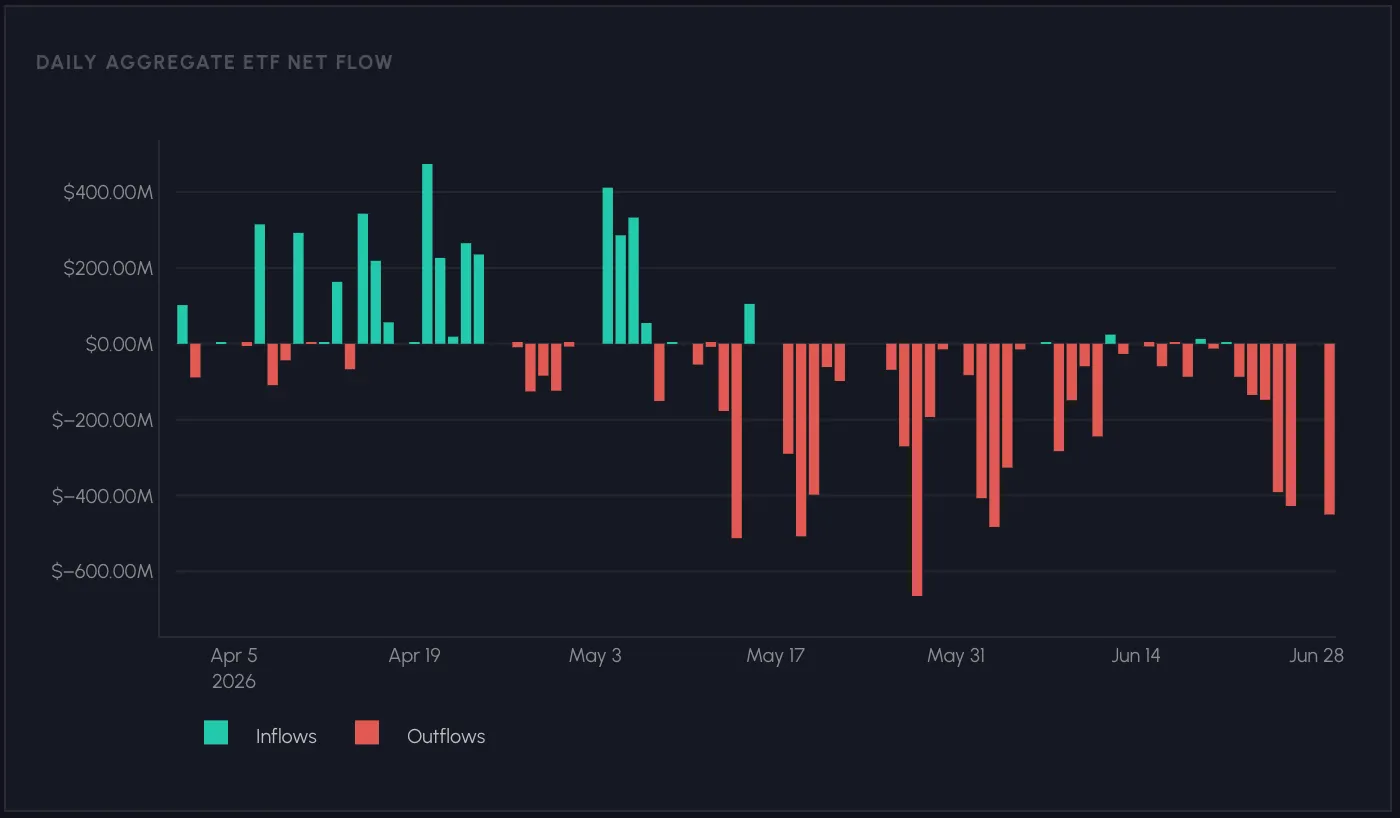
Spot Bitcoin ETFs: April started strong for spot Bitcoin ETFs, dominated by inflows. The peak single-day inflow of $474 million occurred on April 20th, after which flows reversed. Outflows dominated for the rest of the quarter, with 53 days of outflows compared to 30 days of inflows in Q2. June was the primary culprit, with net outflows reaching $3.84 billion for the month among tracked ETF issuers, accounting for the majority of the quarter's total net outflow of $4.08 billion.


Crypto Asset Treasuries (Strategy Companies): This quarter, Bitcoin accumulation by Strategy companies slowed significantly. Their preferred shares (STRC), designed to stabilize around $100, fell to a historic low of $74, while Strategy's market-to-net-asset-value ratio (mNAV) compressed close to 1.0, impacting the funding channels behind their accumulation. A surprise sale of 32 BTC in early June unsettled the market and broke the "never sell" sentiment. In response, Strategy established a new Digital Credit Capital framework, raising STRC dividends to 12%, authorizing the sale of up to $1.25 billion worth of BTC, and setting up a $2.55 billion USD reserve to cover approximately 17 months of debt.


Stablecoins: The total stablecoin market cap contracted by approximately $4.2 billion in Q2, reducing the funds underpinning on-chain activity and liquidity. USDT saw a modest increase of $1.8 billion, while USDC decreased by $3.4 billion. Ethena's USDe fell by $1.4 billion as risk-off sentiment dampened interest in yield-bearing stablecoin strategies.


With the three major demand channels weakening simultaneously, the liquidity environment heading into Q3 is markedly tighter than at the start of Q2. Whether this demand will return to crypto assets or continue flowing into AI stocks remains a dynamic to watch.


Exchange Activity & Derivatives


Total spot trading volume on exchanges fell 28% quarter-over-quarter to $2.32 trillion, continuing a downtrend that began in January. Futures volume fared slightly better at $12.32 trillion, down 11.6% QoQ, but the spot/futures ratio compressed from 0.23x to 0.19x, indicating an increase in derivative positioning rather than spot demand.


Hyperliquid stood out, with its futures trading volume market share growing to around 4.5%, as on-chain perpetuals continued to take market share from centralized exchanges.
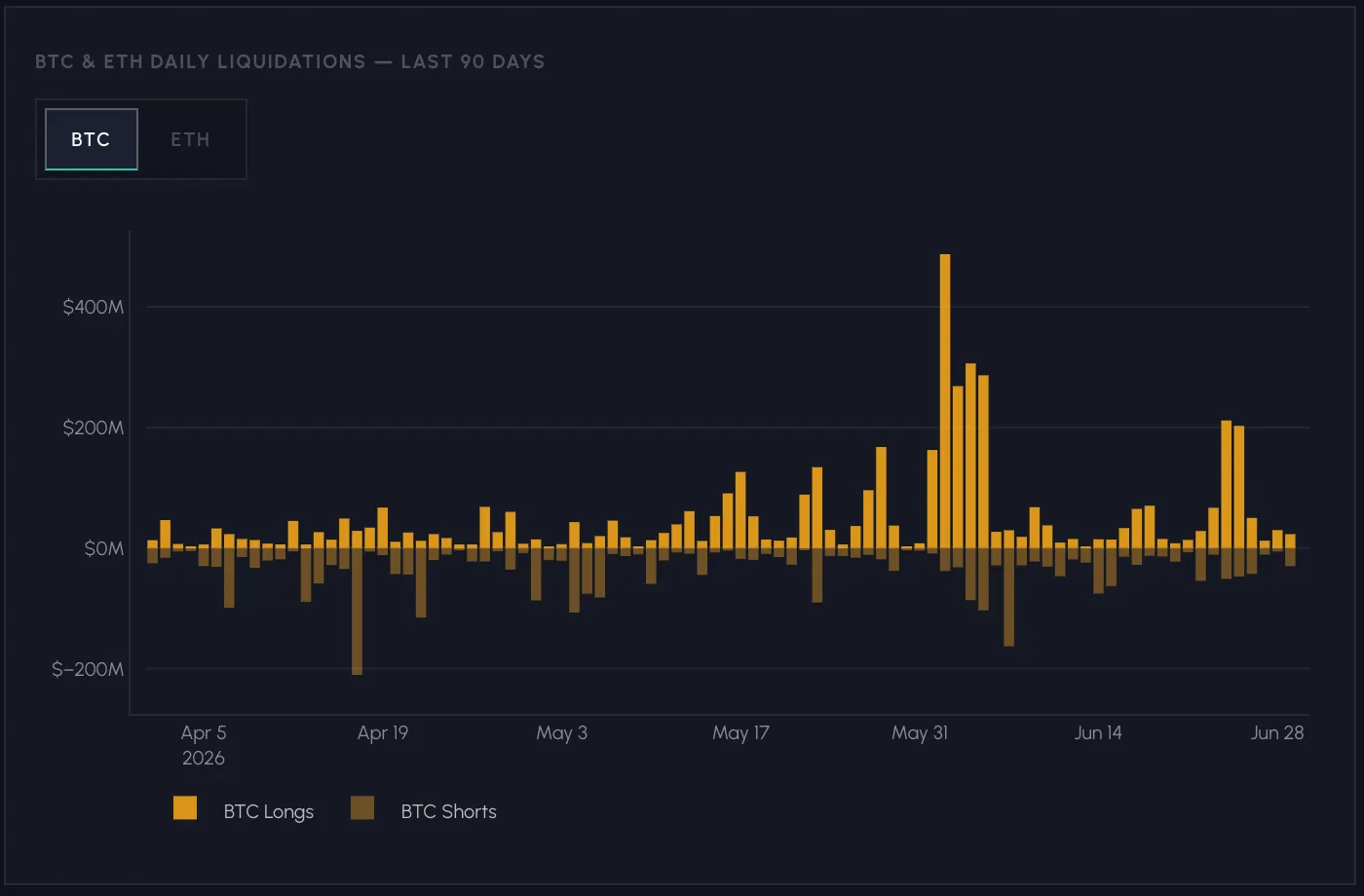


Open interest peaked before the May sell-off, reaching $49.2 billion for BTC and $27.2 billion for ETH. Currently, these figures have dropped to $33.5 billion (BTC) and $16.2 billion (ETH), down 32% and 40% from their peaks, respectively. Throughout Q2, total long liquidations for BTC and ETH reached $8.35 billion. More than half of these liquidations occurred between May 25th and June 7th, as over-leveraged long positions were wiped out. The market entered Q3 in a more deleveraged state.


Funding rates were volatile during Q2, swinging from deeply negative (annualized -16%) in mid-April to strongly positive (annualized +10%) in May as long positions increased. The subsequent sell-off pulled rates back to neutral levels, fluctuating around zero at quarter-end, reflecting cautious sentiment.


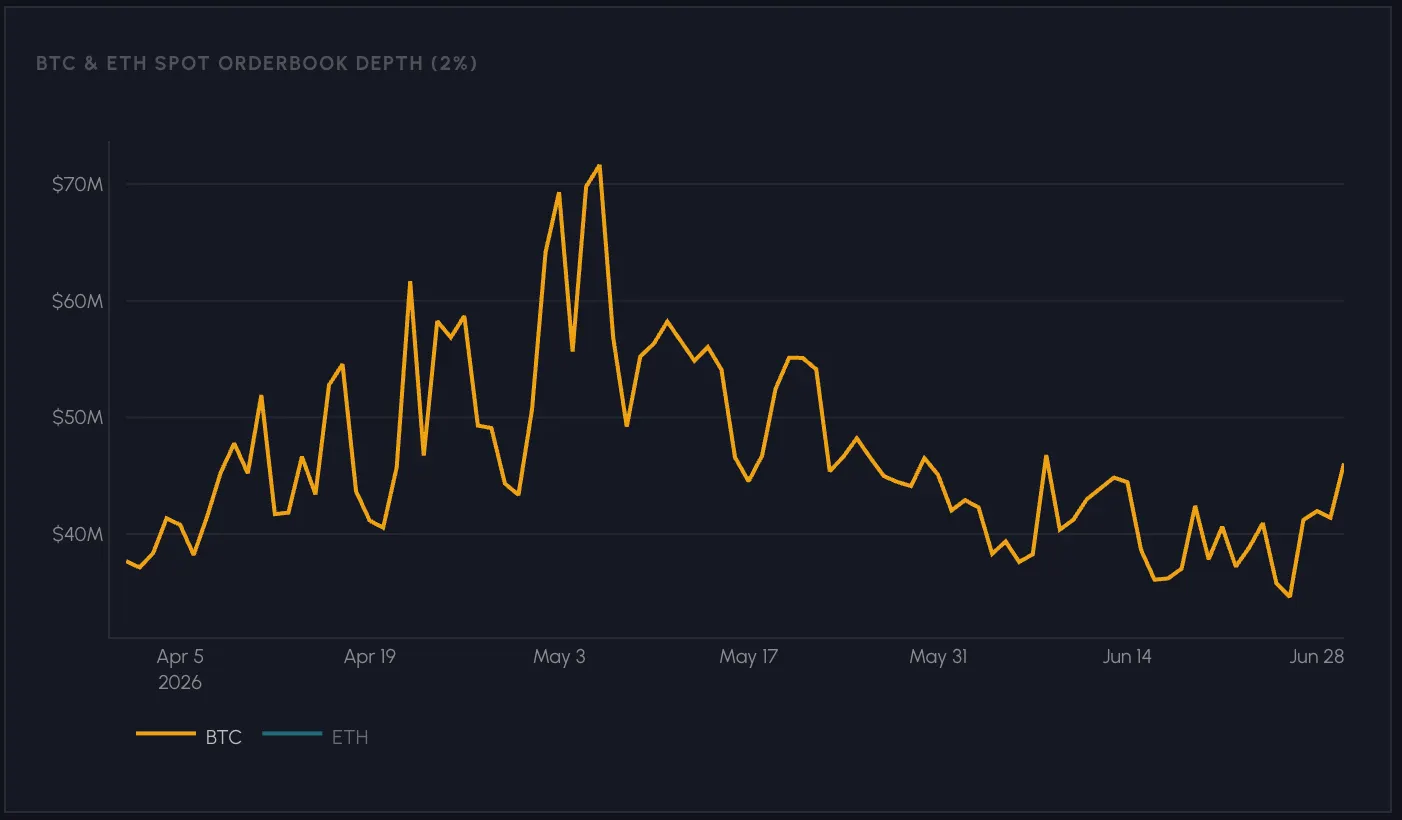
Liquidity also deteriorated in sync. The 2% order book depth for Bitcoin fell from a peak of around $70 million in early May to about $35-40 million by late June, indicating reduced market liquidity and a diminished ability to absorb selling pressure.


Key Themes to Watch Going Forward


Beyond Q2's price action, several structural developments point to the market's future direction, from new asset classes emerging on-chain to the infrastructure supporting them.


  • Tokenized Stocks: Coinbase announced the launch of 1:1 pegged, fully legally entitled tokenized stocks.
  • The Rise of RWA Perpetuals: On-chain trading and price discovery have moved beyond crypto, extending to stocks, indices, and commodities via Hyperliquid HIP-3 perpetuals and centralized exchanges offering 24/7 RWA perpetuals.
  • SpaceX IPO Priced On-Chain: The $1.7 trillion SpaceX IPO was priced on crypto rails ahead of its public listing, providing early price discovery signals for private companies.
  • Vaults & Lending Markets: On-chain vaults are becoming a core allocation layer for institutional capital, pooling deposits into curated lending strategies on protocols like Morpho and Aave. Infrastructure is maturing rapidly as traditional asset managers like Bitwise enter the vault management space.


Trend Kriptolar

İlgili Sorular

QAccording to the article, what were the three main forces that drove the reversal in the cryptocurrency market's recovery in Q2 2026?

AAccording to the article, the three main forces were: 1) Brent crude oil prices hitting a high of $126.41 due to geopolitical negotiation volatility, 2) A shift towards a more hawkish Federal Reserve interest rate outlook, and 3) Capital rotation into the AI stock trading sector.

QWhat was the trend in net flows for spot Bitcoin ETFs during Q2 2026, and which month saw the largest net outflow?

AIn Q2 2026, net flows for spot Bitcoin ETFs reversed from initial strong inflows in April to consistent outflows for the rest of the quarter. The largest net outflow occurred in June, with a net outflow of $38.4 billion, accounting for most of the quarter's total net outflow of $40.8 billion.

QHow did the total stablecoin market capitalization change in Q2 2026, and what were the specific trends for USDT and USDC?

AIn Q2 2026, the total stablecoin market capitalization contracted by approximately $4.2 billion. Specifically, USDT saw a moderate increase of $1.8 billion, while USDC experienced a decrease of $3.4 billion.

QWhat does the article state about the performance of Hyperliquid (HYPE) and the reason behind it?

AThe article states that Hyperliquid (HYPE) was the only standout performer among the top 20 crypto assets by market capitalization year-to-date, with a gain of 142%. This performance was attributed to robust demand for its on-chain trading of stock and commodity perpetual contracts.

QWhat are some of the key structural developments mentioned in the article that signal the future direction of the market?

AKey structural developments mentioned include: 1) Tokenized stocks with full legal rights announced by Coinbase, 2) The rise of RWA perpetual contracts extending to stocks, indices, and commodities, 3) The SpaceX IPO being priced on-chain before public listing, and 4) The maturation of on-chain vaults as a core allocation layer for institutional capital, attracting traditional asset managers like Bitwise.

İlgili Okumalar

A Decade of Change: The Demise of Crypto Startups

"The Decade-Long Transformation: The Demise of Crypto Startups" The article traces the dramatic evolution of the cryptocurrency industry from its anarchic beginnings to its current highly regulated and institutionalized state. In the early days (circa 2017), launching a crypto startup was remarkably simple: a whitepaper, a GitHub repository, and a Telegram group could attract thousands of retail investors via an Initial Coin Offering (ICO). Founders operated anonymously with near-zero regulatory and financial barriers, enabling rapid, global innovation but also widespread fraud. By 2026, the landscape is fundamentally different. To operate in major markets like the US, EU, and Asia, crypto businesses must now navigate a complex web of regulations akin to traditional finance. Compliance costs are prohibitive: estimates for a US multi-state operation range from $750,000 to $1.2 million in the first three years, with annual costs exceeding $2 million thereafter. Regulations like MiCA in the EU and New York's BitLicense have created high capital and operational hurdles that act as barriers to entry. Simultaneously, venture capital investment has shifted dramatically. Following the collapses of Terra and FTX, funding has concentrated in later-stage, established companies, creating a "barbell market." Early-stage and seed funding has shrunk significantly, while mega-funds like Andreessen Horowitz's $15 billion pool dominate. Most capital now flows to trading platforms, lending infrastructure, and B2B services. This environment favors mergers and acquisitions as the primary path for growth. Companies like Coinbase and Ripple are acquiring firms like Deribit and Hidden Road not for their technology, but for their licenses, banking relationships, and institutional trust—assets far more valuable than code. Distribution channels, compliance, and brand reputation have become the new moats, overshadowing pure technical innovation. The industry's maturation brings benefits: reduced scams, increased institutional participation, and clearer regulatory frameworks. However, it comes at a cost. The low-barrier, experimental ethos that defined crypto's first decade is fading. Entrepreneurs without substantial capital, pre-existing licenses, or institutional connections face immense challenges. Funding for exploratory fields like decentralized social media or novel governance models is drying up. Ultimately, the crypto industry is replicating the consolidation pattern seen in banking and tech after the 2008 financial crisis. While this brings stability and legitimacy, it raises a critical question: in this new, resource-intensive reality, is there still room for the disruptive, from-scratch innovation that gave birth to the sector?

Foresight News1 saat önce

A Decade of Change: The Demise of Crypto Startups

Foresight News1 saat önce

İşlemler

Spot

Popüler Makaleler

FLOW Nasıl Satın Alınır

HTX.com’a hoş geldiniz! Flow (FLOW) satın alma işlemlerini basit ve kullanışlı bir hâle getirdik. Adım adım açıkladığımız rehberimizi takip ederek kripto yolculuğunuza başlayın. 1. Adım: HTX Hesabınızı OluşturunHTX'te ücretsiz bir hesap açmak için e-posta adresinizi veya telefon numaranızı kullanın. Sorunsuzca kaydolun ve tüm özelliklerin kilidini açın. Hesabımı Aç2. Adım: Kripto Satın Al Bölümüne Gidin ve Ödeme Yönteminizi SeçinKredi/Banka Kartı: Visa veya Mastercard'ınızı kullanarak anında Flow (FLOW) satın alın.Bakiye: Sorunsuz bir şekilde işlem yapmak için HTX hesap bakiyenizdeki fonları kullanın.Üçüncü Taraflar: Kullanımı kolaylaştırmak için Google Pay ve Apple Pay gibi popüler ödeme yöntemlerini ekledik.P2P: HTX'teki diğer kullanıcılarla doğrudan işlem yapın.Borsa Dışı (OTC): Yatırımcılar için kişiye özel hizmetler ve rekabetçi döviz kurları sunuyoruz.3. Adım: Flow (FLOW) Varlıklarınızı SaklayınFlow (FLOW) satın aldıktan sonra HTX hesabınızda saklayın. Alternatif olarak, blok zinciri transferi yoluyla başka bir yere gönderebilir veya diğer kripto para birimlerini takas etmek için kullanabilirsiniz.4. Adım: Flow (FLOW) Varlıklarınızla İşlem YapınHTX'in spot piyasasında Flow (FLOW) ile kolayca işlemler yapın.Hesabınıza erişin, işlem çiftinizi seçin, işlemlerinizi gerçekleştirin ve gerçek zamanlı olarak izleyin. Hem yeni başlayanlar hem de deneyimli yatırımcılar için kullanıcı dostu bir deneyim sunuyoruz.

296 Toplam GörüntülenmeYayınlanma 2024.12.10Güncellenme 2026.06.02

FLOW Nasıl Satın Alınır

Tartışmalar

HTX Topluluğuna hoş geldiniz. Burada, en son platform gelişmeleri hakkında bilgi sahibi olabilir ve profesyonel piyasa görüşlerine erişebilirsiniz. Kullanıcıların FLOW (FLOW) fiyatı hakkındaki görüşleri aşağıda sunulmaktadır.

活动图片