Author: Claude, Deep Tide TechFlow
Deep Tide Guide: Trump's 2025 annual financial disclosure reveals his crypto businesses generated approximately $1.2 billion in revenue for the year, surpassing most of his real estate portfolio built over decades. The money flowed in from two main sources: World Liberty Financial's sales of new products like governance tokens brought in over $500 million, while another company, CIC Digital, earned about $635 million from royalties on the meme coin TRUMP. Meanwhile, TRUMP has fallen from its initial $74 at launch to $1.68, World Liberty Financial's token is down 80% from its opening price, leaving a large number of retail investors holding heavy bags.
In the first year of Trump's presidency, his crypto ventures have become his most lucrative businesses.
According to the Associated Press, the U.S. Office of Government Ethics released Trump's 2025 annual financial disclosure report on June 30th. This 927-page document shows that the Trump family's crypto operations brought in nearly $1.2 billion over the year. In contrast, former President Obama's final disclosure report was only 8 pages, President Biden's was 11 pages, and Vice President Vance's this year is 17 pages.
These crypto enterprises were just startups when Trump took office, but their revenue now exceeds most of the real estate portfolio Trump accumulated over decades. The AP report directly points out that their rise was fueled by several billionaire investors, and by Trump's policy shift halting the federal regulatory crackdown on the crypto industry.
Two Revenue Streams: World Liberty Financial Gets $500M+, $TRUMP Meme Coin Gets $635M
The $1.2 billion figure isn't from a single source; the disclosure document splits it into two parts.
The first part comes from World Liberty Financial, a DeFi project jointly held by the Trump family and real estate magnate Steve Witkoff, founded with the participation of Eric Trump and Donald Trump Jr. According to the AP, Trump received over $500 million from World Liberty Financial's sales of new crypto products, including "governance tokens." Unlike stocks, buying these tokens does not represent ownership in the company, only voting rights on certain corporate matters, and they are difficult to value—regulators had issued risk warnings before World Liberty Financial even began selling them. Furthermore, the disclosure document shows an additional over $290 million categorized as income from crypto wallets associated with World Liberty Financial, and over $65 million from the sale of equity in a World Liberty Financial holding company.
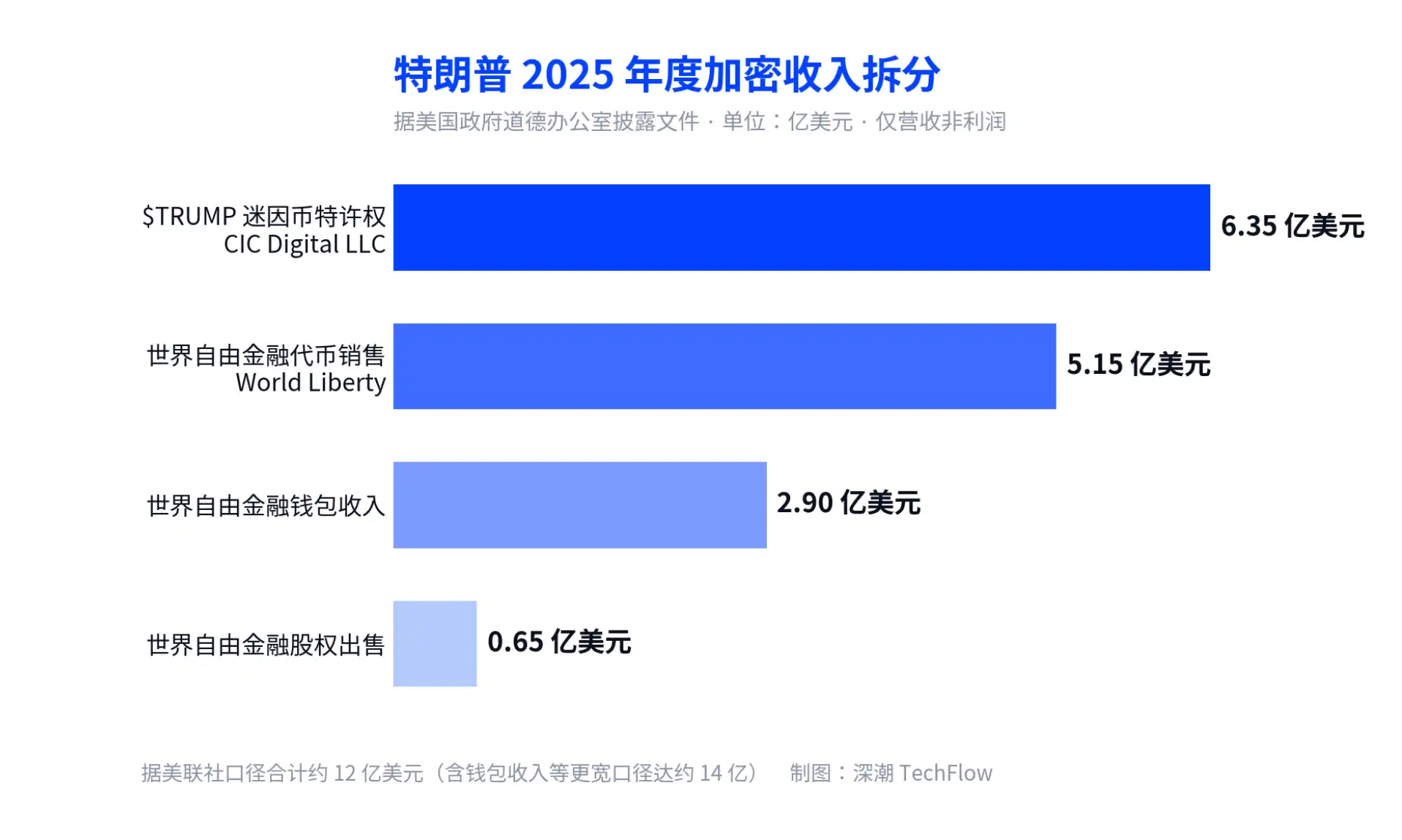
The second part comes from a company called CIC Digital LLC, which earned over $600 million selling commemorative-style "meme coins" featuring Trump's image. This refers to $TRUMP, the meme coin launched on the Solana blockchain just days before Trump's second inauguration in January 2025, listed in the disclosure document under the item "Celebration Coins," amounting to approximately $635 million, categorized as royalties.
It should be noted that the combined total of these two parts, around $1.1 to $1.2 billion, is the figure commonly cited in the market; if the aforementioned $290 million wallet income and $65 million equity sale are included, some media reports give a higher total, reaching into the $1.4 billion range. The total varies with the accounting method, but the conclusion that "crypto revenue exceeded $1 billion for the year" is undisputed.
Trump Rakes It In, While Retail Investors Holding the Bag Lose Money
The disclosure document only reports revenue, not profit, so it's impossible to know exactly how much net profit Trump made. However, the price movements of the tokens and meme coins paint a clear picture of the losses for those who bought in.
TRUMP soared above $74 shortly after launch but now trades at just $1.68. World Liberty Financial's token has fallen 80% since it began trading last September. According to independent data, the vast majority of meme coin buyers lost money, with around 80% of TRUMP's token supply still held by Trump-affiliated entities according to vesting schedules.
One prominent buyer among them is Chinese-born billionaire Justin Sun. According to the AP, he spent $75 million on World Liberty Financial's governance token WLFI and $200 million on meme coins. A federal lawsuit accusing him of defrauding investors, filed in February last year, was briefly paused and settled last month with a $10 million fine. Sun has consistently denied any connection between his spending on Trump's ventures and his federal case, and World Liberty Financial also denies any conflict of interest.
On one side, Trump locks in gains; on the other, retail investors get trapped.
Crypto Has Surpassed Real Estate, Becoming Trump's Signature Business
Trump entered the White House on the reputation of a real estate mogul, but now the rise of his crypto business has overshadowed real estate—a point worth noting especially because his real estate business also surged last year.
According to the AP, Trump collected tens of millions in fees last year from a batch of new overseas hotel, resort, and condominium projects, representing the largest real estate expansion in the century-old family business's history. Many of these countries are in negotiations with the U.S. on important matters like tariffs and military aid. A property in the UAE brought in $10.4 million, one in Saudi Arabia (built by a developer closely tied to the ruling family) wired $9 million to Trump's company, and properties in Bucharest, Romania, and Qatar each wired $5 million. Domestically, Mar-a-Lago brought in $77 million last year, a 50% jump from the year before he was president.
Forbes estimates Trump's net worth at $6 billion, up from $2.3 billion in 2024.
White House: Trump Acts Only in Public Interest, No Conflict of Interest
In response to conflict of interest concerns, the White House has repeatedly emphasized that Trump has placed his businesses in a trust managed by his sons, that no conflicts exist, and that he acts only in the national interest. Trump's umbrella company, The Trump Organization, claims its overseas deals are with private companies, not governments.
But the AP points out that in countries ruled by authoritarians, royal families, or one-party states, it's difficult to determine what qualifies as "private." Taking a new Trump resort in Vietnam as an example, the disclosure document shows Trump received $5 million from it last year, while according to The New York Times, Vietnam's ruling party sent a deputy prime minister to endorse the deal and displaced farmers from their land to make way for the project.
Whether these transactions have directly influenced U.S. policy adjustments is almost impossible to verify, but these countries have indeed gotten what they wanted: Vietnam secured tariff reductions, Qatar obtained previously restricted advanced U.S. technology, and Saudi Arabia received the American fighter jets it long coveted.
The regulatory thread remains. Before World Liberty Financial sold its governance tokens, regulators had warned about the risks of such new crypto assets. After taking office, Trump reversed the Biden administration's hardline stance towards the crypto industry, implementing industry-friendly policies instead—this disclosure document places both the relaxation of regulation and the family's over $1 billion crypto revenue on the same page.